0123 In the historical sequence of Santner’s two interscopes, the original perspective level of Christianity as a suprasovereign religion is increasingly occluded.
In late medieval and early modern political theology, the king became pastor as well as sovereign. This point is explicit in Thomas Hobbes’ Leviathan (1651 AD). The famous Peace of Westphalia (1648 AD) declared that the sovereign determines which Christian factions may congregate within the realm.
In middle and late modern political economy, citizenMarat substitutes for the mortal body of the king. Christianity is completely occluded. The immanence of the organization tier is made transcendent through ideological critique.
0124 Finally, Eric Santner’s style may be described as directed association, similar to the free association that characterizes Freud’s analytic dyad. In my reading of these associations, both the society tier and the 3-tier system come into play.
0125 The 3-tier system looks like this:
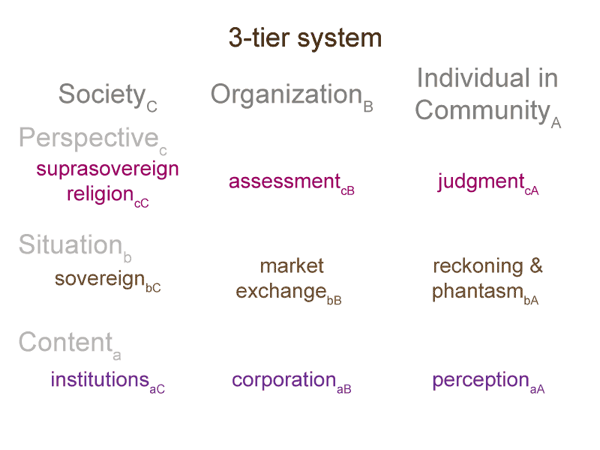
Each label designates a nested form.
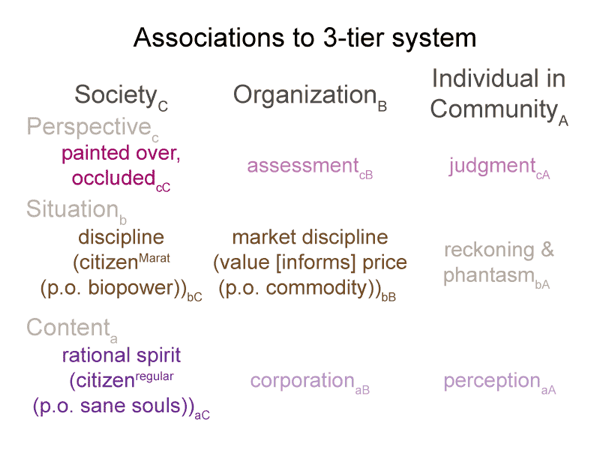
0126 So far, the elements that stand out associate with what communists call “capitalism” and what I call “mercantilism”.
0127 Here are the nested forms that stand out:
0128 Now, let me examine the lectures.
0129 What is the subject matter of the term “political economy”?
The subject matter demands a special sort of materialism. A surplus of matter, similar to (if not derived from) the sublime body of the king, is entangled with the pursuit of the national wealth (mercantilism). This surplus transforms the rational pursuit of ends into a drive.
0130 Santner calls this matter “improper”. This surplus is “dirty”.
Dirt is matter in the wrong place.
From a Freudian point of view, it is almost like excrement. Producing it is a secret pleasure. Otherwise, no one wants to deal with it. It needs to be managed.
Oh, and by the way, the English translators turned Freud’s word “it” into “id”.
0131 What about the qualifying word “subject”?
Santner recalls Jacques Derrida’s deconstruction, entitled The Specters of Marx.
0132 Marx conjures the specter of communism. Derrida associates this apparition to the spookiness of Shakespeare’s Hamlet.
The liminal element, value (informs) price, exhibits a spectral materiality similar to the ghost of the murdered king. Value makes actual the potential within a commodity. This is very similar to the way that kingly values informed the mortal body of the late medieval and early modern king.
0133 Value accounts for the price of a commodity in the modern world.
If the price is greater than corporate and regulatory costs, there is surplus value and the organization continues to do what it is doing. I call this “congelation”. If the price is less than corporate and regulatory costs, there is no surplus value and the organization suffers. I call this “liquidation”.
0134 Value accounts for the royal surplus contained in the mortal body of the king.
If the mortal body exhibits the qualities of kingliness, as defined by the expectations engendered in the subjects by the current political theology, then the king grows in stature. If the mortal body of the king fails, through various shortcomings, then the king shrinks in stature.
When the king dies, the question arises: What do we do with the sublime body of the king?
The answer is: Let’s build an effigy and place it on the throne until the next king takes over.
0135 Weirdly, the Bible also tells of value as a surplus of immanence. Biblical writers called it “idolatry”.
Late medieval Gnostics fashioned their theories of the sublime body of the king from what was available to them. So, they idolized all sorts of expressions of royalty, including the lineage of the royal family.
Did the kings of Judah have sublime bodies?
Read the Bible to see.
0136 Postmodern philosopher Slavoj Zizek says, “We must strike at something other than what’s there.”
This is the job of a messiah, who is capable of altering the potential that underlies value.
0137 How does idolatry work?
Why is the king so special?
Why does a commodity have a particular price?
0138 The answer is found in the word “fetish”.
A fetish connects an invisible value to a real thing.
0139 Fetish empowers Jacques Lacan’s petit objet a.
Petit objet a is a little piece of the Real that cannot be hidden by reality. Ghosts are great examples. So are wedding rings.
The mortal body of the king, then, would be a petit objet a, a little piece of the Real that is connected to the values of kingliness.
If I toured kingdoms in the Late Middle Ages, asking people about the qualities of the king, I would get a list of adjectives that may, or may not, describe the mortal body of, say, England’s Charles I.
Charles I was a nice guy, the very opposite of a king. He would have made a great subject.
0140 Similarly, the price of a commodity is a petit objet a, a little piece of the Real connected to the capricious values of say… fashion.
Fashion values inform price. It pays to be in demand.
But what is demand? It arises from a potential supplied by the presence of the commodity itself, plus the potential of a buyer.
Remember that the category of firstness follows the logic of inclusion and allows contradictions.
0141 The Baroque scholastics got into this mess with the question: What is mind-dependent being?
Mind-dependent being accounts for our connection to mind-independent being.
Similarly, spectral value accounts for both the mortal body of the king and the price of commodities.
0142 So, what does this have to do with the word “fetish”?
A fetish is the contiguity of value with a petit objet a.
0143 An objective value connects with the subjective matter of a petit objet a.
The contiguity allows signification.
A petit objet a stands for an objective value.
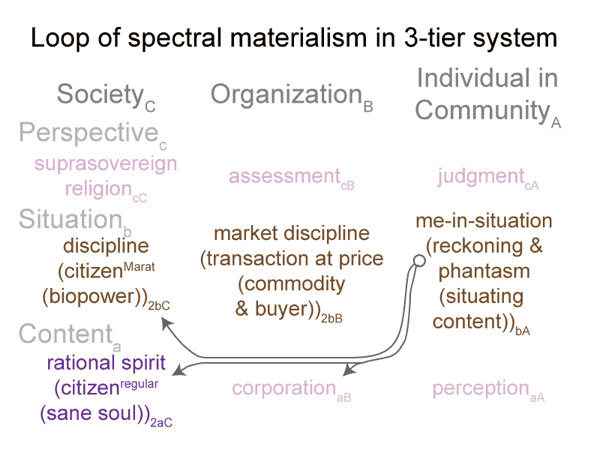
0144 Fetish appears in the situation levels of the society tier, the organization tier and, by extension, the individual in community tier.
Here is how I see fetish appearing in the 3-tier system.
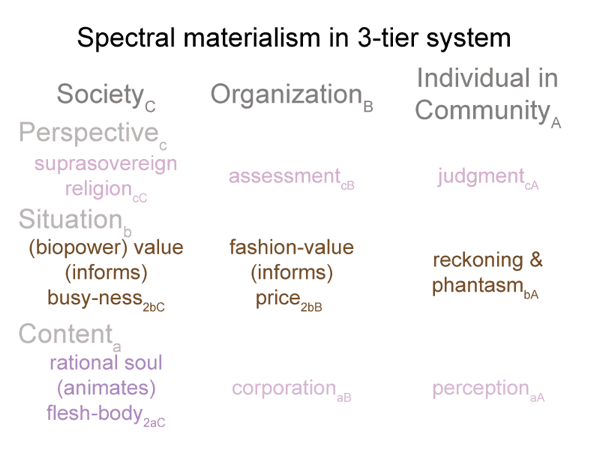
A fetish informs.
Now, let me go from thirdness to firstness.
0145 Third, citizenMarat occupies the situation level in the society tier. CitizenMarat labels a fetish about sovereign actions, laws and decrees. The fetish idolizes an organizational objective within a sovereign religion. CitizenMarat’s actions are the petit object a to the spectral value of biopower.
Second, the commodity fetish occupies the situation level of the organization tier. The price is petit objet a to the spectral value of say… fashion.
First, the situation level in the iic tier is me in the situation, trying to figure it out. Theoretically, my reckonings and phantasms may be described as a fetish, where spectral values account for my views and attitudes.
I may be either sane (citizenregular) or insane (citizenMarat). If sane, I participate in the organization tier. If insane, I strive to occupy a position in the society tier.
0146 Thus, a feedback loop becomes apparent.
Is this the subject matter of the political economy?