0097 Here is an example of the simplification of complexity in the modern political economy:
The Marxist concept of surplus labor value simplifies a very complicated assessment process in the organization tier, producing a demand (an objectorg) that profits go to the worker.
The Marxist concept simplifies the organization tier through a moral (not economic) value judgment. This produces an objectorg requiring sovereign power to implement.
0098 Implementation by sovereign power leads to a corresponding adaptation within the organization tier. Assessors react by reducing profits in order to maintain organizational viability. Mechanisms for reduction might include replacing perfectly good factory machines. Profits dry up through increased expenditures.
Who would have predicted that?
0099 But that is not all.
The society tier ends up divided between institutions with objectsorg requiring sovereign power and those that do not.
The ones demanding sovereign power are drawn upwards, into the sovereign level, long before their policies fail.
Indeed, a failure of implementation indicates that an infrasovereign institution has been incorporated into the sovereign religion.
Failures cannot be analyzed within the language of the incorporated religion. Therefore, consequences of the failed policies will always be attributed to others. Or, failure will lead to a demand for reform through additional regulations.
0100 The premises of each objectorg may never be repudiated.
Why?
The objectorg embodies a simplification, making the incomprehensible organization tier comprehensible.
The purpose of the simplification is to create a cognitive space in which the organization tier makes sense.
The busy-body works within this cognitive space, even when the busy-body’s activities make the originating problem worse.
The worsening consequences of a simplification must be discussed in terms of the simplification. Otherwise, the topic becomes incomprehensible.
We must use the terms that led to the bad consequences in order to cope with a problem that cannot be codified within established parameters.
0101 The reader may laugh. Of course, this makes no sense.
No regular citizen gets to the point where this logic seems sensible.
Only citizensMarat make the leap of faith.
Say that again?
0102 A simplification that contextualizes the organization tier becomes institutionalized. Then, it is implemented by sovereign power.
The simplification may diagnose what is really happening in the organization tier. But, it cannot account for the entire system. The diagnosis is never comprehensive. It only addresses one cause and one symptom.
0103 So, the policy that the simplification evokes may have no effect (or have weird effects) on the phenomena that is being simplified.
This means that a phenomenon in the organization tier sustains a behavior in the society tier that both simplifies and intervenes, but misses the mark, because the simplification neglects the fact that the phenomenon is relational and therefore, difficult to reduce to cause and effect.
Indeed, the organization tier may adapt to interventions based on simplifications in unexpected ways.
Ah, that sounds more like Kafka.
0104 Indeed, the normal contexts discussed so far, the early modern sublime body of the king and the modern discipline, are Kafkaesque in precisely the way that Santner describes. They push against human embodiment. They distort active soul [animates] flesh.
0105 Santner talks about sleep.
The 24/7 of global mercantilism denies sleep. The characters in Kafka’s stories fall asleep at the wrong time. For example, K. falls asleep during a lecture on vigilance.
0106 For modern times, these may be linked to three actualities within the 3-tier system.
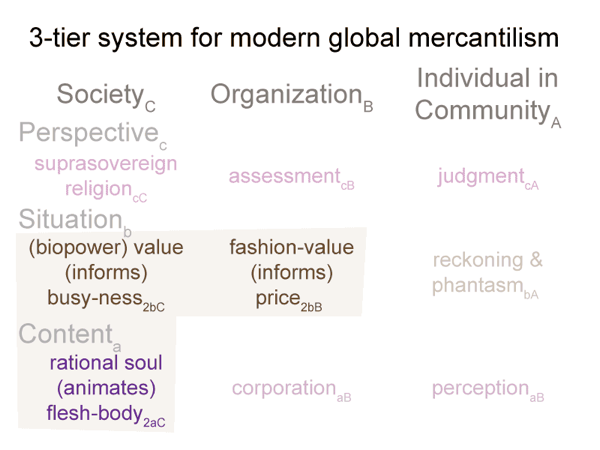
0107 Note how the organization tier comes into play.
The rational soul (animates) flesh-body is the person as an institution. Santner sees a dispersion of sovereign authority to the citizen. I see a transformation of king into citizenMarat and subject into the citizenregular.
Both citizenMarat and citizenregular exhibit an actuality congruent with the content level of the society tier. Each displays a variation of active soul [animates] body-flesh. For citizenMarat, the actuality is biopower value [animates] busy-ness.
0108 The institutions of citizenMarat put the organization tier into context through simplification and objectification. They belong to the content-level, along with citizenregular.
However, they may displace citizenregular. The size and longevity of collective infrasovereign institutions provide an authority not available to the regular citizen.
0109 For example, broadcast media are very effective as sounding boards. Censorship in social media favor established voices… er… “establishment values”.
0110 Finally, the implementation of certain organizational objectives by the sovereign generates long-lived state-supported bureaucratic institutions that may be described as sovereign religions.
0111 In contrast, in late medieval and early modern times, the society tier did not diagnose problems in the organization tier. Instead, the organization tier was already fixed by traditions honed through conflicts within the crucible of Christendom. Contending parties could appeal to the church as an arbitrator.
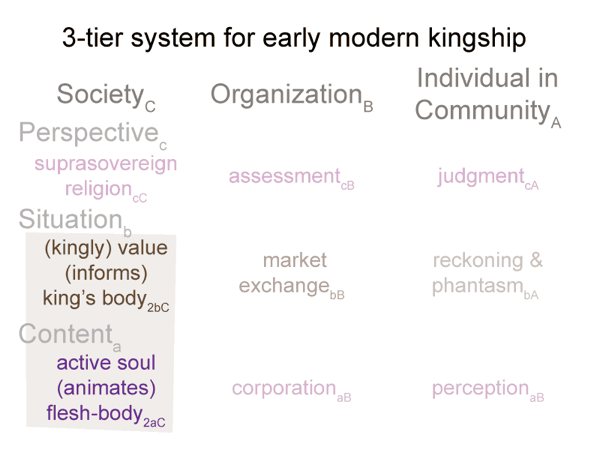
In those days, only the king never slept.
0112 In his Tanner lectures in 1979, Michel Foucault argued that the vigilance of the king was compared to a shepherd tending to his flock. The original Christian image did not focus on the fleecing of the sheep. But, hey, the king has to keep warm, especially during the Little Ice Age. So, the transcendent image became a little more mundane.
0113 The funny thing is… the king did not keep warm by clothes of wool. The king wore animal furs. Animals had to die, providing an image of adornment and strength to the king’s mortal body. Thus, the glorious body of the kingexpressed a dimension that might not have been admired by the angels and saints.
0114 Santner also mentions Gil Anidjar’s recent book on the historical semantics of the word “blood”.
The flesh of the sheep and the blood of wild animals address the same subject matter in the political theology of the king. The king is shepherd, protecting and fleecing the sheep. The king wears the furs of wild animals, who lost their skins through bloody combat.
0115 All this was incorporated into how the subject made sense of his world. Revealed Christian knowledge was transubstantiated into secret knowledge about the qualities of the king.