0078 This scenario, in part, describes the business of the economy. It also describes the organization tier, which is an interscope with three levels.
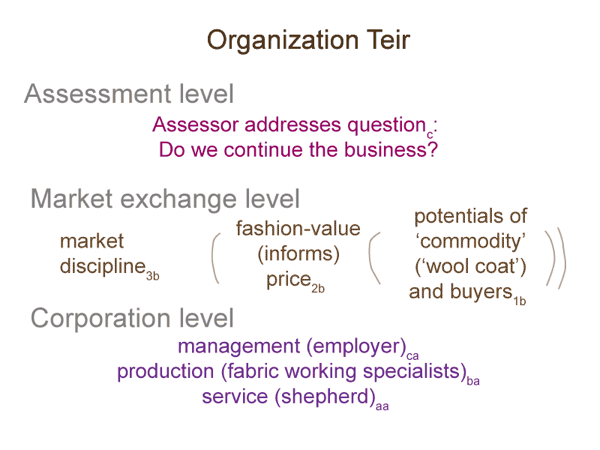
0079 The organization tier demands that all participants act sensibly. This is the world of citizenregular (the person who thinks that things should make sense). Only fashion, in this scenario, does not make sense. However, it makes sense in that it accounts for (or explains) price.
0080 The organization tier is abuzz. Commodities are produced at the corporate level. Commodities are exchanged for money in the market exchange level. The consequences are considered in the assessment level.
0081 Assessors must take many factors into consideration. Factors range from packaging to shepherd satisfaction.
One necessary, but not sufficient, consideration is the difference between price and costs. The entire organization tier succeeds when price times units sold is greater than the total costs of the corporation.
0082 Marx labels this difference “surplus labor value”, implying that corporate profits belong to the worker, not the investor.
If they belong to the worker, the social system is called communism.
If they belong to the owner or investor, the social system is called capitalism.
0083 Are these definitions rhetorical?
If so, then the rhetoric suggests the existence of a specialized class of people (belonging to the society tier) devoted to putting the organization tier into context.
0084 To some, surplus labor value should go to the worker. Communism is righteous. Capitalism is unrighteous.
Here, an institution (a society-tier party) contextualizes organizations that do not belong to it. This explains why Marxist movements pursue and concentrate sovereign power.
0085 To others, surplus labor value should go to the owner or investor.
This is not a moral decision. This is simply part of an assessment.
If a corporation borrows money in order to achieve an organizational objective (that is, in order to do what is right), then the money must be paid back with interest. The owners keep whatever else the investment earned.
In other words, righteousness belongs to the institution contextualizing its own organization.
This explains why some businesses try to avoid or get around sovereign power. The sovereign can re-direct its surplus value. This also explains why other businesses seek a cozy accommodation with sovereign power. The sovereign can restrict markets and guarantee surplus value.
0086 But that is not all. What about the money that a corporation borrows?
Money is magical. It unnaturally increases itself in an environment of risk.
To me, this sounds like mercantilism.
Mercantilism is animist. Money is alive. Money reproduces itself.
The crowns (or money) acquired by investment demonstrate God’s favor.
If the crown (or power) can get its paws on this manifestation of God’s favor, then the mortal body of the king may increase in all things.
0087 In mercantilism, the crown (power) encourages the flow of crowns (money).
The institutions of mercantilism proclaim, “Let the sovereign encourage a thousand crowns (money) to be lent. The magical process will enrich the crown (power) with crowns (money).”
0088 Is there a category-based model for mercantilism?
Here is how the society, organization and individual in community tiers fit together into a system. Each tier is an interscope, having three levels. Each tier composes a vertical column. Each label describes a level.
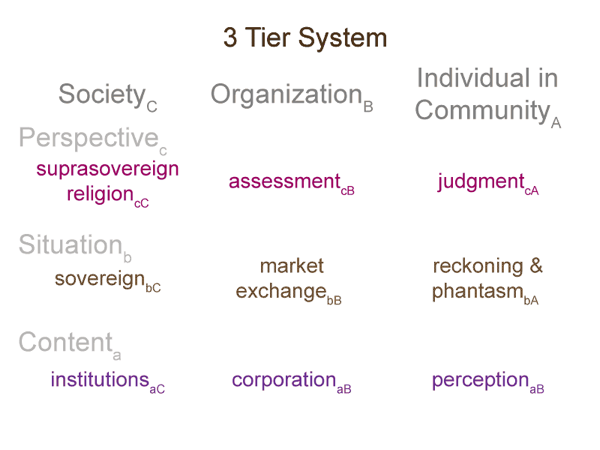
0089 The logic of the organization tierB is the logic of functionality and business.
There is something crass about it all. Money circulates throughout every level of this complex tier. Yet, money is not the end-point. Money is always a means to a reasonable end.
0090 So who decides that money should be an end in itself?
An institutionaC does. The content levela of the society tierC puts the organization tierB into perspective.
What better way to do that than a promise that borrowed money will be returned with interest?
With that promise, money becomes more important than whatever money can buy.
In early modern mercantilism, the acquisition of money (in the form of gold) became an organizational objective demanding the attention of the sovereign.
0091 Today, why does the global economy never sleep?
Is the world economy possessed by an infrasovereign religion similar to mercantilism?
Is a sleepless king gathering a horde of gold?
Or, is everyone just trying to get the most from their investments?
0092 I find it hard to tell.
Everyone wants to avoid a bad assessment. Everyone wants make a good investment.
Opportunities can occur at any time and in any place on the globe.
Each application seeking investment money is configured to be reasonable. The documentation serves to clarify. Or does it conceal? Look into any deal and see.
The details are overwhelming. So, an expectation arises. The government will mitigate the risk through guarantees.
Here is an organizational objective worthy of being called “an infrasovereign religion”.
0093 The question then becomes: How to guarantee success?
In the book 24/7, Jonathan Crary describes a world of global commerce, interconnectedness, production, consumption, indebtedness, liquidity and profit-orientation. Each regular character in the global economy is motivated by something that makes sense. Yet, the whole ecology is beyond anyone’s comprehension.
0094 Incomprehension poses a problem. In order to operate within the organization tier, one must behave sensibly. However, the economic ecology is so complicated, the entire system does not seem sensible.
0095 So, someone offers an explanation that appears comprehensible.
Then, government agents incorporate that simplifying explanation into an institutional organizational objective. These actors are the citizens who would be Marat. They fashion themselves Friends of the People.
Incomprehensible details2a are simplified by citizenMarat into sovereign decrees2b in a normal context of regulatory discipline3b.
But, the simplification never works. The resulting regulated system ends up as unpredictable and furious as the original unregulated circumstances. It is as if the society tier takes on the character of the organization tier.
0096 The business of citizenMarat allows me to appreciate Santner’s association of busy-ness to Kafka’s imagery of a manic world where everyone is busy but nothing makes sense.
Santner recalls the main character in The Castle.
Someone requested that the poor fellow serve as a land surveyor. K. tries to figure out that call. He wants a proper summons. He expects a written document, just as anyone would expect in the organization tier. But, he never gets what he wants. He just goes from one problematic situation to another.