03/31/26

Looking at Mikhail Trunin’s Article (2017) “Semiosphere and history”  (Part 1 of 8)

0841 The article before me is published by Sign System Studies (volume 45(3/4), 2017, pages 335-360) by Mikhail Trunin in the School of Humanities at Tallinn University, Estonia.  The full title is “Semiosphere and history: Towards the origins of the semiotic approach to history”.  This particular volume is dedicated to semiotics and history.

0842 Juri Lotman (1922-1993 AD) and Boris Uspenskij (1937-present) are central characters in the first ascent of the Tartu-Moscow School of Semiotics during the 1960s through the 1980s.

Lotman’s treatment of a semiotics of history connects to his conceptualization of the semiosphere.  Of course, “semiotics” stands in the place of “semiology”.

Uspenskij’s treatment of the semiotics of history starts with the Latin phrase, “historia sub species semioticae”.  The phrase transliterates (more or less) into “history as a species of semiotics”.

Or maybe, “historical under the semiotic species”.

Of course, “semiotics” stands in the place of “semiology”.

0843 Previous examinations of articles in this and other volumes of Sign System Studies provide a way to appreciate what these semiologists have in common.

0844 So, let me briefly review.

The academic development of semiological consciousness for humanities scholars starts in the Departments of Slavic languages, during the so-called “Cold War”, since the Union of Soviet Socialist Republics casts its dominant ideology as that of science.  These humanities scholars begin to frame their interpretations of Slavic literature in terms of Saussure’s semiology and structuralism.  After all, semiology and structuralism are scientific, aren’t they?

0845 Semiology deals with content, the relation between parole (spoken words) and langue (corresponding ideation).  Technically, the relation between speech and thought is not motivated (hence the qualifier, “arbitrary”), since spoken words do not image or point to their referents.  Nonetheless, civilized humans behave as if they do.  But, that behavior may be attributed to grammatical structure (for a mother tongue) or a style system (for specialized discourse).

0846 Structuralism deals with how content is situated. Humans do not behave as if a spoken word is arbitrarily related to a mental act (or thought).  Humans act as if words and thoughts are one thing.  

Rather than attributing this behavior to an innate trait evolved under conditions where a parole (manual-brachial word gesture) images and indicates its referent (by way of the natural sign-qualities of icons and indexes, respectively), the modern scientist must attribute the behavior to truncated material and efficient causes.

In this case, the situating efficient and material causes are due to a system3b. Both mother tongue and specialized discourses3b operate on the potential of ‘laws of the system’1b.

0847 Here is a fundamental interscope containing semiology3a and structuralism3b.

0848 On the content level, the normal context of Saussure’s semiology3a brings the actuality of the dyad {langue as matter2am [substantiates] parole as form2af}2a into relation with the potential of ‘signifier and signified’1a.

Cleverly, the content-level potential1a buries the evolution of language in the milieu of hand-talk in the ambiguity of the co-existence of signifier and signified.  Can a signifier exist without a signified?  Of course not. They must be belong to a monad, a single element.

Can a thought about ‘something’ exist without an image or indication of that ‘something’?

Does a manual-brachial word-gesture picture or point to its referent?

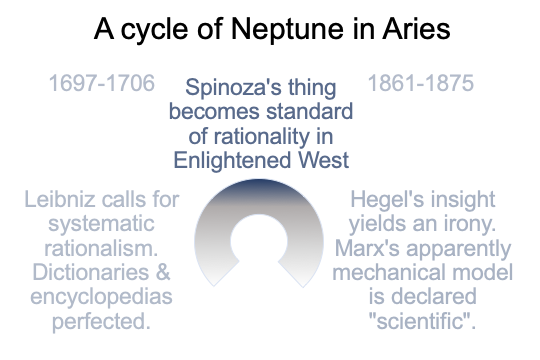
0849 Ironically, both Charles Peirce (1839-1914 AD) and Ferdinand de Saussure (1857-1913) live right before the monumental, civilization transforming battles among the enlightenment gods.  Peirce focuses on the nature of signs as triadic relations.  Saussure focuses on language as a thing (that is, a dyadic actuality).  

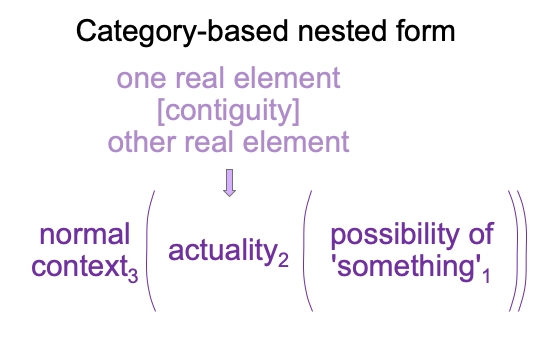
0850 The above figure tells the tale.  The content and situation level actualities2 are dyads, as suggested by Saussure. Normal contexts3 and potentialsare presumed in Saussure’s tradition, but explicit in terms of Peirce’s categories.

The category-based nested form is a triadic relation.  Triadic relations constitute the human niche.  Hominins adapt into the potential of triadic relations.

The content-level appears to be a reasonable expression of Saussure’s semiology because it expresses a triadic relation.  Not only that, but the content-level category-based nested form manifests all four of Aristotle’s causalities.  The dyadic actuality, corresponding to Peirce’s category of secondness, parallels Aristotle’s hylomorphe, the home of material causes and one terminus for efficient causation.

0851 Here is a picture of the category-based nested form as a manifestation of Aristotle’s causalities.  Peirce’s category of secondness contains two contiguous real elements.  For Aristotle’s hylomorphe, the one real element is matter.  The other real element is form.  The contiguity is [substantiates] or [substance].

0852 So, what does this imply?

First, Lotman and Uspenskij start out as scholars of Slavic literature in Russia, under a socialist regime, which extols its scientific credentials.  Academics in literature adapt to regime incentives by adopting Saussure’s scientific approach to language.  Saussure’s semiology is regarded as a scientific theory explaining the phenomena of language in our civilized world.

Second, the fundament interscope starts with Saussure’s semiology3a as a content-level nested form.  The actuality2 is {langue2am [substantiates] parole2af}.

Third, the category-based nested form manifests all three of Peirce’s categories as well as all four of Aristotle’s causalities.

Fourth (and yet to be discussed), Lotman’s and Upsenskij’s treatment of history and semiology starts with the fundament interscope.  Semiology characterizes a content-level interscope.  History enters the picture as a literature-based situation-level form2bf.  

0853 If these implications stand, then Upsenskij’s Latin title, “history as a species of semiotics”, will convert into “history as a species of literary text”.

03/30/26

Looking at Mikhail Trunin’s Article (2017) “Semiosphere and history”  (Part 2 of 8)

0854 According to the Trunin, various reviewers conclude that Uspenskij proposes that history, as a species of semiotics, is analogous to the linguistic act of communication, that is, spoken language.  Indeed, for the fundament interscope, history can be viewed as a literary text2bf substantiated by written language2bm.  So, the reviewers are not off base.  Spoken and written language as matter2bm substantiates history in the form of a literary text2bf.

0855 On the content level, history already enters into the picture as past historic thoughts2am and historic words2af.  What is spoken2af can be written2af.  Many scholars claim that history only begins with the invention of writing, because written texts provide evidence that spoken words cannot.

However, what is the nature of the written… or spoken word?

Well, if the word involves an explicit abstraction, the signifier is a label.  The signified may be called a “definition”, because the label operates on the potential of ‘something’, and that something… um… must be plausible enough to conjure a “definition”.

Did I say that correctly?

0856 Remember the historical moment when nouns were subjugated by verbs?

Well, I guess it was a prehistorical moment that is imagined by an archaeologist who never read Razie Mah.

This archaeologist proposes that the first spoken words are nouns, because things can be associated to sounds through synaesthesia.  That is “cross-modal cognition”. 

Then, verbs come along because, once nouns are spoken, verbs are necessary to validate the nouns as relevant, that is, capable of doing something.

0857 Here, the noun is the historic thought2am that emerges from and situates the potential of definition (reference) and label (utterance)1a.  An utterance2af labels1a a definite thing1a (er… a signified1a) and voila!  The form is the spoken word2af in the normal context of definition3a.

Then, the verb subjugates the noun, producing statements1b that serve as artifacts2bm that validate the relevance of nouns2c.

0858 The archaeologist’s own written words2bm emerge from (and situate) the possibility of a prehistoric era where nouns arise through synaesthesia and verbs appear in order to provide relevance to the nouns1b.

And, that is a little confusing because the archaeologist’s written words2bm are about spoken words2af that arise during a postulated prehistoric era when statements become possible1b

0859 So, these prehistoric folk construct statements as artifacts1b, but cannot produce written words because writing has not been invented.

The archaeologist constructs the artifact of prehistoric statements1b as as a way to write about2bm the previous statement2af.

Plus, the archaeologist’s written words2am go into a literary text2bf titled, Talk to Me: The Prehistory of Simple Statements.

0860 Of course, Uspenskij’s claims are also theoretical.  Theory carries implications.

However, the article bearing the title, “Historia sub species semitiotica”, consists of an application. Uspenskij makes a detailed case study for how the reformer, Peter the Great, ended being regarded as the antichrist.

0861 Nonetheless, I pause and reflect on the implications appearing in bright green in the preceding figure.

0862 On the content level, I substitute “label” for signifier1a and “historic speech” for parole2af, implying that the efficient cause of a spoken word2af is the potential of a label1a.

Furthermore, I substitute “definition” for signified1a and “historic thought” for langue2am, intimating a final causality.  Saussure’s semiology3a intends to bring langue as matter2am into relation with the potential of definition as the signified1a

0863 But, there is a problem.

“Definition1a” cannot be a signified1a.

Why?

Definition3 is a normal context that brings the actuality of a spoken word2 into relation with the potentials of meaning, presence and message1.

0864 Does that mean that a word’s meaning, presence and message1 may be labeled, “definition1a“?

0865 Well, why don’t I replace the term, “definition1a” with the term, “reference1a“.

A spoken word2af cannot picture or point to its referent1a.

So, how can I assume that my label1a for the signifier1a potentiates a signified1a that pictures or pointes to its referent1a, especially when that referent1a is an explicit abstraction?

0866 I suppose that when definition1a replaces the signified1a in Saussure’s semiology3athe constellation2 of meaning, presence and message1 is deferred in favor of the construction of a situation-level artifact1b.

0867 Definition1a as signified1a is definition3 as normal context deferred.

Notably, the content-level of the adjacent higher interscope reproduces the category-based nested form for how to define a spoken word.  So technically, definition1a is deferred in the fundament interscope and manifested in the derivative interscope of the Tartu-Moscow School of Semiotics3a.

The content-level of the derivative interscope mimics the unfolded Positivist’s judgment and expresses (however imperfectly) the category-based form for defining a spoken word.

03/28/26

Looking at Mikhail Trunin’s Article (2017) “Semiosphere and history”  (Part 3 of 8)

0868 Back to the fundament interscope, here is a picture of the content level.

0869 Label1a replaces the signifier1a.  The label as potential1a is the efficient cause for the spoken word (paroleas form2af.

0870 Definition1a replaces signified1a, implying explicit abstraction.  Definition as potential1a is the final cause for historic thought (langueas matter2am, because that is the intention behind replacing the signified1a with an explicit abstraction… er definition1a… hmmm… how about referent1a?

Definition should belong to thirdness.  But, definition (as thirdness) is deferred in Saussure’s semiology3a because language is scientifically characterized as two arbitrarily related systems of differences, parole2a and langue2a.  There is no substance, so to speak.  Okay, the substance is a completely habitual association.  Consequently, the scientist does not know the final cause for why a particular {langue as matter [substantiates] spoken word as form}2a exists.

0871 In contrast, the formal cause is obvious.

Saussure’s semiology3a contextualizes the above dyad2a as a material being2a.  The actuality of a spoken (and written) word2af  justifies the scholar regarding it2af as a thing2a that is subject to natural inquiry, of which Aristotle’s hylomorphe is the first abstraction.  An encountered thing2a consists in two contiguous real elements, matter2am and form2af.  The spoken (or written) word2a is situated as an encountered thing2a.

Is there another way to say that?

0872 The spoken word is the encountered form2af that corresponds to a label1a.  The matter of langue2am is presumed to emerge from um… the potential (and deferral) of definition1a.

0873 Somehow, that1a must have ‘something’ to do with reference1a.

But, one cannot picture or point to that referent1a unless an artifact1b is constructed to validate the spoken word2af.

0874 On the situation level, the formal cause is also obvious.

The structure (or system) of spoken words3b contextualizes {written words as matter2bm, as they substantiate history as a literary form2bf}2b.  Spoken words2af are forms on the content level.  They2af become matter2bm on the situation level,as they fit into the sensible (or material) construction of history (as a literary text)2bf.

0875 The efficient cause must be the sensible construction of artifacts1b that will validate the definitions1a underlying the langue2am that Saussure’s semiology associates to historic explicit abstractions, as if to veil the fact that “definition” is the normal context3 for the potential of meaning, presence and message1 for a spoken word2.  Yes, definition1a in firstness is definition3 in thirdness deferred.

0876 So where do these artifacts1b, these sensible constructions that validate the forms of the spoken words2af, come from?

0877 Consider a historical event.  During the event itself, people may give the ongoing event one name.  Later, the historian may assign a different label.

0878 For example, the European War of 1914-1918 is called, during the conflict, The Great War.

One hundred years later, my label is The First Battle Among The Enlightenment Gods, The Tragic War Among Naive Mercantilists (who, on second thought, may have been not so naive).

The written words of the time plus the constructions of the historian certify each composition of thought2am and word2affor use as matter2bm in the substantiation of history in the form of a literary text2bf.

0879 So, why the difference in definition1a and labels1a for the same historical event?

Perhaps, it comes from the perspective-level potential1c.

0880 The perspective-level potential1c should read, the possibility of ‘observations of literary phenonema’1c.  But, now that “history2bf” stands in the place of “the literary text2bf“, the transformation is breath-taking.  

Every literary text1c is a semiological and structural noumenon, manifesting literary phenomena1c.  Now, history2bfstands in the place of the literary text2bf.

0881 If this is the case, the Uspenskij is on target.  History is a species of semiotics.

03/27/26

Looking at Mikhail Trunin’s Article (2017) “Semiosphere and history”  (Part 4 of 8)

0882 The author raises an impressive option in the section of semiotics as a meta-discipline

Should academic research in the humanities require conceptual frameworks or hermeneutical subtlety?

The answer becomes obvious once the author concedes that most contemporary researchers working with Uspenskij’s paradigms concentrate on applications.

0883 The author suggests that the determination of a semiological3a structural3b model2c of a clearly demarked historical moment (such as Peter the Great attempting to move the mountain of Slavic indolence) or movement (such as indolent Slavs convincing themselves that, if the Czar Peter the Great acts like he is divine, then he must be the Antichrist) freezes the dynamics of history.  This is correct…

…until the historian’s Zeitgeist melts.

0884 Perhaps, a fixation about the difference between synchrony and diachrony distracts attention from a more foundational point.

0885 What value does the fundament interscope offer over and above what a historian is already doing?

The historian already constructs history as a literary text2bf, using spoken words2af, based on observations of historical phenomena1c as if these are the observable and measurable facets of a historical noumenon, a thing itself.

In doing so, the historian intellectually freezes the dynamics of history.

0886 Does the historian generate the equivalent of a semiological3a structural3b historical2af model2c?

Here is a picture of the fundament interscope.

0887 Yes and no.

Yes, the historian treats history as a literary form2bf because the historian writes a text, a literary form about a historical moment or movement.

No, the historian does not treat history as a literary form2bf because the historian does not construct a semiological3astructural3b model2c that serves as an interventional sign-vehicle (SVi) that stands for an interventional sign-object(SOi), constituting a content-level actuality2a in a derivative (and open to the future) interscope.

Rather, the historian imposes present-day divisions of time and place onto the past, using labels such as “era”, “movement”, “dynasty” and so forth.

0888 Say what?

An interventional sign-relation bridges from the perspective-level actuality2c of the fundament (or “loquens”) interscope to the content-level actuality2a of the derivative (or “ego”) interscope in the same way that a sign-vehicle(SV) stands for a sign-object (SO) in regards to a sign-interpretant (SI).  In this instance, the SI is the content-level normal context3a and potential1a.

08891 Here is a picture of the interventional sign-relation relevant to this article.

0890 A semiological structuralist model2c (SVi, virtually contextualizing the situation-level dyad of {written words2bm[substantiate] history as a literary form2bf}) stands for the entanglement, {history as form2af [entangles] language as matter2am} (SOi), in regards to the normal context of the Tartu-Moscow School of Semiotics3a operating on the potential of ‘meaning’1a (SIi).

0891 At this point, a discussion about the difference between synchrony and diachrony draws attention to a crucial point.

0892 Necessarily, history must be segmented into moments and movements (whatever way a scholar wants to slice it) in order to arrive at a model2c that allows the scholar to draw contemporary meaning1a, presence1b and message1c, (depending on how far the intellect wants to go into the derivative interscope).

0893 According to the author, Juri Lotman argues that the diachronic aspect of history may be captured by stringing synchronic models1c in sequence, like pearls on a necklace.

The key point is that each pearl involves the past coming into the present through the interventional sign-relation.  The historian-semiotician uses the positivist intellect of the Tartu-Moscow School3a to manifest contemporary meaning1a(SIi), whereby a model2c of a past moment or movement (SVi) stands for {history as a form2af [entangling] present-day language as matter2am}(SOi).

0894 This brings me back to the question, “Does the historian generate the equivalent of a semiological3a structural3bhistorical2af  model2c?”

0895 While some historians claim authenticity by writing out historical events as they sequentially and perhaps, instrumentally, occur, the reader of these highly dense volumes often gets lost in the details.  In short, the lack of a semiological3a structuralist3b model2c results in the reader wondering, “What does this intricate detailing of eventsstand for?”

0896 Is it necessary that the loquens (“speaking”) interscope entangles the ego (“me”) interscope?

0897 Here is a difficulty.

0898 On one hand, the perspective-level of the fundament (or loquensinterscope mimics the unfolded empirio-schematic judgment and the content-level of the derivative (or egointerscope recapitulates the unfolded Positivist’s judgment.

On the other hand, the content-level of the derivative (or ego) interscope coincides with something that looks like the normal context of definition3 (such as the TMS school3abringing the actuality of a spoken word2 (the dyad where {history as form2af [entangles] language as matter2aminto relation with the potential of meaning1a, presence1b and message1c.

0899 In other words, the pearls on a string, and even the pearl-alone approach, touches base with scientific detachment(ego, in Descartes’ use of the term) and connects with me (ego, in the classic Latin use of the term), in a way that a tabulation of happenstance and intrigues does not.

03/26/26

Looking at Mikhail Trunin’s Article (2017) “Semiosphere and history”  (Part 5 of 8)

0900 Lotman and Uspenskij pursue independent approaches once this interventional sign-relation comes into play.  Lotman continues a scientific path and enters discussions on how semiological structuralist models2c can overcome the distinction between synchrony and diachrony.  Uspenskij orients his path toward semiotics as an adjunct to the work that historians do.  Each historical text is about ‘something1a‘ and all these ‘somethings1a‘ have one feature in common: semiotics (or semiological structuralist models).

I suppose that both paths suggest that, if a history is to be about ‘anything’, that ‘that thing’ must take the form of a literary text2bf.

Such a suggestion is very different than what some label, “historical determinism”.

0901 Juri Lotman argues against Soviet academic attempts at historical determinism in the late 1920s.

Historical determinism?

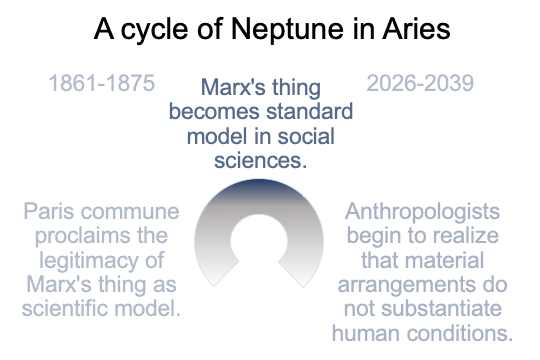
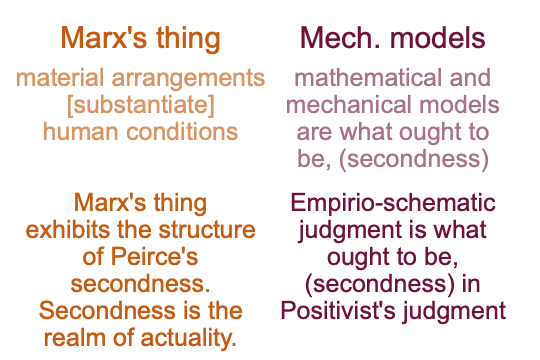
Material arrangements [substantiate] human conditions?

If history as form2af entangles language as matter2am arising from the potential of ‘meaning’1a, then ‘meaning’ cannot be constrained to economics, sociology, communication systems, and other material-oriented disciplines that do not include linguistics (that is Saussure’s semiology3a).

0902 Eventually, Lotman settles on Ilya Prigogine’s characterization of self-organizing systems, which achieve states that cannot be deduced from their initial conditions.

Yeah, I mean, like the growth of mushrooms or ideas or cities or civilizations.

Each dyadic aspect of such growth may be modeled deterministically.  The relationality among the dyadic actualitiescannot be deterministically modeled.  But, that does not mean that models of relationality are worthless.  Science does not end when each linear cause and effect2 is contextualized by a normal context3 and potentiated by multiple possibilities1.  Or does it?

0903 Remember that Juri Lotman and Boris Uspenskij are scholars of Slavic literature and languages.  The Slavic narod is baptized into the Byzantine Orthodox tradition, which maintains an unbroken historic thread to both Jesus, and before him, Plato and Aristotle.  In the West, the thread to Aristotle is cut.  Aristotle’s philosophy is re-discovered when the Crusades (which sacked Constantinople) return home with Greek and Arabic translations of Aristotle.

So what does an unbroken chain of tradition from the present, through St. Cyril and St. Methodius, through Jesus, to Aristotle imply?

0904 Comments on Alexander Dugin’s Book (2012) The Fourth Political Theory offers an image.  This sequence of four elements corresponds to the four corners of a Greimas square.  The sequence can also be configured as labels for a periods of Russian history.

0905 The closest that the Slavs get to their ethnos is the migration of speech-alone talking tribes from northern Mesopotamia over the Caucasus mountains and onto the steppes, where they tame horses, make wheeled carts, build very large settlements, are ruled by their own chiefs, then eventually invade into the Indian and European subcontinents, spreading proto-Indo-European languages.

The next historical moment starts with the conversion of the Slavs to Orthodoxy by brothers Cyril (826-869 AD) and Methodius (815-885).  Plus, a (Scandanavian-originating? Slav-assimilating?) kingship starts with Oleg the Wise (879-912).  These traditional folk and clerics and kings may be called, “narod”, using Dugin’s terminology.

0906 Remember Machiavelli (1469-1527)?

Well, Ivan the Great (1440-1505) unites the principalities around Moscow, centralizes the Russian state, and fashions the title, “tsar” (which harkens back to the Roman title, “Caesar”).  He champions the idea that Moscow is the third Rome.

Constantinople falls to the Ottomans in 1453, ending the Byzantine polity.

In 1452, Johannes Gutenberg prints 180 copies of the Bible using a mechanical press.

Sailing from Spain, Columbus discovers a new continent to the west of Europe that is not India in 1492.

0907 All this happens before the Luther posts his 95 theses on the church doors in Wittgenstein (1517), inadvertently launching the so-called “Reformation”.  Inadvertently?  Luther’s arguments are available to all literate folk because of the new-fangled printing press.  The Gutenbergs are not the only ones with a movable-type printing press.

Was Martin Luther (1483-1546) a political theorist?

John Calvin (1509-1564)?

0908 It seems that, currently, most moderns regard them as theologians.

But, if history is a species of semiotics, then I suspect that they may also be political theorists, because theoretical political models2c (SVi) can stand for the dyad2a, {church and salvation history as form2af [entangles] the language of reform2am} (SOi) in regards to a school that is focused on the semiotics of plain reading3a operating on potential ‘meanings of institutional decadence and renewal’1a (SIi).

0909 Say what?

How about the following interventional sign-relation?

0910 Surely, this is not a model2c of prayer, sacraments and mystical union with the Son of the Father2c.

Political theorists love to point out hypocrisy.  All they do is criticize.  At least, that is what the bishops of Christendom say when they hear news of Martin Luther’s critical theory.

03/25/26

Looking at Mikhail Trunin’s Article (2017) “Semiosphere and history”  (Part 6 of 8)

0911 So, what am I saying?

Do the sixteenth-century reformers engage the same relational structure that this examination of the publications of Tartu-Moscow School brings to consciousness?

How weird is that?

0912 Is this a case of historical determinism?

Or do the fundament and the derivative interscopes serve as semiotic templates?

According to the author, Juri Lotman argues against sociological or economic determinism.  He adopts Ilya Prigogine’s ideas about self-organization, such as the “explosion” that occurs when a seed germinates, a butterfly emerges from its chrysalis, a flock of geese begin their migration, as well all sorts of spontaneous moments.  That includes political and religious movements in civilization.

0913 What does Lotman intuitively sense from all his inquireies into the literature produced by Russian civilization?

Somehow, an explosion occurs when a text as form2af entangles semiotic meaning as matter2am.

Indeed, semiological and structural matters in the mother-tongue and literary style2bm substantiate a literary text2bfthat is modeled2c according to a disciplinary langauge3c operating on the potential of ‘observing related and relevant phenomena’1c.

0914 And, in German history, Martin Luther is exemplar in this regard.

The matter of the people’s ability to read the Bible in their own tongue2bm substantiates the 95 theses2bf  that are modeled2c as a declarations that identify the contradictions in scholastic interpretations3c and the hypocrisy of the Church1c.  Surely, the clerics debate in Latin and not in common vernacular.  The little (and now, literate) people want to hear what they are saying.

The 95 theses2af  entangles the language of reform2am, in the normal context of a literate people being able to read a translated Bible3a operating on the potential of ‘decadence and renewal of the Church’1a.

0915 Here is a picture of the resulting content-level of the derivative interscope.

The astute reader may wonder, “What is the literary text2af?  Luther’s theses?  The Bible in Latin?  The Bible in vernacular?  Church and salvation history?”

0916 May I say that, in the above actuality2a, a model2c stands for the thing itself2athe noumenon of a historical moment or movement?

Also, may I say that, in the above figure, the actuality of church and salvation history as form2af has emerged from the matter of history as a literary text2bm and now entangles the matter of a novel language of reform2am?

How confounding.

0917 Plus, what about Aristotle’s four causalities?

Material causes comport with economic (the lowered cost of printing due to the innovation of the Gutenberg press) and sociological (the outrageous selling of ‘indulgences’ in order for aristocrats to purchase absolution for their excessive conduct and their excessive wealth) causations.

But, these are like soil analysis to a plant biologist.  They are conditions, more than formal causes.

0918 The formal cause is the germination of the seed of general literacy3a (also made possible by the printing press, but also by the success of priests in spreading the gospel) in the soil of a rigid aristocracy and clergy who are the only ones who used to be able to read2a.  Oh, the newly self-minted bourgeoisie probably play an important role in that germination, because they hatch all sorts of plans to reform everything that the aristocracy and the clergy use for self-promotion.

0919 The final cause harmonizes (3) the idea that the Bible is open to a plain reading3a, (2) an impasse in church and salvation history2af, where illiterate folk are excluded from theological debates but are expected to purchase theologically-suspect indulgences and to pay the costs of building a more magnificent cathedral than a neighboring diocese2am, and (1) the potential of ‘renewal after demanding an end to the decadence’1a.

0920 The efficient cause brings the language of reform2am into relation with the potential… the hope… of an end to decadence and the birth of a renewal1a.

The results are explosive.

The Reformation produces a civilizational blow-out that lasts all the way to the present day.

03/24/26

Looking at Mikhail Trunin’s Article (2017) “Semiosphere and history”  (Part 7 of 8)

0921 The author provides two case studies.  I will cover the first, concerning the history of science.

Vladimir Vernadskij (1863-1945), a Russian-Ukrainian geochemist, formulates a law that living matter will occupy every niche that is available, whether environmentally (geologically) or ecologically (biologically).  Plus, that occupation may create novel environmental and ecological possibilities.  He called the propensity, “the pressure of life”.

0922 How about an example?

0923 The early Earth’s atmosphere is composed of hydrocarbons, carbon dioxide, water, and nitrogen.

The atmosphere is translucent, because ultraviolet radiation from the sun is absorbed by hydrocarbons, producing colored complex molecules that give the atmosphere the appearance of a global smog.

0924 Prokaryotes conduct photosynthesis and find ways to live in almost any area wet enough to support its life-forms.  Photosynthesis uses the energy of light to build carbon-based biomolecules and simply releases oxygen gas as a waste-product.  Over time, the accumulating atmospheric oxygen reacts with the hydrocarbon gases, reacts with the soluble iron in the oceans (precipitating the huge iron-band formations), and so on.  Later, in the Precambrian, oxygen-dependent eukaryotic cells appear.  Eukaryotic cells build into the multi-cellular organisms of the Cambrian Era.

The atmosphere is now transparent.

0925 The law of “life pressure” is like an observation, or rather, an understanding.

0926 How does understanding work?

First, one encounters an actuality2.

Then, one finds an appropriate normal context3 and potential1.

0927 In other words, understanding associates to a category-based nested form where all the slots are filled in, in a manner that comports with Aristotle’s four causes.

0928 Here is a picture of Vernadskij’s formulation.

0929 The normal context of Vernadskij’s observations of geology and chemistry3a brings the dyadic actuality of {natural history of life as form2af [entangles] a language of aspiration as matter2am} into relation with the potential of ‘the meaning of what life is doing, trying to occupy every available niche through adaptation’1a.

0930 Vernadskij’s law2am does not arise from a mathematical or mechanical model, based on truncated material and efficient causation (that is, material without formal and efficient without final causes).

Plus, the natural history of life forms2bf is very much like a literary text2bf put into perspective by semiological3astructuralist3b models2c.

0931 According to the interventional sign relation, a biological parallel to a semiological3a structuralist model3a (SVi) stands for the literary text2af (again, the natural history of life forms2af), along with its entangled language2am (SOi) in regards to Vernadskij’s geochemical positivist intellect3a operating on the potential of ‘meaning’1a (SIi).  The meaning1aof what Vernadskij observes3a supports the aspirational term, “life pressure”2am.

0932 The author reports that, in the early 1960s, Vyacheslav Ivanov (1929-2017), a philologist and one of the members of the Tartu-Moscow School of Semiology, is the first to situate the language of life-pressure2am in terms of the potential of ‘presence’1b within the normal context of cultural relevance3b.

0933 Say what?

The presence of an (entangled) language of meaning1b undergirds the dyadic actuality of {cognition as matter2bm[substantiating] social interactions as form2bf} in the normal context of cultural processes3b.

Here is a picture of a general version of the derivative or “ego” interscope.

0934 Here is the history.

Lotman, following Ivanov’s intuition, grasps Vernadskij’s language of “life pressure2am” as a metaphor for the way that the intellect of the Tartu-Moscow School3a operates on the potential of meaning1a, presence1b and message1c.  Then, he finds himself situating the metaphor2am with the presence of meaning1b, cognition2am, and social interactions2af, under the umbrella of cultural studies3b.

03/23/26

Looking at Mikhail Trunin’s Article (2017) “Semiosphere and history”  (Part 8 of 8)

0935 What happens next?

Lotman and Uspenskij publish an article in Russian (in 1971), which is translated into English (in 1978), titled “On the semiotic mechanism of culture”.

This is followed by intense study of Vernadskij’s language of life-pressure, then the publication of Lotman’s seminal paper, “On the semiosphere”, in Russian (in 1984).

0936 The author goes to some length to distance Lotman’s concept of the semiosphere and Teilhard de Chardin’s (1881-1955) framework of Alpha-Omega Points.

Why?

De Chardin’s concept does not put the dyad, {cognition as matter2bm [substantiates] social interaction as form2bf}, into a semiological message1c.  De Chardin packages this actuality2b into a theological message1c.  A theological message1cdoes not comport with the TMS positivist intellect3a.

0937 Or does it1c now that the USSR no longer reigns?

That is question for another day.

0938 For this examination, I must stay with a positivist-loving message1c.

The crucial point is that culture-pressure2b is like life-pressure2b and the perspective-level model1c that is appropriate for this culture-pressure2b is esse_tially semiotic.

Esse_tailly?

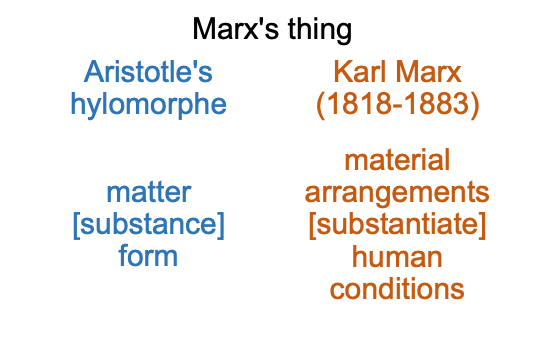
Yes, esse_ce is matter substantiating and essence is substantiated form.

So, semiotic arrangements as matter2cm [substantiate] human conditions as form2cf.

0939 Here is a picture.

0940 Esse_ce is {semiotic arrangements as matter2cm [substantiating]}.

Essence is {[substantiated] human conditions as form2cf}.

0941 Do I need to note that the universe of messages1c is Lotman’s “semiosphere1c“?

0942 The semiosphere1c parallels the concept of biosphere1c.

One can say that the semiosphere1c contains the totality of individual texts and independent languages.  They all relate to one another.

Why?

All texts and statements are forms2af that entangle matters of the language of meaning2am.  The presence of the language of meaning2am has the potential1b of engendering the matter of cognition2bm.  Cognition as matter2amsubstantiates social interactions as form2bf.  These forms2bf are contextualized as messages1cA universe of messages1cundergirds the doctrine2c that semiotic arrangements2cm substantiate human conditions2cf, in the normal context of mind theory3c.

0943 And what else?

This explanation also applies to the Lebenswelt that we evolved in.  See Razie Mah’s e-book, The Human Niche.   The human niche is the potential of triadic relations.

0944 According to the author, Lotman and Uspenskij agree.

They also disagree.

That is the nature of intellectual discourse and discovery.

The author tells some of the story in a section titled, “How Lotman and Uspenskij influence each other”.

0945 In our current Lebenswelt, cultural studies3b (the situation-level normal context in the derivative interscope) always involve historical processes and texts2bf (situation-level actualities of the fundament interscope).

0946 How so?

The normal context of cultural processes3b brings the dyadic actuality2b of {cognition2bm [substantiates] social interaction2bf} into relation with the possibility of presence1b.

The presence1b of what?

Literary texts2af [entangling] a language of meaning2am.

0947 In the twentieth volume of Sign Systems Studies (1987), Uspenskij publishes “On the problem of the genesis of the Tartu-Moscow School of Semiotics”.

This examination adds value by commenting on Mikhail Trunin’s 2017 review of Uspenskij’s conflation of semiotics and history.

0948 The subtitle of the twenty-fifth volume of Sign Systems Studies (1992), the last volume edited Juri Lotman, is “Semiotics and history”.

Twenty-five years later, the forty fifth volume (2017) contains a special issue on semiotics and history.

0949 Finally, in 2025, Kaveli Kull and Ekaterina Velmezova publish Sphere of Understanding: Tartu Dialogues with Semioticians.  The book contains interviews with several of the figures mentioned in this article (volume 23 of Semiotics, Communication and Cognition, edited by Paul Cobley and Kalevi Kull, Walter De Gruyter, Boston/Berlin).

0950 One wonders whether the Tartu-Moscow School of Semiotics will find a path to a second ascent.

0951 Surely the scenery will differ.

In the first ascent, science is god and {material arrangements [substantiate] human conditions}2c.

In the second, the divine Trinity is God and {semiotic arrangements [substantiate] human conditions}2c.

0952 So, what I am I suggesting?

Is Juri Lotman the Karl Marx of a new era?

History is a species of semiotics.

03/21/26

Looking at Augustin Fuentes’s Article (2016) “The Extended Evolutionary Synthesis…” (Part 1 of 16)

0001 The full title of the article before me is “The Extended Evolutionary Synthesis, Ethnography, and the Human Niche: Toward an Integrated Anthropology”.  The work is published in Current Anthropology (volume 57, supplement 13, June 2016, pages S13-S26; DOI: 10.1086/685684).  At the time of publication, the author is a Professor at the Department of Anthropology at the University of Notre Dame, Indiana.  He has since been scooped up by Princeton.

Scooped?

Ask anyone in Human Resources what that term means.

0002 The material for this thought-piece is developed at the Center for Theological Inquiry in 2012-13, in a collaborative titled, “Inquiry on Human Nature”, and presented to a Wenner-Gren symposium in 2014.

0003 This is the time when the much-vaunted program of “niche construction” is in the Zeitgeist… er… air.  The author seeks to capitalize on this extension of the evolutionary synthesis.  The first extension, starting fifty years earlier, is from natural history into genetics, and is now called “Neodarwinism”.

And what does he want to invest that capital in?

An integrated anthropology.

0004 Integrated anthropology?

I suppose that anthropology is to integrate with evolutionary science.

This is precisely an interest of Razie Mah, as witnessed in his three masterworks: The Human Niche (2018), An Archaeology of the Fall (2012), and How To Define the Word “Religion” (2015).

0005 But, that is not the references that I really should be pointing to.

I should be indicating two primers, by Razie Mah, available at smashwords and other e-book venues.  These are A Primer on the Category-Based Nested Form and A Primer on Sensible and Social Construction.

0006 Why?

The terms in the title of the work under examination associate to elements in a category-based nested form.

I associate “integration” to the normal context3.

I associate “anthropology” to the actuality2.

I associate “evolutionary science” to the potential1.

0007 The category-based nested form derives from the philosophy of Charles Peirce.  It consists in four statements.  The fourth is paradigmatic.  A triadic normal context3 brings a dyadic actuality2 into relation with the monadic possibility of ‘something’1.  The subscripts correspond to Peirce’s three categories.

0008 Here is a picture of my associations, along with how each element gets specified by the title of this article.

0009 What do these associations imply?

The human niche3 is the “integration3” of an “integrated anthropology”.

As such, the human niche3 should contextualize ethnography2 (as a specific application of anthropology2).

0010 The formal causation in these statements seems reasonable.

But, does the efficient causation seem plausible?

Does anthropology2 emerge from the potential of evolutionary science1?

Can ethnography2 situate the potential of ‘niche construction (as a case-study for an extended evolutionary synthesis)’1?

0011 The following figure distills the author’s challenge.

03/20/26

Looking at Augustin Fuentes’s Article (2016) “The Extended Evolutionary Synthesis…” (Part 2 of 16)

0012 Let me begin with the formal cause, along with a substitution.

“Integration3a” substitutes for “the human niche3a“.

0013 Section 1 is titled, “Providing context”.

Doesn’t that sound like the old Aristotelian term, “formal causation”?

0014 The author starts by bellyaching about the divisions within anthropology.  Methodological and theoretical tool-kits (efficient causes) are in abundance, testifying to the lack of a consistent normal context3… er… integration3.

Indeed, the very term, “ethnography”, does not denote “logos” or “understanding”.  “Ethno-” means people.  “-Graphy” means “writing” or “mapping”.

Ethnographic accounts by Westerners attempt to write out (or map out) the cognitive spaces held in common by the encountered group (or “people”).

0015 But, is a group the same as “people” (or “ethno-“)?

Well, the salient group turns out to be a community.  Typically, an ethnographer lives (or works) in a community.  The encountered group (or “people”) is a community (numbering around 150).

0016 As it turns out, the community (150) is relevant to human evolution.  British evolutionary psychologist, Robin Dunbar, concludes that there is a consistent ratio between brain volume and group size (with caveats).  The human brain size corresponds to a group size of 150, matching size of a community (150).

See Comments on Clive Gamble, John Gowlett and Robin Dunbar’s Book (2014) Thinking Big (by Razie Mah, available at smashwords and other e-book venues, part of the series, A Course on the Human Niche).

0017 Happily, the fact that the community (150) coincides with the group size expected for the volume of the human brain produces an efficient cause that appears to be consistent with the normal context of integration3.

0018 Unhappily, as soon as anyone talks to an ethnographer, then the normal context3 and potential1 appear to be highly unlikely.  

Yeah, integration3 is not a plausible normal context.

The potential of ‘evolutionary science’1 at least has the size of community correct.

So, maybe I can shift to a plausible efficient cause and the formal cause will make itself clear.

Okay, the ethnographer is trained to encounter a community and to map the cognition within the community (without losing one’s identity as an anthropologist).

0019 This training suggests that the proper normal context3 is community3.

Here is a picture with a plausible efficient cause and a reasonable formal cause.

The normal context of community3 brings the actuality of ethnography2 into relation with the potential of ‘communal cognitive spaces’1.