0195 So, what does the differentiation of Nammu specify?
Let me consider the mythic separation of An (sky) and Ki (earth) (SVs), appearing in chapter 4.
What are the semiotic arrangements (SOs) that it stands for?
0196 Here is my initial guess.
An2 and Ki2 are two real elements. They belong in the category of secondness. They are two [contiguous] real elements. These constitute a content-level actuality2a and the sign-vehicle of a specifying sign-relation (SVs).
The embrace of An and Ki has the potential to be fertile1b. This situation-level potential1b plays a role in the specifying sign-interpretant (SIs) along with a normal context that has to do with cognition3b (SIs). The implicit abstraction of fertility becomes explicit with a conception2b (SOs).
0197 The fertility of An and Ki’s embrace1b produce the child2b that will separate them into father and mother figures. The sky and the implicit abstraction of fatherhood are labeled “An”. The earth and the implicit abstraction of motherhood are labeled “Ki”. The substance potentiated by that separation is [the air], the domain of Enlil3. The domain of the god of the storm, Enlil3, is the child that separates father and mother.
0198 Formulated in this manner, the Marxist thing no longer applies. That is expected.
What is not expected?
The resulting sign-relation says that the separation of An and Ki2a (SVs) (which occurs after the birth of Enlil) ends up conceiving Enlil2b (SOs).
That makes no sense at all.
0199 So, I must step back and concoct a second guess.
0200 If I want to observe a sign-relation within the Sumerian creation story, then I need two levels.
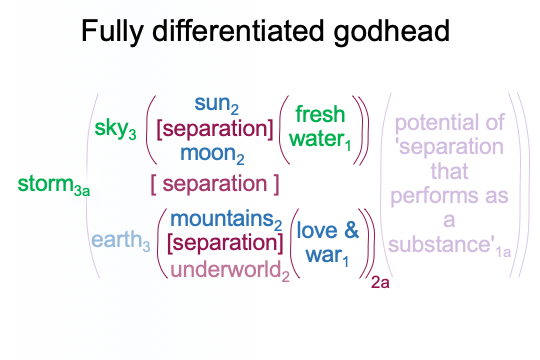
The story starts with Nanna. Nanna2a is a pure monad, but still belonging to the realm of actuality. Of course, this is not possible. All it takes is a spoken word1a in order to induce a disturbance in this monad3a, that supports the differentiation of Nanna2a.
So, the content-level actuality2a and the specifying sign-vehicle (SVs) testify to the instability of pure potential in a world where all that it takes is a spoken word1a to induce a disturbance in the monad3a.
Perhaps, this explains why monotheism takes so long to develop in our current Lebenswelt. On the content level, a single god is a monad that either (1) remains in the category of firstness and therefore does not actualize or (2) enters into the category of secondness and differentiates into a dyadic actuality.
0201 Okay, that is a good start.
Here is a picture of my second guess for the specifying sign-relation.
0202 The sign-relation is apparent. Nanna differentiating into An (male) and Ki (female)2a (SVs) stands for the actuality of the separation of An (sky) and Ki (earth)2b (SOs) in regards to Enlil3b (the child, whose domain is the air) operating on the potential of ‘the fertile embrace of An and Ki1b (SIs).
In effect, the birth of a normal context3b shuts down further expression of the potential1b that supports it.
Or, does it?
Recalling earlier comments, the potential of ‘the fertile embrace of An and Ki’1b shifts into ‘separation that may support a substance’1b in the normal context of Enlil3b. In short, the fertility of the embrace between the heavens and the earth1b sublimates into the separation that supports Enlil’s domain of the [air]1b. The [air] is the contiguity between heaven and earth. Enlil3b is the god of the storm2b.
0203 If I compare the sign-vehicle and the sign-object for the two guesses, I get the following.
0204 In the first guess, I start with the same actuality that I conclude with in the second guess.
Each guess produces a specifying sign-relation.
Do these two guesses offer a lesson about semiotic arrangements?
Surely, it is not necessarily obvious how explicit abstractions fit into the empty slots of the two-level interscope of sensible construction. One of the reasons is that the content and situation two-level interscope embodies a specifying sign-relation. In other words, the two-level interscope contains a semiotic arrangement. Associations must comport with the logics of both relations.
0205 The SOs contributes to the esse_ce of the situation-level actuality2b, “separation” is an explicit abstraction that does not indicate what fills in between the two real elements. “Air, Enlil’s domain,” (SOs) is an explicit abstraction that does indicate what fills in between the two real elements. What is the implicit abstraction that one must draw? Enlil’s domain is not a real element. It is neither heaven nor earth. Enlil’s domain actualizes a separation that serves as a substance.
0206 A comparison of the two guesses in the realm of possibility is also interesting.
The content-level comparison is evocative. In the first guess, I choose the potential of ‘a separation that serves as a substance’1a as the ground for the separation of An and Ki2a. In the second guess, the potential of ‘the breath it takes to speak a word’1a is enough to destabilize the pure monad of everything, Nammu, having entered the realm of actuality2a.
0207 In sum, the Lotman thing directs the inquirer to consider entering terms of explicit abstraction into interscopes that contain embedded sign-relations. The discussion here is only an intimation of how extensive this research project will be. The three types of sign-relation that are integral to the three level interscope is discussed in Razie Mah’s blog for October 2023 titled, Looking at John Deely’s Book (2010) “Semiotic Animal”. A lengthy anthropological application may be found in the four-part e-work, Original Sin and the Post-Truth Condition, available at smashwords and other e-book venues.
0208 Chapters 4 and 5 of Basak’s text discuss the generation of the major and minor gods that comprise the divine council, the Anunnaki.
I would like to start with the actuality2 of Enlil’s separation of the sky and the earth from the point of view of Lotman’s thing.
0209 Here is a picture of Lotman’s empirio-schematic virtually contextualizing a nested form of Enlil’s creation story.
Uh oh, does this figure imply that Lotman’s thing is now operating on the perspective level?
Does that mean that an unfolded empirio-schematic judgment occupies the perspective level?
Oh my.
0210 As mentioned earlier (and completely missed by Basak), the actualities of An2 and Ki2 are further differentiated in the creation of the other members of the divine council, resulting in a surprisingly rich actuality2 composed of two contiguous real category-based nested forms.
Remember that the green separation consists of Enlil’s domain, which is not a real element, but a substance. The [air] is the contiguity between the heavens and the earth.
0211 The categorical qualities within heavenly and earthly nested forms are colored by the fact that the nested forms are real elements within a divine actuality2b.
0212 The thirdness of An3 and Ki3 is reified into two complementary normal contexts3. They do not align with one another. They do not exclude one another.
0213 The secondness of Utu2, Nanna2, Ninhursag2 and Ereshlugal2 is as solid as the sun, moon, mountains and underworld.
0214 Finally, the gods of Enki1 and Inanna1 associate to the realm of possibility, as if those possibilities are actual.
Surely, these are speculative observations.
Nevertheless, these are the ones that I want to explore, using Basak’s text for mythological accounts.
0215 I start with Enki1. Part III of chapter 6 recounts the congratulatory celebration following the creation of humans as the resolution of the Igigi’s labor stoppage in the Eridu Genesis.
Yes, the gods throw a party. Enki1 and Ninmah2 (Ninhursag2) are both in attendance. Enki1 is the one who comes up with the idea of creating humans in order to solve the divine labor dispute. Ninmah2 is crucial to fashioning the human out of clay from Enki’s domain, the Abzu.
Already, the impression is made that Enki1 belongs to the realm of possibility (the category of firstness) and Ninmah2 belongs to the realm of actuality (the category of secondness).
0216 After drinking jugs of beer, the two gods engage in a contest about who can create the most useless humans.
0217 Ninmah2 goes first. She creates six messed up humans. One has weak hands. Another is blind. A third has broken feet. A fourth is incontinent. A fifth is barren. A sixth is sexless. This comports with what one expects for a goddess imbued with secondness (in regards to Ki3) within Enlil3‘s secondness.
Enki1‘s retort addresses the question, “How can each disfigured or dysfunctional person be a productive member of society?” He assigns different specializations to each. In doing so, he1 offers a divine precedent for inclusion and for balancing apparent contradictions (between a person’s functionality and that person’s job).
0218 Enki1 goes next. He fashions a creature that looks like the following.
It cannot sit. It cannot stand. It cannot walk. It cannot eat bread or drink beer. It cannot speak or listen. What can this flawed, helpless being do? It cannot do anything. Ninmah2, the so-called “mother goddess”, is flummoxed. She2 curses Enki1 for his folly.
0219 Chapter 5 discusses the goddess Inanna1 (in Sumerian) and Ishtar1 (in Akkadian). She is queen of the heaven and earth, but mostly the earth, since her interests include love and war.
Yes, she reigns over the contradictory domains of love, beauty, sexuality and fertility as well as war, conflict, political power and intrigue.
To me, that sounds like the category of firstness. The logics of firstness are inclusive. Firstness allows contradictions.
0220 The following story associates to the forty-day retrograde of the planet Venus.
0221 Inanna1 desires power (one wonders why) even from Kur, the underworld, the domain of her elder sister, the goddess Ereslugal2. She1 decides to go herself1. Inanna1 adorns herself before her descent, but she is forced to surrender a piece of her regalia at each of the seven gates. By the time she gets to Ereshlugal2‘s throne-room, she is naked and powerless to defend herself.
Uh-oh.
0222 Ereshlugal2 calls the Anunnaki, once the celestial divine council (in the Sumerian sign-world), now a court ruling over the fate of the deceased (in the Akkadian sign-world). Their decision is brutal. Inanna1 is killed and her corpse is hung on a hook.
Is this what happens when potential1 enters the underworld of actuality2 in order to obtain power?
Is this what happens when the planet Venus enters into combustion (conjunction) with the sun?
0223 As one might expect for a goddess imbued with potential1 (in the normal context of Ki3) as well as actuality2 (in the normal context of Enlil3), after three days, Inanna’s servant Ninsubar1, and Enki1, find a way to rescue her1. A deal2 is struck, Inanna1 may leave the underworld alive if she1 provides a substitute for… you know… that hook.
0224 Upon her return, she1 finds a substitute right away. A shepherd king sits on her empty throne. Out come the demons to drag the presumptuous fellow down to serve as Inanna1‘s substitute on a meat-hook in hell.
0225 While these two instances do not grant certainty to the assignment of Enki1 and Inanna1 to the realm of possibility for An3 and Ki3 respectively, within Enlil3‘s differentiated actuality2, they do lend credence to the intelligence of the guess.
Isn’t that the most that we can expect in a world perfused with sign-relations?
0226 Chapter 7 of Basak’s text is titled “When the Heavens Wept: The Great Flood Myth”.
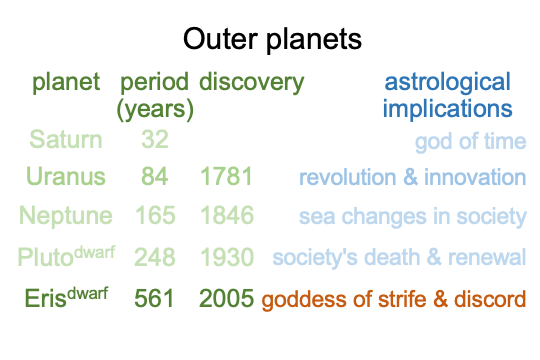
0227 The biblical story of Noah’s flood corresponds to similar stories written about the end of the Uruk archaeological period, often labeled the “Jamdet Nasr” (3600-3800 U0′). If the Uruk starts around 2800 U0′, then the townships of the Uruk period have around 1200 years (or 7 orbits of Neptune) to denude nearby forests in unwitting preparation for catastrophic flooding.
Or, the Uruk townships have 3 transits of Eris in order to destroy their own Lebenswelt from within… er… without. After all, who cares if Uruk deforests the hills that surround Mesopotamia and attacks the nascent civilization forming on the nearby Susa plain and digs holes all over the region in order to extract copper to smelt and sends emissaries to distant lands in order to show how wealthy and powerful the gods of the townships have become?
0228 Surely, the long periodicity and the name selected for Eris offers an opportunity to frame a cyclic process beginning and ending in strife and discord.
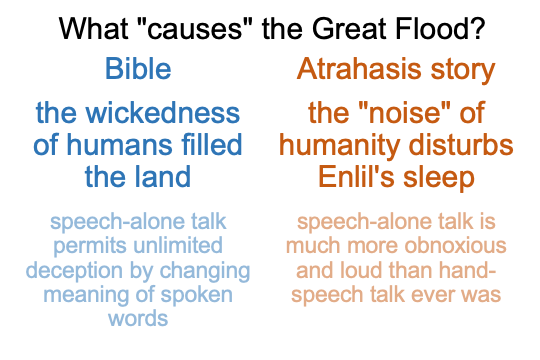
“Strife and discord” constitute divine punishment. So do catastrophic natural events.
0229 On one hand, no archaeologist knows precisely which flood (among several candidates) informs both the Biblical flood story and the flood story appearing in the Epic of Gilgamesh. So, the Marxist interpretation of the flood stories suffers in that no one can figure out the material arrangements.
0230 On the other hand, at the start of 2026, no archaeologist is aware of Razie Mah’s groundbreaking hypothesis, propounded in the e-book, The First Singularity and Its Fairy Tale Trace, and briefly outlined in points 0162 and 0163 of the exposition at hand. So, none can appreciate the relevance of a Lotmanist interpretation of the causes for the flood according to the ancient texts themselves.
This figure is not accounted for in Basak’s survey of current (up to 2025) literature in the field of archaeology.
0231 It almost makes one wonder, “Could civilization have been potentiated by a semiotic transition from hand-speech talk to speech-alone talk, starting with the Ubaid of southern Mesopotamia?”
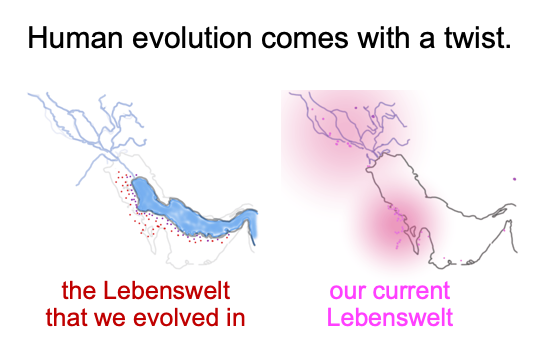
0232 If the answer is affirmative, then our current Lebenswelt is not the same as the Lebenswelt that we evolved in.
Plus, the celestial clockssuggested in this commentary start to tick.
0234 In the Lebenswelt that we evolved in, the celestial bodies were used for signs and for marking the seasons.
In our current Lebenswelt, the celestial bodies may be used as time-pieces, whose zodiac return marks the turning of a spiral of revolutions withinthe trajectories of unconstrained social complexity.
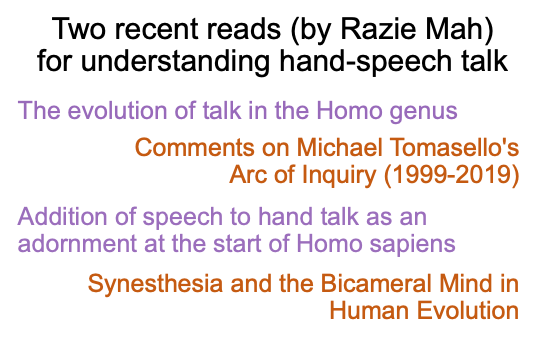
0235 At this point, young professional archaeologists may want to know how Razie Mah gets to the claim that, since the inception of our species, hand-speech talk has been re-organizing the way humans think. The following diagram presents two recent reads that should assist in satisfying that desire.
0236 The first commentary reviews a number of books by a (now former) Director of the Department of Evolutionary Anthropology at the Max Planck Institute in Leipzig. Michael Tomasello never adopted a fully semiotic frame of mind. This commentary adds value to his works by showing how relevant the framework of triadic relations can be.
0237 The second commentary reviews Steven Mithen’s 2024 book, The Language Puzzle, as well as Julian Jaynes 1976 book, The Origins of Consciousness in the Breakdown of the Bicameral Mind. Steven Mithen intimates that synaesthesia is instrumental in attaining speech talk, yet refuses to consider that a fully linguistic hand talk need only add the voice as an adornment, using synaesthesia as a guide, to achieve hand-speech talk. The fluid semiotic dynamics of hand-speech talk explains many cultural features of the Late Paleolithic.
0238 Why is a review of an old (1976) book by an expert on literature be relevant?
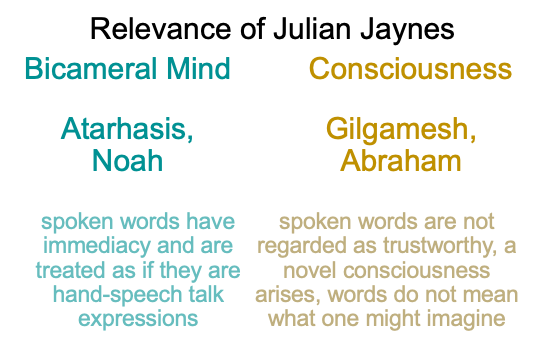
0239 If it turns out that synaesthesia is instrumental in adding the voice, as an adornment, to fully linguistic hand-talk at the dawn of our species, Homo sapiens, then the mindset where a spoken word is recognized to image or indicate the same referent as a hand talk word must be of interest. Spoken words do not picture or point to anything. Hand talk words do. So, the automatic transit of spoken word to image and indication suggests that… if a person hears a voice… then that purely symbolic being is automatically taken to be as real as the iconic and indexal beings of hand talk.
Julian Jaynes calls this mind-set, “the bicameral mind”. He argues that Homer’s Iliad portrays the bicameral mind, where the words of the gods (that is, auditory hallucinations) are regarded literally, and the Odyssey portrays modern consciousness, where spoken words are not immediately and literally taken as one would regard a manual-brachial gesture. As it turns out, the same difference applies to Atarasis and Gilgamesh. There is a different in mind-set between the two. The same difference applies to Noah and Abraham.
0240 Here is a picture summarizing the issue.
To me, this shows how Lotman’s thing may be more relevant to the discipline of archaeology than Marx’s thing.
0241 Chapter 8 covers the Epic of Gilgamesh.
The tablet containing one chapter of the Epic of Gilgamesh is pieced together by George Smith in 1872. This portion of the epic contains an account of the flood that parallels the Biblical account of Noah (a table appears in chapter 7).
Gilgamesh, a king who lives long after the flood, quests for immortality after the death of his friend. He knows that Utnapishtim (Atarhasis) was granted immortality by the gods after the flood. Gilgamesh makes the dangerous trek to visit him in order to obtain the secret.
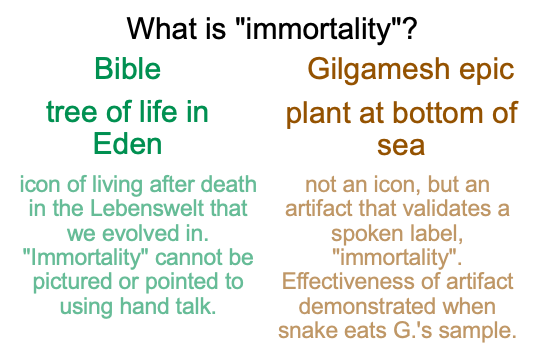
Gilgamesh learns that there is no way to get immortality from the gods. But (and this sounds precisely like a sales pitch) there is a plant that grows at the bottom of the sea that produces youthful regeneration. Eat this plant and the promise is youthful renewal. So, Gilgamesh goes to the bottom of the sea, obtains the plant, then takes a nap. A snake eats the plant, then sheds its skin, thereby attaining youthful regeneration. See! The plant works as promised!
0242 Here is a comparison between the mythic tree of life in the Biblical Garden of Edenand the plant that Gilgamesh obtains from the bottom of the sea.
0243 When the word, “immortality”, is taken literally by Marx-informed archaeologists, something is missing.
What is missing?
Where is the semiotic difference between the world of hand- and hand-speech talk (that is, the Lebenswelt that we evolved in) and our current world of speech-alone talk (that is, our current Lebenswelt)?
0244 Chapter 9 covers more spoken-word games.
The Weld-Blundell prism offers an ideological narrative called “the Sumerian King List”. Gilgamesh is one of the kings before the great flood. The kingship descends from heaven. Only one city at a time holds the banner.
The name for this type of narrative is “mytho-history”. The narrative is ideological, but seems to read… well… y like any other story.
The spoken words say, “Take our purely symbolic beings to be icons and indexes that picture and point to their referents.”
0245 Julian Jaynes argues that the invention of writing disrupted the operations of the bicameral mind in the most insidious manner. Writing allows oracular proclamations to be compared. Before writing, a person would hear a voice telling him to do this or that, and, just like Utnapishtim and Noah, the person would create the artifact that the voice was calling for. After writing is invented, one can see that the voices convey different messages.
Even better, the person writing the script is now in a position to be a voice in other people’s heads.
0246 Chapter 10 concerns the divine assembly, the Anunnaki, according to Akkadian script. As already noted the Anunnaki originally have seven members. The big three (in green) are Enlil3, An3 and Enki1. The other four (in blue) are Utu2, Nanna2, Ninhursag2 and Inanna1.
Here are the assignments based on what the gods represent (see list in chapter 5.2).
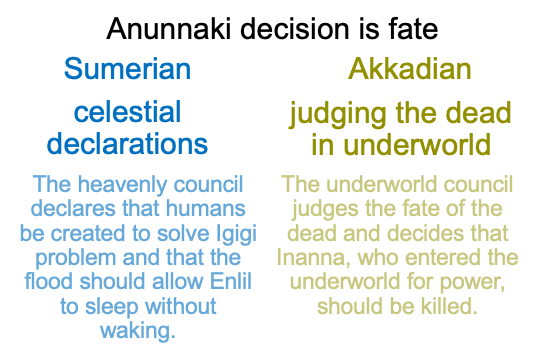
0247 Early on, in the Sumerian civilization, the Anunnaki compose a divine council. They decree that a great flood should occur. After the flood, they rule that Utnapishtim receives immortality. They also rule that humans should be created to solve the Igigi labor dispute. The Anunnaki declare fate from above.
Once the mantle of civilization passes to the Akkadians, the Anunnaki become judges in the underworld. They work for Ereshlugal, the queen of the underworld.
0248 What a change in jobs. Here is a picture.
After centuries, maybe millennia, the Anunnaki lose their differentiated nature. They become like a jury, where all the members are technically the same. In this capacity, they serve as the court that condemns Inanna, the goddess of love and war, to death.
0249 Chapters 11, 12 and 13 are devoted to debunking an agenda, called “the ancient astronaut theory”, proposed by various hucksters starting in the 1950s. This theory is multifaceted, since there is more than one proponent. Basak’s book says that the theory sweeps into public popularity because of the uncertainty following the second battle among the Enlightenment gods, the hot war among fraternal ideologies (1938-1945 AD) and leading into the third battle among the Enlightenment gods, the cold war among materialist ideologies (1945-1989).
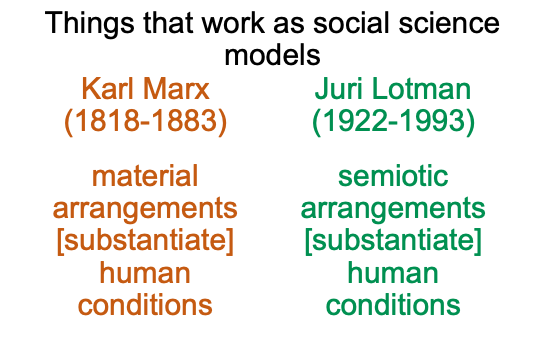
0250 Against this interpretation, which explains this social phenomenon in terms of a model where material arrangements after the Second World War and the start of the Cold War [substantiate] conditions ripe for scam-ideas about ancient civilizations, I place a Lotmanist suggestion that the social popularity of the ancient astronaut theories is accounted for by the inadequacies of Marxist-interpretations of archaeological research into the Neolithic period.
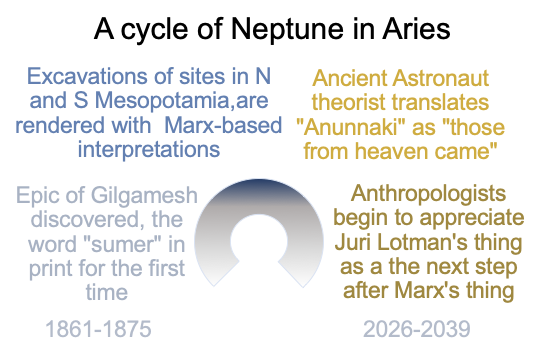
0251 Here is a picture of the framework of the latest cycle of Neptune in Aries.
Highly successful excavations by Western archaeologists offer the promise of coming to terms with the rise of ancient civilizations, based on Marxists formulations.
The Marxist thing does not quite do the job, so alternate theories are proposed by hucksters anticipating an explanatory breakthrough. Basak’s exercise in debunking the very entertaining alternatives only replays the Marxist thing. Basak relies on the Marxist thing to debunk the alternatives that arose from the lack of explanatory power of the model that material arrangements [substantiate] human conditions.
Now, anthropologists are starting to realize that all those people who entertained the now-debunked “ancient astronaut theory” were not as stupid as the Marxist thing presumes.
0251 Once again, Razie Mah’s four part blog, Looking at Melinda A. Zeder’s Article (2025) “Unpacking the Neolithic”, offers insights. The results of anthropological research into the so-called “Neolithic” does not… indeed, cannot… account for another trend hidden within the data. That trend is towards unconstrained social complexity. Basak’s AI program (my speculation, of course) trains only on results and discussions produced by researchers interested in looking for the material arrangements that substantiate neolithic conditions. They cannot account for a change in semiotic practices. They cannot account for what Razie Mah’s hypothesis of the first singularity suggests.
0252 Therefore, why not postulate ancient astronauts?
Surely, ancient monumental constructions, such as pyramids, stone circles, and tracks of figures that can only be seen from the sky indicate ways that civilizing humans communicate with these alien beings.
0253 If this is not a cry for a semiotic accounting for the emergence of unconstrained social complexity, I don’t know what is.
0254 Chapter 14 offers a standard summary of the achievements of ancient Sumeria.
0255 Chapter 15 returns to the topic of the Sumerian creation myths. Once again, the text re-iterates established points. On one hand, the Marxist thing can provide an explanation that cannot be challenged because… well… it is supposedly just like a mathematical or mechanical natural science model. On the other hand, the Marxist thing cannot account for the emergence of unconstrained social complexity in southern Mesopotamia.
Lotman’s thing can.
0256 Here is a picture.
0257 Although this pair of options may appear stunningly simplistic, the ancient astronaut theory shows that stunningly simplistic can work. It can offer an off-ramp to the current academic highway of a publication-based arms race, where young professional archaeologists struggle to pass through the substance called “tenure” only to realize that they have merely passed from antithesis to thesis (see points 0124-0128).
0258 Beck et al.’s manifesto, “Changing the Landscape of Archaeological Publishing” (Current Anthropology 67(1) (2026), https://doi.org/10.1086/739789), is well worth contemplating as a marker for the end of one Neptune in Aries spiral and the beginning of another.
0002 In 2012, the European Science Foundation convened an exploratory workshop, titled, “The Neolithic of Arabia: New Paradigms and Future Perspectives”. The schema is available online.
In the section on the main objectives of the workshop, the organizers (Dr. Remy Crassard and Dr. Phillipp Drechsler) note that the fragmentary characteristics of scientific knowledge to date favors the persistence and acceptance of current theories and precludes the development of new paradigms, along with comprehensive and coherent approaches to the Neolithic.
0003 This “favoring” and “precluding” is intrinsic to a recent essay in the journal, Prehistory, which is examined in Razie Mah’s blogs on January 1, 2026, titled Looking at Melinda Zeder’s Article (2025) “Repackaging the Neolithic”.
0004 While the workshop organizers do not call for a novel global vision, they do call for a synthetic approach that encourages the integration of diverse research on the topic.
0005 This open letter calls for more comprehensive research into the link between the early Holocene infilling of the Arabian Gulf and the emergence of two spheres of interaction for the Ubaid (southern Mesopotamia and the western Gulf littoral). The addendum provides an introduction.
0006 How comprehensive?
0007 Consider the questions raised by Razie Mah in the e-book, The First Singularity and Its Fairy Tale Trace.
0008 First, does the forced migration induced by the early Holocene marine transgression explain the ‘Ubaid phenomenon, where this culture may be considered to be the first to practice speech-alone talk?
0009 Second, does speech-alone talk spread from the Ubaid, along established paths of down-the-line trading, to the rest of Eurasia? Why do all hand-speech talking cultures adopt speech-alone talk after coming into contact with a speech-alone talking culture? Are there archaeological markers indicating that, not only has contact occurred, but the transition is underway. Artifacts that might demand labels, like copper, certain types of pottery (such as the white pottery of the Archaic Hassuna), changing habits of lithic-tool knapping, might serve as markers.
0010 Third, what are the semiotic natures of hand-talk, hand-speech talk and speech-alone talk? Does hand- and hand-speech talk constrain social complexity? Does speech-alone talk potentiate unconstrained social complexity?
0011 These questions can be bundled into one grand question, which, ironically, is what the workshop specifically forbade.
Is our current Lebenswelt the same as the Lebenswelt that we evolved in?
Are we who we evolved to be?
0012 I hope this call is heard by all people of good will. The time has come to set aside the swords and pick up where European Science Foundation’s exploratory workshop left off.
0010 Earnestly yours,
The Desk of Razie Mah
September 2-15, 2026
0011 Addendum: Looking at Richard Cuttler’s Article (2013) “Considering Marine Transgression as a Mechanism for Enforced Migration and the Littoral Gulf ‘Ubaid Phenomenon” in Razie Mah’s blog, September 1, 2026
0001 The citation for this article is: Cuttler, R. (2013). Considering marine transgression as a mechanism for enforced migration and the littoral Gulf ʿUbaid phenomenon. Arabian Archaeology and Epigraphy, 24(1), 37–43.
I obtained my copy from Wiley online. Thank you.
0002 In the early 2010s, Dr. Richard Cuttler smells a very interesting intellectual aroma, but is unable to sense where the trail leads. What is the link between the infilling of the Persian Gulf and the appearance of the Ubaid culture of southern Mesopotamia?
0003 The titular “consider” is one way of saying, “Imagine the possibility.”
If the marine transgression into the Arabian… or is it Persian?.. Gulf enforces a migration of the people who originally settled the fresh water marshes of the Ur Shatt (that’s “Ur Schatt” for Germans) waterway, then does that account for the Ubaid appearing in both Mesopotamia and on the shoreline of central Arabia?
0004 Why would an archaeologist consider such an if-then scenario?
During the glacial period, the Euphrates and Tigris Rivers flowed together into a waterway, the Ur-Shatt, that fed a corridor of lakes and marshes (now underwater “basins”) into the sea. Such a concourse would be a favorable place for Epipaleolithic enthnoses to settle, taking advantage of diverse natural resources.
0005 Little did they realize that the Ur-Shatt waterway, a veritable oasis during the glacial period, would slowly be covered with around 70 meters of sea-water. By “slowly”, I mean thousands of years. At the same time, the rise in sea-level has a horizontal dimension. After filling the basins, sea-water spreads into a shallow geological bowl.
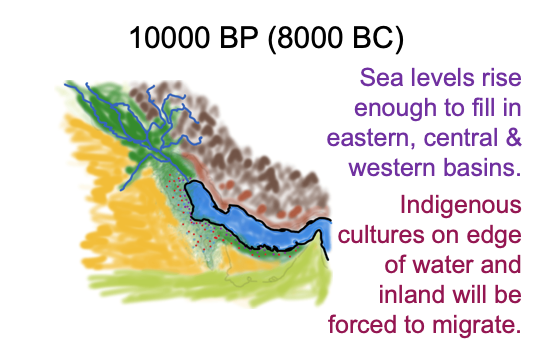
0006 Here is a picture of the scenario once the low-lying basins are full.
The indigenous settlements are represented by red and purple dots.
The sea-rise will force these people to migrate.
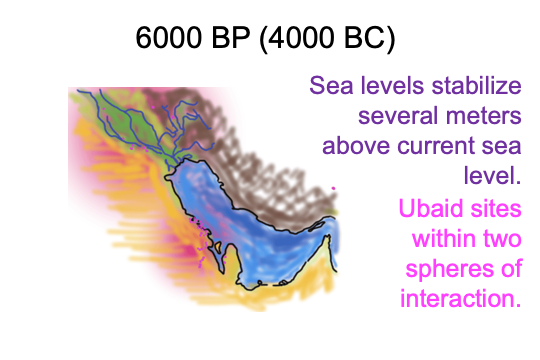
0007 Here is a picture once the Gulf is filled to the brim (as far as the sea-rise would go, which is several meters above the present sea-level).
The Ubaid settlements are represented by magenta dots. Plus, the background color has taken on a magenta hue, denoting two spheres of interaction, the central Arabian Gulf and southern Mesopotamia. This is my rendition of Figure 1 of the article.
0008 How does anyone know that there are two spheres of Ubaid settlements?
Originally, the term, “Ubaid”, labels a type of pottery found in excavations throughout southern Mesopotamia. Why did archaeologists not also look at the central Arabian Gulf region?
The author is perhaps too embarrassed to say that late-nineteenth and early-twentieth century archaeologists focused on this region because… well… that is where the Garden of Eden is supposed to be. That is where Noah’s flood took place. That is where Judah was taken into exile in ancient times. So, of course, Protestant Christians are going to pay for exorbitant excavations in order to reveal… you know… something about justification by faith alone, scripture alone, and grace alone.
0009 Okay, I am just guessing on that one.
0010 Then, in 1968, G. Burkholder discovers Ubaid pottery in the western Gulf littoral.
0011 What a surprise.
The Ubaid is the lowest level excavated in southern Mesopotamia, which means that it has the deepest time horizon. Now, the Ubaid shows up near Bahrain. Doesn’t that smell like a great research project? To an archaeologist, it sure smells good… but, how does one follow the scent when the trail goes under the waters of the Gulf?
Professor Richard Cuttler, who I am sure has some good stories to tell, seeks funding for seismic reflection maps of the Gulf’s underwater landscape, in order to obtain better placed sediment cores of the sea-floor. He wants to investigate, but he does not know that there is another component to the puzzle. Also, big funding is hard to come by.
0012 If the project is funded, what will he find?
Among other points, the sediment cores would provide pollen-based clues to the changing climate of the time.
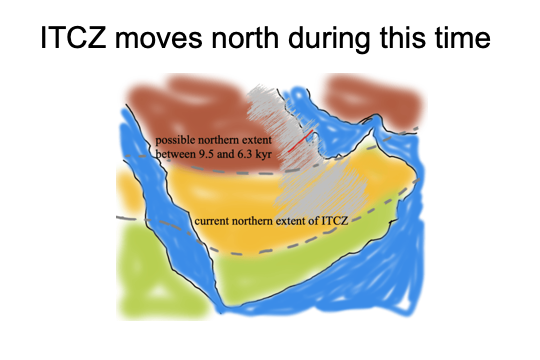
0013 At the start of the current interglacial, the Inter-Tropical Conversion Zone (ITCZ) shifts north, then back, then north again, in a most fickle manner. For the time under consideration, the ITCZ moves north, but not as far north as the gulf-to-be.
Here is a picture.
0014 The two dotted gray lines indicate the furthest extend of the ITCZ currently, and between 9.5 and 6.3 thousands of years ago (kyr). South of the line, the monsoons deliver plenty of rain water. North of the line, the westerlies lose all their water before arriving in Arabia.
0015 Curiously, all the Ubaid sites develop north of the early Holocene ITCZ line, suggesting that water was not a crucial issue. That makes no sense. Southern Mesopotamia obviously has lots of fresh water because of the Euphrates and Tigris and other rivers. What provides water to the pre-Ubaid sites in the central western Gulf?
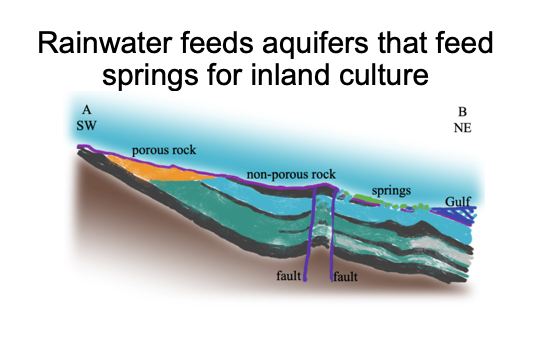
0016 Take a look again at the above figure. The gray brushstrokes and the red line denote a massive aquifer that is tilted. It is high in the west and low in the east. The Dammam label is a concatenation of the saying, “That’s a damn aquifer, ma’am.” Am I kidding? This aquifer relies on a huge tilted fault-riddled plate of non-porous rock supporting porous layers that allow rain water, falling south of the northernmost ITCZ line, to flow underground and come to surface in springs that stand outside the low-lying basins.
0017 Here is my version of the article’s Figure 2.
Note how water flows downhill in the Dammam aquifer then comes up in springs further inland from the sea-water filled basins.
0018 Why is this so important for this examination?
This examiner wants to show that… in the land surrounding the freshwater marshes and salt-water depths of the basins at 10,000 BP… there are two cultures: a Mesolithic culture that lives right along the water and uses fresh and salt water resources and a Neolithic culture that exploits the water from Dammum-fed springs to engage in rudimentary agriculture and stockbreeding.
0019 The question is, “Why would I want to establish two disparate cultures in the same region?”
Wouldn’t that just complicate the story of an enforced migration?
0020 Here, I review.
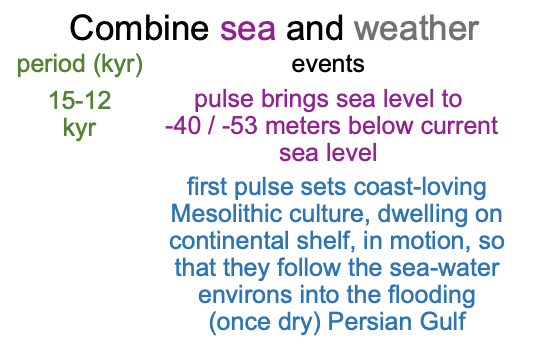
0021 First, the sea level starts to rise, if there is not a paleolithic culture already on the fresh-lakes of the Ur-Shatt waterway, then a Mesolithic culture displaced from living on the continental shelf could enter into the environs. Such a culture would simply follow the water into the eastern, central and western basins, since they already know how to exploit fresh-water and marine resources.
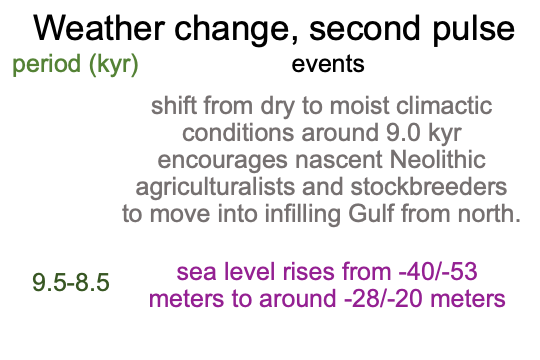
0022 Second, there is a shift from dry to wet climactic conditions, as the intertropical convergence zone (ITCZ) shifts north. Does it shift north enough to provide water directly to lands around the infilling Gulf? The author establishes that even if it does not, the ITCZ shifts north enough to feed the Dammum aquifer which would provide fresh water to a Neolithic agricultural and stockbreeding culture that migrates in from the north and settles in the dry-lands just beyond the marshes.
0023 Then the sea-level rises more, overfilling the basins and entering into the flat-bowl terrain of the surrounding landscape. Now, both the Mesolithic and Neolithic culture are forced to migrate in response to the rising seas.
0024 Here is where I introduce an idea that Dr. Cuttler did not think of and may have never heard about until this moment.
The economies of the Mesolithic and the Neolithic culture are different. They do not depend on the same resources. Practical reason predicts that these cultures should mingle with one another and eventually become one.
However, each culture practices its own hand-speech talking language. That means that they have a serious impediment to talking with one another. Both practice a dual-mode style of language. How are they going to get around that?
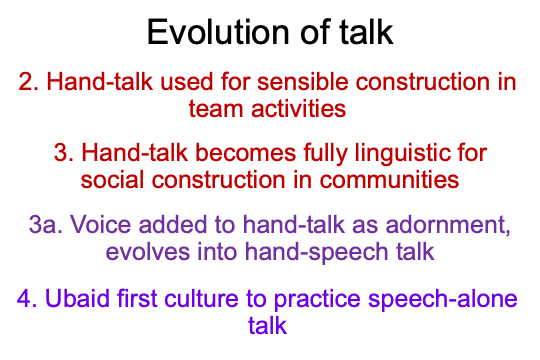
0025 Let me step back and say that the evolution of talk is not the same as the evolution of language. Almost every book available on human evolution discusses the evolution of language as a facet of hominin communication. Only Razie Mah’s books discuss the evolution of talk as a semiotic adaptation.
0026 Here is a brief overview.
0027 The first period ranges from the separation of the chimpanzee and human lineages (around 7 Myr) to the start of bipedalism (around 3.5 Myr). The hominin lineage communicates in two small and one larger social circles. The small social circles are family (5) and friends (5). The larger social circle is the band (50).
0028 The second period ranges from the start of bipedalism to the domestication of fire (around 0.6 Myr). Michael Tomasello says that this period is dominated by “obligatory collaborative foraging”. That means that the social circle under the most intense selection pressure is the team (15). Hominins forage in teams. Pre-linguistic hand-talk is an adaptation to team work. Pre-linguistic hand-talk relies on sensible construction. Sensible construction relies on content and situation.
0029 The third period ranges from the domestication of fire to the first singularity (around 9kyr). The social circle under the most intense selection pressure is the community (150), the team of teams. This period is dominated by, what Razie Mah calls, “obligatory social-circle harmonizing”. Hand-talk becomes fully linguistic as an adaptation to the semiotic dynamics of social construction. Social construction involves content, situation and perspective.
0030 Prior to the evolution of Homo sapiens, the voice comes under voluntary neural control for singing. Why sing? There are two social circles larger than the community, the seasonally gathering mega-band (500) and the occasionally gathering tribe (1500). Their episodic gatherings require rapid synchronization. The voice was recruited to do precisely this. Singing identifies each participant within these larger social circles as belonging to the group. Plus, singing synchronizes all participants to the tasks at hand.
Sexual selection does the rest.
0031 With the evolution of Homo sapiens, the voice is systematically adapted for use as an adornment to hand-talk. In liminal lighting, communal hand-talk is difficult to instantly recognize. The voice is added as an adornment. Sound-word adorns gestural-word. The semiotics of the union remains grounded in hand-talk. However, the semiotic qualities of the sound-word (speech) are unique. So, cultural evolution produces two independent channels of talk, hand and speech talk, that are highly socially regulated.
In short, the transition from the voice as an adornment to hand-talk to fully elaborated hand-speech talk occurs over hundreds of thousands of years during the Paleolithic. My guess is that archaeological evidence of adornment parallels the development of this cultural adaptation.
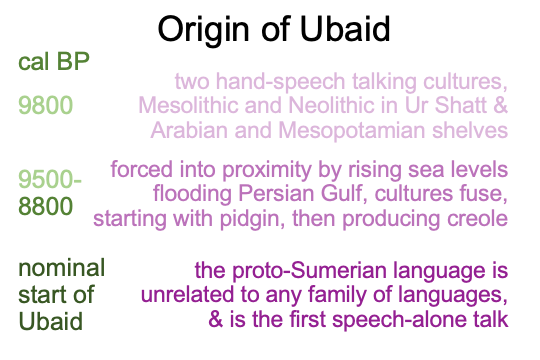
0032 The fourth period begins when two hand-speech talking cultures, one Mesolithic and one Neolithic, are forced into the same migration. These cultures have different economies, so they do not fight over resources. Rather, they trade and get along. They intermarry. They engage in interactions familiar to anthropology. They start with a pidgin. Then, later generations establish a creole. That creole is the proto-Sumerian language. Sumerian is unrelated to any large family of languages.
0033 Plus, that creole is the first speech-alone talk on Earth.
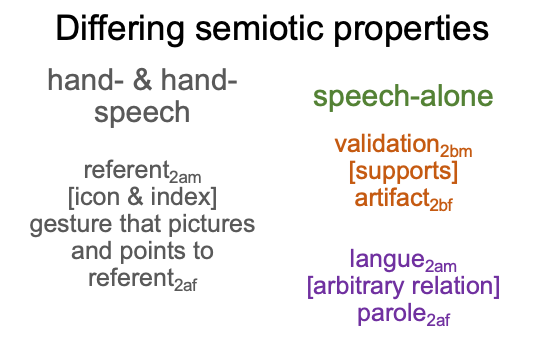
The semiotic properties of hand- (and hand-speech) talk and speech-alone talk are significantly different. The following figure presents dyads (characteristic of the Charles Peirce’s category of secondness) that may be read as Aristotle’s dyad of {matter [substance] form}.
0034 Hand- (and hand-speech) talk requires only one hylomorphe. A referent as matter substantiates, by way of icon and index, a manual-brachial word-gesture as form. The fact that word-gestures become routinized, and thereby instantly recognized, does not detract from this semiotic grounding. The referent precedes the hand-talk word.
0035 Speech-alone talk requires two hylomorphes, one on the content and one on the situation level. In terms of content, Ferdinand de Saussure (1859-1913) defined spoken language as “two arbitrarily related” systems of differences. What I think is arbitrarily related to what I say. So, where does the referent come in?
The referent comes on the situation-level, because each content-level word-utterance2af must be validated2bm(as situation-level matter) by the form of an artifact2bf. The spoken word precedes its referent.
0036 While this explanation sounds like gibberish to any newcomer to the field of semiotics, including many anthropologists and archaeologists in 2026, there is clearly method to the madness.
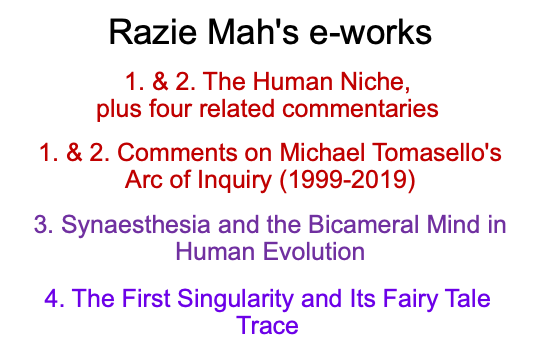
0037 Here is a list of Razie Mah’s e-works that are pertinent to this topic.
0038 The bottom line?
Hand- and hand-speech talk constrain social complexity.
Speech-alone talk facilitates unconstrained social complexity.
0039 This is precisely the theory that Dr. Cuttler needs in order to bring his research proposals to the next level.
0040 The origin of the Ubaid is the first step in a huge research project that is intrinsic to The First Singularity and Its Fairy Tale Trace.
0041 Cuttler’s analysis concerns the material arrangements that set in motion a dramatic shift in semiotic reality.
0042 Our current Lebenswelt is not the same as the Lebenswelt that we evolved in.
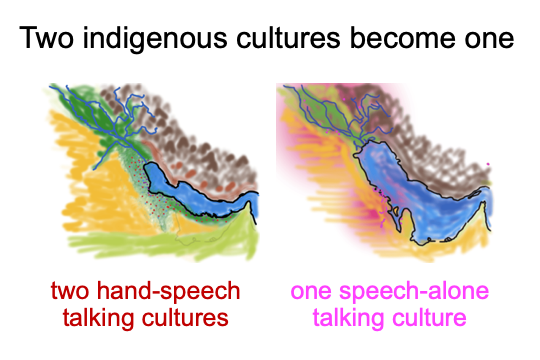
The image on the left represents two hand-speech talking cultures that belong to the Lebenswelt that we evolved in.
The image on the right represents one speech-alone talking culture that initiates our current Lebenswelt.
0043 I suspect that the Ubaid narod knows that they are different. They are surrounded by ethnoses that are poor and disorganized, in comparison to the wealth and the power that comes from (even a little) labor and social specialization.
The Ubaid does not know why it is special, it only knows that the surrounding hand-speech talking cultures talk with their hands. The hand-speech talking culture cannot help but notice the inverse. The Ubaid emissaries do not talk with their hands. However, they have the best dried fish. Plus, they want to give us their pottery, but it seems that they expect something in return.
Soon enough, the Ubaid strains at maintaining communality, or whatever it was that they had before their creation. Meanwhile, their way of talking encourages them to create artifacts that validate their spoken words, condemning them to further social complexity.
0044 It is hard to imagine what it was like, when every youth is ready to move past the tired artifacts that validate their grand-parent’s words.
Or, maybe it is not hard to imagine.
0045 Nor is it hard to imagine Abdullah Hassan Masry’s 1974 “sphere of interaction” hypothesis. Each Ubaid site belongs to a sphere of interaction, where it takes on its own “specialties”, its own gods, and its own ways of accommodating its labor and social specializations.
Doesn’t that sound like the contemporary term, “multipolar world”?
0046 Here is a picture.
0047 What is the second research project demanded by the hypothesis of the first singularity?
From the spheres pictured above, speech-alone talk spreads to the four corners of the world.
Imagine the research project needed to establish whether that claim is plausible!
0048 Dr. Richard Cuttler, the door is open. Follow your nose. Thank you for publishing your considerations.
0001 The book before me is published by Fidelity Press. The subtitle is “The Rise, Fall and Return of American Identity”. The author is editor of Culture Wars Magazine. And, everyone knows what “culture wars” means.
For students who are pursuing Semiotics and History, please have a copy of this book at hand. Look at the title and read the table of contents. The instructions in this examination should be clear.
Dr. E. Michael Jones, the author, reads and comments on literature from a Catholic point of view. His works are iconic, in so far as he is orthodox. “Ortho” means “right”. What about “dox”? Here, I mix terminology. Orthodox love icons. You know, those paintings that adorn the churches with names like “Saint Basil’s”.
0002 Of course, for the semiotics of Charles S. Peirce, an icon is one of three types of natural signs. An icon is a triadic sign-relation whose sign-object is based on the qualities of similarity, imagery, pantomime, likeness and so on. In other words, an icon offers a sign-vehicle that allows me to visualize its sign-object.
0003 But what about the icon rendered in E. Michael Jones’s text?
What about the icon on the wall of St. Basil’s?
Razie Mah’s blog appearing in January 2025, Looking at Boris Uspenskij’s Article (2016) “Semiotics and History”, contains a hypothesis about Russian icons.
0004 Boris Uspenskij (1937-present) is a Soviet era expert on Slavic literature who, along with Juri Lotman (1922-1993), proposes that semiotic arrangements substantiate the human condition. He does so in the 1990s, after the Soviet political system lost all credibility. The Soviet system enshrined Marx’s slogan: Material arrangements substantiate the human condition. How well did that thing work?
0005 Boris Uspenskij’s journey into semiotics begins in the 1950s, when the Soviet empire is intimidating and everyone senses that Marx’s slogan applies. After all, it sounds so scientific.
Uspenskij wants to offer a materialist explanation for the power of Russian iconography. Russian icons are portraits and scenes painted on the foreground with a background of thinly hammered gold foil. Uspenskij figured that icons are meant to be viewed by candlelight. The flickering light of candles produce the aesthetic effect associated with Russian icons.
0006 Of course, this is a materialist explanation for Russian iconography, fully congruent with the central slogan of the Marxist thing: material arrangements [substantiate] human conditions.
However, from the Korean War until the fall of the Berlin Wall, Uspenskij (along with Lotman) reach the conclusion that Marxism does not have the vocabulary to explain Slavic literature. Instead, they figure out the aesthetic effects of Slavic art by using the vocabularies of semiology and structuralism.
“Figuring out” means “bricolage”. They practice what they figure out. The vocabularies of semiology and structuralism hammer out a model. Then, when the form of the work of art is viewed in the flickering light of that model, an aesthetic effect is reproduced as matter. The work of art entangles the contemporary language of the positivist mind.
0007 In the flickering illumination of a semiological and structuralist model, the work of art begins to speak to the viewer.
The Tartu-Moscow School of Semiotics is discussed in Razie Mah’s blogs, spanning from December 2025 to May 2026. These blogs initialize an online course titled “Semiotics and History”. See Razie Mah’s blogs for October 3-6, 2025 for an introduction.
0008 This is confounding.
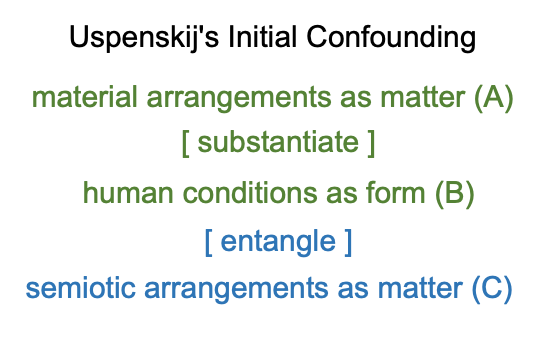
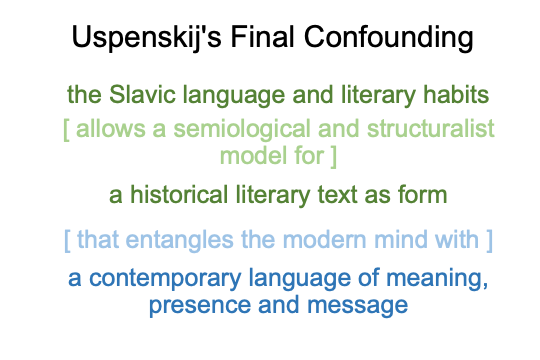
“Confounding” is a technical term, labeling a single form (B) that originates from one matter (A), yet entangles another matter (C)
A historical literary text (or a work of art, such as a Russian icon, A&B) becomes a form (from the perspective of a semiological and structuralist model, B alone) that entangles a voice (matter within the viewer, speaking to the viewer, in a contemporary vocabulary of meaning, presence and message, C).
0009 A as matter [substantiates] B as form. {A[&]B} constitutes a thing.
B as form [entangles] C as matter. {A[&]B[entangles]C} is a confounding.
0010 The question that I pose is this.
Does Dr. E. Michael Jones construct a similar cognitive apparatus in the USSA, during the years preceding the collapse of its big government (il)liberal and neoconservative Marxist ideations?
0011 I know what you are thinking.
USSA?
United Sycophantic States of America?
I love acronyms.
But, what the hell is a “sycophant”?
Okay, the author has another word that begins with “S”.
0013 Does the author start with historical literary texts (or works of art, {A[&]B})?
Yes, this book is divided into fifty-three chapters. Each chapter focuses on an author and his works of art. The matter, A, consists of an author’s life and the plotlines of his literary and artistic works. The form, B, consists of the literary text in history.
0014 Does the author frame each historical text in terms of a semiological structuralist model (the Tartu-Moscow School’s flickering flame of illumination)?
No. But, the author does frame historical works of art in terms of a model. The model is not based on semiology or structuralism. The model is based on the philosophy of Saint Thomas Aquinas (1225-1274 AD), who interprets Aristotle (384-322 BC) during the so-called “Middle Ages”.
0015 Of course, the historical trajectory of Thomism is not so straight-forward. John Deely (1942-1917 AD) articulates a narrative of “the causalities inherent in signs” in his massive masterwork, Four Ages of Understanding (2001).
Aristotle treats signs as symptoms or indexes. The Latins, starting with Augustine (354-430), notice that signs operate in both nature and culture, but the nature of signs is not a focus of inquiry. This stance includes even Aquinas, who writes about signs, but not about their nature. Over the centuries, Aristotle’s methods, passing through Aquinas, eventually formulate the definition of sign as a triadic relation. The honor goes to John of St. Thomas (aka John Poinsot, 1589-1644), a junior colleague to the famous Baroque scholastic, Francisco Suarez (1548-1617).
Fast forward to America, three centuries later. After reading Francisco Suarez, among others, Charles Sanders Peirce (1839-1914) comes up with the same definition of sign-relation as John Poinsot. Peirce uses his own home-grown vocabulary, rather than Aristotelian terminology. In this manner, Thomism passes from the Baroque scholastic (written in Latin) to Peirce’s philosophy and semiotics (written in English), long after (what John Deely calls) the Latin Age ends.
Here, I mention Robert Junqueira, whose 2025 doctoral thesis is titled, The Coimbra Jesuit Course as a Source of the Semiotic Logic of Charles Peirce.
0016 So what am I saying?
E. Michael Jones uses a model based on the Aristotelian philosophy of Thomas Aquinas.
However, Charles Peirce stands within the grand historical tradition of Thomism and provides a novel “scientific-sounding” terminology for Aristotle’s insights. Plus, Peirce’s tradition allows diagrams, such as the category-based nested form.
This is where my examination adds value to the author’s text.
I offer diagrams of relational structures.
0017 Of course, E. Michael Jones does not know of this historical development in philosophical inquiry into the nature of signs.
Who does?
This diversion into disquieting twists in the history of philosophy is necessary, because the examiner intends to render the model that E. Michael Jones uses to illuminate historical persons and texts in terms of Peirce’s categories.
0018 Here is the foundational association.
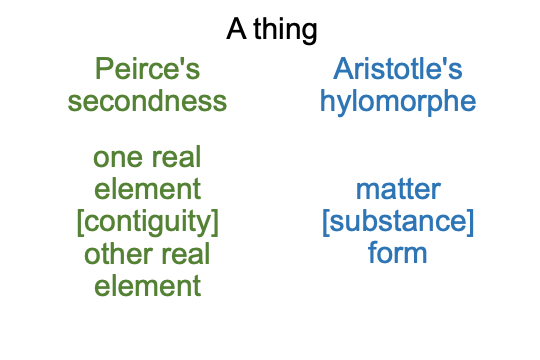
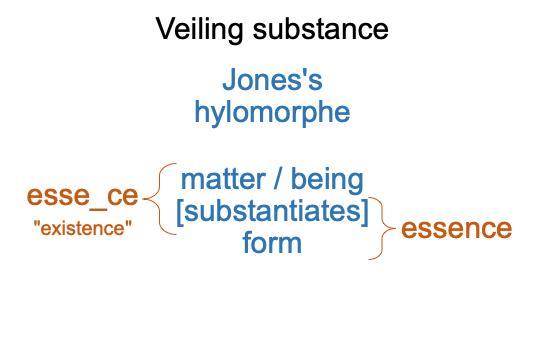
For Aristotle, a thing is a hylomorphe, consisting of two real elements, matter and form. Peirce’s category of secondness is defined as two contiguous real elements. For proper notation, the contiguity will be placed in brackets. For Aristotle’s hylomorphe, the contiguity is [substance]. Here is a picture of Peirce’s secondness and Aristotle’s hylomorphe.
0019 This is the basic building block of the author’s model.
I can use it to frame the author’s burning wick, in a simple fashion. A more complex model will follow.
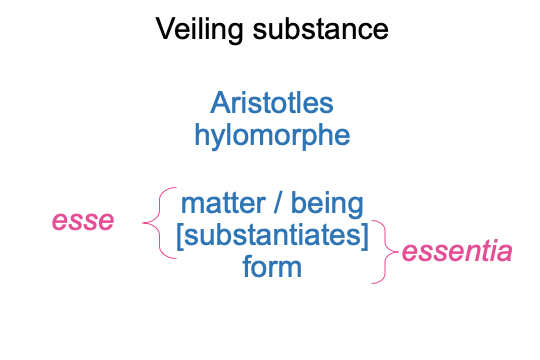
For now, it pays to look for other familiar terms that fit into Aristotle’s schema. In Latin, these are esse (matter substantiating, anglicized to “esse_ce”, corresponding to Jones’s “existence”) and essentia (substantiated form, corresponding to Jones’s “essence”).
0020 Here is a picture.
0021 Now, I will anglicize the Latin terms into the terms that I will use for this examination.
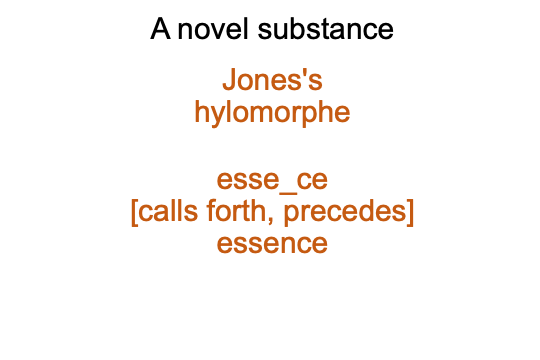
0022 One more step is required in order to get my first snapshot of the model that E. Michael Jones works with, as an artisan working with historical texts. Many slogans are attributed to Aquinas. Jones selects the slogan, “Existence precedes essence”.
0023 How do I place this slogan into the above diagram?
The magic of spoken labels allows me to regard “esse_ce” (“existence”) and “essence” as real elements. So, following the logic of Peirce’s category of secondness, there must be a contiguity. This contiguity is [calls forth], according to the above slogan.
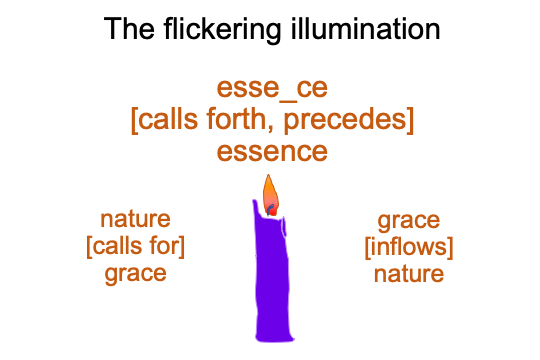
0024 What is one advantage of Jones’s hylomorphe?
It is a flickering candle of illumination.
How so?
Let me ask the question, “Which of the dyads next to the candle shines most brightly within Jones’s model?”
0025 “Calls forth” and “precedes” cannot manifest simultaneously as “calls for” and “inflows”.
At any time, [the substance] shines as one or the other.
The above figure is a Peircean diagram of the author’s model.
0027 The Tartu-Moscow School of Semiotics grows within the repression of the USSR then blossoms with the fall of the Soviet empire. Boris Uspenskij and Juri Lotman participate in that end-of-an-era flourishing. That is the end of the story. What about the start?
Uspenskij and Lotman begin their careers in Slavic studies by proposing atheist materialist explanations for the nature of Russian (and Slavic) literature. Uspenskij’s model of the candle-illuminated Russian icon is an example. However, the vocabulary of atheist materialism proves inadequate, so they supplant their explanations with semiology and structuralism.
0028 This fits the pattern of a confounding.
0029 By the time the USSR ends (along with the incentives for atheist material explanations), their confounding is refined into the following script for inquiry into aesthetics.
0029 This is not the same as the original confounding.
Instead, the above figure matches Uspenskij’s original insight arguing that Russian icons should be regarded in candlelight.
B: The form is a literary historical text (which is like the Russian icon).
A: The originating matter is the Slavic language and literary genres (which is like the material for the substance of the flame of a semiological and structuralist model).
C: The entangled matter is a contemporary (and, yes, academically inclined) language of meaning, presence and message.
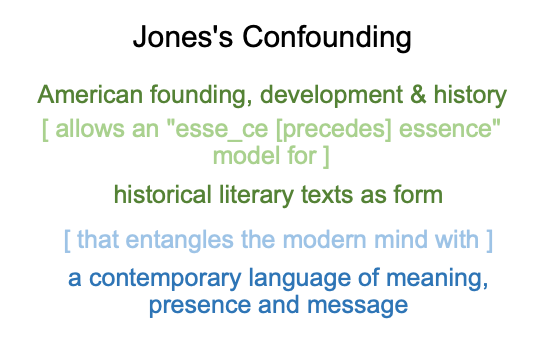
0030 Independently, E. Michael Jones learns to practice these steps in the USSA, using a model that is not associated with semiology or structuralism.
0031 To me, the parallel is striking.
The Tartu-Moscow School of Semiotics develops a practice that coheres to the categorical structure of a confounding. They do so in order to plumb the beauty and insights of Slavic arts and literature. Yet, no one in that school explicitly articulates that structure.
Similarly, E. Michael Jones develops a practice that coheres to the categorical structure of a confounding. He does so in order to plumb the charisma of the American identity, as expressed historically in its arts and literature. Yet, he does not explicitly articulate the structure of the confounding.
0032 I wonder, “What is the esse_ce that calls forth the essence of the title of this book?”