01/31/25

Looking at Alexei Sharov and Morten Tonnessen’s Book (2021) “Semiotic Agency” (Part 1 of 24)

0001 The book before me is Semiotic Agency: Science Beyond Mechanism, by biosemioticians Alexei Sharov and Morten Tonnessen.  The book is published in 2021 by Springer and logs in at volume 25 of Springer’s Series in Biosemiotics.  Series editors are Kalevi Kull, Alexei Sharov, Claude Emmeche and Donald Favareau.  These editors have Razie Mah’s permission for use of the following disquisition, with attribution of said blogger.

Points 0001 to 0226 cover Parts I and III of this book.  These Parts are titled, (I) Overview and Historiography and (III) Theoretical Considerations.  These two sections set forth the rationale for scientific inquiry into semiotic agency

0002 Chapter one begins with a question.

Can agency be a scientific subject?

To me, the question, “What is science?”, must be addressed.

0003 Scientific inquiry involves a judgment within a judgment.

0004 Okay, then what is a judgment?

A judgment is a triadic relation containing three elements: relation, what is and what ought to be.  When each of these three elements uniquely associates to one of Peirce’s categories, then the judgment becomes actionable.  Actionable judgments unfold into category-based nested forms.  

What am I talking about?

Consult A Primer on The Category-Based Nested Form and A Primer on Sensible and Social Construction, available at smashwords and other e-book venues.

0005 Here is a diagram of judgment as a triadic relation.
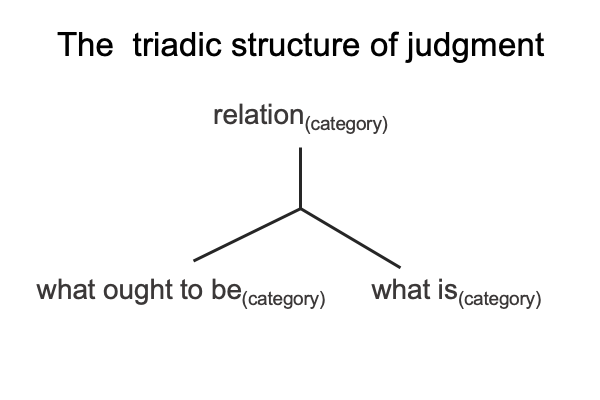
A relation (belonging to one category) brings what ought to be (belonging to another category) into relation with what is (belonging to the one remaining category).  Peirce’s three categories are firstness, secondness and thirdness.  Firstness is the monadic realm of possibility.  Secondness is the dyadic realm of actuality.  Thirdness is the triadic realm of normal contexts, mediations, judgments, sign-relations, and so forth.

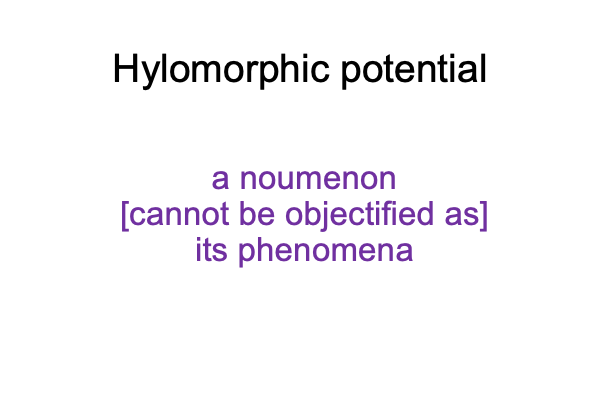
0006 If scientific inquiry involves a judgment within a judgment, then the larger judgment is called the Positivist’s judgment.  A positivist intellect (relation, thirdness) brings an empirio-schematic judgment (what ought to be,secondness) into relation with the dyad, a noumenon [and] its phenomena (what is, firstness).

Here is a diagram.
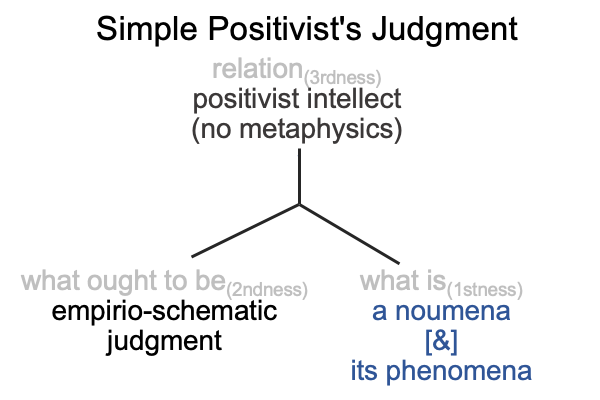
0007 In regards to the relation, the positivist intellect has a rule.  Metaphysics is not allowed.

0008 What is “metaphysics”?

Aristotle proposes four causes: material, efficient, formal and final.  The first two are (more or less) physical.  The second two are (more or less) metaphysical.  So, the second two causes are ruled out in the seventeenth century by the mechanical philosophers of northern Europe.

0009 Of course, ruling out formal and final causes truncates material and efficient causalities.  Imagine a material cause (such as the flow of ink onto a piece of paper) without its formal cause (the piece of paper will then be folded and put into an envelope).  Imagine an efficient cause (the role of glue in sealing an envelope) without its final cause (the envelope will be put in the mail).

So, the rule of the positivist intellect has the effect of truncating physical material and efficient causalities from their metaphysical companion causalities.  The positivist intellect is assigned to the category of thirdness, the realm of normal contexts.

0010 In regards to what ought to be, the empirio-schematic judgment belongs to the category of secondness (the realm of actuality), even though it obviously belongs to the category of thirdness, because judgments are triadic relations.  In other words, to think in terms of the Positivist’s judgment, one must disregard the obvious and regard the empirio-schematic judgment as an exercise in the realm of actuality, if that makes any sense.

0011 It may help to consider the empirio-schematic judgment as a tool for producing scientific models.  Disciplinary language (relation, thirdness) brings mathematical and mechanical models (what ought to be, secondness) into relation with observations and measurements of phenomena (what is, firstness).

Here is a picture.
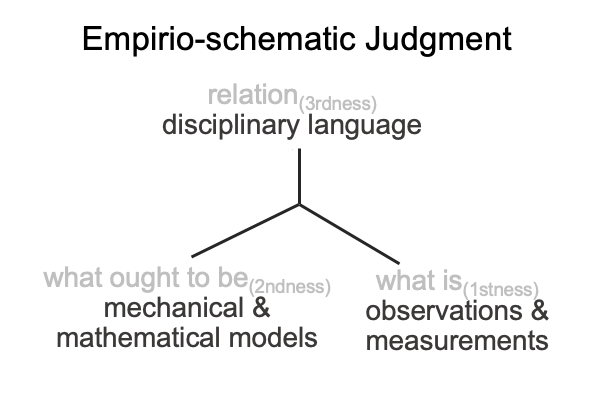
These figures are initially constructed in Comments on Jacques Maritain’s Book (1935) Natural Philosophy, by Razie Mah, available at smashwords and other e-book venues.
01/6/25

Is Biosemiotics Scientific? (Part 1 of 4)

0201 The book before me is Semiotic Agency: Science Beyond Mechanism, by biosemioticians Alexei Sharov and Morten Tonnnessen.  The book is published in 2021 by Springer and logs in at volume 25 of Springer’s Series in Biosemiotics.  The editors of this series have Razie Mah’s permission for use of following disquisition, with attribution of said blogger.

Part III concerns theoretical considerations, addressing the headliner question.

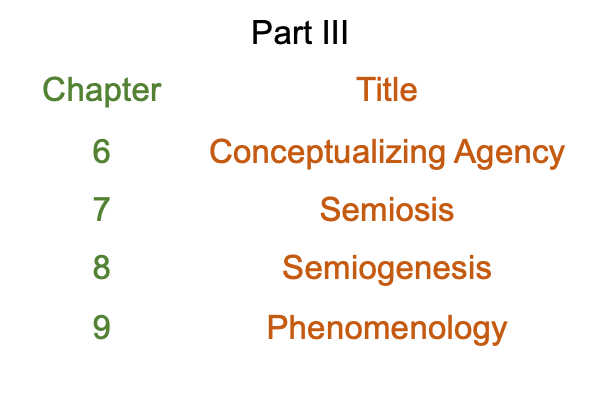
Here is a list of the chapters, along with their titles.

Each title labels a labor of biosemioticians.

0202 So far, from Part I, Sharov and Tonnessen propose a philosophical dyad that serves as an overlay for the noumenon of biosemiotics.  The authors’ proposed noumenon constitutes what is for the Positivist’s judgment and contains what all biosemiotic phenomena have in common.

This is significant.

0203 The Positivist’s judgment is constructed, starting in the 1600s, by mechanical philosophers.  Mechanical philosophers aim to bracket out metaphysics, in favor of models based on observations and measurements.

So, what is science?

0204 Comments on Jacques Maritain’s Book (1935) “Natural Philosophy” shows that the scholastic ideation of three styles of abstraction comes close to a satisfying answer.  But, no one can capitalize on that answer until a hidden knot is unraveled.  A knot?  Two judgments are entangled.  This becomes clear when the abstractions are pictured as elements of judgment.

0205 The following diagram of the Positivist’s judgment is a satisfying way to portray what the mechanical philosophers created in the 1600s and what Kant corrected in the late 1700s.

In 2025, no definition of science compares to this diagram.

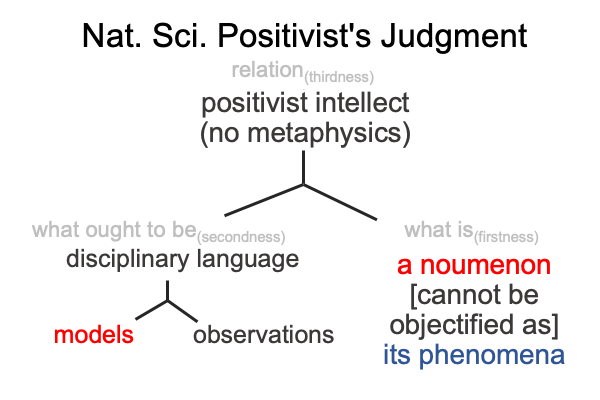
0206 In the Positivist’s judgment, the positive intellect (relation, thirdness) brings the empirio-schematic judgment (what ought to be, secondness) into relation with the dyad, a noumenon [cannot be objectified as] its phenomena (what is, firstness).

In the empirio-schematic judgment, disciplinary language (relation, thirdness) brings mathematical and mechanical models (what ought to be, secondness) into relation with observations and measurements of phenomena (what is,firstness).

0207 Immanuel Kant (1724-1804) forces natural scientists to concede that they investigate the observable and measurable facets of the thing itself.   Plus, their observations and measurements cannot fully objectify the subject of inquiry.

0208 Over the next two centuries (1800s and 1900s),  scientists promote their successful models, saying, “Our models are more illuminating than the thing itself.  Indeed, our models can take the place of the noumenon.  Once that happens, then our models can be objectified by their phenomena.  Observations and measurements validate the successful model.”

The academic laboratory sciences are born.  For example, a chemistry laboratory and its accompanying lecture belong to the laboratory science of chemistry.  In contrast, the science of chemistry is the study of natural processes, that is, things themselves.  The key to science is to make an observation and then explain it.  The model is an explanation, rather than the thing itself.

01/2/25

Is Biosemiotics Scientific? (Part 4 of 4)

0222 With that said, here is a quick wrap-up of the four chapters in Part III.

For chapter six, Sharov and Tonnessen’s noumenal overlay conceptualizes semiotic agency.

For chapter seven, semiotic agency is considered an actuality2.  In order to understand an actuality2, the actuality2 must have a normal context3 and potential1.

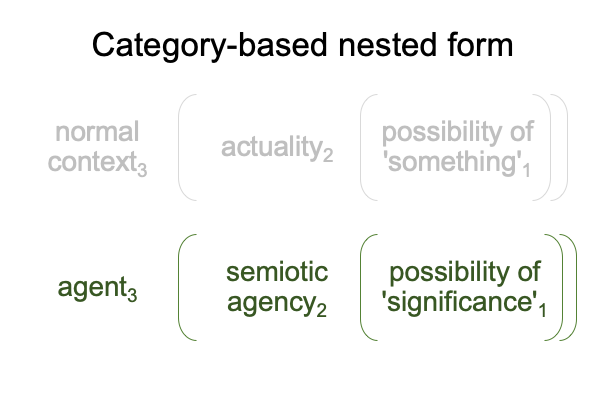
0223 Here is the nested form for semiotic agency2.

Semiotic agency2 presents a sign-relation as a dyadic actuality.  This is shown in Part I.

Semiosis2 does not occur without an agent3 and the possibility of ‘significance’1.

0224 For chapter eight, the evolution of agents3 and the possibility of ‘significance’1 proceeds in tandem with the evolution of semiotic agency2.

0225 For chapter nine, phenomenology serves as a precursor to biosemiotics, just as the social sciences of the nineteenth and twentieth centuries serve as intimations of phenomenology.

0226 Without a doubt, Sharov and Tonnessen build upon the insights of philosophers writing a century earlier, as seen in two of Razie Mah’s e-books: Comments on Jacques Maritain’s Book (1935) Natural Philosophy and Comments on Nicholas Berdyaev’s Book (1939) Spirit and Reality.  Both Maritain and Berdyaev are interested in understanding the nature of scientific inquiry.  And now, their works inform biosemioticians.

03/23/22

Looking at Jack Reynolds’ Book (2018) “Phenomenology, Naturalism and Science” (Part 1 of 3)

0001 Jack Reynolds, Professor in Arts and Education at Deakin University, publishes a book with the subtitle, “A Hybrid and Heretical Proposal”.  The book concerns two views that seem to resist hybridization: phenomenology and naturalism.  Why?  Does each regard the other as heretical?

Plus, where does that leave science?

Hmmm.

0002 Razie Mah examines Reynolds’ book in Comments on Jack Reynolds’ Book (2018) “Phenomenology, Naturalism and Science”, available at smashwords and other e-book vendors.  The commentary is part of a series, “Phenomenology and the Positivist Intellect”.

0003 Phenomenology has an awkward relationship with science.  It situates hands-on natural science.  Yet, it competes for that role with visionary science.

Visionary science takes what is most precious to practicing scientists, the empirio-schematic judgment, and unfolds it into a situation-level nested form.  

Phenomenology competes with and excludes visionary science.

0004 Consequently, phenomenologists and visionary scientists despise one another.

Both work to situate hands-on natural science, represented as a content-level nested form.

Each offers its own situation-level nested form.

0005 Perhaps, this is why Reynolds’ proposal directs attention away from the point of contention.

Hands-on science is naturalism.  Hands-on science may be portrayed as the unfolding of the Positivist’s judgment into the content-level of an interscope.

Phenomenology and visionary science situate first-order natural science in very different ways.

0006 Phenomenology wants to consider phenomena in order to elucidate what the thing itself must be.

Visionary science wants to take an established scientific model and coronate it as what the thing itself must be.

03/22/22

Looking at Jack Reynolds’ Book (2018) “Phenomenology, Naturalism and Science” (Part 2 of 3)

0007 There is something funny about the last blog.

Phenomenology3b virtually situates hands-on natural science3a by bracketing out the empirio-schematic judgment2a and asking phenomena, “What must the noumenon1a be1b?”

Visionary science2b virtually situates hands-on natural science3a by unfolding the empirio-schematic judgment2a into a situation-level nested form, where the normal context of disciplinary language3b brings the actuality of mathematical and mechanicals models2b into relation with the potential of observations and measurements1b.

0008 Phenomenology3b faces the delicate task of framing its identification of what the noumenon1a must be1b without using metaphysical terms.  Why?  The content-level normal context, the positivist intellect3a has a rule that says, “Metaphysics is not allowed.”

What else is not allowed?

Common sense.

0009 Visionary science3b says that the model2b is what the noumenon1a must be2b.  The goal is to replace the thing itself1a.

For example, a bird in flight1a flaps its wings1a.

The bird in flight is a noumenon, a thing itself1a.  The flapping-wings are phenomena1a, observable and measurable facets of the thing itself1a.  The idea2a that the flapping wings resist gravity models2a the resulting observations and measurements2a.  Plus, the idea2a must be properly configured according to the disciplinary language of physics2a.  Gravity is part of that model.

0010 The visionary scientist then boldy situates the above example as a facet of this grand law2b, the law of gravity2b, which determines laboratory observations of birds in flight1b, and therefore becomes the thing itself1a(2b).  Now, birds in flight1a are phenomena1a that objectify what the noumenon1a must be2b (that is, gravity2b.)

0011 The phenomenologist takes a completely different path, using phenomenological reduction2b to bracket out the empirio-schematic judgment2a in order to intuitively assess what the noumenon1a must be1b.  This is how Husserl returns to the noumenon1b.

Ideally (or I should say, “transcendentally”) phenomenological reduction2b regards phenomena1a, the observable and measurable facets1a of the thing itself1a, without science-work2a in mind at all (except for the positivist intellect3a saying, “No metaphysics.”).

0012 Try the exercise.  Imagine the flapping-wings business, not as a way to resist gravity, but as a way to use something in order to survive.  Oh, bracket out even that.  What do the flapping wings, the tucked in feet, and the determination of the bird say to me?  The bird in flight is embodied, enactive, enchanting and entertaining.  Now, fix the consciousness in order to identify what the noumenon1a must be1b.

Does the word, “sail”, come to mind.

Wings are to birds as sails are to boats?

0012 As soon as wings are sails, then the phenomenologist walks out of the room and the hands-on natural scientist says, “Hey, did you hear that?  What an excellent idea.  Let us model the phenomena of flapping wings as sails, instead of things that resist gravity.”

0013 Meanwhile, some visionary scientist stands at a podium, accepting an award for A Visionary Application of Science,from the Academy of Important and Tenured Figureheads, for his declaration that gravity is a noumenon1a(2b) and birds in flight are its phenomena1a.

03/21/22

Looking at Jack Reynolds’ Book (2018) “Phenomenology, Naturalism and Science” (Part 3 of 3)

0013 Comments on Jack Reynolds’ Book (2018) “Phenomenology, Naturalism and Science”, is available at smashwords and other e-book venues.
How do I find the work?

Search for Razie Mah and the series, Phenomenology and the Positivist Intellect.

Here are some lessons.

Visionary science virtually situates hands-on natural science.

Phenomenology virtually situates hands-on natural science.

Phenomenology and visionary science are at odds.

Phenomenology hinders visionary science from completing its self-anointed task.

There is something funny, dramatic, and wonderful about the insights that phenomenology offers.

The category-based nested form and the triadic structure of judgment allow the inquirer to explore Peircean implications of Jack Reynolds’ book.  What a tale these implications tell.

09/30/21

Looking at Joseph Trabbic’s Essay (2021) “Jean Luc-Marion and … First Philosophy” (Part 1 of 5)

0001 Joseph Trabbic’s essay appears in the American Catholic Philosophical Quarterly (volume 95(3), pages 389-409).  This is the second article on phenomenology to attract attention.  The full title is “Jean Luc-Marion and the Phenomenologie de la Donation as First Philosophy”.

Jean-Luc Marion is a French phenomenologist who attempts to put Husserl’s paradigm into perspective.  His book is published 25 years ago.  It still confounds readers.

Trabbic performs admirably in trying to decipher both the French language and the book.

0002 There is a lot to unpack, especially since science is not mentioned at all.

I wonder what Husserl is up to when he calls for a return to the noumenon?

Perhaps, scientists focus so much on phenomena that they neglect the thing itself.

0003 This is the lesson formulated in Reverie on Mark Spencer’s Essay (2021) “The Many Phenomenology Reductions”(available for purchase at smashwords).  Spencer also publishes in the American Catholic Philosophical Quarterly.  The full title of Spencer’s article is “The Many Phenomenological Reductions and Catholic Metaphysical Anti-Reductionism”.

Spencer mentions Jean-Luc Marion, along with many other phenomenologists.

It is like going through an old jewelry box.

Jean-Luc Marion sparkles.

0004 Comments on Joseph Trabbic’s Essay (2021) “Jean Luc Marion and … First Philosophy” (also available at smashwords) builds upon this reverie.

Why does Jean-Luc Marion catch the eye?

09/29/21

Looking at Joseph Trabbic’s Essay (2021) “Jean Luc-Marion and … First Philosophy” (Part 2 of 5)

0006 Trabbic’s approach to Jean Luc-Marion’s masterwork, The Phenomenology of Givenness, is curious.

Trabbic precisely executes a style that is rarely used in contemporary works.

He asks us to recognize a possibility (that seems to be impossible).

0007 First, the reader must recognize that there are phenomena, rather than nothing.  Things themselves are simply given.

Second, the reader must recognize that givenness implies a gift with no giver and no recipient.

0008 Trabbic’s construction leads the reader up the staircase of one and down the staircase of two.

The literary structure is beautiful to behold.

09/28/21

Looking at Joseph Trabbic’s Essay (2021) “Jean Luc-Marion and … First Philosophy” (Part 3 of 5)

0009 The following looks like a hylomorphe, but it does not belong to the realm of actuality.

Figure 1

0010 This dyad expresses what is in the Positivist’s judgment.

The Positivist’s judgment constitutes the second first philosophy, arising and ruling out the first first philosophy.

0011 What is a first philosophy?

A first philosophy addresses the question, “Why is there something rather than nothing?”

This is the first question that every philosophy must confront.

0012 Many prefer to skip to the next question, “What is ‘something’?”

The first first philosophy, as practiced by scholastics of the Latin Age, says, “It must be the things of God and of everyday life.”

The second first philosophy, modern science, says, “No, it must be phenomena, the observable and measurable facets of things.”

The third first philosophy, Husserl’s phenomenology, says, “We must return to the noumenon, the thing itself, and figure out what the noumenon must be.”

But, is the thing itself the same as what the thing itself must be?0013 Here is where Jean-Luc Marion enters the picture and says, “A fourth first philosophy should place Husserl’s situating of science into perspective, by addressing the question, ‘Why are there noumena, rather than nothing?’.”

09/27/21

Looking at Joseph Trabbic’s Essay (2021) “Jean Luc-Marion and … First Philosophy” (Part 4 of 5)

0014 Ah, phenomenology situates empirical science.

This is one lesson found in Reverie on Mark Spencer’s Essay (2021) “The Many Phenomenology Reductions” (available for purchase at smashwords).

0015 Givenness puts phenomenology into perspective.

This statement stands at the heart of Comments on Joseph Trabbic’s Essay (2021) “Jean Luc Marion and … First Philosophy” (also available at smashwords).

0016 Yet, neither Spencer nor Trabbic mention science.