1294 Biosemiotics is born out of the tradition of phenomenology.
Biosemiotics explains of how phenomenology works in light of modern biology.
In Semiotic Agency (7821 U0′), Alexei Sharov and Morten Tonnessen effectively propose the first step of a biosemiotic noumenal overlay. Alexei Sharov and George Mikhailovsky complete the overlay in 7824 with Pathways to the Origin and Evolution of Meanings in the Universe.
The biosemiotic noumenal overlay consists in semiotic agency and the interventional sign-relation.
1295 The examination of these works has proceeded in Razie Mah’s blogs since the start of January, 2025. The examination is not exhaustive. But, it has been revealing. These blogs will be collected into four books, titled Biosemiotics as Noumenon (by Razie Mah, available at smashwords and other e-book venues).
Of course, Razie Mah has been writing and blogging on semiotic topics for over a decade. The blog may be found at Razie Mah’s website. E-articles and e-books for sale are available at smashwords and other e-book venues. These works are placed in series for convenience. A full table of contents for e-works and the blog should be available by the end of the year.
Meanwhile, a few suggestions for further research follow.
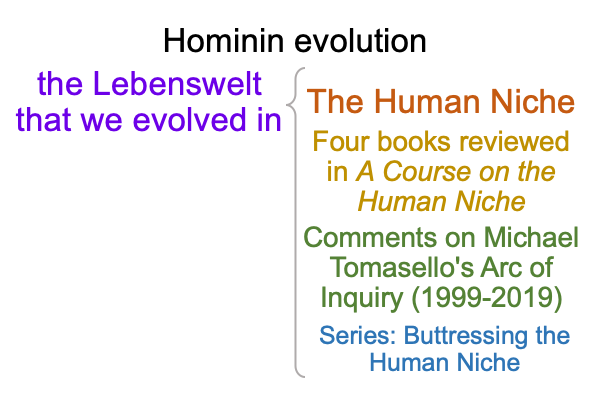
1296 For the Lebenswelt that we evolved in, the following should be of interest.
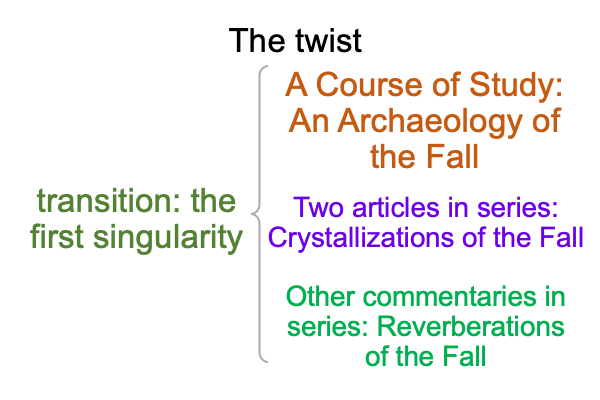
1297 For the twist in human evolution, the following applies.
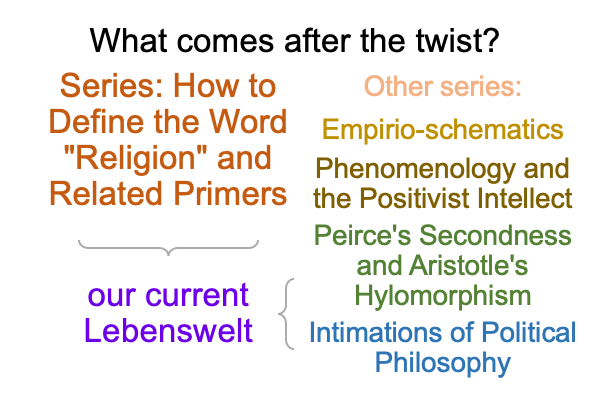
1297 For our current Lebenswelt, there are many threads to follow.
1299 All these works pertain to chapter three of Semiotic Agency, titled “Human Agency”.
They show what biosemiotics can do.
1300 My thanks to Alexei Sharov, Morten Tonnessen and George Mikhailovsky, as well as the many contributors to Pathways, for interesting material to examine. As noted elsewhere, all the material in these examinations, as well as in Biosemiotics as Noumenon, are available to these authors and contributors to use in their efforts to build biosemiotics as a specialization… or… maybe I should say… a “noumenalization” of what all biological processes have in common.
0829 I have, under examination, two texts that bring the inquirer to the door of a truly postmodern discipline of biosemiotics.
0830 The first book is Semiotic Agency: Science Beyond Mechanism, by biosemioticians Alexei Sharov and Morten Tonnessen. The book is published in 2021 by Springer (Switzerland) and logs in at volume 25 of Springer’s Series in Biosemiotics. Series editors are Kalevi Kull, Alexei Sharov, Claude Emmeche and Donald Favareau. These authors and editors have Razie Mah’s permission for use of the continuing disquisition, with attribution of said blogger.
0831 The second book before me is Pathways to the Origin and Evolution of Meanings in the Universe, edited by Alexei Sharov and George Mikhailovsky. Each chapter has its own author(s). The book is published in 2024 by Scrivener Press (Beverly, MA) and logs in as volume 1 in Scrivener’s Series on Astrobiology Perspectives on Life in the Universe. Series editors are Martin Scrivener and Phillip Carmical. Chapter authors and book editors have Razie Mah’s permission for use of the continuing disquisition, with attribution of said blogger.
0832 If biosemiotics is postmodern and scientific, what is modern and scientific?
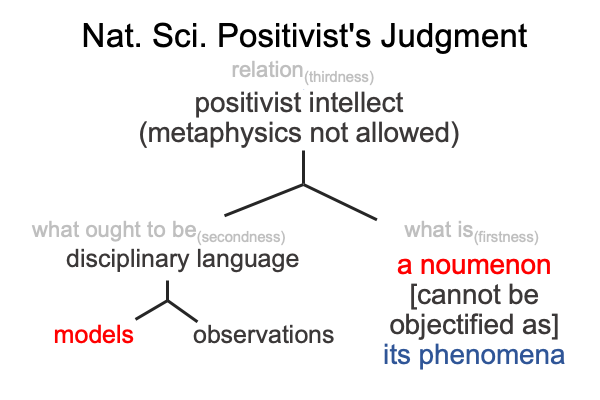
The modern natural sciences (physics, chemistry, in their diverse applications) and the modern social sciences (including sociology, psychology, anthropology and other, various specialties) conduct empirio-schematic inquires, under the auspices of the Positivist’s judgment.
Here is a picture of the fully modern Positivist’s judgment.
0833 The empirio-schematic judgment occupies the slot for what ought to be and is imbued with secondness (the realm of actuality).
In the empirio-schematic judgment, disciplinary language (relation, thirdness) brings mathematical and mechanical models (what ought to be, secondness) into relation with observations and measurements of phenomena (what is,firstness).
0834 In the following points, I re-capitulate the argument in points 0201 through 0226.
0835 Notice that biology is not listed above.
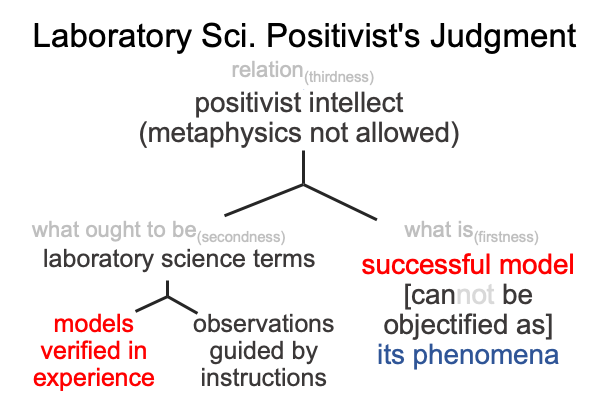
In some ways, biology goes into the same basket as physics and chemistry, in which the noumenon is obvious. The noumenon is so obvious that triumphalist scientists get around Kant’s slogan (occupying the slot for what is) by substituting a successful model in for the noumenon. Then, a successful model (as the new noumenon) [can be objectified as] its phenomena. This is the character of the laboratory sciences in chemistry, physics and biology.
Here is a picture.
0836 The modern social sciences develop in the same century as the laboratory sciences.
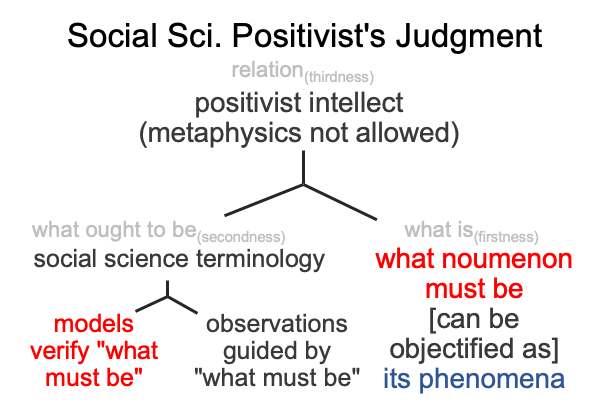
One advantage of laboratory science is that a successful model does not completely occlude its noumenon. The social sciences do not have that advantage. Instead, social scientists observe phenomena with the expectation that there must be a noumenon.
Say what?
0837 The modern social sciences pull their noumena out of their asses and then develop an empirio-schematic charade that substantiates their intuition (that is, their guess of what the noumenon must be.
Here is a picture.
0838 The hocus-pocus of modern social science seems tawdry, at first, but then Edmund Husserl formalizes the process of assessingwhat the noumenon must be.
Husserl’s phenomenology is so well-targeted that contemporary social scientists blame his followers for pulling noumena out of their asses, then go about claiming that their non-phenomenological assessments of what the noumenon must be are far better, because they are guided by observations and models.
0839 Ahem, let me get this straight.
Phenomenologists use a clearly delineated methodology to determine what the noumenon must be, thereby supporting novel empirical inquiry.
Social scientists…
0840 Stop! My academic audience is agitated.
A highly credentialed sociologist yells, “Hey, you have that wrong!”
“Phenomenologists pull what the noumenon must be out of their asses.”
“Modern social scientists allow data and models to speak for themselves.”
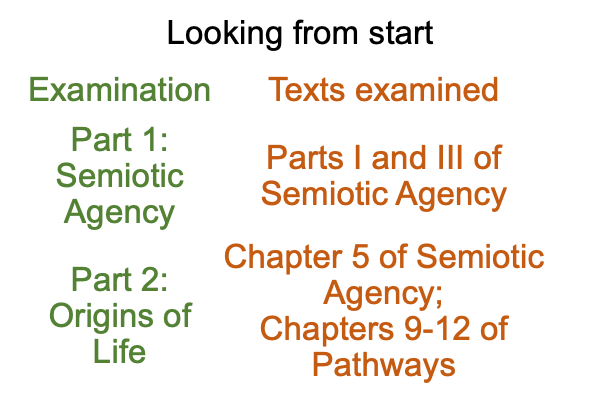
The current examination looks at two books, described in point 0830 and 0831..
Here is how the examination starts.
These two examinations are available as e-books, by Razie Mah, under the title, Biosemiotics as Noumenon, Parts 1 and 2. Part 1 is subtitled, “Semiotic Agency”. Part 2 is subtitles, “Origins of Life”.
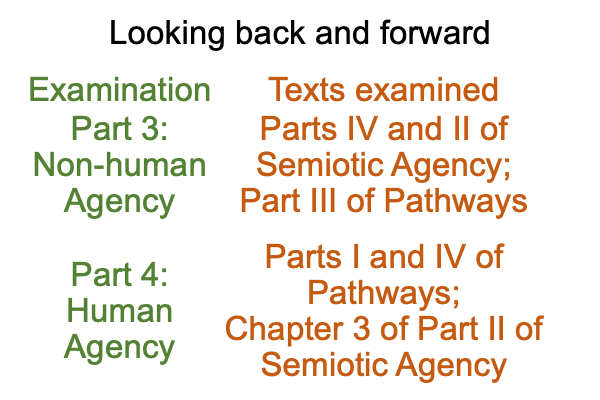
0864 Part 3 concerns nonhuman agency. This examination is completed.
Part 4, concerning human agency, remains.
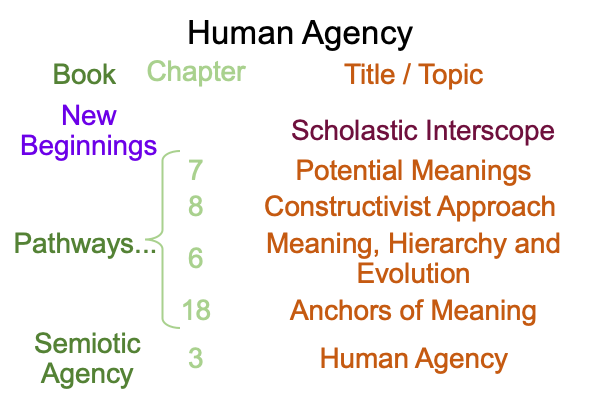
0865 The reading list for Part 4 starts with a discussion of Comments on John Deely’s Book (1994) “New Beginnings”, by Razie Mah. The commentary is available at smashwords and other e-book venues.
There is cause for this.
0866 The STI noumenal overlay (Sharov and Tonnessen’s semiotic agency along with the interventional sign-relation) not only explains why phenomenology works, but it also recovers some philosophical riches of the much-derided scholastic era. Modern histories of philosophy during the twentieth century often omit the period from the 500s to the 1400s, corresponding to the birth and development of universities throughout Christendom. Some call the period, “the dark ages”.
It is sort of like the way modern social sciences pooh-pooh phenomenology.
Academic turf must be protected. Who is more important, an expert in modern analytic philosophy or a so-called schoolman who can explicate Saint Thomas Aquinas?
0867 One of those treasures is uncovered by John Deely (1942-2017). Deely is both a Thomist and a semiotician (in the tradition of Charles Peirce). Deely figures out that Charles Peirce (in the 1800s) arrives at the same definition of the sign-relation as Baroque scholastic, John Poinsot (also John of St. Thomas, in the 1600s).
This discovery is discussed in New Beginnings. But, it is not the only surprise.
0868 What is of interest to me, in this examination of biosemiotics, is the fact that the specifying and exemplar sign-relations are embedded in a three-level interscope composed of category-based nested forms, which I call, the scholastic interscope for how humans think.
The reason is obvious. Semiotic agency2 is a reification of the specifying and exemplar sign-relations.
0869 So, the trajectory of this examination proceeds by way of the following script.
0870 So, this juncture between non-human agency and human agency ends and the examinations continue.
0871 The scholastic three-level interscope for how humans think is introduced in Comments on John Deely’s Book (1994) New Beginnings (by Razie Mah, available at smashwords and other e-book venues).
The conceptual apparatus is developed in A Primer on the Category-Based Nested Form and A Primer on Sensible and Social Construction.
The semiotic tool is productively used in Looking at John Deely’s Book (2010) “Semiotic Animal” (appearing in July 2024 in Razie Mah’s blog).
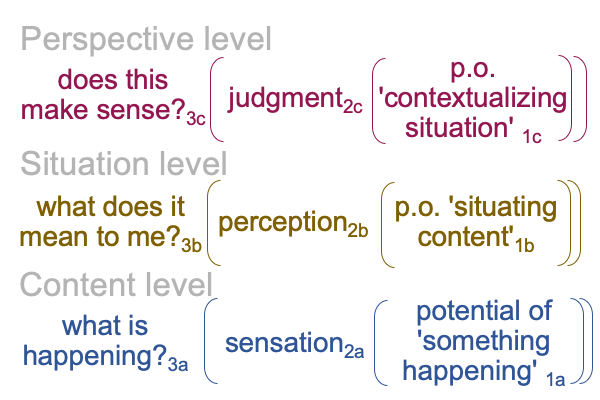
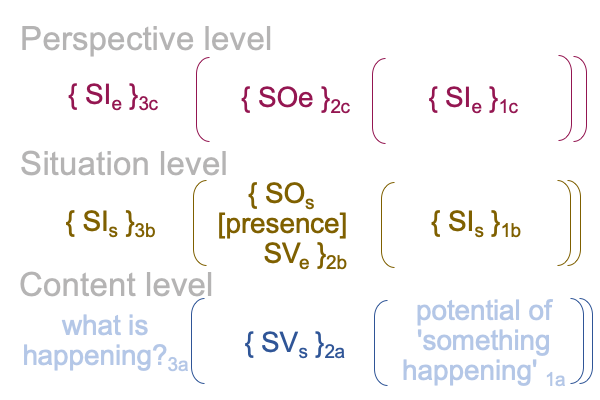
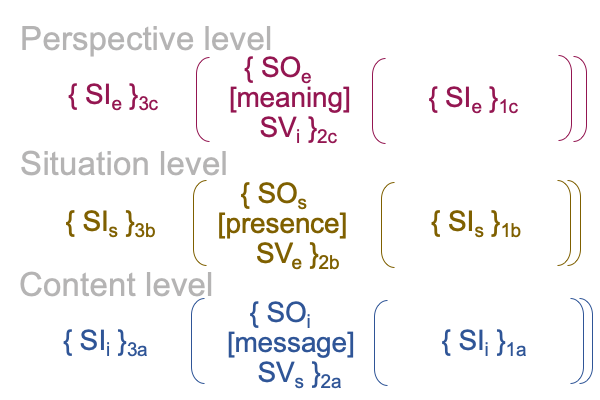
0872 Here is a diagram.
0873 The three-level interscope is a category-based nested form composed of category-based nested forms.
For each level, a triadic normal context3 brings a dyadic actuality2 into relation with a monadic possibility of ‘something’1.
Among levels, perspectivec brings situationb into relation with contenta. Likewise, thirdness brings secondness into relation with firstness.
0874 Here is how each nested form is articulated.
On the content level, the normal context of what is happening3a brings the actuality of sensation2a into relation with the potential of ‘something happening’1a.
On the situation level, the normal context of what it means to me3b brings the actuality of perception2binto relation with the possibility of ‘situating content’1b.
On the perspective level, the normal context of whether this makes sense3c brings the actuality of a judgment2c into relation with the possibility of ‘contextualizing the situation’1c.
0874 Notice that the actualities are not portrayed as dyads. When they are, the scholastic interscope becomes more… well… beautiful. And, biosemioticians must be careful when a transcendental manifests, like a beautiful painting at the end of a hallway. There is no telling where that hallway leads.
0875 What about biosemiotics?
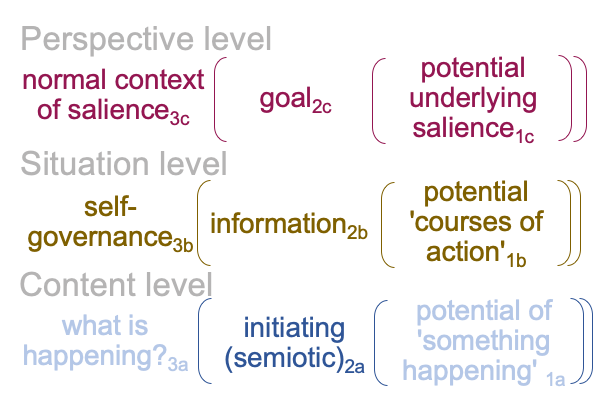
Elements of Sharov and Tonnessen’s noumenal overlay fit nicely into various slots in the scholastic interscope.
0876 Can I discern a specifying sign-relation?
Here, the initiating (semiotic)2a is a real event2a.
Information2b virtually situates the initiating semiotic2a, in the same way that a specifying sign-object (SOs) virtually situates its sign-vehicle (SVs).
Notice that both SOs and SVs belong to the realm of actuality.
0877 A specifying sign-interpretant (SIs) enables the SVs to stand for its SOs.
What is that SIs?
SIs consists of the situation-level normal context3b operating on its possibility1b.
In this instance, SIs is the normal context of self-governance3b operating on potential ‘courses of action’1b.
0878 I can go further.
I can imagine the exemplar sign-relation.
0879 A perspective-level goal2c virtually contextualizes situation-level information2b, in the same way that an exemplar sign-object (SOe) virtually contextualizes its sign-vehicle (SVe).
Both SOe and SVe belong to the realm of actuality.
0880 An exemplar sign-interpretant (SIe) enables the SVe to stand for its SOe.
What is that SIe?
This is where the scholastic interscope for how humans think comes in handy.
For semiotic agency, the SIe is vague. The normal context of salience3c operates on a potential underlying salience1c. I suppose the potential1c is ‘the possibility1c of contextualizing information2b‘, if that helps.
For the scholastic interscope, the normal context asking, “Does this make sense?”3c operates on the possibility of ‘contextualizing the situation’1c.
0881 To me, this implies that the term, “salience3c((1c))“, supports an actuality2c that weighs perception2b against sensation2a, while asking what goal2c might be attempted.
What does that imply?
0882 The scholastic interscope contains the specifying and exemplar sign relations, which figure so prominently in semiotic agency.
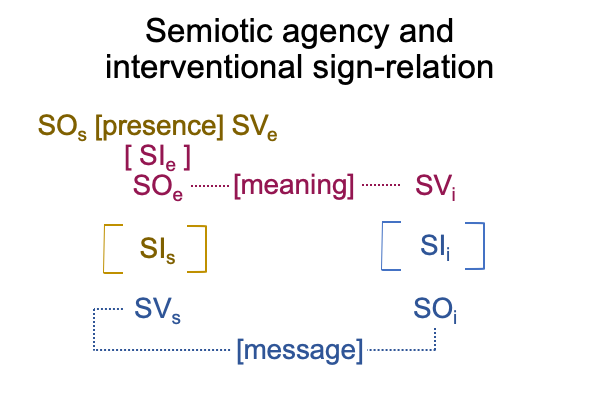
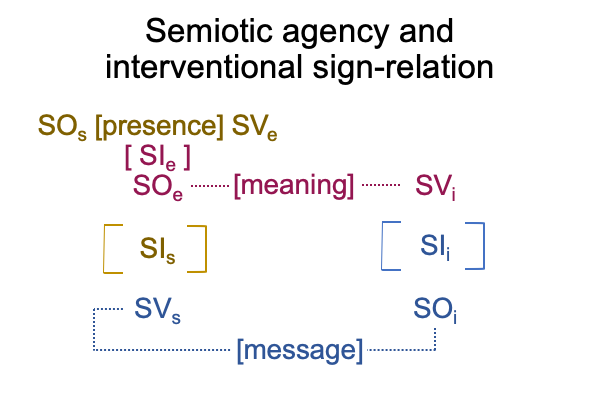
0895 So, I have a working definition of [meaning], as a judgment2c (SOs) unfolding into a category-based nested form2c (SVi).
Also, from point 0862, I have a working definition of [message], as the continuity between an expression of intention (SOi) and an initiating (semiotic) event (SVs). Plus, the initiating (semiotic) event2a (SVs) is not the same as the event that occurs after judgment2c unfolds into an action2c (SVi).
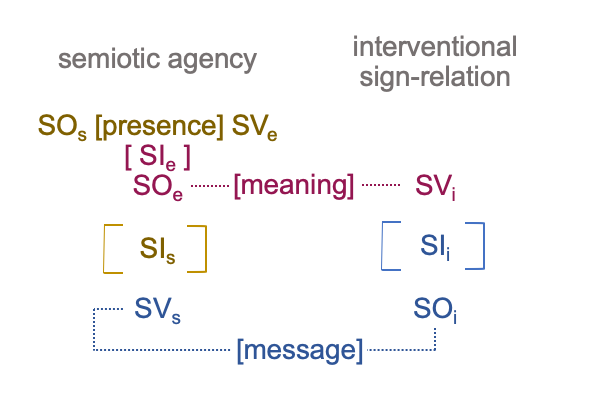
0896 Here is a picture of the interventional sign, along with its contiguities.
0897 These contiguities turn out to be the connections between semiotic agency and the interventional sign-relation.
This is shown clearly in the biosemiotic (or STI) noumenal overlay.
In sum, the scholastic interscope for how humans think assists in appreciating the nature of the biosemiotic noumenal overlay.
The scholastic interscope contains three boundary-crossing sign relations. Two belong to semiotic agency. One belongs to the interventional sign-relation.
The scholastic interscope also contains three contiguities between sign-relations. These correspond to content-level [message], situation-level [presence] and perspective-level [meaning].
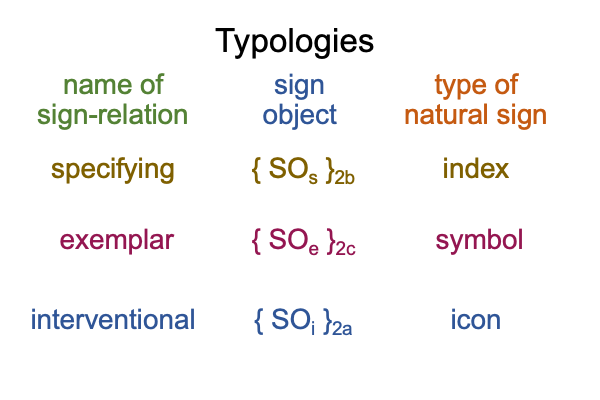
0898 Finally, there is Peirce’s natural sign typology, consisting of icons, indexes and symbols.
An icon is a sign-relation, whose sign-object is based on the qualities of images, pictures, unities, monads and so forth.
An index is a sign-relation, whose sign-object is based on the characteristics of pointing, contact, cause and effect, and other dyads.
A symbol is a sign-relation, whose sign-object is based on the stuff of habit, convention, law, agreement, and so on.
0899 I conclude with a list of the sign-relations that are embedded in the scholastic interscope for how humans think,along with the sign-object and type of natural sign.
0900 This information should prove handy in the upcoming examination of human agency.
0901 The text before me is chapter seven of Pathways (see point 0831 for book details, pages 137-166).
Examinations of the chapters on non-human agency end up with a suggestion that biosemiotics may include more than semiotic agency. Semiotic agency contains the specifying and exemplar sign-relations. The scholastic interscope for how humans think contains one other sign-relation. The interventional sign-relation is odd, compared to the other two sign-relations.
So is the author’s term, “potential meanings”.
0902 Of course, the terms, “interventional sign-relation” and “potential meanings” are mere labels. They are tags. They are spoken words. They are unlike the manual-brachial word-gestures of fully linguistic hand or hand-speech talk.
For hand talk, in terms of parole, gesture-words picture and point to their referents. They are icons and indexes. So, word-gestures (SVs) abstract the natural sign-qualities of these types of signs. Icons and indexes picture and point to ‘something that could be present’ (SOs). Presence (SVe) can have many meanings, depending on what is going on. Consequently, SOe is an intuitive abstraction based on what the word-gesture implicitly pictures and points to(langue). I call the process, “implicit abstraction”.
For example, the hand-talk word, [image RAVEN], can denote the color black, as well as particular attitudes.
The hand-talk word, [POINT to corner of eye], can denote the color white, as well as particular attitudes and warnings.
0903 Can the term, “potential meaning” be stated using hand-talk?
No. What is there to picture or point to?
The term is an explicit abstraction.
0904 In speech-alone talk, parole is arbitrarily related to langue.
Since parole comes first, as SVs, the specified referent (SOs) comes into being after a word is spoken. After all, SVsassociates to message and message precedes presence (SOs). The specified referent (SOs) associates to information2b. But, since speech-talk cannot picture or point to anything, that information2b (SOs) may end up being explicitly defined.
0905 I say “may”, because sometimes information2b is obvious. Consider the word, “chair”. Everyone immediately intuits a “chair”, even though chairs do not occur in nature. But, what about the American bureaucratic designation, “chair-person”?
Sit down for a minute and think about it.
How can a person be a chair?
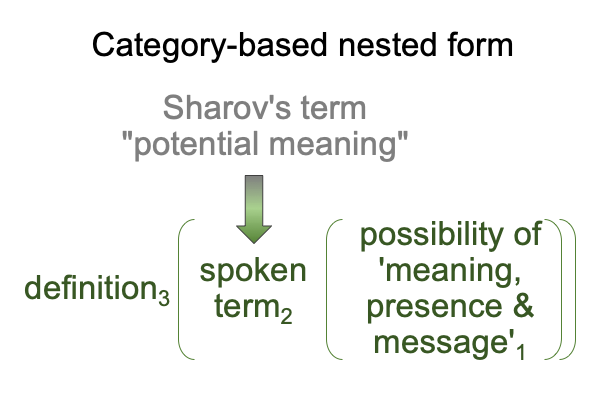
0906 Sharov’s technical term, “potential meaning” has two descriptors made into one character. So, one way to approach the term is to step back and consider the initial claim made in Razie Mah’s e-book, How To Define The Word “Religion” (available at smashwords and other e-book venues). The normal context of definition3 brings the actuality of a spoken term2 into relation with the potential of its meaning, presence and message’1.
0907 Surely, the reader anticipates my next move.
The words that go into the slot for potential1 are familiar.
Not only do they1 underlie the actuality of a spoken term2, they1 have already been used to label the three intra-level contiguities that occur in the biosemiotic noumenal overlay.
0908 Here is a picture.
Since [meaning] is the one contiguity that associates to “meaning”, [presence] and [message] must associate to the qualifier, “potential”
0975 In the closing, section 7.8, the author mentions a confounding word.
0976 What is that word?
Communication.
0978 Well, at least I can offer two other labels, “inter” and “infold”, which apply when the message comes externally or internally.
I don’t think that either “inter” or “infold” correspond to “communicate”.
And yet, they must.
0979 To this examiner, the conceptual apparatuses of potential meanings and potential signs entangle two features of the biosemiotic noumenal overlay, [presence] and [message]. “Potential meaning” dwells within [presence] and seems integral when an SOs “causes” an SVe. “Potential sign” dwells within [message] and seems crucial to two types of contiguity between SOi and SVs, [inter] and [infold].
0980 By way of conclusion for this chapter, which harkens back to the beginnings of life on Earth, yet ends with humans in our current Lebenswelt, I would like to repeat the transformation that Sharov and Tonnessen perform(perhaps, unwittingly, but leading to great insight) in Semiotic Agency. They transform the specifying and the exemplar sign relations into a dyad, suitable to overlay over the noumenon of what all living systems have in common.
0981 Specifically, they transform a fairly mature three-level interscope (comparable to the scholastic interscope for how humans think) into a dyad (matter2b [salience] form2c}) within a dyad (matter2c(2b( [self-governance3b: courses of action1b] form(2a))).
0982 Now, I review.
But, this will be more than a review.
I want to re-enact Sharov and Tonnessen’s construction of semiotic agency.
Plus, I want to add a reification of the interventional sign-relation, which completes the biosemiotic noumenal overlay.
0983 And most of all, I wish to perform this transformation and this re-enactment on the Deacon and Tabaczek interscope for emergence, appearing in Comments on Mariusz Tabaczek’s Arc of Inquiry (2019-2024) (by Razie Mah, available at smashwords and other e-book venues) and in the Razie Mah’s blogs for April through June, 2024.
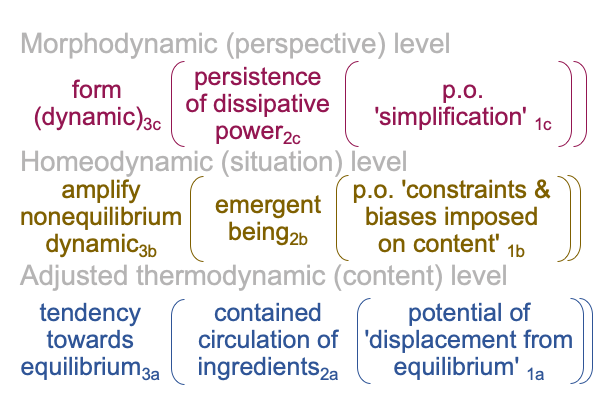
0984 Here is a diagram of the three-level interscope for emergence.
0985 The element corresponding to the biosemiotic real initiating (semiotic) event is “the contained circulation of ingredients2a“.
For mitochondria, this is the separation of oxidative and reductive reactions involved in the combustion of glucose with oxygen. On the oxidative side, glucose loses electrons to biomolecules capable of carrying them, generating a few ATP equivalents in the process. On the reductive side, oxygen gains electrons from those electron-bearing biomolecules, generating lots of ATP equivalents in the process.
0986 The combustion of glucose with oxygen is disposed to move towards equilibrium3a and, when ignited1a, may do so with the release of lots of heat.
Mitochondria do not allow ignition. Rather, they use the separation of the oxidative and reductive reactions1b in the normal context of utilizing the nonequilibrium dynamics (of what would be combustion)3b in order to generate emergent beings, ATP2b. ATP2b then makes its way from mitochondria to various enzymatic sites in the eukaryotic cell.
ATP2b is a high-energy molecule and will decompose if left alone. So, an enzyme3c that has the potential of using ATP2b “simplifies1c” the situation, by using the energy-released when ATP becomes ADP plus Pi (inorganic phosphate in solution) in order to perform a cellular actions2c, such as building a protein2c or transporting a molecule across a membrane2c.
0987 Back to the diagram.
The content-level category-based nested form for mitochondria “burning” glucose and oxygen follows. The normal context of combustion3a brings the actuality of separated oxidation and reduction reactions2a into relation with the potential of ‘conducting these spontaneous reactions separately’1a.
For the situation level, the normal context of taking advantage of a nonequilibrium dynamic3b brings actual biosynthesis of ATP2b into relation with the agent’s ability to transfer free-energy from the oxidation of glucose and the reduction of oxygen to the emergent being1b.
For the perspective level, the normal contexts of enzymatic forms3c perform various biophysical operations2c based on the potential of coupling the energy-releasing degradation of ATP with an energy-requiring cellular operation1c.
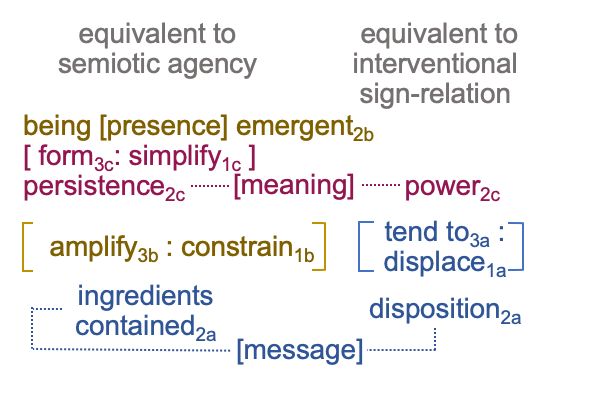
0988 Here is the transformation to a dyad within a dyad coupled to an interventional sign-relation.
On the perspective level, the persistence of an eukaryotic cell2c [means] the power2c to accomplish various biochemical tasks.
For the interventional sign-relation, power2c (SVi) stands for a disposition2a (SOi) in regards to the normal context of chemical reactivities3a operating on the potential to displace chemicals to distinct compartments1a (SIi).
On the content level, the disposition2a to keep the reagents coming2a {(SOi) [message]} adds more new ingredients to the container2a (SVs).
0989 The actualities go with phenomena. These are real elements.
The normal contexts and their respective potentials are what need to be explained. These are the major contiguities between actualities on different levels.
A minor contiguity occurs within each level, [message] for content, [presence] for situation and [meaning] for perspective.
0990 These associations may be subject to revision. That is the nature of exploration into the topic of “potential meanings”.
I thank the author for his well-referenced chapter and hope that this examination adds value to the text.
0991 The text before me is chapter eight of Pathways (see point 0831 for book details, pages 167-185). The full title is “A Constructivist Approach to Meanings in the Universe”. The author is a linguist at Baikal University, Irkutsk, Russia.
0992 My examination, so far, identifies a biosemiotic noumenal overlay, composed of both semiotic agency (the Sharov and Tonnessen noumenal overlay) and the interventional sign relation. The diagram reifies three sign-relations: specifying, exemplar and interventional. The specifying and exemplar sign-relations belong to semiotic agency. The interventional sign relation stands outside of semiotic agency, but is integrated with semiotic agency by way of its participation in a three-level interscope. A three-level interscope contains all three sign-relations.
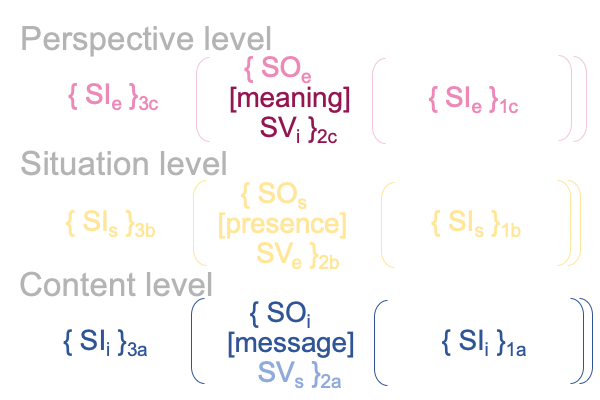
0993 The following figure of an interscope contains the three sign-elements (SV for sign-vehicle; SO for sign-object; SI for sign-interpretant) for each sign-relation (subscripts “s” for specifying; “e” for exemplar; “i” for interventional).
0994 An interscope is a category-based nested form composed of category-based nested forms.
For each level, a triadic normal context3 brings a dyadic actuality2 into relation with a monadic potential1.
The dyadic actuality2 fits Peirce’s formula for the category of secondness. Secondness consists of two contiguous real elements. For clear notation, the contiguity is placed in brackets.
0995 In the above figure, the real elements are sign-vehicles and sign-objects. The contiguity in each level carries the same label as one of the three potentials1 underlying any spoken term2 in the normal context of definition3.
Finally, among levels, perspectivec brings situationb into relation with the potential of contenta.
0996 Hmmm. I have an interruption.
Now, what was I saying?
Uh-oh, I better start over.
0997 My examination, so far, isolates a biosemiotic noumenal overlay, composed of both semiotic agency (the Sharov and Tonnessen noumenal overlay) and the interventional sign relation. The biosemiotic noumenal overlay reifies three sign-relations: specifying, exemplar and interventional. The specifying and exemplar sign-relations belong to semiotic agency. The interventional sign relation stands outside of semiotic agency, but is integrated with semiotic agency by way of two contiguities, [meaning] and [message].
0998 Here is a picture of the biosemiotic noumenal overlay.
0999 So far, so good.
The author of this chapter addresses the existence of meaning in the universe from an epistemological perspective. “Episteme” derives from the Latin word for “knowledge”. “Logos” comes from the Greek word for “word”. Or maybe, “intrinsic nature of”? How about “study of”?
Looking at the above figure, I see a problem.
For this examination, [meaning] is the contiguity between the exemplar sign-object (SOe) and the interventional sign-vehicle (SVi).
Is that the same as “the meaning” that exists in the universe?
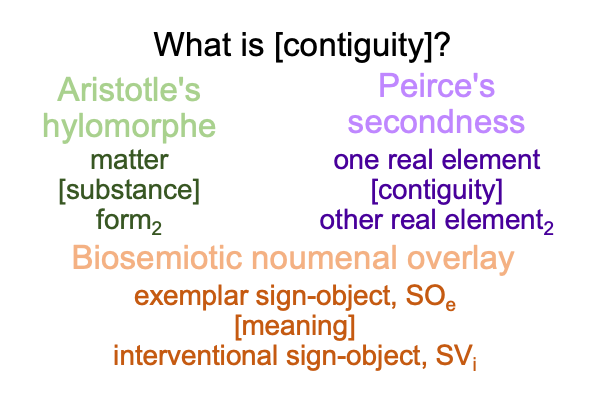
1000 It makes me wonder, “What is a contiguity?”
Here are some cases.
1001 Aristotle’s hylomorphe is exemplar. The much-abused word, “substance”, weirdly captures the way that matter “causes” form. The verb, “substantiates”, is just as effective. Can I justify the choice of the term, “substance”? Well, what is one more technical definition among the many dictionary definitions for the word, “substance”? Is that good enough?
One thing for sure, [substance] is not one of the real elements. [It] is neither matter nor form. [It] is the contiguity between them. So, what is [substance]?
1002 We (humans) know [substance] because we know [cause], [effect], [contact], [influence] and many more contiguities between real elements. This is precisely why contiguities cry out to be modeled. The real elements support phenomena. The contiguities cry out to be explained.
We (humans) also know actuality2. Semiotic agency begins with a real initiating (semiotic) event (SVs) (that is, an encounter). The first step in natural philosophy (for Aristotle’s tradition) is to regard a thing as matter [substance] form. See Comments on Jacques Maritain’s Book (1935) Natural Philosophy (by Razie Mah, available at smashwords and other e-book venues).
Actuality2 belongs to the Peirce’s category of secondness. Secondness consists of two contiguous real elements. Secondness is dyadic.
1003 With this said, I can see why there is a problem with [meaning]. [Meaning] is a contiguity between two real elements. One of those elements (SOe) belongs to semiotic agency. The other element (SVi) belongs to the interventional sign-relation.
1004 Earlier, in points 0887 through 0894, I portray [meaning] as the contiguity between the triadic structure of an actionable judgment (such as SOe) and the triadic structure of its category-based nested form (such as SVi).
In this case, another word for [meaning] is [unfolds].
An actionable judgment [unfolds into] a category-based nested form.
This very curious insight is not explored further in this examination.
SOi is what a disinterested observer would objectify if he were actually on the suprasubjective level, which he obviously claims to be.
So, where is the language game?
Is it in our brains or in our minds?
In section 8.4, the author raises a rather frightening option.
The agent3 may be the human nervous system3 rather than the human person3.
Does the potential of ‘final causality’1 implicate my brain1 or my mind1?
1050 Oh my, does my own brain3 bring forth the actuality of semiotic agency2 with the potential of ‘a final causality, where meaning and message bring forth my mind in an entanglement of the suprasubjective and the subjective (very similar to language and also very similar to the idea that both my Innerwelt and my Umwelt are Outerwelt to my nervous system)’1?
How about Daisy’s mind?
Or the duck’s?
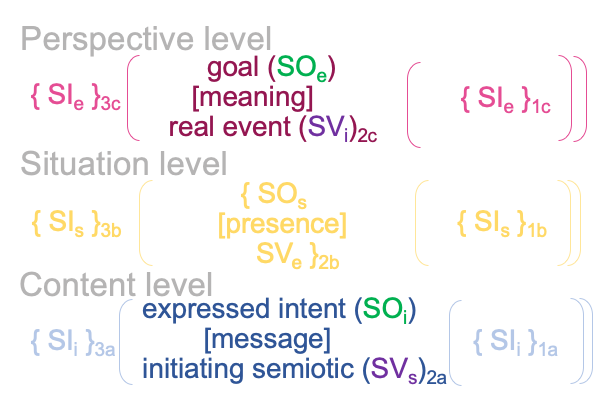
1051 Here is a picture of the semiotic three-level interscope, with descriptive dyadsfor the perspective and content-level actualities displayed.
The colors indicate complementary pairs.
To me, these pairs look like human adaptations into the niche of triadic relations. The human niche includes the potentials of interscopes and sign-relations. The pairs link dyadic actualities on the perspective level and the content level of a three-level interscope. These actualities contain contiguities that bridge the interventional sign-relation and semiotic agency.
1051 If [message] goes with “mind” and if [meaning] goes with the contiguity between two real elements, a goal2c and its expression as a real event2c, I may ask, “Are ‘meaning’ and ‘mind’ brought forth by a… gasp… brain?”
What about “language”?
Or, are mind and meaning organic to the reality that the three-level interscope also contains three sign-relations and the fact that the interventional sign-relation bridges to semiotic agency through the contiguities of [meaning] and [message]?
These are good questions.
1052 Sometimes, it is good to conclude an examination with a few of good questions.
My thanks to the author of this chapter, fully titled, “The Constructivist Approach to Meanings in the Universe”.