06/10/21

Looking at Kirk Kanzelberger’s Essay (2020) “Reality and the Meaning of Evil” (Part 14 of 18)

0056 Kanzelberger lays out the moral theodrama.

The mystery of iniquity starts to unfold when I come up with ‘something’ objective1b, without attention to the rules of reason and the divine law1c.  At first, the objective1b sets aside the suprasubjective1c, by not admitting to the intersubjective1b.  

I decide what makes sense3c.

0057 Isn’t this the nature of concupiscence?  Why should I worry about right reason or Yahweh’s law?  I’m going to hang out with Cupid.  Cupid likes me.  Cupid agrees with me.

After a phantasm2b of deliciously-worded2a desire2b becomes habitual, self-justification3b strains towards the intersubjective1b.  For self-deception1b to become openly regarded, it must first become intersubjective.

So, I, a self-deceiver3b, search out a team that will judge2c my privation2b as virtuous and true.  Let my intersubjective2bhabit find an accommodating suprasubjectivity1c.  Yes, I may join the club.  I may join the secret society that does not pay attention to some aspect of the rule of reason or the divine law1c, then justifies the consequences2a.

In fact, our common intersubjective privation2b reflects a self-congratulating fullness of suprasubjective being2c.  Our good is obvious to anyone who is “educated”.  We all love one another and despise the uneducated morons, don’t we?

0058 We blather2a in production of our subjective agreement1a.

Are we really free to choose1b?

Or, am I forgetting something1c?

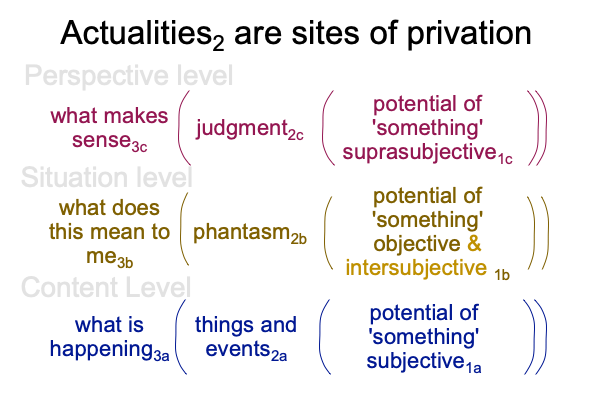
0059 There are privations in things and events2a, including speech-alone talk2a.

There are privations in phantasms2b, losing the balance between judgment2c and speech2a.

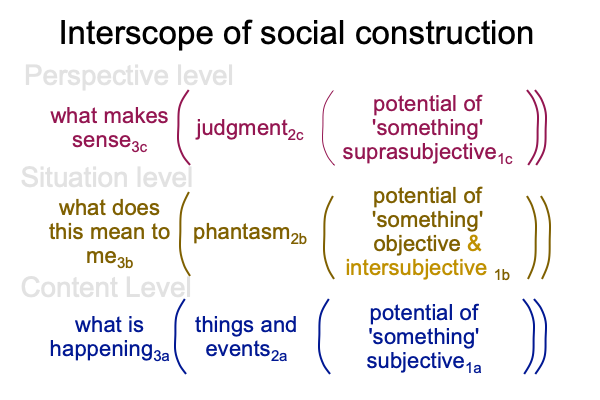
Here is a diagram for social construction.

Figure 7

What am I missing?

06/9/21

Looking at Kirk Kanzelberger’s Essay (2020) “Reality and the Meaning of Evil” (Part 15 of 18)

0060 In sections four and five, Kanzelberger pulls more threads through the loops of Poinsot’s scholasticism and Peirce’s postmodernism.  He does so well, that I continue in parallel, like a harmony to his melody.

0061 I turn to privation of judgment2c.

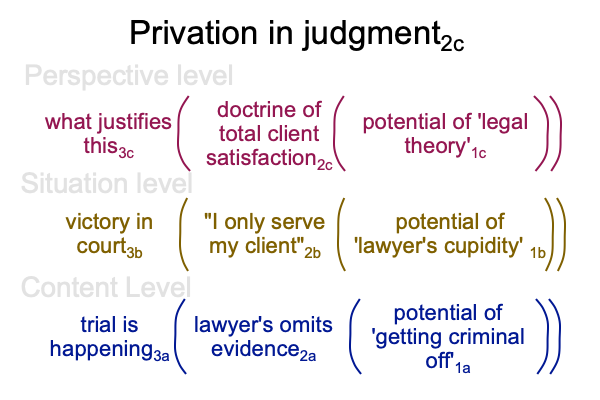
Consider an example.

0061 Crooked lawyers love the sin of omission.  They love to omit the evidence that would cause them to lose the case.  This love is justified by the doctrine of total satisfaction for the client.  The crooked lawyer does not serve justice.  The crooked lawyer serves only his client, even when his client is guilty as charged.

In the domain of morals, the doctrine of total client satisfaction stands in opposition to an oath to serve justice.  Lawyers take an oath to serve justice.  This doctrine deprives the oath of its merit.  Evil is a privation of good.

Legal theory contextualizes a lawyer’s cupidity, even as the lawyer’s exploits defy the attainment of justice.

0061 Is there a hierarchy here?

Crime is what happened3a.  A trial is what is happening3a.  Victory in court is what it means to me3b.  Someone really depraved constructs the legal process that permits it all3c.

There is a hierarchical difference between a corrupt lawyer3b, who objectifies what is happening3a in the pursuit of total victory for his client1a, and a legal theorist3c, who formulates the consensus of what is legally permissible1c.  Legal theorists3c fashion suprasubjective entities, concocting law-determining judgments2c that alter, tweak, nudge, correct and re-configure the intersubjectivity2b within which a moral agent3b signifies.  Legal theorists3c alter the machinery of justice2c.  Evil ex academia1c.

The well-educated cutting-edge legal theorist3c offers norms2c that may oppose the rule of reason and the divine law1c, just as parody opposes tragedy.  The projection of alternate meaning into words1c, such as “client interests”, “service”, “mandates” and so on, mocks the hard-won projection of true meaning1c, where the client’s interests do not outweigh justice and true justice ultimately furthers the interests of us all, including the client.

0062 Here is a picture.

06/8/21

Looking at Kirk Kanzelberger’s Essay (2020) “Reality and the Meaning of Evil” (Part 16 of 18)

0063 What is the catch?

Alternate legal theories2c cannot endure in the absence of the original truth of justice1c.  There are two types of immoral actors.  The practitioners of concupiscence2b, like crooked lawyers, struggle with self-justification1c.  The self-justified2c, like opportunistic legal theorists, strain to defy right reason and divine law1c.  They offer better alternatives2c.  They3coffer them2c in droves.  A multitude of alternatives2c swarm with betterness.

Kanzelberger writes, “Purposeful evil is not a matter of ignoring the moral context of courses of action, but a semiotic disorder involving… a fictive construction… that functions as… an imagined future.”

0064 You mean, like that approaching cloud of legal locusts?

Imagine a world where the rule of reason2c and the divine laws1c are partially, then totally, eclipsed by a swarm of organizational objectives2c, each declaring its own righteousness1c, each supported by its own theoretical imperatives1c and each relying on the power of the state to enforce its dictates.

Imagine a world where certain words1a are made flesh2a, and this winged flesh2a fills the air with what is happening3a, so that all things and events2a actualize theory-distorted subjectivities1a.  

Imagine a world where our phantasms2b are not grounded in truth, but in the projection of meaning2b into once truth-filled speech-alone words2a.

0065 Surely, we have eaten from the tree of the knowledge of good an evil.

Like locusts.

There will be hell to pay.

06/7/21

Looking at Kirk Kanzelberger’s Essay (2020) “Reality and the Meaning of Evil” (Part 17 of 18)

0066 Kanzelberger writes, “Moral evil is a dark image.  It weaves a web that bewitches its author, then ensnares others.”

But, the author and the ensnared do not necessarily stand on the same level.

0067 Natural evil makes no sense.  Natural evil is privation of the subject.

Moral evil makes sense.  Moral evil is privation in phantasms.  We selectively use word-symbols deprived of their fullness.  We seek agreement1a, not wisdom1c.

Metaphysical evil defies moral sense, by willfully projecting its own relations between what is and what ought to be2c, into spoken words2a, which cannot image or indicate on their own.

0068 Imagine a nest, full of duly-appointed avian-philic crooked lawyers, passing a law decreeing the latest innovation of their premier legal theorist.  All cats are to be banished from the sovereign realm, because they are symbols of human maliciousness and cruelty.

Here is a brood worthy of Kanzelberger’s philosophical consideration.

06/6/21

Looking at Kirk Kanzelberger’s Essay (2020) “Reality and the Meaning of Evil” (Part 18 of 18)

0069 Kirk Kanzelberger joins Thomas Aquinas with a basic acknowledgment: Evil is a privation of a good.

He then considers natural and moral evil.

In moral evil, he locates a semiotic disorder, in addition to a privation.

He considers the nature of the sign, as formulated by Charles Peirce.

0070 He publishes his argument in a journal worthy of the reader’s support.

Reality: A Journal for Philosophical Discourse

0071 My comments are not so different.  They thread through both Peirce and Poinsot.  They pass through the two loops brought to light by John Deely.

Yet, the are different, in that they offer diagrams based on Peirce’s categories.

0072 Typically, Razie Mah’s comments are published in the smashwords website and carried by a variety of e-book vendors.

Start with A Primer on the Category-Based Nested Form.

Add A Primer on Sensible and Social Construction.

That is all that is needed to introduce oneself to the interscope of social construction.

Figure 09

0073 The three-level interscope appears in the chapter on meaning in the masterwork, How To Define the Word “Religion”.

The three-level interscope plays a role in A Primer on the Individual In Community.

The three-level interscope serves as a model of langue, in Comments on Robert Berwick and Noam Chomsky’s Book (2016) Why Only Us: Language and Evolution.

0074 All these works are available at the smashwords website.

So concludes this look at Kanzelberger’s foray into both Aquinas and Peirce, concerning reality and the nature of privation.

Look to Reality.

God bless.

04/12/21

Looking at Jeff Hardin’s Essay (2019) “Biology and Theological Anthropology” (Part 10 of 15)

0054 So far, The Human Niche covers the Lebenswelt that we evolved in.

An Archaeology of the Fall covers the first singularity.

In both these exercises, theological and biological anthropology move together, without violating the Positivist’s construction of what is.

What about our current Lebenswelt?

The first singularity initiates our current Lebenswelt.

Speech-alone talk spreads, through mimesis, to adjacent hand-speech talking cultures, on the basis of marginal differences of wealth and power.

0055 Why is the Ubaid wealthier and more powerful than surrounding hand-speech talking cultures?

Speech-alone talk works on symbols, while hand-speech relies on icons and indexes (even though language itself consists in two related systems of differences, that is, symbolic orders).  Speech-alone talk can name parts, irrespective of wholes.  In hand-speech talk, a part may name the whole.  Consequently, speech-alone talk facilitates specialized languages, which supports labor and social specialization.

The Ubaid has more wealth and power because it is further along a path of labor and social specialization.

0056 But, isn’t there a problem with speech-alone words that is not present in hand-speech talk?

Yes, in hand-speech talk, the gesture-word pictures or points to its referent.  So, of course, the word and referent go together.

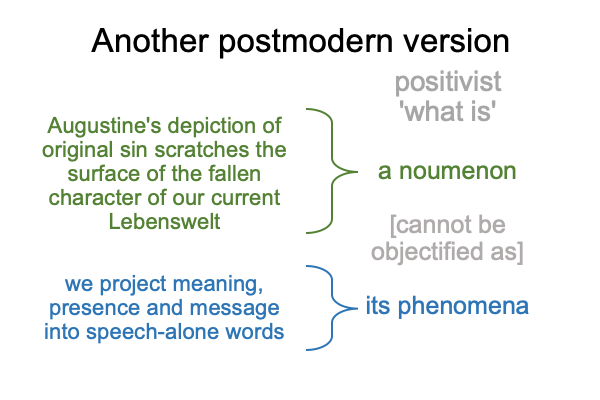
In speech-alone talk, we innately anticipate that a spoken word pictures or points to its referent.  But, a speech act does not picture or point to anything.

What happens next?

We project meaning, presence and message into a spoken word.  Then, we construct an artifact that serves as a referent and validates the projected meaning, presence and message.  As long as the projection-validation works, the artifact is salient, and serves as a referent.

0057 Perhaps, the reader sees a problem with this arrangement.

Indeed, Augustine’s depiction of original sin only scratches the surface of the fallen character of our current Lebenswelt.  Some Reformed traditions have a more precise term: total depravity.

If a person is able to construct an artifact that validates the meaning, presence and message that “he” projects onto a spoken word, then what is to stop “him” from um… creating and taking advantage of a situation?

Welcome to our current Lebenswelt, where our own spoken words allow us to name our own “realities”.

0058 Here is another pairing of Biblical interpretations and a new approach to the human sciences.

09/9/20

Comments on Yoram Hazony’s Post (2020) “Challenges of Marxism” (Part 1)

0001 Yoram Hazony publishes a six part opinion piece, concerning the relation between Enlightenment traditions and Marxism. on August 16, 2020, in the Quillette website (http://vlt.tc/41uo).  The essay is eye-catching for its portrayal of the capture of liberal institutions by marxists (now, with a small “m”) during the past three-score years.  Marx is back in a big way.

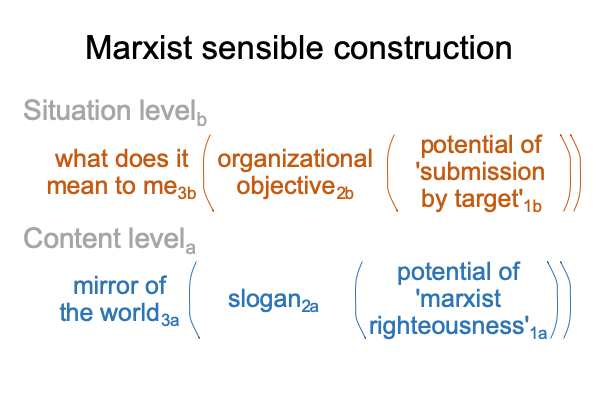
0002 In the prior blog, discussing the Be Little Men movement, two actualities come to the fore.  The first is a slogan2a, based on righteousness1a, that addresses the mirror of the world3a.  The second is an organizational objective2b, telling what the slogan means to the marxist3b.  This objectorg2b arises from the possibility of submission1b.  Submission1bvirtually situates (and emerges from) marxist righteousness1a.

0003 Here is a picture of the two-level interscope, composed of two nested forms, following the style in A Primer on the Category-Based Nested Form.

0004 According to Hazony, marxists have infiltrated American media companies, universities, government bureaucracies, courts, so-called profits, so-called non-profits and churches.  Classical liberals have lost control of their own institutions. Classical liberals do not have the intellectual or spiritual resources to combat the threat.

09/8/20

Comments on Yoram Hazony’s Post (2020) “Challenges of Marxism” (Part 2)

0005 How should I define the righteousness of the classical liberal?

The classical liberal entertains a perspectivec that occludes the foundational world of Christianity.  The classical liberal extols3c equality, freedom and fraternity2c.  These2c are the means to human fulfillment1c.

The American Bill of Rights declares life, liberty and the pursuit of happiness.  Equality is the right to life and justice.  Freedom is the liberty to make one’s own choices.  Fraternity involves private property.  One must own the possessions that one shares with family, friends, teammates and other social circles.  Otherwise, one usurps.

0006 The classic liberal perspective-level nested form looks like this.

Figure 2

0007 Surely, this perspectivec level does not contextualize marxist contenta and situationb levels.

Why?

Hazony speaks of two steps.  In the first step, the Enlightenment covers up Christianity.  In the second step, Marxism occludes the Enlightenment.

So, let me start at the first step.

Christian social virtues describe what God reveals about human sociality.  Saint Paul discusses equality in his letters. Christ frees humans from the chains of original sin.  The body of Christ, the Church, possesses an object that brings all into relation.  Finally, all these actualities emerge from the potential that a human can attain eternal life with God, the ultimate fulfillment.

The Enlightenment makes these virtues immanent.

0008 What does this immanence entail?

How does the Enlightenment perspective play into situation and content levels?

0009 First, let me simply slide the normal contexts of the situationb and contenta levels of the marxist sensible construction underneath the Enlightenment perspectivec level.  Here is the resulting three-level interscope, a relational structure discussed in A Primer on Sensible and Social Construction.

Figure 3

0010 Second, I fill in the blanks.

The content level actuality2a turns extols3c into a dream2a, an object associating with an individual’s future, choices and companions. The individual’s dream2a arises from talents and dispositions1a.

What possibility1b situates the individual’s dream2a?

Of course, there must be opportunity1b.

Then, with hard work and luck, one realizes2b that dream2a.

0011 This sounds so American.  Here is the interscope.

Figure 4

0012 The French Enlightenment, on the other hand, rots as it ripens.  Unlike eighteenth-century America, France is loaded with god-defying intellectuals, salon-attending little royals and cunning lawyers, who dream of running political affairs without the burden of king and church. They have talents and dispositions1a toward promoting organizational objectives2bbased on reason1b.  Reason1b gives opportunity to righteousness1a.  As such, their dreams2b,2a are tautological.

The Marxist frame, perceptively delineated by Hazony, develops in situ within French Enlightenment civilization.  The sarcastic godless intellectuals, self-absorbed gossip-bearing little nobles and the reason-worshipping lawyers consider themselves to oppressed by the oppressors, king and church.  King and church express a false consciousness.  The system works for them, not everyone else, especially the discontented.  Revolution will reconstitute society and the inherent ironies of the present regime will disappear.

0013 Here is a diagram.

Figure 5
09/7/20

Comments on Yoram Hazony’s Post (2020) “Challenges of Marxism” (Part 3)

0014 Part 3 concerns the attractions and power of marxism.

The individual is attracted to classical liberalism.

The discontented are attracted to marxist (il)liberalism.

The current iteration of marxist religion is Big Government (il)Liberalism (BG(il)L).

0015 What do marxists have that liberals do not?

Here is a picture of the marxist’s sensible construction

Figure 6

0016 Where is the perspective levelc?

Is it too horrible to view?

The Enlightenment perspective-level actuality (equality, freedom and fraternity2c) addresses three important aspects of human sociality in our current Lebenswelt.

0017 According to Marx, these are not sufficient.

What else is required?

First (A), people form cohesive classes or groups.  May I call them, “institutions”?  Second (B) these classes or groups invariably oppress and exploit one another, culminating in one (the state) enforcing order.  Third (C), the state eventually functions as an instrument of the oppressing class.

0018 Weirdly, Marx’s insight is captured in the chapter on presence in the masterwork, How To Define The Word, “Religion”.   The three elements appear in the institution (content) and sovereign (situation) levels of the societyC tier.

Figure 7

0019 In theory, Enlightenment liberalism achieves order1b, while using the fewest official acts and decrees2b.  It cultivates personal commitments2a to life (equality), liberty (freedom) and the pursuit of happiness (fraternity)2c.  Civic culture consists of various fraternal institutions3a, some Christian (“religious”) and some not Christian (“not religious”)1a, pursuing diverse objectives2a.

Righteousness1a does not arise from within Enlightenment liberalism.  Rather, Enlightenment liberalism is conducive to a wide variety of inspirations.  Liberal righteousness1a demands that each individual pursues opportunities1b offered by competing civic institutions3a according to their talents and dispositions1a.

0020 In contrast, the Marxist vision proposes that a number of otherwise civic institutions3a (A) will pursue organizational objectives2a (B) that require official acts and decrees2b for their implementation1b (C).

0021 Hazony offers examples.

Ideally, public education should be implemented through a general decree stating that all individuals over a certain age must pass a civic exam in order to gain citizenship.  The exam would be offered by (not one but) a suite of competing voluntary institutions, each operating with transparency due to competition.  Education may be subsidized by vouchers to parents.

In practice, modern education engages unionized teachers (A) who demand a monopoly over “public” instruction and examination, as well as a host of other organizational objectives (B), that require state enforcement through official decrees (C).

In sum, Big Government (il)Liberal education exemplifies the Marxist vision.

0022 Hazony offers other examples.  But, the point is clear.  Marxist righteousness1a sensibly constructs organizational objectives2b, that, on one hand, arise from directly from the potential of submission by a target (individuals or institutions)1b, and, on the other hand, are virtually situated by official acts and decrees2b in the sensible construction of societyC.

0023 One reason why Marxist ideas are so attractive is that they promote a righteousness1a that both demands submission from others1b and entangles sovereign power3b.

The task of identifying like-minded individuals is relatively easy, since conservatives, Christians, nationalists and (above all) enlightened liberals espouse other styles of righteousness1a.  All institutions in a modern civic society are vulnerable to infiltration by marxists.

In sum, marxists can easily identify one another, selectively promote one another, and humiliate perceived competition within each institution.  Those who are not marxist within each institution are increasingly expected to toe the party line and to promote entanglements with sovereign power.

0024 Amazingly, Enlightenment liberals find themselves dispossessed by the very institutions that they built.

Does this imply that the marxists hold a perspective-level actuality2c that (if you will excuse the pun) trumps equality, freedom and fraternity2c?

Hazony does not directly raise this question.

He does so, indirectly.

He discusses the flaws that make marxism fatal.

09/5/20

Comments on Yoram Hazony’s Post (2020) “Challenges of Marxism” (Part 4)

0025 Hazony points to the obvious.  Humans evolve in social circles where there are many relationships between a more powerful individual and a less powerful one, starting with mom, dad and their children.  The organizational structure of this foundational institution is discussed in A Primer on the Family.

0026 The family starts in the Lebenswelt that we evolved in.  So, there is more.

We must add the unconstrained social and labor specializations that characterize our current Lebenswelt.

Our current Lebenswelt is not the Lebenswelt that we evolved in.

0027 The organizational structures of civilizationB is a topic worthy of consideration.  The institutionaC and sovereignbClevels of the society tierC contextualize the organization tierB.  The organization tierB encompasses productionaB, exchangebB and assessmentcB.  The organization tierB emerges from (and situates) the individual in communityA.

Too bad inquiry into the organization tierB is yet to be initiated.

Advancements are blocked by marxist theory, in its various guises.  Marxist theory offers a “scientific” model that forecloses intellectual exploration of the organizations tierB.

0028 The model goes like this:

The diverse relations between more powerful and less powerful individuals in the organization tierB are equivalent to the relation between oppressors and oppressed.

The two are more than equivalent.  They are contiguous.

Figure 8

0029 What does contiguity imply?

Peirce’s category of secondness consists of two contiguous real elements.  The contiguity is not a real element, it is the substance that causally binds the two real elements.  The marxist substance carries the character of equivalence, but that is not enough.  Ask any marxist.  The causality is systemic.

Anyone who disagrees speaks with what Jacques Lacan callsthe master’s discourse.  Here is the oppressor.

Anyone who agrees speaks, to me3b, in discourses that Lacan labels, hysteric (for some) and scientific (for others).  For the most part, I find it hard to tell the difference.  I suppose the label depends on the slogan2a.   Each slogan2a addresses the one who asks what does this mean to me3b.

“Me3b” is a placeholder, virtually situating the person’s reflection3b in the marxist mirror of the world3a.

0030 Oppressed? Or oppressor?  Find a location within the abundance of asymmetric relations contained within the organization tierB.

Here is a diagram of the marxist interscope, as far as this discussion sees.