12/28/23

Looking at Joseph Farrell’s Book (2020) “The Tower of Babel Moment” (Part 6 of 10)

0061 In chapter four, Farrell introduces the reader to Gottfried W. Leibniz (1646-1716 A.D.), a polymath in a century filled with polymaths.  Leibniz writes volumes.  Many of his works are not translated into English.  So, let the reader beware.  At the same time, let that not deter us.  Farrell picks up a translation of a short article (circa 1696) titled, “On the Principle of Indiscernibles”.

0062 I suppose that, if one tries, one can discern something.

But, what if that ‘something’ is indiscernible?

0063 Leibniz writes (I follow Farrell’s quotation), “All that we have said here arises from that great principle, that the predicate is in the subject.”

Does this apply to the Tower of Babel story?

Here is my guess.

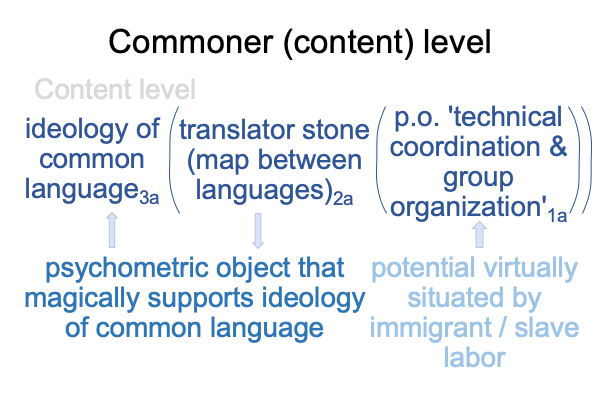
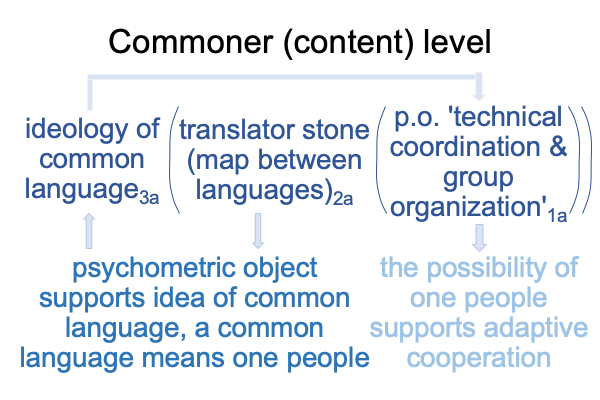
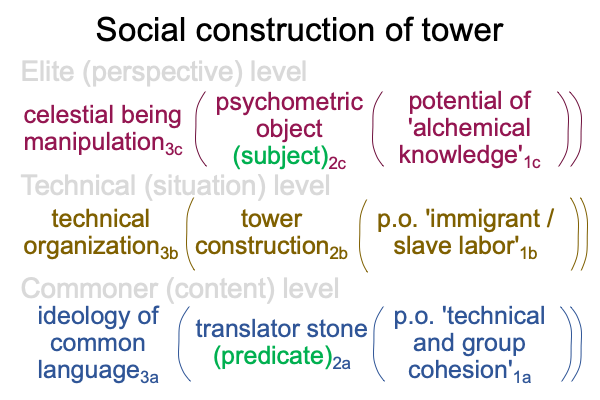
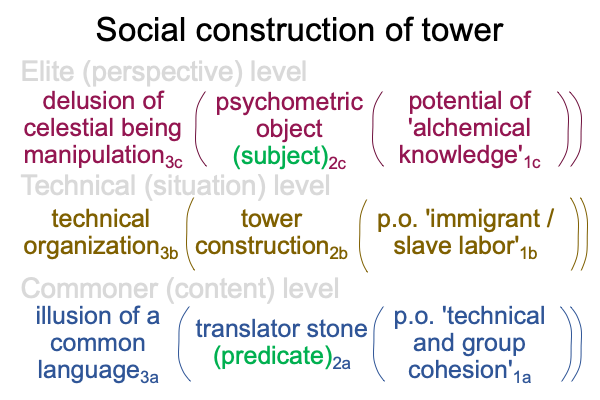
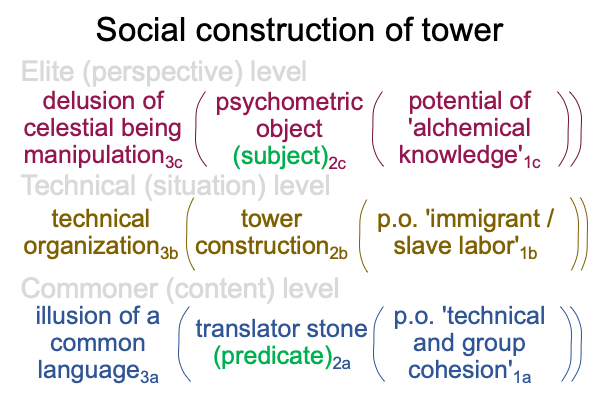
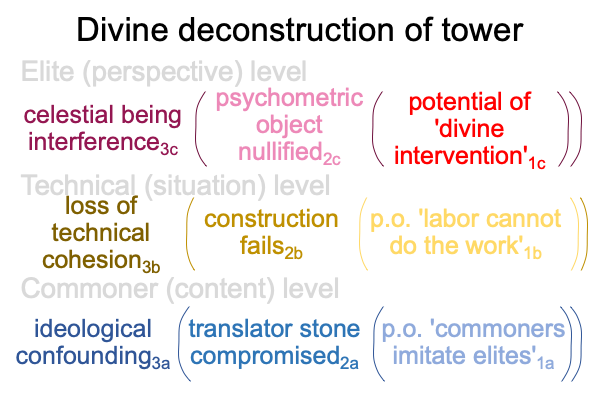
0064 The translator stone2a is a predicate.  It2a is a psychometric object that actualizes the potential of ‘group cohesion’1awhile sustaining a normal context, the ideology of a common language3a, that maximizes that potential1a.

The Tower of Bab-ilim2c is a subject.  It2c is the psychometric object that actualizes the potential of ‘alchemic knowledge’1c while sustaining the hidden normal context3c, the manipulation of celestial beings3c, which may include “stars” like Nimrod, a mighty hunter and, no doubt, ruthless psychopath.  The administrators want Nimrod’s name on a tower that puts the Egyptian pyramids to shame.

0065 Leibniz’s proclamation concerns the principle of indiscernibles.

Farrell passes into the mists of that principle.

Who can discern, in the haze of a story about the confounding of languages, a Tower of Babel moment, which, to me, corresponds to the loss of efficacy of a translation stone?

0066 Does Farrell suggest that Leibniz seeks to recover the translation stone of translation stones, one that brings us to the beginning, that is, to the time when speech is added to hand talk, in the form of anatomically modern humans?

From this moment of divergence, all spoken languages radiate in time and space, except for a handful of isolates.  And, never mind about the issue of hand-speech talk.

This is not about isolates or hand-speech talk.

0067 Leibniz seeks to discern a translation stone that puts the one in the land of Shinar to shame.  Leibniz invents the calculus.  Plus, he envisions a lost form of philosophical analysis that imitates the calculus, in so far as it translates nature’s language into human discourse.  All that is needed is a map.  A topogram.  A translation stone.

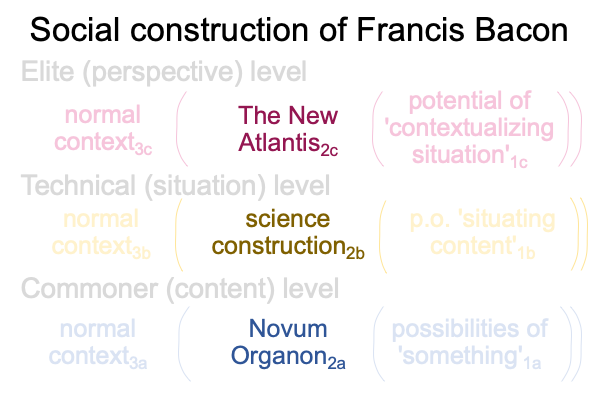
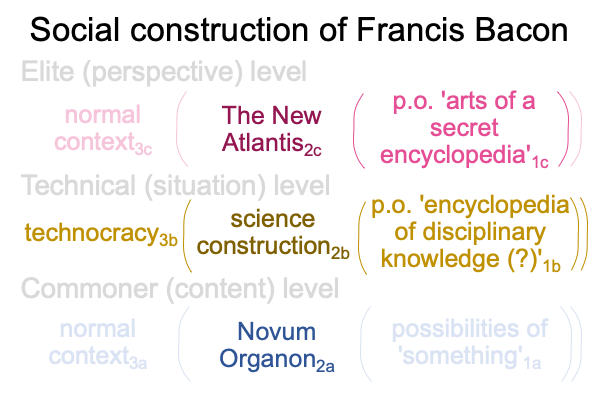
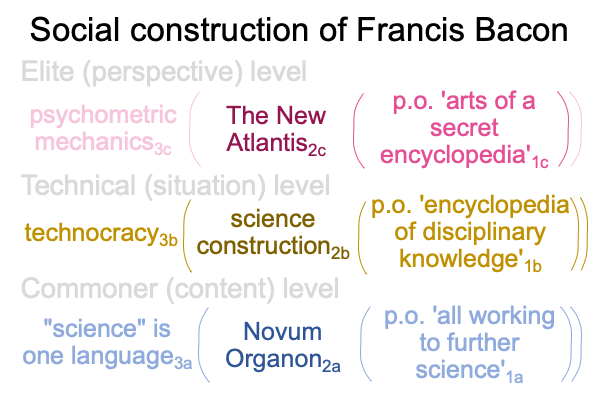
Leibniz is not alone in his search for “characteristica universalis”.  Francis Bacon (1561-1626 AD) writes his own fictional manifesto, The New Atlantis, as an epilogue to his mechanical-philosophy oriented Novum Organon.

0068 Does Bacon’s towering manifesto and topographic mechanical philosophy overlay onto the actualities of the Tower of Babel construction?

Here is how that might look.

0069 Okay, back to Leibniz.

In 1679, a work entitled, “An Introduction To A Secret Encyclopedia”, circulates among later-to-be labeled, “enlightenment” thinkers.  

An Introduction To A Secret Encyclopedia mentions technocracy.

Now, if I were to put “technocracy” into the above interscope, then what slot would I choose?

How about the situation level normal context3b?

0070 Leibniz presents a long list of the arts involved with a complex administration of the secret encyclopedia.

Where do these arts go?

Perhaps, they go with the perspective-level potential1c.

Here is my prior guess, adjusted.

0071 Farrell highlights one of the arts: the art of subtlety.

This art is on display in Looking at Daniel Dennett’s Book (2017) “From Bacteria, to Bach, and Back”, appearing in Razie Mah’s blog during the month of December 2023.

0072 Indeed, this reader suspects that Farrell’s line of thought is designed to carve a deconstructive path into the art of subtlety, as well as the art of the obvious, in order to allow entrance to those who, like himself, are neither commoner nor aristocrat.

The art of the obvious pertains to what is intersubjectively accepted by commoners as “objective”.  Yes, the translator stone is real.  It is more real than the plain observation that the people of the Shinar plain speak Sumerian and Akkadian.  The translation stone is a psychometric object capable of altering social conditions.

The art of subtlety pertains to what is subjectively accepted by the commoner as “suprasubjective”.  Yes, the translator stone verifies the ideology that we all speak a common language and therefore, are one people.  If many people believe it, then that turns the translation stone into a psychometric object.

Yes, both arts are at work in the psychometrics of the translator stone2a and the Tower of Bab-ilim2c.

0073 All sorts of philosopher stones have been fashioned.

I suppose that, in the beginning, one of them worked as advertised.

What Farrell points out, in his spiral-staircase ascent through his deconstructive augur, is that all the nascent figures of the western enlightenment, suspect that this is the case.  All that we need to do is rediscover the one philosopher’s stone that works.  A translator stone connects us to the beginning of human kind, even to before the beginning of our kind.  A philosophical instrument translates the language of nature into the language of humans.  This alchemical recipe will even convert lead into gold.

0074 And so, I may pencil in a few more elements to Francis Bacon’s own Bab-ilim.

12/27/23

Looking at Joseph Farrell’s Book (2020) “The Tower of Babel Moment” (Part 7 of 10)

0075 Farrell concludes chapter four with speculative fireworks, launched from the platform of Leibniz’s characteristica universalis and the Nimrod-administration’s topogram that converts Sumerian to Akkadian and back again.  Content-level actualities2a generate a normal context3a and potential1a that allow people1a… well, at least the representatives2c of the people1a… or better, the people2c who claim to represent the people1a… to challenge God3c or at least, achieve ends3c that are hidden beneath a blanket of official propaganda2c.

0076 The popular Cabbala represents a translation stone2a, of sorts.

Jacob Boehme’s occult references to an Adamic language3a, a Natursprache3a, intimates the hidden potential of everyone working from the same playbook1a… er… illusion3a.

Illusion?  Delusion?

0077 Here I must pause to plug the examination that marks the start of 2023, just as this review ends the year.  In January of this year, Razie Mah opens with Looking a Alex Jones’s Book (2022) “The Great Reset”.  The theatrical Alex Jones labors to reveal illusions and delusions.  That is his mission and his gift.  In the analysis, two words are defined.

An illusion is a mind-independent reality that is regarded as mind-dependent.  The psychometric translator stone is a mind-independent reality that is regarded as a sign that there is a common language, hence, a common people (that is, a mind-dependent being).

A delusion is a mind-dependent reality that is regarded as mind-independent.  On the perspective level for the construction of the tower, the mind-dependent reality of alchemical knowledge1c supports a mind-independent manipulation of celestial beings3c.

0078 How does one discern all this?

The predicate is in the subject.

Here is a picture.

0079 Farrell turns the metaphor of the topogram inside out.

Surely, the radiation of languages from an original proto-Indo-European people is documented by writing.

What about a radiation of almost all the spoken languages of the world from a single population, say 250,000 years ago?

This radiation cannot be documented by writing.

What about petroglyphs?

Does the commonality of petrographic symbols validate the impression of a continuity that stretches from the start of our species to the Tower of Babel Moment that precedes the Tower of Babel Story in Genesis 11?

0080 Farrell suggests that we may turn to the last Renaissance man… or maybe, the first figure of the western enlightenment… for further insight into the principle of indiscernibles.

12/27/23

Looking at Joseph Farrell’s Book (2020) “The Tower of Babel Moment” (Part 8 of 10)

0081 Before I go there, I want to pause and gaze back to the beginning of Farrell’s journey: the eleventh chapter of Genesis.

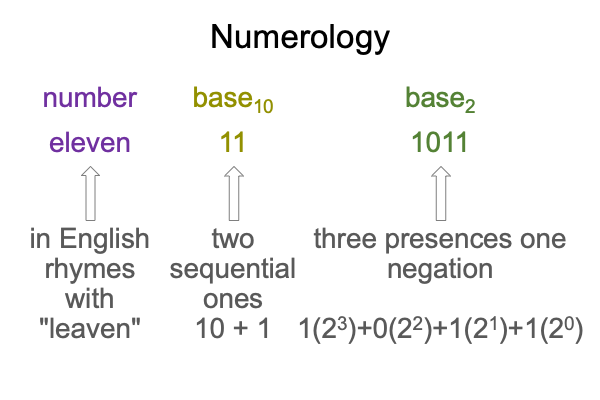
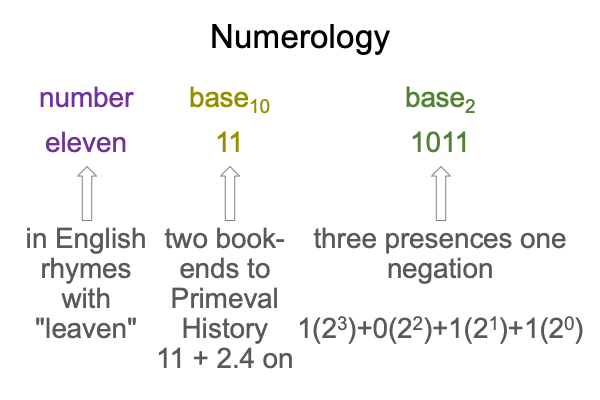
Here is a numerological picture for the number eleven.

0082 Yes, this sounds goofy, but in terms of English puns, “eleven” sounds like “leaven”.  Leaven makes bread dough rise.  It is yeasty.  It is like something that grows in something else and ferments it.  So, chapter 11 is the yeast in the bread dough… of what?

If man does not live on bread alone…(see point 0041).

Then, what about base ten?

Base ten calls to mind two hands, working together, so maybe, chapter eleven leavens chapter one.

0083 In chapter one, God creates our world, step by step, in what looks to be a sequential evolutionary process.

In chapter eleven, Nimrod’s administrators create a tower, step by step, by commanding bricks to be made according to strict technical specifications.  The bricks must be burnt thoroughly. The administrators are able to accomplish this goal because their immigrant slave labor think that they are of one people with the elite.  Why?  The translator stone tells them so.

One must never underestimate the power of people to do what they evolved to do or to be what they evolved to be.  We evolved to recognize that one language means one people.  And what does one people do?  They work together.

So, of course, immigrant slave labor will work as if they are “stakeholders”.  They think that they are.  Fools.

The administrators are not the God of all creation.

Instead they are at war with God.

0084 Okay, let me try that again.

Base ten calls to mind two hands, working together.  So, maybe, chapter eleven leavens the stories of Adam and Eve.

On one hand, the story of Adam and Eve is not the subject of Farrell’s discourse.  However, it serves as a predicate to the Tower of Babel story as subject.  How so?  According to Saint Augustine, Adam and Eve stand at the origin of our kind. Each one of us descends, through begatting (and don’t tell me that the Genesis writers are unfamiliar with that term) from Adam and Eve.  The idea is implied in the letters of Saint Paul.

Unfortunately, modern genetics disproves Augustine’s thesis.  If a species starts with the union of one pair, scientists expect a genetic bottleneck.  Geneticists do not observe a bottleneck for the start of the species, Homo sapiens.

0085 Does that leave us empty handed?

No, the Fall of Adam and Eve essentially corresponds to a Tower of Babel Moment.  Adam and Eve are on one hand.  The Tower of Babel is on the other.

Theological nomenclature supports the suggestion.  Chapter one of Genesis is typically referred to as “the Creation Story”.  Chapter 2.4 through 11 are typically labeled, “the Primeval History”.  So, the stories of Adam and Eve and the story of the Tower of Babel bookend the Primeval History.

So much for two sequential ones in base ten.

0086 What about base two?

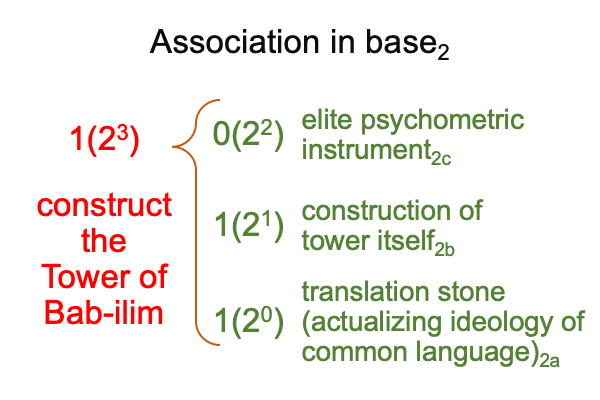
Let me start with the social construction of the Tower of Bab-ilim.

Now, let me consider that numerology business in terms of (1) presence and (0) negation.

Okay, now I consider the virtual nested form in the realm of actuality for social construction of the Tower of Bab-ilim.

The negation within the number eleven corresponds to the perspective-level actuality2c.

Isn’t that a coincidence?

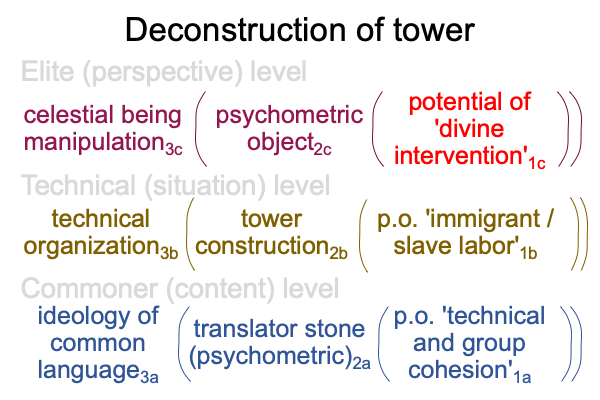
0087 Now, I replace the potential1c underlying that negation2c with divine intervention.

0088 That does the trick.  Eleven goes to zero.  The blame game begins.

Some think that numerology can substantiate any claim.

For proof, one need look no further.

0089 But wait!

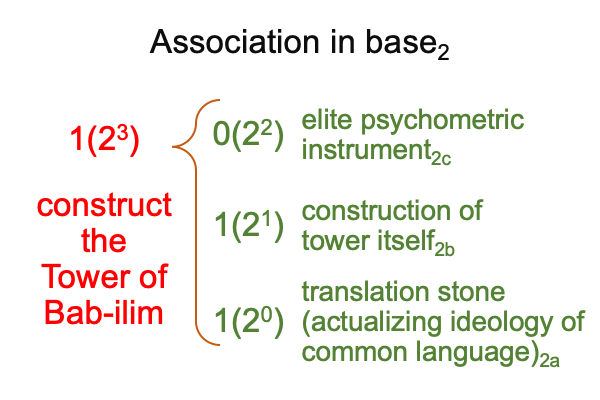
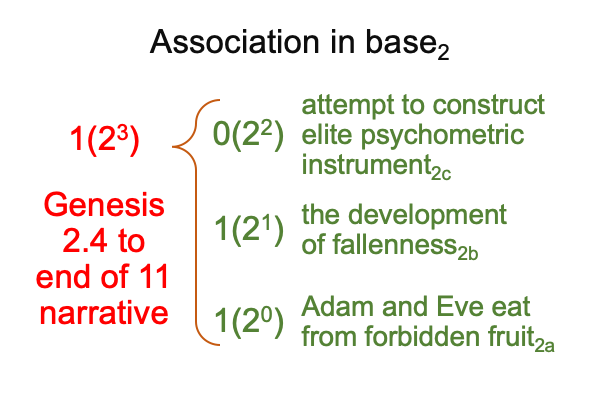
I have another association for base two.

This associate recapitulates base 10, which presents the stories of Adam and Eve as 1 and the Tower of Babel story as 10.

Here, the beginning of the Primeval History is 20 and the end is 22 and the middle is 21.

Here is the association.

0090 In this, the Tower of Babel2c represents the culmination of what the serpent in the Garden of Eden tells Eve during the drama of temptation2a.  The fruit of the tree of the knowledge of good and evil2a is the predicate.  The Tower of Babel2c is the subject.

Does that suggest that the translation stone2a, the thing that turns Sumerian and Akkadian into a common language, is a fruit from the tree of the knowledge of good and evil?

Does the seed of the fruit that Adam and Eve ate germinate and grow into theTower of Bab-ilim2c?

Does the seed of the fruit of the tree of knowledge of good and evil predicate the subject of all social manifestations of evil dangerous enough to challenge God?

0091 Has numerometrics isolated a new, postmodern, philosopher’s stone?

Numbers can tell me anything.

12/26/23

Looking at Joseph Farrell’s Book (2020) “The Tower of Babel Moment” (Part 9 of 10)

0092 At the start of chapter five, Farrell appeals to his regular readers.  Recall, The Gaza Death Star Deployed (2003) presents a hypothesis that the Great Pyramids of Egypt stand for a weapon of mass destruction.

0093 Well, it sure worked on the people on the plain of Shinar.

They got it in their heads that, because they practiced a common language, they could beat the Great Pyramid in terms of scale and psychometric capability.

Then, God destroyed them.

0094 What type of weapon is this?

The question sets the last Renaissance intellectual, a Jesuit, Fr. Athanasius Kircher (1602-1680 AD) into cognitive motion.  Farrell dwells on Kircher’s engravings, which are at once informative (for commoners) and fantastic (for fellow elites).

0095 What does Kircher say about the Tower of Babel?

Well, first, Kircher does not have nice things to say about Nimrod.  I will only mention that Nimrod worships fire, which should have inspired those industrious, illusion-enthralled, immigrant laborers on the plain of Shiner to be more studious in thoroughly burning their bricks.

That is not all.

I ask, “What does fire leave?”

Ashes.

0096 Second, Kircher draws a taciturn association between Nimrod and Saturn.  Both are lords.  Both are titans.  Plus, Nimrod’s administrators construct a tower that incinerates the entire civilization.  Only ashes remain.  Smoldering, vengeful, nasty ashes.  Sounds like Saturn to me.

0097 Third, the scale of the project renders it… unlikely… at best.  In order to reach the firmament, roughly corresponding to the the orbit of the moon, five million laborers adding a mile to the top of the tower per week would not even come close to the moon, even after 400 years of work.

0098 Fourth, there are other options.  What if the tower is the platform for some sort of weapon.  One could place a giant lens (or a parabolic mirror) on top and smoke enemies from a great distance, using the focused rays of the sun.

In recounting this, Farrell reminds the reader of the importance of optics.  Optics are foundational to the psychometric sciences.  So is scale.  So is time.

That brings me back to Saturn, the Titan once named Kronos.  Kronos is the titan who ate his own children.  Kronos is time itself.   His wife, tiring of his ploy, offers a stone for one of them.  Kronos swallows the stone whole.  Then, his wife hides the infant, who grows into who else?… Zeus.

0099 The word, “Chronos”, needs rehabilitation.  Modern psychometrics have dealt with worse.   Today, human resources use software named, “Chronos”, in order to keep track of time for employees.  

0100 In chapter six, Farrell celebrates the wormhole, the spiral staircase, drilling into the fruit of the tree of the knowledge of the natural and the social sciences.  Farrell asks the reader to take a look.  Why?  Farrell wants the reader to explore, if not further tunnel into, the modern gate of the gods, the postmodern psychometric sciences.

0101 I once called them “interventional sciences”.

Then, the term, “advocacy sciences” seemed to fit.

Now, the qualifier, “psychometrics”, captures my imagination.

0102 Farrell offers a few suggestions before closing.

But, I cling to the lessons that Farrell offers.

0103 First, Farrell emphasizes the relatedness between Greenberg and Ruhlen’s linguistic families and the genetics of populations that speak the same language.  The association between spoken languages and genetic groups is undeniable and supports the hypothesis that the vocal track is exapted for speech by a small population at the origination of our own species, Homo sapiens.

According to Razie Mah (in The Human Niche), speech is added to hand talk at the start of our species.  Humans practice hand-speech talk for over 200,000 years.  But now, all civilizations practice speech-alone talk.  So, there is a transition.  Mah calls it, “the first singularity”.  The transition is dramatized in An Archaeology of the Fall.  The transition is stated plainly in The First Singularity and Its Fairy Tale Trace.  Both are available at smashwords and other e-book venues.

This examination further suggests that Greenberg-Ruhlen’s association is ingrained in humans, so that the impression of a common language will trigger the perception of one people.

0104 The coincidence between linguistic family and genetic heritage poses a problem for an obvious (or “exoteric”) reading of the Tower of Babel Moment.  When isolated, both language and genetics naturally diverge.  So, a Tower of Babel Moment is not required to explain the diversity of languages to the modern mind.

0105 Second, the scientific notion of the co-evolution of diverse languages and populations suggests the potential of a translator that renders any one spoken language into any other.

Indeed, if an expectation of the co-evolution of languages and populations is built into the human phenotype, as an adaptation, then this nascent awareness would be a good target for a society-wide illusion.

Third, the disruption of that illusion (and the delusions built upon that illusion) entails widespread societal… confusion.

Such is the subtle (or “esoteric”) reading of the Tower of Babel Moment.

0106 To conclude, I would like to associate Abram to the fall of Ur III.  Why?  The demise of Ur III marks the end of Sumerian as a spoken language.  Sumerian continues as a written language for centuries longer.

As a spoken language, Sumerian dies.  Akkadian remains.

The language is confounded for the Sumerians, not the Akkadians.  The Tower of Babel is a story coming from an “insider” who now finds himself an “outsider”.

0107 Also, consider the societal fallout.

The Tower of Bab-ilim turns out to be a disaster.

Who gets the blame?

The last Sumerian families are finally ousted from their positions of institutional authority, to be replaced by the entitled children of the Nimrod-affiliated administrators (yes, the ones who cannot tell a thoroughly burnt brick form any other brick).  The purge will not be contained by any authority, because the purge covers the stupidity and incompetence and hubris of those in charge of the the tower’s construction.

0108 On that note, Haran dies before his father, Terah, in the land of his birth, Ur of the Chaldeans (Gen. 11:28).  So, Terah leaves with Abram and Sarai, along with Lot, the son of Haran, and settles in the land of Canaan (Gen 11:31).  But, there is no respite from the intrigue emanating from home, so Abram goes on, according to Genesis, and the Stories of the Patriarchs commence.

And what happens to Genesis?The stories from Adam and Eve to the Tower of Babel, become fairy tales that Sarah tells her children.

See Looking at Mark S. Smith’s Book (2019) “The Genesis of Good and Evil” appearing in Razie Mah’s blog in late January 2022.

12/26/23

Looking at Joseph Farrell’s Book (2020) “The Tower of Babel Moment” (Part 10 of 10)

0109 Farrell dares to worm a way into the fruit of the knowledge of the natural and the social sciences.

What does this examiner see?

Welcome to the postmodern version of the Tower of Babel.

0110 There is a new science in town.  It is the science of psychometrics.

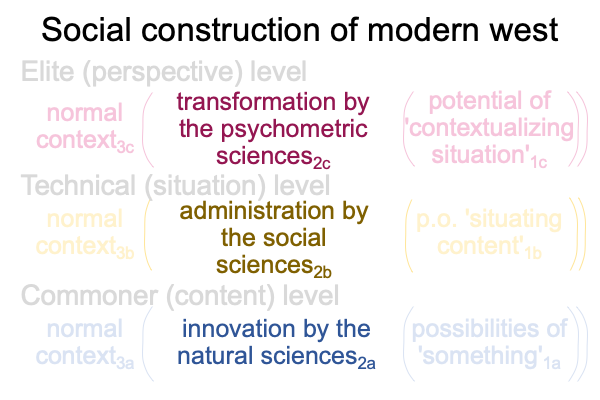
If the natural sciences stand for “science” for commoners, and if the social sciences constitute “science” for the technocrats running the modern administrative state, then the psychometric sciences define “science” for the movers and shakers constructing the modern Tower of Bab-ilim on the banks of the river, Potomac.  Turn on corporate television.  It is your gate to the gods.

0111 I leave to the reader, the exercise of transmuting the following figure with the social construction of the postmodern west in mind.

0111 With this transmutation, the spiral of Farrell’s speculation becomes a vision to behold.  How does one worm into the fruit of the contemporary tree of knowledge, with all of its exoteric and esoteric dispositions and powers?  One proceeds just as Farrell does, with an open heart and and an imaginative mind, in the conviction that, in the end, God reveals all truth.

0112 My thanks to Joseph Farrell for publishing such a wonderful and provocative book, with arguments worthy of the procrustean bed of the three-level interscope.

11/4/23

Looking at Andrew Ter Ern Loke’s Book (2022) ” The Origin of Humanity and Evolution”   (Part 19 of 22)

0162 What contributes this feeling of understanding in a completed three-level interscope?

Understanding conveys a feeling of satisfaction.

For example, when confronted with an uncontextualized actuality, one does not know its normal context or potential.  That does not convey any feeling of satisfaction.

In contrast, an actuality2a in a content-level nested form is not scary.  It is content.  The normal context3a is what is happening.  The potential is for ‘something’ to happen1a.  Knowing the normal context3a and potential1a at least conveys a feeling of understanding.

If understanding comes from placing an actuality2 into a nested form, then how much more intellectually satisfying is situatingb contenta in the light of a perspectivec?

0163 The Traducian doctrine is beautiful to behold.

When I look down each column in the interscope for the Traducian doctrine, I see a virtual nested form.

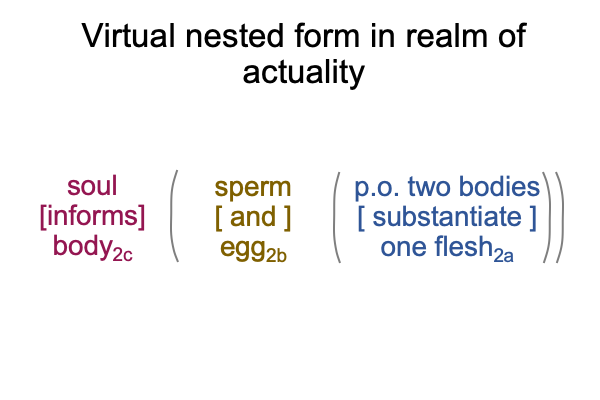
0164 For example, here is a picture of the virtual nested form in the realm of actuality.

Figure 33

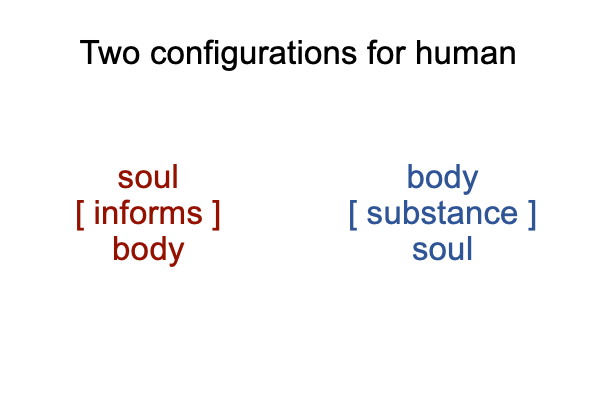
Two of these actualities belong to the two configurations of body and soul.

Figure 34

Their arrangement offers a theological lesson.

The perspective-level actuality2c associates to grace.  Soul [informs] body.

The content-level actuality2b associates to nature, where body [substantiates] soul.  Look at the content-level actuality2aand make the comparison.  The doctrine of Traducianism offers a lesson that coheres to the meaning of marriage.

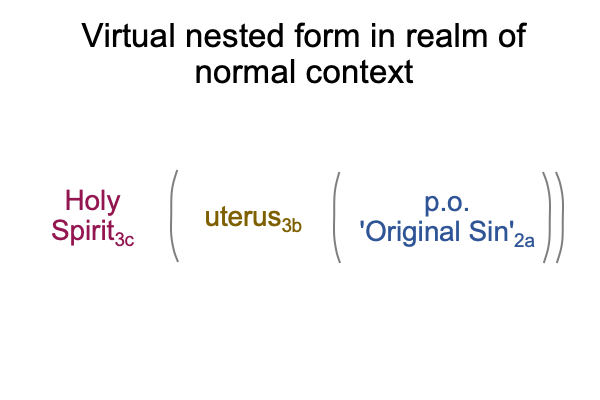
0165 Here is the virtual nested form in the realm of normal contexts.

Figure 35

Do I see an intimation of the Catholic doctrine of the Immaculate Conception of Jesus?

The funny thing is Mary, Mother of God, is not simply a uterus.

Mary is the mediatrix3b, dwelling between the normal context3 of the Holy Spirit3c and the potential1 of Original Sin1a.  She is baptized even before Christ institutes the sacrament of baptism.  Her womb is the site of God’s revelation.

Replace the normal context of uterus3b with the name of Mary, Mother of God, and one may appreciate why the Catholic Church proclaims that Mary is born without the stain of Original Sin.  How else could she have the courage of her convictions?  How else could she bear her unbearable responsibility?

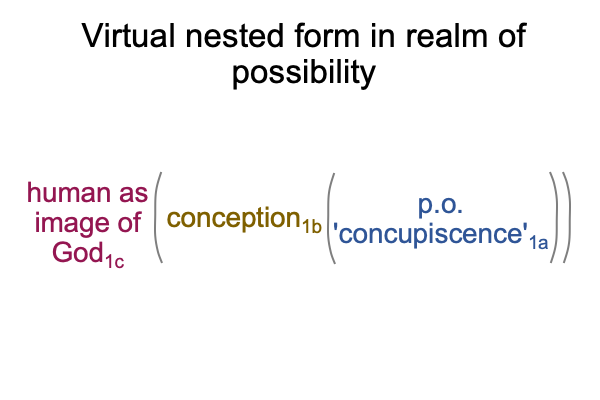
0166 Here is the virtual nested form in the realm of possibility.

Figure 36

0167 This nested form captures the essence of the Augustinian notion of the corruption of humanity following Adam’s transgression.  Theological debate ranges from theatrical claims of total depravity to scholarly assessments concerning the loss of original justice.  We are conceived in sin.  How does that impair our ability to wear the badge, “Image Bearer of God”?

0168 When rendered as a filled-in three-level interscope, the doctrine of Traducianism is beautiful to behold.  The virtual nested forms come alive, each in its own way, in the intellectual ferment that Christianity enjoys.  Jesus came so that we may have life, abundant life.  That includes intellectual life.

09/29/23

Looking at Appendix 1.1 in Brian Kemple’s Book (2019) “The Intersection” (Part 1 of 18)

0028 This is the second blog in a series.

 Looking at Brian Kemple’s Book (2019) “Intersection” appears in Razie Mah’s blog from May 15 through 18, 2023.  In that brief examination (points 0001-0027), a technical category-based definition of the term, “intersection” is shown to mesh with the theme of Kemple’s book, whose full title is The Intersection of Semiotics and Phenomenology: Peirce and Heidegger in Dialogue (Walter de Gruyter, Boston/Berlin).

To me, that is fascinating.

0029 In this series of blogs, I examine Kemple’s appendices.

Yes, he has more than one appendix.

Plus, there are subdivisions.

0030 Appendix 1.1 is titled, “Presentative forms and the grounding of transcendence”.  My associations will draw upon A Primer on the Category-Based Nested Form and A Primer on Sensible and Social Construction, as well as A Primer on Natural Signs, Comments on John Deely’s Book (1994) New Beginnings, and Comments on Newell Sasha’s Article (2018) “The Affectiveness of Symbols”.  These primers and comments touch base with Razie Mah’s masterwork, How To Define The Word “Religion”, which is available, along with the other mentioned e-works, at smashwords and other e-book venues.

0031 The title of Appendix 1.1 contains two technical terms.

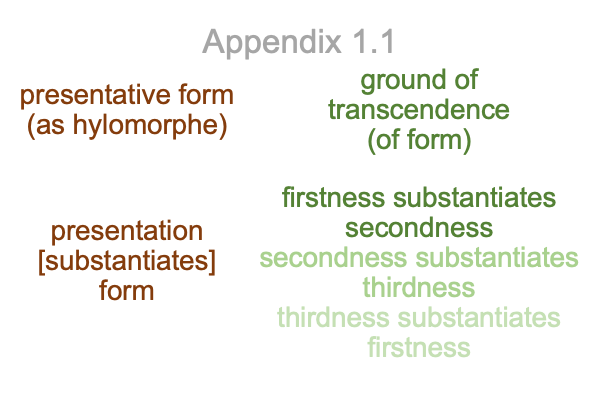
“Presentative forms” is a term coined by Jacques Maritain and literally means a form that is substantiated by its presentation, rather than by matter.  The hylomorphe is presentation [substantiates] form, rather than matter [substantiates] form.

“The grounding of transcendence” is a phrase used by Martin Heidegger.  It conveys what the presentative form accomplishes.  The presentative form accomplishes more than matter-substantiated form, because it leads to (grounds) another form, which is located at a higher categorical level (transcendence).

Figure 01

0032 Surely, this implies that presentative forms and the grounding of transcendence coincide in a particular way.  The “matter” of the presentative form associates to the adjacent lower category of its corresponding “form”

Is this is a general feature of presentative forms?

Well, the claim is a good working hypothesis.

09/28/23

Looking at Appendix 1.1 in Brian Kemple’s Book (2019) “The Intersection” (Part 2 of 18)

0033 So why are presentative forms and the grounding of transcendence important?

It seems that they govern the ways in which the categories of firstness, secondness and thirdness appear.  The process is not straightforward.  After all, if one category associates with what is expressed and the adjacent higher category goes with what is experienced (with the caveat that thirdness in what is presented wraps around to firstness in form), then each presentative form expresses two categories.

Oh yeah, that makes sense.

0034 But, it does not make sense.

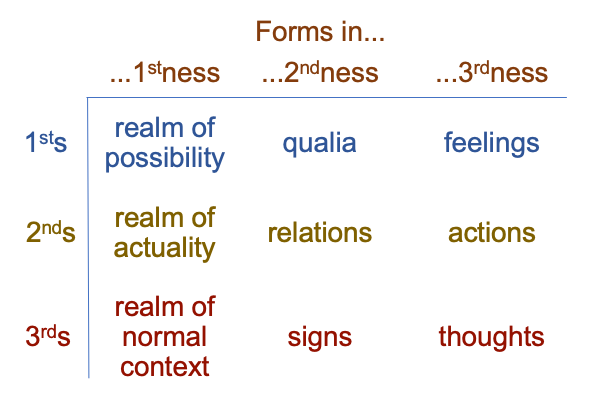
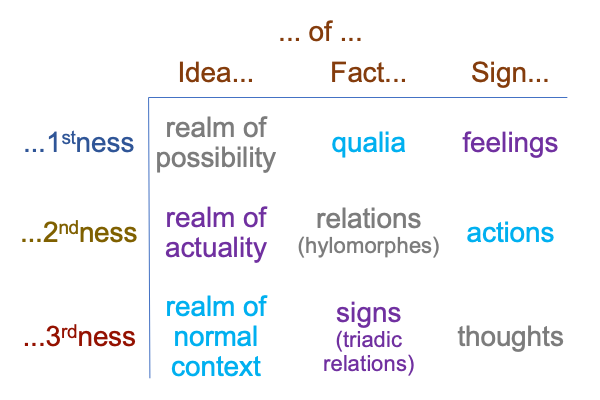
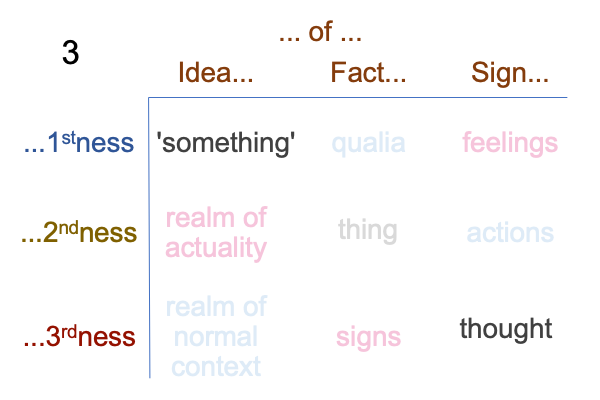
Kemple quotes from Peirce’s 1903 essay, “Sundry Logical Conceptions”, concerning the modes of appearance for the categories of experience.  In the following table, nine presentative forms are listed.  Vertical columns correspond to the category of experience for the presentative form.  The rows correspond to expression according to category.

Figure 02

The columns denote forms and the rows denote appearance (presentation).

0035 For example, consider the form of firstness (first column) and the appearing category of secondness (second row) corresponds to an idea of secondness.  Here, I depict it as ‘something’  in the realm of actuality.  An idea pertains to ‘something’ actual.

Here is another example from the above table.  The form of secondness (second column) and the appearing category of secondness (second row) corresponds to the fact of relations.  To me, these relations are hylomorphic, consisting of two contiguous real elements, characterizing Peirce’s category of secondness.  A thing is a fact of (hylomorphic) relation.

One more example will help.  The form of thirdness (third column) and the appearing category of secondness (second row) corresponds to signs of secondness. Actions are signs of secondness.  So are modes of conduct.

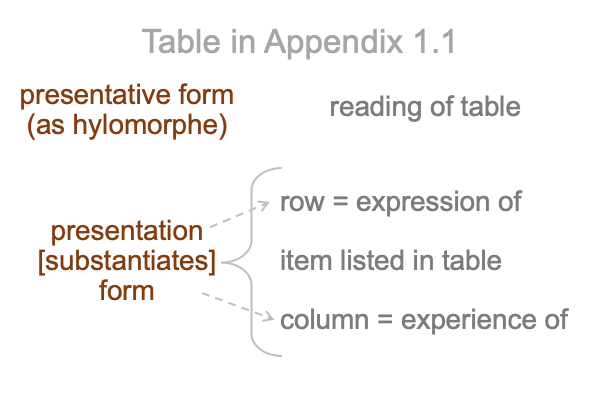
0036 Each element in the above table embodies a form in one category and an appearance in another category.  So, two categories are involved for each item in the table.  Plus, the matrix is exhaustive.

Figure 03

0037 What about the idea that transcendence is grounded in crossing categories?

My head swims.  But, it’s not Kemple’s fault.  It is the idea that the presentative form has a hylomorphic structure and that the element that corresponds to “matter” belongs to one category and the element that corresponds to “form” belongs to the adjacent higher category.

This idea is not apparent in Peirce’s table, pictured above.

Kemple continues…

0038 Going down the first column, forms in firstness may be labeled as “ideas”.  So, the element in the first row and the first column, is an idea of possibility (or, ‘something’ in the realm of possibility).  Likewise, ‘something’ in the realm of actuality corresponds to the idea of secondness.  ‘Something’ in the realm of normal context goes with the idea of thirdness.

Going down the second column, forms in secondness may be labeled as “facts”.  So, qualia are facts of firstness.  Relations in the style of hylomorphes are facts of secondness.  Signs and other triadic relations are facts of thirdness.

Going down the third column, forms in thirdness may be labeled as “signs”.  Feelings, such as awareness of a thing of beauty, are signs of firstness.  Actions, such as modes of conduct, are signs of secondness.    Thoughts are signs of thirdness.

0039 Still, I have a problem.

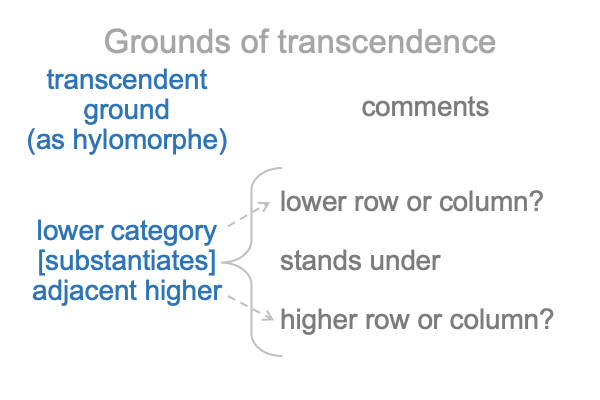
Even though each element in the above table references two categories.  The rows and columns do not highlight the hypothesis about transcendence developed in the previous blog, where the “matter” of a presentative form belongs to the adjacent lower category of its corresponding “form”.

Is there a ghost of a chance that Heidegger’s ground of transcendence haunts Perice’s table of presentative forms.

Figure 04

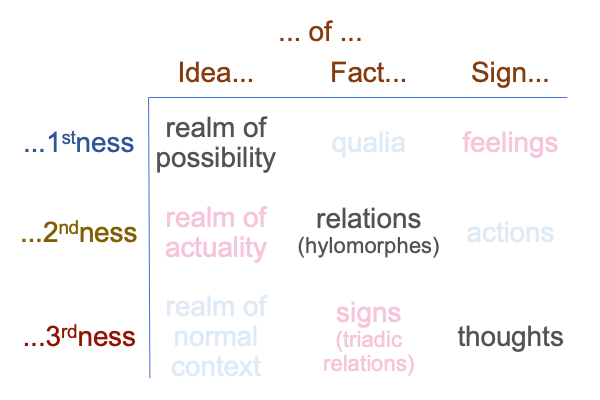
0040 Perhaps, I can conjure its specter by coloring a sequence of presentative forms, following the proposed hypothesis.

For each transition, from idea to fact, from fact to sign, and from sign to idea, there is a corresponding transition from firstness to secondness, secondness to thirdness and thirdness to firstness.  

The result is a seqence of novel presentative forms that are composed of elements of the table.  The lower category presentative form for both appearance (row) and form (column) serves as “matter”… er, I mean “presence”… and the higher-category presentative form in both appearance (row) and category (column) serves as “form”.   

0041 In the following diagram, sequences appear in color.

Figure 05

0042 The hylomorphic structure, lower-category presence [substantiates] higher-category form, embodies transcendence, defined as moving from one category to the adjacent higher category in both form and appearance.  So, ways to imagine the coincidence of presentative forms and grounds of transcendence track the colors in the table above

09/27/23

Looking at Appendix 1.1 in Brian Kemple’s Book (2019) “The Intersection” (Part 3 of 18)

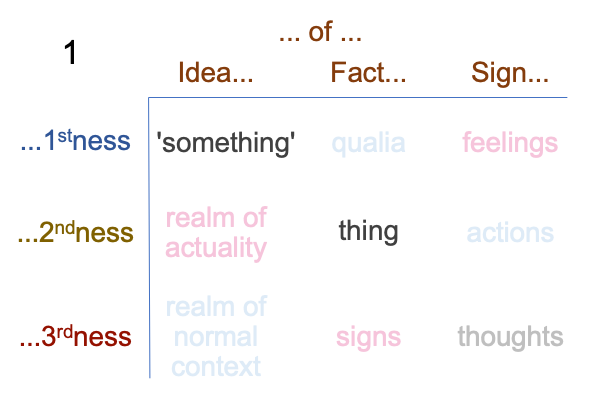
0043 Okay, allow me to explore the most obvious diagonal.

Figure 06

0044 Consider ‘something’ in the realm of possibility [substantiates] the form of a hylomorphic relation.  According to the hypothesis on grounding transcendence, the novel presentative form is ‘something’ possible [substantiates] a thing.   An idea in firstness causes (or is contiguous with) the facts of a cause-and-effect relation.  Element (column 1, row 1) substantiates element (column 2, row 2).

Figure 07

0045 Does this capture Heidegger’s use of the German term, Moglichkeit (translated into English as “possibility”)?

Yes, Moglichkeit applies when ‘something’ in the realm of possibility serves as grounds for a cause-and-effect fact.

‘Something’ presents itself as a thing.

Okay, that sounds plausible.

0046 Let me consider the next novel presentative form.

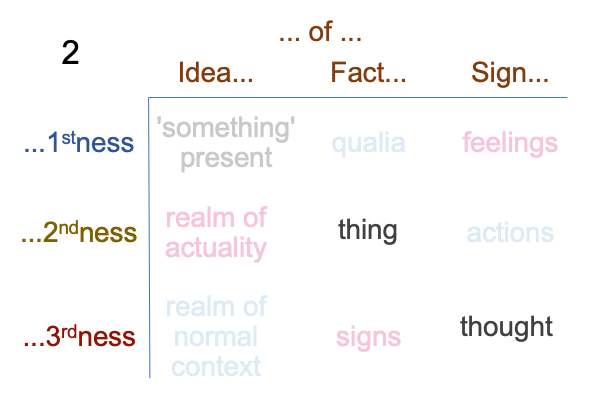
Consider hylomorphic relations [substantiate] thoughts.  A fact of secondness grounds a sign of thirdness.   The thing is like matter.  The thought is like form.  Element (column 2, row 2) substantiates element (column 3, row 3).

Figure 08

Facts of secondness [substantiate] signs of thirdness.  Things [substantiate] thoughts.

0047 Does this capture Heidegger’s use of the German term, Ausweisen (previously rendered as “account” and now translated by Kemple into “pointing out”)? 

A thing has significance.

Okay, here are two successes in a row.  But, the trend is making me nervous.

The form of the first movement, presents itself as a fact and that presentation substantiates a sign in the realm of thirdness,corresponding to a thought.

I am afraid that this trend will end up as a tortuous run-on sentence.

0048 One more step.

Consider thoughts [substantiate] ‘something’ in the realm of possibility.  A sign of thirdness grounds an idea of firstness.   Thoughts are like matter.  ‘Something’ in the realm of possibility is like form.

Figure 09

0049 Does this capture Heidegger’s use of the German term, Boden (previously translated as “basis” and now translated by Kemple as “surroundedness”)?

Is the originating ‘something’ in the realm of possibility subsumed into a form that is substantiated by a thought?

Okay, I am not nervous anymore.

I am perplexed, yet intrigued.

0050 Of course, the questionable character of the following hypothesis cannot be doubted.

Otherwise, I could present the following claims as fiat accompli.

First, presentative forms in the table in Appendix 1.1 are hylomorphes, where the column conveys experience (form) and the row represents appearance (presentative).

Second, presentative forms may contribute to a novel presentative form, corresponding to Heidegger’s grounding of transcendence.

Third, tabular presentative forms that cross adjacent categories constitute a grounding of transcendence.  This is a hypothesis.

In other words, the grounding of transcendence follows diagonals within Kemple’s table of presentative forms.

0051 What transitions do Moglichkeit, Ausweisen and Boden correspond to?

How about passages from idea to fact, fact to sign, and sign to idea?

Another option is firstness to secondness, secondness to thirdness and thirdness to firstness.

One more option is that both passages are implicated.

0052 In section 6.3.1, Kemple notes that Peirce’s categories and Heidegger’s groundings do not map onto one another perfectly.  Peirce’s categories pertain to semiosis.  Heidegger’s labels are contained within a framework of ontic-ontological transcendent grounds that are specific to human beings.

0053 So far, my associations to Kemple’s appendix 1.1 yields a hypothesis and a challenge.

The hypothesis is that Maritain’s presentative forms and Heidegger’s grounding of transcendence coincide with the construction of novel presenative forms, composed of presentative forms.   A tabular element in one categorysubstantiates the tabular element in the adjacent higher category, for both columns and rows, with a wrap-around at thirdness.

The result is three sequences of three transitions, depicted in colors in the above table.

0054 If this result is plausible, the elements in the table are not only presentative forms, but they are also elements in a novel hylomorphic structure: presentative (column A, row B) [substantiates] form (column A+1, row B+1).

Heidegger’s terms seem to jive with these novel presentative forms.

0055 Is that confusing?  If so, then I wonder.

Does Moglichkeit (possibility) start with the column of idea or with the row of firstness?

09/26/23

Looking at Appendix 1.1 in Brian Kemple’s Book (2019) “The Intersection” (Part 4 of 18)

0056 I repeat.  Here is a table that colors in the hypothesis of the coincidence between a sequence of novel presentative forms and grounding of transcendence, with one diagonal strand colored in bold.

Figure 10

0057 First, I associate two contiguous elements, ‘something’ in the realm of possibility (presentative) and hylomorphic relations or things (form) to Heidegger’s term, Moglichkeit.  ‘Something’ (presentation, idea in firstness) substantiates a thing (form, fact in secondness).

Kemple elaborates in section 6.3.1.  Heidegger identifies the dimensions of Moglichkeit (possibility) as Shiften (translated as establishing, finding, causing, as well as inducing) and Weltenwurf (translated as projection of world).

0058 What do these dimensions suggest?

Following the argument of the previous blog, the presentation of Moglichkeit rests primarily in firstness, rather than the idea of firstness and the form of Moglichkeit rests in secondness, rather that the fact of hylomorphic relations.

That would associate Moglichkeit with a contiguity between firstness and secondness, more or less mirroring the relation between contenta and situationb-level actualities2 for a two-level interscope.

0059 If this association to Moglichkeit is plausible, then the presentation of Ausweisen rests primarily in secondness (the row), rather than the fact of secondness (the column), and the form of Ausweisen touches base with thirdness (the row), instead of signs of thirdness (the column).  Maybe, I should say, essentially with thirdness, and accidentally with signs of thirdness.

How to translate the term, Ausweisen?  Kemple recommends the term, “pointing out”, while other translators choose the term, “account”.  “Pointing out” distinguishes an object from its surroundings.  An object is “laid out in consciousness”.

Finally, Boden (surroundedness) connects thirdness (the row) with firstness (the row) in the same manner as Moglichkeitand Ausweisen.  The presentation belongs to row 3 and column N.  The form belongs to row 1 and column N+1, unless N+1 equals four, then the column returns to idea (the form of firstness).

Here is the summary for the ongoing diagonal.

Figure 11

0060 Does Moglichkeit, Ausweisen and Boden associate to pairs of elements in a sign relation?

Here is a guess.

Figure 12

0061 For Moglichkeit, the sign-vehicle (SV) associates to novel presentation in firstness (row) and the sign-object (SO) associates to novel form in secondness (row).  The columns shift as well.

For Ausweisen, the SO associates to novel presentation in secondness (row) and the SI associates to novel form in thirdness (row).  The columns shift as well.

For Boden, the sign-interpretant (SI) associates to novel presentation in thirdness (row) and a corresponding nacent SV associates to novel form in firstness (row).  The columns shift as well.  The nascent SV may sustain the next Moglichkeit.

0062 Here is a picture of how sign-elements key into the tabular presentative forms along one diagonal.

Figure 13

Each novel presentative form expresses the tabular presentative form (row M, column N) [contiguity based on the two manifesting sign elements] the tabular presentative form (row M+1, column N+1), with wrap-around from thirdness to firstness.

0063 Here is a picture of the flow of Heidegger’s terms and how they might associate to the elements of Peirce’s sign-relation for this particular diagonal.

Figure 14

0064  In general, Moglichkeit moves diagonally from the first to the second row and associates to a hylomorphic structure crossing from firstness to secondness.  A sign-vehicle makes a sign-object possible.

Ausweisen moves diagonally from the second to the third row and associates to a hylomorphic structure crossing from secondness to thirdness.  A sign-object points to the facet of a sign-interpretant in thirdness.

Boden wraps around diagonally from the third to the first row and associates to a hylomorphic structure crossing from thirdness to firstness.  The facet of the sign-interpretant in thirdness joins with the facet of the sign-interpretant in firstness.

0065 So far, I suggest that Heidegger’s grounding of transcendence corresponds to novel presentative forms.

Plus, these novel presenatitive forms further correspond to elements in a sign relation.

In the previous figure, couplings of sign-elements label the contiguity between the two tabular presentative forms that contribute to the novel presentative form.

0066 If these associations make sense, then I may claim the following.

Heidegger’s grounds of transcendence may be technically written as a novel presentation [substantiates] form.  Plus, the novel presentation belongs to one category (foremost in appearance (row) and secondarily in experience (column)) and the novel form belongs to the adjacent higher category (for both row and column, with wrap around).

A sequence of dyads may be depicted by focusing on diagonals in a table of appearances versus forms.  A table of presentative forms contains nine ” presentative forms” (or better, “tabular presentative forms”) according to the current normative use of the term, and supports three sequences of “novel presentative forms”.  Each sequence associates to Heidegger’s three terms describing the grounds of transcendence.

0067 Finally, the contiguity between novel presentation and novel form along one particular diagonal juxtaposes two elements within a sign relation.