0075 Meanwhile, I doubt whether any of the commentators of the article in Current Anthropology know that Dr. D. Basak has scooped information from publicly available internet sources, therefore performing a function similar to podcasting. Unfortunately, many of Basak’s references are from Wikipedia and other collating on-line venues, rather than from actual researchers.
0076 The lullu podcasters will solve that defect.
All twenty-three researchers who contribute the Beck’s manifesto should network with podcasters who are (1) interested in the material, (2) humble and (3) willing to ask questions.
0077 A comment by Aja M. Lans is on target in this regard, questioning whether multiversities are “public goods”. The term, “public good”, sends a message. The multiversity deserves sovereign support. The sovereign supports the Anunnaki-level administrators, not the Igigi-level yet-to-be-tenured faculty.
If the label, “public good”, acts as a thesis, and if “the Anunnaki-level administrators who claim that their institutions serve the public good” operate as an antithesis, then, as long as the potential for a synthesis is subverted, the status quo will remain.
Something will break. The Igigi will rebel. But, does that bring the synthesis out of the realm of possibility?
0078 Shall we ask Enki?
Is Ninmah available to fashion the podcaster, who will do the heavy labor of interviewing the young professional archaeologists?
The podcasters will be the humans that sustain a world where the Igigi can do what they really want to do: research into the origins of humanity.
0079 In sum, the mythic structures of the ancient Eridu Genesis and a recent (2026) publication concerning academic publishing in archaeology are not only similar, but the comparison allows this examiner to make a prediction. As soon as podcasters fill the role of the newly created lullu, then the nature of professional academic archaeology will transform.
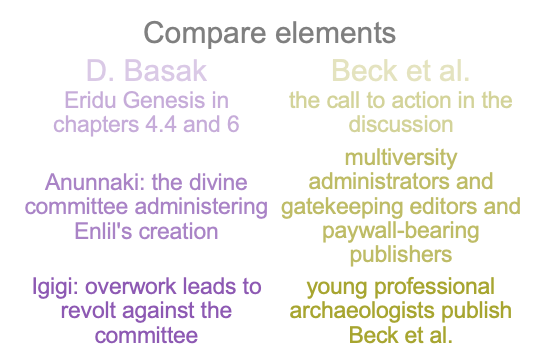
0080 Here is a comparison of mythic and dramatic elements.
0081 This type of comparison of mythic structures is integral to chapter 1 of Razie Mah’s fiction, titled An Archaeology of the Fall. The Sumerian myth of world creation can be compared to the founding of the United States of America. I call the Sumerian creation myth, “the differentiation of Nammu”. This myth is discussed in chapters 4 and 5 of Basak’s book.
Chapters 4 and 5 of Basak’s book present Sumerian origin myths of the world and of humans. These myths are recorded in cuneiform tablets recovered by archaeologists. It is amazing that the tablets survived.
0083 I start with the world.
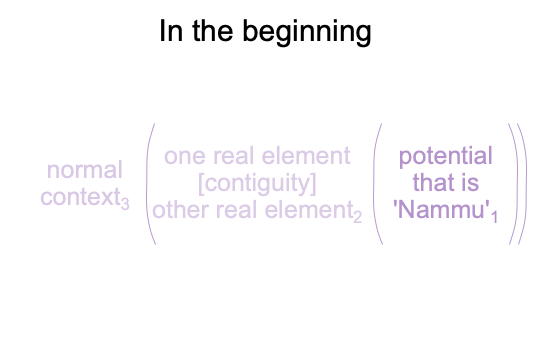
In the beginning, Nammu is the uncreated oneness.
Oneness describes Peirce’s category of firstness. Firstness is the realm of possibility.
0084 According to Peirce, all existence can be portrayed in terms of three categories. He names the categories on the basis of the number of elements. Thirdness has three. Secondness has two. Firstness has one. Each category exhibits its own logic. Thirdness follows the logics of exclusion, complement and alignment. Secondness exhibits the logics of contradiction and noncontradiction. Firstness is inclusive and allows contradictions. Finally, each higher-level category prescinds from the adjacent lower category. Thirdness prescinds from secondness. Secondness prescinds from firstness.
0085 The category-based nested form is one of the simplest examples of thirdness.
Thirdness bring secondness into relation with firstness.
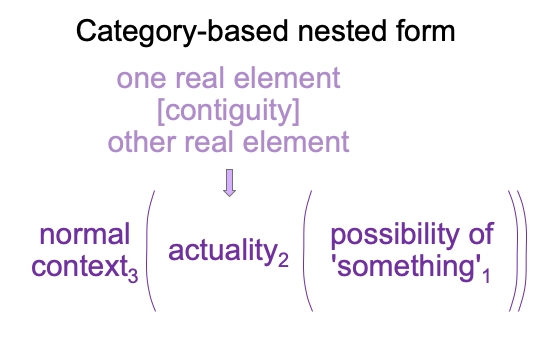
A triadic normal context3 brings a dyadic actuality2 into relation with the possibility of ‘something’1.
Here is a picture.
0086 To me, Nammu, the undifferentiated god at the start of the Sumerian origin myth, corresponds to firstness.
Here is a diagram.
0087 The Sumerian creation story continues.
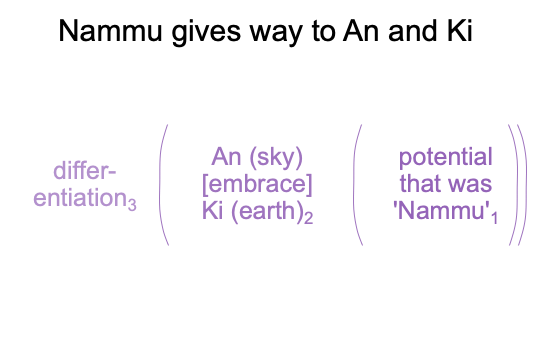
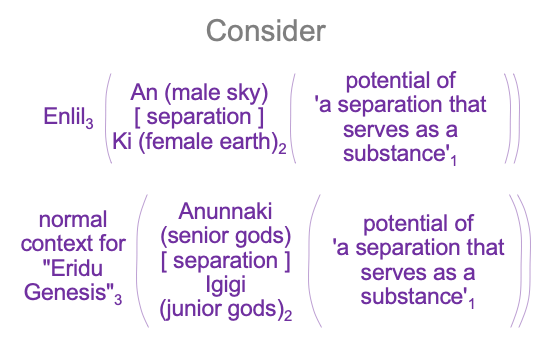
Nammu differentiates into two real elements, An (a male principle and the waters above) and Ki (a female principle and the waters below). These occupy the slot for actuality2 when the normal context is differentiation3. They embody a principle of duality, undergird by the lingering unity of Nammu, from which they came. The contiguity between An and Ki bears the label “embrace”.
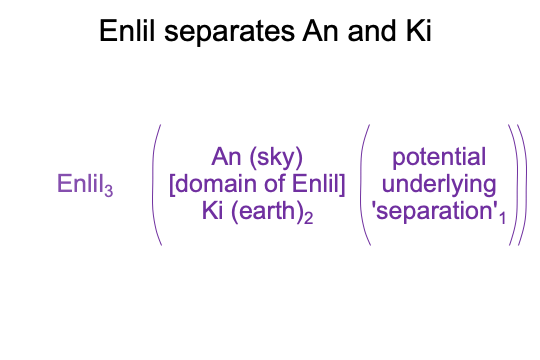
0088 Then, An and Ki conceive. Ki gives birth to Enlil. Enlil goes about separating his parents.
[Embrace] gives way to [the domain of Enlil].
0089 Here is a picture.
0090 An2 associates with the celestial domain.
Ki2 associates with the mundane domain.
Enlil’s domain2 is the contiguity between heaven and earth.
0091 I ask, “Does this sound like a nested form that is ’caused’ by living in the fertile land between two capricious, creative and destructive rivers?”
Or, does this look like something that anthropologists have never looked at before?
0092 Enlil2 is the god of the air, as well as the storm. His realm is pure substance, standing between the fixed domains that people can picture and point to, the sky (An) and the earth (Ki).
Does that substance have anything to do with rivers or land or anything material?
Or does that substance entangle rivers and land and grain and clay and all sorts of materials?
0093 How can separation, as a potential, empower Enlil’s domain which a substance in the realm of actuality?
0095 The potential of ‘a separation that performs as a substance’1 supports further differentiation.
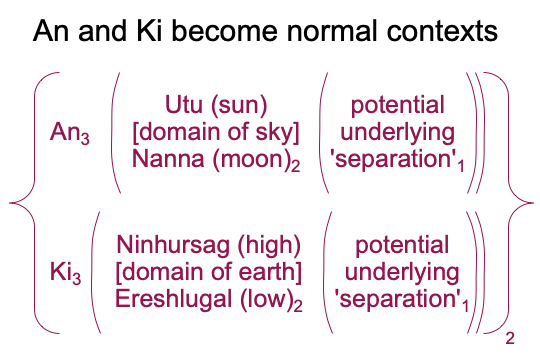
An (the sky)2 becomes the normal context3 for Utu (the sun)2 and the Nanna (the moon)2 who arise from the potential of ‘separation as a substance’1.
Ki (the earth)2 becomes the normal context for Ninhursag (the mountains)2 and Ereshlugal (the underworld)2 who arise from the potential of ‘separation as a substance’1.
0096 Of course, Sumerian mythology does not describe the creation of minor gods in precisely this way. So, I extrapolate from the origin myth at hand.
Here is a picture.
0096 [The domain of sky] is the substance that arises from a celestial potential of ‘a separation that performs as a substance’1.
0097 I ask, “What domain of the sky somehow captures a celestial phenomenon that associates to ‘a separation that performs as a substance’1?”
Is rain a good candidate?
Rain falls from the domain of the sky to the earth where it enters into domains associated to the trickster god, Enki. Enki is the god of freshwater that flows in streams and in underground passages that come to the surface as springs. All that underground fresh water is called “the Abzu”.
0098 [The domain of earth] is the substance that arises from a mundane potential of ‘a separation that performs as a substance’1.
0099 I ask, “What domain of the earth captures mundane phenomena that associate to ‘a separation that performs as a substance’1?”
Is fertility a good candidate? What about competition? What about the pursuit of love? What about grasping for power?
Perhaps, I may consider the goddess, Inanna, as the personification of ‘a separation that performs a substance’1.
Innana is the goddess of love and war. To me, that designation sounds like the two extremes of earthy, organic desire. Humans are animals, after all.
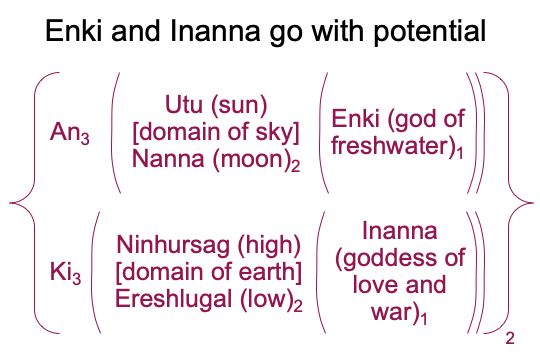
0100 In brief, I associate An2 and Ki2 to normal contexts3 dwelling within the actuality2 of Enlil3. Further, I associate the potentials1 underlying An3(2) and Ki3(2), to Enki (the god of freshwater and the Abzu) and Inanna (the goddess who drives people together and drives people apart). Enki1(2) and Innana1(2) label potentials that reside in the realm of Enlil3‘s actuality2.
0101 Here is a diagram of the actuality2. The overall normal context is Enlil3. The potential1 is ‘a separation that empowers a substance’ or ‘a separation that performs as a substance’ or ‘a separation in potential that supports a substance in actuality’.
0102 An3, the sky god, belongs to the realm of actuality in Enlil’s nested form, yet serves as a normal context3 that is separated from Ki3, the earth goddess. The separation of An3 and Ki3 is not pictured in the above figure. [Separation] is the contiguity between these two gods. [Separation] is the substance of Enlil’s domain.
0103 Four gods belong to the realm of actuality in the normal contexts of An3 and Ki3.
Utu, the god of the sun, is separate from Nanna, the goddess of the moon. That separation is like a substance, belonging to the domain of the sky.
Ninhursag, the goddess of the mountains and other highlands, is separate from Ereshlugal, the goddess of underground places, including the resting place of the dead. The separation is like a substance, belonging to the domain of the earth.
0104 Two gods belong to the realm of potential within the actuality in Enlil’s nested form.
0105 Enki is the god of fresh water in streams and running underground.
Why do I associate him with the potential underlying Utu2 (the sun) and Nanna2 (the moon)?
The freshwater in streams and underground waterways comes from rain. Rain occurs when the sun and the moon are not visible. They are behind clouds. When the sun and moon are visible, then there is no rain. Rain is fresh water. The fresh waters are in motion, on land in streams and under land in passageways leading to springs.
Of course, my association is counter-intuitive. The logic of actuality2 is that of contradiction and non-contradiction. The logic of actuality applies to Utu and Nanna. The logics of possibility1 are counterintuitive. Firstness allows contradictions and is inclusive. We can see by the lights of Utu and Nanna. But, we cannot drink their sky-water. Their sky-water must come to earth.
Enki is like a substance that supports a separation in the domain of the sky.
0106 Innana is the goddess of love and war.
To me, a goddess that represents such a direct contradiction must belong to the category of firstness. I have two options. Enki goes with the sky. So, Innana goes with the earth.
Innana potentiates the gods of the earth, Ninhursag (the goddess of highland places) and Ereshlugal (the goddess of underground places). Why would the goddess of love and war pertain to the mountains and the caverns? Perhaps, love and war reflect desire and desire is what makes mountains (out of molehills) and pitfalls (out of stumbles).
Innana is like a substance that supports a separation in the domain of the earth.
0107 These associations in the category of firstness are highly speculative.
The fact that Enlil’s actuality2 consists of two category-based nested forms suggests a highly differentiated godhead. The only potential that is not labeled is the potential1 underlying Enlil3, which is the potential1 that ‘a separation can serve as a substance’. This potential1 is inverted in the potentials that I associate to Enki1(2) and Innana1(2).
0108 Enki1 labels a substance that has the potential of separation from the sky. That substance is rainwater.
Innana1 labels a substance that separates from the earth, yet is as grand as the mountains and as dangerous as the underground. We (humans) are grounded in desire.
0109 The only spot that does not contain the label for a god is the potential1 underlying Enlil3.
Otherwise, there is a god labeling every slot of a fully differentiated godhead. How many generations does it take to reach this level of inferential expression? That is a good question.
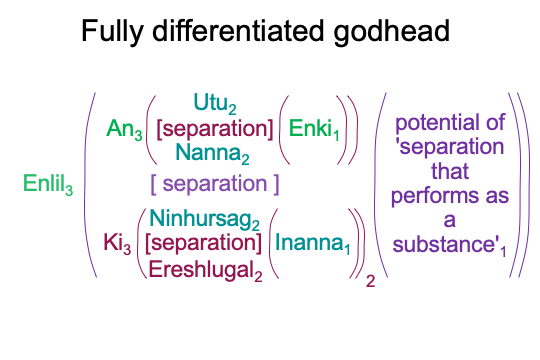
For now, here is a diagram of the fully differentiated godhead, containing the original members of the divine council, called the “Anunnaki” by the Akkadians.
0110 The three big name gods are in green. The remaining four lesser name gods are in blue-green. Notably, Ki3 and Ereshlugal2 are out of the Anunnaki club. Ki3‘s appears to hybridize with Ninhursag2 within the name of Ninmah3(2). Ereshlugal2 eventually becomes queen of the underworld.
0111 Are there any clues that support these associations?
0112 Let me first look for a clue in the heavens.
0113 I asked google-based AI to search for an article about the Sumerian gods and celestial beings. It came up with a work by Enn Kasak and Raul Veede titled “Understanding Planets in Ancient Mesopotamia”. The article appears in the electronic journal, Folklore (vol. 26 (2001) doi: 10.7592/FEJF2001.16.planets). The search software even offered an AI summary.
Planetary assignments are not always clear, since the systematic observations of the heavens is not standardized among the competing city-states for the longest time. Also, associations change over time. Some planets are very apparent to the naked eye (Mercury, Venus, Mars, and Jupiter) and some are less so (Saturn).
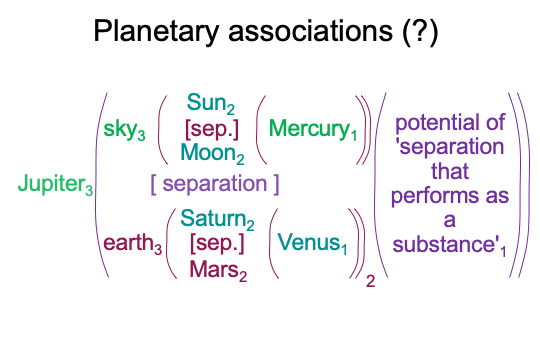
0114 Kasak and Veede offer a Table 2 that is geared to the Sumerian period from 3500 to 2300 BC. My reproduction of the table is not accurate, in so far as I substituted Enki and Ninhursag for Sumerian gods that Dr. D. Basak does not mention. These gods are Simut for Mars and Ninurta for Saturn.
With that said, here are my associations.
0115 Once again, these associations are speculative. They show that this godhead differentiated sometime before the Sumerian Dynastic. Each god is distinct enough to associate to a wandering star (more or less). Plus, the association of Enlil3 with Jupiter3 is astrologically appropriate and historically associates to the lead god of a pantheon.
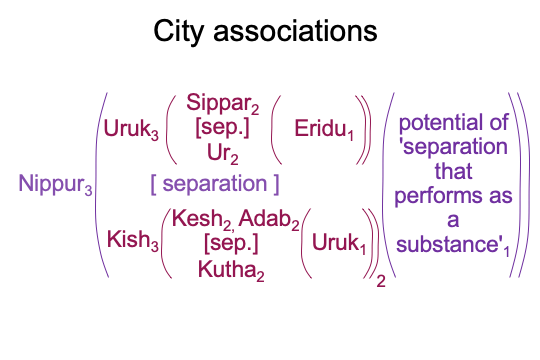
0116 Another match comes from chapters 0 and 5 from Basak’s text. Each Sumerian city associates to a god.
0117 The holy city of Nippur3 associates with Enlil3. The first city is Eridu1, associating to Enki1. The dual-affiliated city of Uruk3and1 associates to An3 (one district) and Inanna1 (another district).
Why demonstrate that the Anunnaki god-system coheres to a complete category-based nested form that reconciles the major gods and many minor ones (at least the gods that appear directly in the Enlil3 creation story)?
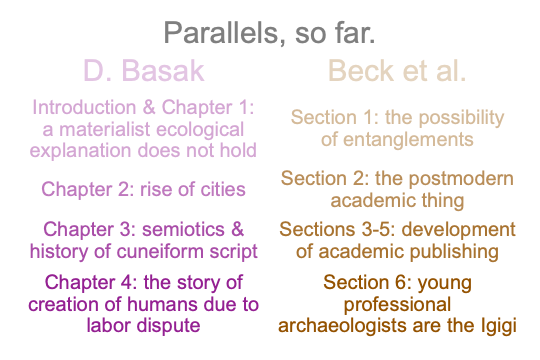
0119 Take a look at where I’ve been.
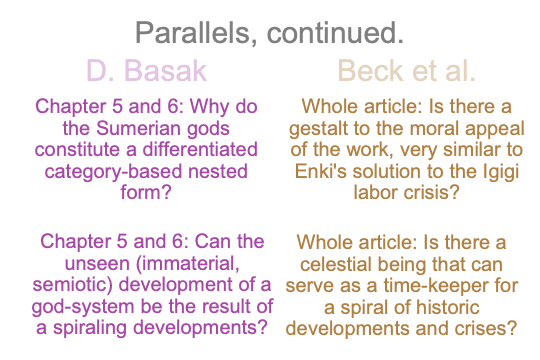
Here are the parallels between D. Basak’s (2025) text and Beck et al.’s (2026) article.
0120 These parallels tell me that Basak’s notion in chapter 1, that the ecology, geology and climate of the land between the two rivers entangles the Sumerian mind, does not fully account for the origin of Sumerian mythology. It is not the reason why southern Mesopotamia gives rise to one of the first ancient civilizations. And yet, if Basak’s book is AI generated, then that is what pre-2025 modern archaeological literature is saying.
0121 Not only that, but the same… um… potential that Enlil’s Sumerian creation myth imagines, but cannot label, seems to be operating today, as witnessed by Beck et al.‘s article. Little do these experts realize that their civilizational struggle is as old as… um… civilization itself.
The rise of urban sites during the Uruk parallels the academic thing for the past 165 years. The development of cuneiform script unfolds like the three types of natural sign-relations. So does the journal article in modern academic publishing. Finally, the woeful conditions of young professional archaeologists mimic the Igigi. Their rebellion initiates the creation of humans (in order to do the work of the Igigi). The big question is, “Who are the lullu that the gods will create in order to solve the current labor crisis?”
My guess is that they are podcasters.
0122 Next, I enter into a nested form inquiry into the Enlil creation story, with the intent to show that the Anunnaki cohere to the relational structure of the category-based nested form. The Anunnaki are the seniors gods compared to the Igigi lower gods. Even though the senior gods are apparently different, because they represent different features of humanity’s material world, each god settles nicely into a slot in a highly differentiated nested form. The actuality of this nested form consists of nested forms.
The only slot that does not have a god as a label is the potential1 underlying the ruler of the pantheon and figurehead of the Anunnaki, Enlil3.
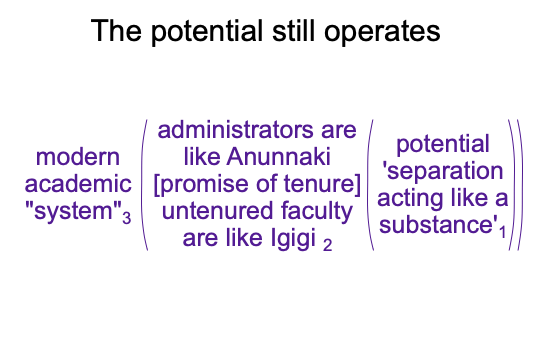
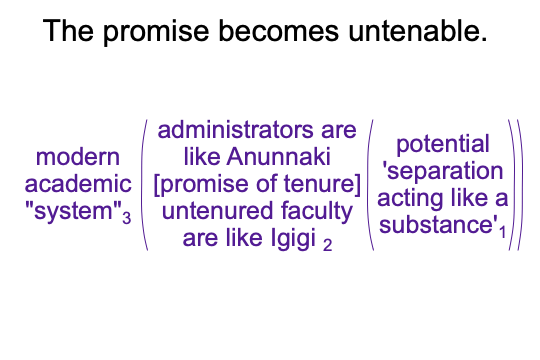
0123 The following nested form tells me that this potential1 still operates.
And, young professional archaeologists are living it.
0124 Here is a problem that is difficult to face. In the above figure, the promise of tenure is the contiguity between Anunnaki-positioned administrators (including the publishing houses) and Igigi-positioned young professional archaeologists. The promise of tenure is the substance that the potential of separation manifests.
To me, the promise of tenure recalls Gilgamesh’s heroic pursuit of immortality.
Indeed, the awarding of tenure elevates a faculty through the contiguity, the substance that manifests the principle of separation, into the realm of the… how shall I say it?… senior gods.
After the coming financial deluge, there will be only one professor with tenure, and his name will be “Utnapishtim”.
0125 What do I mean by that?
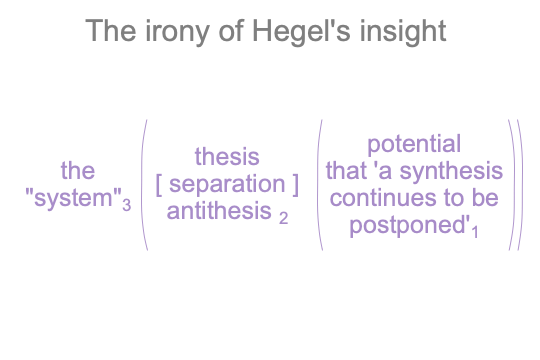
Writing in the early 1800s, Georg Wilhelm Friedrich Hegel (1770-1831) figures out that the spirit3, moving over the waters, operates on the potential of a synthesis1 to overcome the dyadic actuality of a {thesis [separation] antithesis}2 in the normal context of a civilizational system3.
Perhaps, this is precisely what contemporary young professional archaeologistsare calling for.
0126 Unfortunately, as long as the spirit3 does not move, the synthesis1 is postponed.
The system3 remains as is.
In other words, the potential of postponing a synthesis1 resides in the same location as the potential of a separation acting like a substance1.
0127 Just saying.
0128 This pathos-ridden side-comment raises a question hidden within Beck et al.’s history of the academic journal.
Are the authors asking for a solution in which tenure remains, thereby postponing the synthesis1 and maintaining the system3?
0129 Here an introduction to a few of the questions that I am wondering about.
0130 These questions must be regarded in light of Beck et al.’s brief history of academic journals. Their story starts with the establishment of state-supported institutions of higher education around the time of the Civil War in America and after the revolutions of 1848 in Europe.
0130 In America, the federal government establishes land-grant universities through legislation in 1862 and 1890.
In Europe, France, under the Emperor, Napoleon III, starts a war with Prussia in 1870. In 1871, France is defeated after a Prussian siege of Paris. During the siege, the so-called “Paris commune” springs to life, extolling a communist manifesto by an intellectual in Britain, Karl Marx, who (up to this point in history) was regarded a fringe. Marx returns the favor by giving a rousing speech, titled “Civil War in France”.
French citizens blame the results of the war on the superior public universities in Germany.
0131 Before this moment, journals are private affairs aiming to inform practitioners of the latest investigations and results. Journals image problems, methods, data, and results.
After this moment, journals start to serve as indexes of academic accomplishment.
0132 In 2026 AD, Beck et al. notify the readers of Current Anthropology that this civilizational cycle is coming to a close.
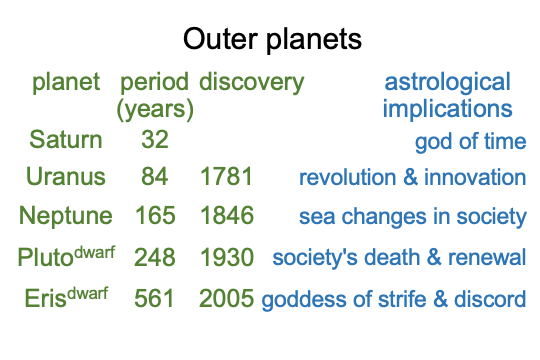
0133 The time difference between 2026 and, say, 1862 is 164 years. If the archaeologist uses the periodicity of the outer planets as celestial clocks, which outer planet matches this timeframe?
0134 Obviously, it is the periodicity of Neptune.
Since Neptune is discovered by astronomers in 1846, astrologers of a modern bent have been hard at work combing though various histories in order to see whether social events show a spiraling periodicity with a 165 year cycle. The zodiac is already divided into 12 slots, so a pattern of social events that occurs when Neptune passes through one house should repeat when Neptune returns to the same house.
Does that sound like an anthropological hypothesis?
0135 As it turns out, Beck et al.’s brief history of journal publishing fits a 165-year spiral with remarkable precision.
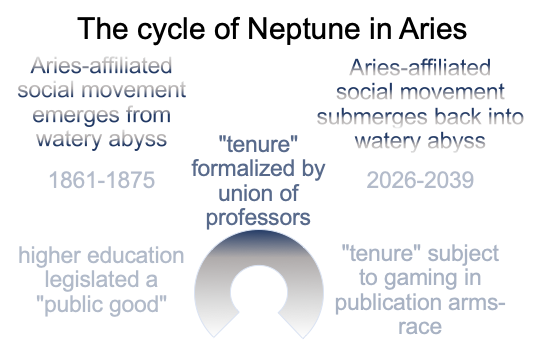
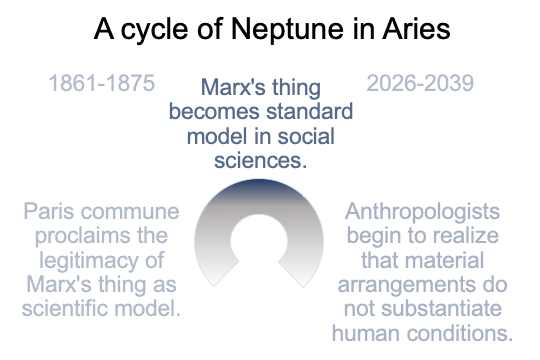
Neptune enters the constellation of Aries in 2026, matching the terminus of a social movement that began the last time when Neptune was in Aries, between 1861 and 1875.
Here is a picture.
0136 The social movement that comes together to declare that higher education is a “public good” in the 1860s currently falls apart on the contradictory nature of what is called, “tenure”. Near the start of the cycle, tenure is formalized by a union of professors. At the top of the cycle, tenure has an impeccable reputation. Then, more are more academics discover that tenure is a substance that can be gamed, resulting in the same societal crisis as the one portrayed in the Eridu Genesis. In the end, corruption from above overwhelms competition from below. The game is rigged.
0137 Here is a reminder.
0138 The label given to Neptune serves as a site for astrologers (and anthropologists) to regard our current Lebenswelt as a developing spiral.The Neptune spiral is about sea changes in society. An idea rises as an island of certainty within a sea of uncertainty. Then, it sinks from the weight of its own internal contradictions.The professionalization of the sciences is not the only spiral associated with Neptune in Aries. The emergence and submergence of other conceptual apparatuses may be worthy of consideration. I will present one shortly.
What other conceptual apparatus congeals when Neptune is in Aries and then blobs out in the same zodiac sign, one orbit of Neptune later?
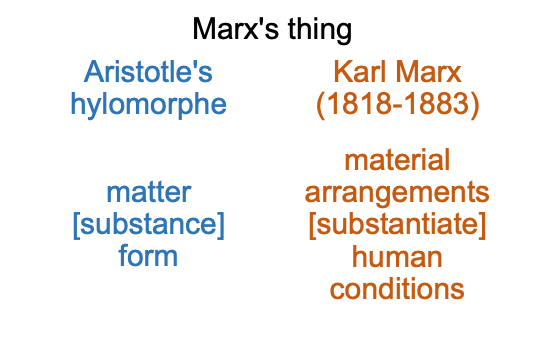
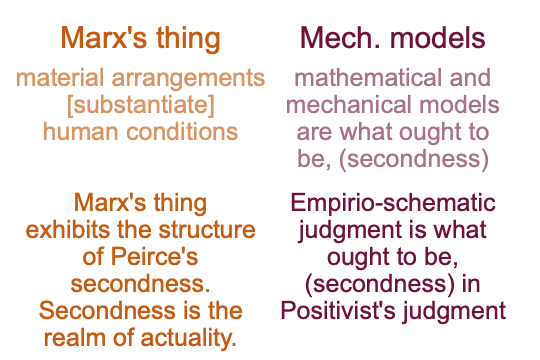
0140 Here is a picture of Marx’s thing.
0141 Marx’s thing is not a mathematical or mechanical model. It is a variation of Aristotle’s hylomorphe, which is an exemplar of Peirce’s category of secondness. Secondness is the realm of actuality. The realm of actuality is subject to the logics of contradiction and non-contradiction. The realm of actuality is what science is all about.
Remember that the mechanical philosophers are writing in Europe around 1600s, near a peak of Neptune’s cycle that passes through Aries in 1533-1548 and then in 1697-1706. This Neptunian cycle concerns literalism. Literal references [substantiate] spoken words. I call this hylomorphe, “Martin Luther’s thing”.
0142 A sea change starts with the Reformation (1533-1548) proclaiming that literal interpretation of the Bible (translated into the person’s vernacular) is to be preferred to the Catholic’s literal, allegorical, moral and anagogical approaches.
The sea change overflows the dikes by the time Neptune enters Aries again. Pierre Bayle (1647-1706) publishes Dictionnaire Historique et Critique (1697) with copious and often secret messaging footnotes. John Harris (1667-1719) publishes Lexicon Technicum, the first with all the accoutrements of a modern encyclopedia. The modern dictionary is a tribute to Luther’s thing. If literalism is real, then aren’t dictionaries necessary?
What is more literal than a dictionary?
At the height of this sea change, mechanical philosophers (around 1600) design the empirio-schematic judgment. This judgment is a triadic relation. A literalist disciplinary language (relation, thirdness) brings mathematical and mechanical models (what ought to be, secondness) into relation with observations and measurements of phenomena (what is, firstness). Dictionaries and encyclopedia are demanded by disciplinary languages.
0143 Baruch Spinoza (1632-1677) is the precursor to what comes together during the next Neptune in Aries (1697-1706). If literalism is real, if literal references [substantiate] our spoken words, then we can be rational in ways that people have never really been rational before. Gottfried Leibniz (1646-1716) proposes a systematic rationalism, which rises to the formulation of the Positivist’s judgment, which contains the empirio-schematic judgment as what ought to be.
0144 What is the Positivist’s judgment?
A positivist intellect (relation, thirdness) brings the empirio-schematic judgment (what ought to be, secondness) into relation with phenomena (what is, firstness).
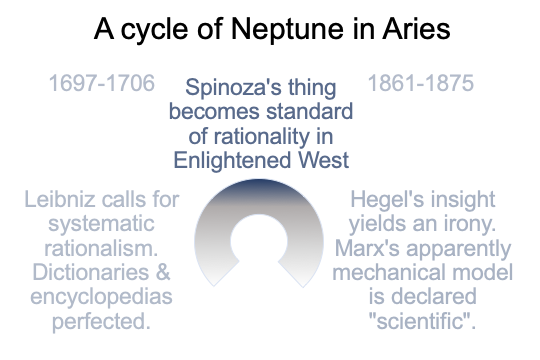
When Neptune is in Aries between 1697 and 1706, the relationship between faith and reason is a topic of intense interest. Scientific reasonas a manifestation of literalism (as opposed to religious reasoning) arises from the sea of uncertainty and sets the stage for further developments. The western Enlightenment is going to be the high-point of the coming cycle (1697 to 1861). I call this Neptune-in-Aries cycle, “Spinoza’s thing”.
0145 Here is a picture.
0146 Both Immanuel Kant (1724-1804) and Georg Wilhelm Friedrich Hegel (1770-1831) write between the emergence and submergence. In a way, they represent how Spinoza’s thing, actualized by Leibniz during Neptune’s passage through Aries, reaches its peak as well as its point of manifesting the contradictions that will lead to its submergence.
In the descent, Karl Marx (1818-1883) proposes a dyadic structure that substitutes for a mathematical and mechanical model. In other words, Marx claims that his dyadic model is scientific. At the start of the next passage of Neptune through Aries, the Paris Commune proclaims Marx’s thing as the scientific model that must be taken literally by their international movement. This international movement captures the imagination… er… “empirical interest”… of the burgeoning social sciences.
0147 Here is a picture of the next cycle for Neptune in Aries, which comes to its submergence at the current moment (1861-2026).
0147 For this cycle, one may ask, “Is Marx’s thing really a scientific model? Or is Marx somehow gaming the Positivist’s and the empirio-schematic judgment?”
0148 The answer begins with the question, “What is a judgment?”
A judgment contains three elements, relation,what ought to be, and what is. When each element is assigned a unique Peircean category, then the judgment becomes actionable. Actionable judgments unfold into category-based nested forms on the basis of the categorical assignments.
0149 What are the Positivist’s and empirio-schematic judgments?
The Positivist’s judgment consists of a positivist intellect (relation, thirdness) bringing an empirio-schematic judgment (what ought to be, secondness) into relation with the dyad, {a noumenon [cannot be fully objectified as] its phenomena} (what is, firstness).
The empirio-schematic judgment, in turn, consists of a disciplinary language (relation, thirdness) bringing a mathematical or mechanical model (what ought to be, secondness) into relation with observations and measurements of phenomena (what is, firstness).
0150 Here is the trick.
Marx’s thing has the structure of Peirce’s secondness. Secondness consists of two contiguous real elements. The real elements are material arrangements and human conditions. Secondness is the realm of actuality.
Mathematical and mechanical models belong to what ought to be in the empirio-schematic judgment. And, what ought to be is assigned to the category of secondness. Observations and measurements belong to the category of firstness. Disciplinary language belongs to the category of thirdness. These assignments place mathematical and mechanical models into the realm of actuality.
Also, the empirio-schematic judgment belongs to what ought to be and is assigned to the category of secondness in the Positivist’s judgment.
0151 So, why would a dyad that belongs to secondness not effortlessly glide into a slot that is twice imbued with that category?
0152 Who is so fixated on the natural sciences as to notice that Marx’s thing is not exactly a mathematical or mechanical model?
Only natural scientists would notice. Those that do are shunned by social scientists.
0153 Meanwhile, social scientists bend over forward in order to apply rigorous statistical criteria and analysis to their materials and methods sections, as if statistical manipulations are equivalent to mechanics and mathematics.
Precisely how does an inquirer demonstrate that the Marxist thing (as a scientific model) does not work because there is a flaw in its mathematical or mechanical formulations?
Indeed, phenomena are observed and measured selectively in order to support the appearance of mathematical or mechanical certainty characteristic of the physical sciences.
0154 Even more disheartening, statistical models constructed on selective observations and measurements of phenomena are crucial for the publications that administrators count, as if each publication is a data point that goes into a model of “academic productivity”.
0155 No wonder young professional archaeologists are exhausted.
0156 In biology, appearances initiate sign-relations.
Sign-relations are based on Peirce’s three categories of firstness (monadic possibility), secondness (dyadic actuality) and thirdness (triadic relations).
So are category-based nested forms.
0157 Category-based nested forms are not material. Materials participate in these immaterial relations.
Category-based nested forms are real. They contain secondness (what most scientists consider to be their subject matter) within their relational structures.
0158 How real are triadic relations, such as signs and category-based nested forms?
According to Razie Mah’s 2018 e-book, The Human Niche, our kind adapts to exploit the potential of triadic relations. This e-book is packaged with separate reviews of four works: Steven Mithen’s Book (1996) The Prehistory of the Mind, Clive Gamble, John Gowlett and Robin Dunbar’s Book (2014) Thinking Big, Derek Bickerton’s Book (2014) More Than Nature Needs and Robert Berwick and Noam Chomsky’s Book (2016) Why Only Us?.
Later works by Razie Mah include the 2024 work, Comments on Michael Tomasello’s Arc of Inquiry (1999-2019).
0159 What else might be of interest to young professional archaeologists?
What else points to the failure of Marx’s thing?
Here is a question.
Does human evolution comes with a twist?
In four blogs posted on January 1, 2026, Razie Mah looks at Melinda Zeder’s Article (2025) concerning the term, “Neolithic”. He proposes that two transitions occur at the same time (S and T).
0160 The first (S) concerns the domestication of plants and animals, sedentary communities, and other items that archaeologists associate with the term, “neolithic”. This topic has been the subject of intense inquiry by archaeology since… around… 1861 to 1875? Research into the neolithic era has been conducted with Marx’s thing in mind.
0161 Well, shades of Neptune in Aries, according to my internet search, the term “neolithic” was first coined by John Lubbock in 1865, as a refinement of the stone, bronze and iron ages.
0162 The second (T) concerns a change in semiotic conditions, from hand-speech talk (the way of talking for Homo sapiens since its inception) to speech-alone talk. According to Razie Mah’s short 2014 e-book, The First Singularity and Its Fairy Tale Trace, the first culture to practice speech-alone talk is the Ubaid of southern Mesopotamia. The Sumerian language (which is unrelated to any family of languages) is a speech-alone creole formed when two hand-speech talking cultures (one living along coast and rivers and one living on hills in the dryland Arabian Gulf) are forced into proximity by the rising waters of the Persian Gulf. They form a pidgin, then a creole.
0163 Returning to that review of Melinda Zeder’s (2025) article in the journal, Prehistory, Razie Mah suggests that, within the currently conceptualized Neolithic period, another transition – a change in semiotic practices – occurs with the spread of speech-alone talk from the Ubaid to the hand-speech talking world, constituting an irreversible phase transition.
Needless to say, Razie Mah’s hypothesis of the first singularity suggests that a lot of research needs to be done in the field of archaeology.
The e-work, The First Singularity and Its Fairy Tale Trace, is framed as a research proposal.
0164 The word, “sumer”, is first published in 1869, when Neptune is in Aries.
0165 The review of Melinda Zeder’s article is published January 1, 2026, at a time when Neptune is about to enter Aries.
0166 I’m not saying that this is an astrological phenomenon. I am saying that anthropological researchers need a way to track civilizational changes within our current Lebenswelt, spanning from the most rapid sea-water rise at the end of the last ice age (nominally, at 0 Ubaid Zero Prime) to our current moment (nominally at 8823 U0′). The orbits of the outer planets may have periodicities convenient for marking spiraling developments in unconstrained social complexity.
I love sentences like that.
For U0′, subtract BC year from 6800 or add AD year to 6800. 6800BC equals 0 U0′.
Future refinements should be anticipated.
0167 This examination of two distinctly different contemporary works, a (possibly AI-generated) book on Sumerian mythology by Dr. D. Basak and a recent publication on the need for a change in publishing in archaeology, show that – whatever is responsible for the Sumerian civilization – is still operating today.
0168 There may be (say) two millennia (12 Neptunian cycles) between the routinization of the creation myth associated with Enlil3 and the one associated with the so-called “Eridu Genesis”.
Yet, from my associations (which are admittedly speculative), both narratives rely on the potential of ‘a separation that serves as a substance’1.
0169 Here is a picture.
0170 Does that potential still operate today?
The surprisingly evocative similarity between the creation of humans in the Eridu Genesis and a recent publication in Current Anthropology suggests that the current labor dispute will resolve with the creation of a new “human” that will take some of the work of the Igigi-like professional archaeologists.
I think that these new “humans” will be podcasters.
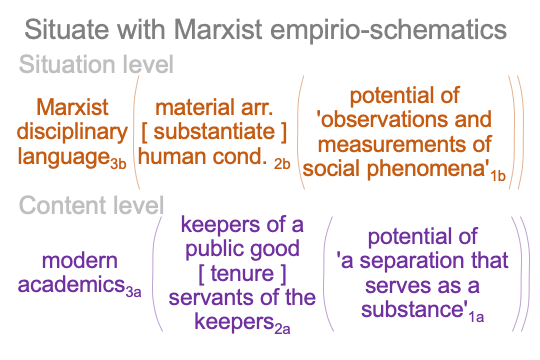
0172 Even more disturbing, the similarity suggests that [tenure]2a, the promise of low pay combined with total job security, is the substance that actualizes the potential of ‘a separation that serves as a substance’1a for the current labor dispute.
0174 Did the Igigi work so diligently for the Anunnaki because they were promised something akin to tenure?
0175 In the following diagram, the current iteration of the Eridu Genesis occupies the content-level of the following two-level interscope.
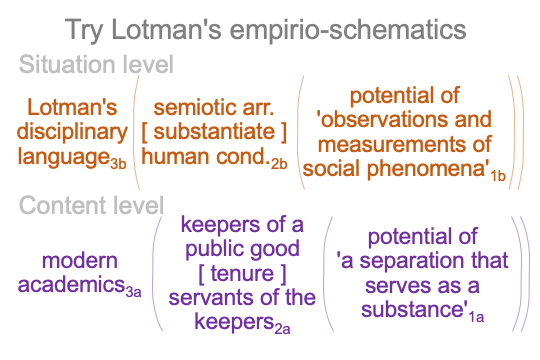
0176 Marxist empirio-schematics occupies the situation-level.
Marxist disciplinary language (relation, thirdness) brings the dyadic model, {material arrangements [substantiate] human conditions} (what ought to be, secondness) into relation with observations and measurements of civilizational phenomena (what is, firstness).
0177 The situation-level virtually emerges from (and situates) the content-level.
Here, “virtually” means “in virtue” (the premodern reference) rather than “in simulation” (the modern reference).
0178 Beck et al. clearly exhibit the hallmarks of this sensible construction. The article clearly articulates that the material arrangements of academic publishing and university promotions [substantiate] their less-than-acceptable conditions. The essay suggests ways to improve those arrangements.
The manifesto does not suggest any changes that challenge the substance that separatesthe archaeological researchers (the authors) fromthe keepers of the public good (university administrators and publishing houses). After all, these young professionals have worked so hard to obtain tenure. It is inconceivable that “tenure” is the highest point of elevation in a wave, passing through time, starting with legislation promoting higher education as a “public good” (in the 1860s) and ending with a publication arms-race that guarantees that the… um… well connected get to pass through the separation that serves as a substance (in the 2020s).
0179 Meanwhile, Dr. D. Basak does not need tenure to produce an (apparently AI generated) book on Sumerian mythology, ancient civilization and the epic search for humanity’s origins. Perhaps, Dr. Basak does not care that tenure is what falls apart as a sea change submerges due to the weight of its internal corruption and contradictions.
Nor does Dr. D. Basak recognize that the first chapter, which asserts the dyad, {the material arrangements of geology, ecology and climate of the land between the Tigris and Euphrates Rivers [substantiates] the human conditions associated with the emergence of the one of the earliest civilizations on Earth}, is Marxist to the core.
0180 The proposition may be correct to some degree.
A particular set of material arrangements may have set the stage for a change in humanity’s semiotic arrangements.
However, speech-alone talk is what potentiates unconstrained social complexity, in a unique irreversible transition that starts with the Ubaid of southern Mesopotamia, 8826 years ago.
0181 Doesn’t that sound like a huge research project?
Plus, it portends the dissolution of the Neptune-in-Aries sea-change starting between 1861 and 1875.
0182 The claim that Juri Lotman’s semiospheric thing will replace Karl Marx’s materialist thing as the social science model is developed in Razie Mah’s blogs in December 2025 through March 2026. The first in the series is Looking at Igor Pilshchikov and Mikhail Trunin’s Article (2016) “The Tartu-Moscow School of Semiotics”.
0183 Here is a picture of a new paradigm for understanding Beck et al.
Now, postmodern intellectuals can imagine that tenure2a actualizes the potential of ‘a separation that may serve as a substance’1a.
This raises the semiotic question, “What does tenure2a stand for?”
0185 First, ideology defines the Sumerian city (chapter 2, Basak) and the modern multiversity (section 2, Beck et al.).
0186 Second, Peirce’s natural sign typology may be used to frame the historic transition from ideographs to the rebus principle (chapter 3, Basak) as well as the historic development of academic journals (section 2, Beck et al.).
0187 Third, the same historic transitions in the second item may also be framed using Razie Mah’s category-nested form for the definition of a spoken word.
0188 Fourth, the creation of humans in the Eridu Genesis (chapter 4, D. Basak) portrayed as a nested form, matches the current crisis in academic publishing in the discipline of archaeology (discussion, Beck et al.).
0189 Fifth, D. Basak fails to recognize that the Sumerian divine assembly (the Anunnaki) may be portrayed by filling in slots within the purely relational structure of the category-based nested form. This failure indicates a blind spot that implicates the field of archaeology for the past 165 years. If the speculation that the book under examination is AI-generated is true (and that is not certain at the moment of writing) and if an AI program cannot process what its training material does not envision, then this failure may also apply to Jess Beck et al.’s assessment of the material arrangements that substantiate the conditions of young professional archaeologists.
These researchers are blind to parallels between ancient Sumerian mythology and their own professional crisis, because the Marxist thing clouds their vision.
0190 Sixth, the Marxist thing sinks into a sea of uncertainty.Anthropologists are burdened with material analysis. They cannot envision Lotman’s thing, {semiotic arrangements [substantiate] human conditions}, distilled within a Marxist political institution from the art and literature of Slavic civilization.
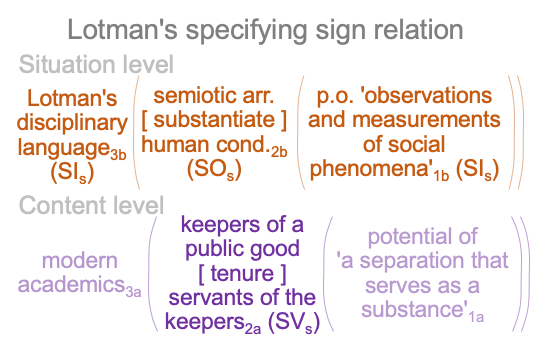
Only Lotman’s thing3b allows anthropologists to address the question, “What if tenure2a (SVs) stands for the substance2b (SOs) actualizing the potential of ‘observing and measuring a social conflict’1b in the normal context of the disciplinary language of the Tartu-Moscow School of semiotics3b (SIs)?”
What if tenure is not situated as a material arrangement?
What if tenure (SVs) stands for a semiotic arrangement (SOs)?
0191 Indeed, the specificative sign-relation says the following, “The content-level actuality of {keepers of the public good [tenure] servants of the keepers)2a (SVs) stands for the situation-level actuality of Lotman’s thing2b (SOs) in regards to the disciplinary language of the Tartu-Moscow School of Semiotics3b operating on the potential of ‘observations and measurements of phenomena of the current crisis in the publishing of research papers and its importance in promotions in post-modern universities’1b (SIs).
Where can I get information on this specifying sign-relation?
Take a look at Razie Mah’s blog for October, 2023, titled Looking at John Deely’s Book (2010) “Semiotic Animal”.
0192 Now, I would like to return to the idea that Dr. D. Basak approaches Sumerian mythology, ancient civilization and the epic search for humanity’s origins from a Marxist point of view, because, to date, all research in anthropology is conducted with the Marxist thing as a model.
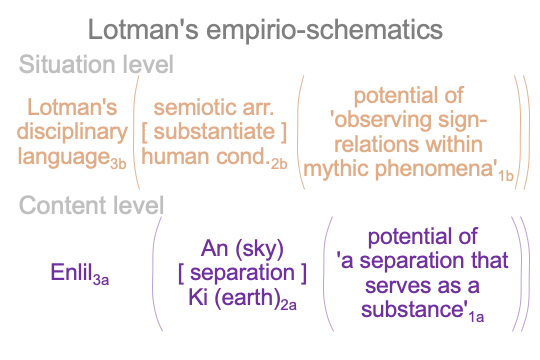
0193 The following figure shows the challenge posed by a specifying sign-relation whose time has come (according to a Neptune in Aries cycle).
0194 This specifying sign-relation says, “The content-level dyad, {An (sky) [separation] Ki (earth)}2a (SVs) stands for the situation-level dyad, {semiotic arrangements [substantiate] human conditions}2b (SOs), in regards to a situation-level normal context, Tartu-Moscow School of Semiotics disciplinary language3b, operating on the potential of ‘observations and measurements of mythic phenomena’1b (SIs).