07/10/26

Looking at Peter Burfeind’s Book (2014) “Gnostic America” (Part 18 of 26)

0320 In the following figure, brown is evil and red is good.

0321 Already, this looks a little scary, since the de-humanization of others is built into the realm of actuality.

Other people are machines or animals or little folk.  They are people possessed by material concerns, the daemons of Yaltabaoth and the Establishment.  As such, they are evil.

0322 In the Gnostic origin myth, the Establishment level is ruled by mindless reason.  The Establishment level is dominated by the builder god and his establishment.  It situates the ego through material concerns.

0323 The establishment level matches the organization tier in the 3-tier system. The comparison follows:

0324 Let me go over the storyline for the organization tier, before delving into the comparison.

Here is how the organization tier goes from content to perspective levels.

The individual in community (IiC) makes a judgment. The judgment inspires the individual to associate with others of similar judgment. If the judgment is about material concerns, then the individual may join or invent an organization. This organization will manage, produce or service these material concerns.

0325 If the organization is a factory, then management, production and service come into play in its operations.  The money brought in from product sales must be greater than all costs of manufacture, delivery and sales.   So, there may be conflict among the various parties within the content-level of the organization tier.  Management always wants to pay less salary than factory workers think they deserve.

0326 The price of the product in the market minus the cost to the worker in the production of the product resembles Marx’s concept of surplus value.  The price is always set to bring in more money than total costs.  The cost to the worker cannot be measured since it involves lost opportunity.  Consequently, Marx’s concept of surplus valueconstitutes secret knowledge.

0327 Goods and services must be marketed. In an open market, the exchange occurs when both parties are willing to exchange something of value. You give me this. I give you that. The exchange would not occur without benefit to both parties.

In market exchange, others participate in the corporation without directly belonging. Whenever I buy a loaf of bread or an automobile, I participate in an organization, even though I think that I am buying a simple commodity.  This is the idea behind Marx’s concept of the commodity fetish.

0328 At crucial junctures, the entire organization must be assessed.  The question is: Do we continue to do what we are doing?

The answer must take into account the institutional mission, as well as the people in management, production, and services.  The answer must take into account market exchange, the sales division, the price of the good, subsidies and taxes, advertising and the participation of others in the organization through purchases.

0329 Marxist theory condenses all these difficult assessments into one factor: capital. This is remarkable, because the status of the balance sheet is a necessary, but not sufficient, feature of an organization’s assessment.  Marxist theory reduces assessment to capitalism.

0330 That reduction constitutes secret knowledge.  Anyone who decries “capitalism” talks Marxist Gnostic lingo.  The lingo’s “secret” is that assessment in the organizationcB tier is equivalent to mindless rationality3b.  If that were the case, then stressed-out assessors would be liberated from both responsibility and freedom.  All the assessors would need to do is follow a recipe.

0331 There is no “ism” for “capital”.  The word “capitalism” is not a religious belief.  Communism, the belief that capital is an undead thing that possesses the souls of assessors, is.  Capitalism is the name applied to assessment by communists.

0332 Capitalism is a projection. Balance sheets are not.

(These topics are discussed in the two Primers on the Organization Tier.)

07/9/26

Looking at Peter Burfeind’s Book (2014) “Gnostic America” (Part 19 of 26)

0333 Now, I will detail the association, starting with the second column, the virtual nested form in secondness.

Remember: In the Gnostic formulation, the Establishment level is evil.

0334 By sublimating all the difficult parts of the assessment, Marxist theory reduces economic and political planning to both capitalism and mindless rationality.

Capitalism and mindless rationality put market exchange into a normal context.  Consequently, the actuality of market exchange is both evil and stupid. Market exchange is evil because it tends to focus on material concerns. Market exchange is stupid because it is contextualized by an undead ruthless thing (capital) and mindless rationality.

0335 Yaltabaoth is the builder god. The builder god establishes physical and cultural cause and effects.  The Establishment denotes the corresponding social norms.

0336 Initially, I would think that both would correspond to the content level of the organization tier. They do not. Instead, they correspond to the Real of the organization tier.  They correspond to the situation level of market exchange.

0337 Market exchange is so difficult to consider.

0338 One analogy is the jungle.

Every animal is looking for food. There is no awareness of how the food got there. Where do the plants come from? They are like factories that turn light energy from the sun into chemical potential energy. Animals look for plants that they can eat. They have no idea of what the plants are doing. Can I call this lack of awareness, the “grazing fetish”?

Then, there are the animals that eat other animalsThe eater is not aware of how the eaten got there. Ah, this must be the carnivore’s fetish.

0339 The evil builder god that is ‘the jungle’, then, manifests itself as a complex web of exchange that determines whether every living form lives or dies.

0340 Maybe, there are lesser gods, like the archons, determining processes in each living form that helps it to survive. Maybe, there are “social” norms, allowing animals and plants to mix their genes and reproduce. Every species has its own Establishment.  Each species follows its own fetishes.

The foundation of each species rests in the requirements of sexual reproduction.  The rule is simple. The rule is mindless. Genetic material is the equivalent of capital in the jungle. Assessment is the continuation of the species.

0341 So, market exchange is like the jungle. It is unpredictable, wondrous, horrifying, teeming with life, and exploding with fetishes.

Yaltabaoth and the Establishment construct and maintain something immaterial: relationships. These relationships are among beings with material concerns.

0342 For a moment, let me flash back to how the Gnostic origin myth images the first singularity.

Once the small river valleys of Iran came in contact with Ubaid explorers and missionaries, they adopted speech-alone talk. Each locale began to explore the cognitive spaces opened by speech-alone talk.

Each locale finally produced enough know-how (labor specialization) and know-who (social specialization) to determine the forms of those within the civilization. The princes and priests enforced the basic rules allowing market exchange. Or, so they claimed. The basic rules actually reinforced themselves through successful market activity.

0343 Various technical clans produced. Various bureaucrats (if one can call them that) managed. Various anointed ones arranged services.  The market worked as long as everyone followed the simple rules.  The local skeptic called the rules: fetishes.

0344 The entire society flourished with the generation of surplus value. More children lived than died. The population increased. The various roles within the civilization became more fixed. More land was put into cultivation. More traders were sent out. More warriors were recruited.

0345 Yaltabaoth and the Establishment were builder gods.  They were honored because of the material advantages of unconstrained complexity.  They constructed society from nothing.  

The only thing that can be created out of nothing is not a thing. It is a relationship.

0346 Do I have that correct?

Obviously not, because the builder gods were already working with things: people.

0347 What did the builder gods produce from these things that the things did not already have in themselves?

Relationships.

0348 Here is my association with Marx’s surplus value.

Surplus value is not the difference between the price of a commodity and the worker’s effort expended to produce that item. It is the value of the relationships that hold people in an organization. Without surplus value, the organization cannot hold itself together.

0349 Why are Yaltabaoth and the Establishment evil?

They build immaterial relationships based on material concerns. These relationships are inherently simple. They may be regarded as fetishes.  Relationships ground transactions.  Would I exchange goods with someone that I do not know?  Of course, I would not.

0350 Immaterial relationships build a web that sustains the egos of the participants.

The ego accounts for the Self. The ego is responsible for the Self. The ego acts in the name of the Self.

0351 The ego cages the Self.  The ego will not release the Self until the builder gods fail.  The builder gods fail when the cognitive spaces, opened by their efforts, no longer yield surplus value.  Without surplus value, relationships fail.

0352 Type 2 Gnosticism views the organization tier as an evil matrix that must be regulated and ultimately, destroyed.

Marxist theory concerning capitalism, commodity fetish and surplus value coheres to type 2 Gnosticism.

07/8/26

Looking at Peter Burfeind’s Book (2014) “Gnostic America” (Part 20 of 26)

0353 Now, I attend to thirdness.

Here is the match between elements of the Gnostic origin myth and levels of the society tier.

0354 The association strikes fear into my heart.  Look who is queen.

0355 The pleroma associates to the suprasovereign religionThe suprasovereign places the sovereign office into perspective. The pleroma puts Personified Wisdom into perspective.

0356 This is the foundation of relativism of the deepest sort.

Each age actualizes a different personification of SophiaThe Sophia of any past age is not the Sophia of the present ageThe Sophia of the present age is not the Sophia of the New Age.  Yet, ironically, the role of Sophia never changes.

0357 The division of ages by Joachim of Flora, in the 1100s, marks the birth of a new type of Gnosticism. The three ages inherent in Christendom, the disruption of the continuum of time by the entrance of God as a Person, were brought to Earth

Ever since, a New Age dangles in front of the type 2 Gnostic. The New Age lies just beyond the horizon. The New Age will be immortal. The present age is mortal.

0358 How to fly over the horizon?

No, that is type 1 Gnosticism.

0359 How to birth the New Age?

Yes, that is more type 2. 

The answer is: Seize sovereign power.

0360 The Marxist begins by destroying capitalism, the commodity fetish and the chains of surplus value.  The French revolutionaries of the late 1700s started by murdering the king while proclaiming a slogan, “fraternity, equality, and liberty”.

0361 Each contender for Sophia proclaims its own New Age.  Each pursues sovereign power in order to achieve the objectives of destroying the current regime in the process of giving birth to a New Age.

0362 Now, let me recall the Gnostic origin myth again.

The pleroma proceeds through emanations of male and female pairs, each grounding its own aeon. Then, female Sophia does not mate with her corresponding male emanation. She becomes pregnant and, before the child is even born, tears him from her womb and places him in a cloud.

No one can see Yaltabaoth. Yaltabaoth cannot see anyone else. So, in the cloud, Yaltabaoth creates his own universe.

What does he create his universe from?

From the personal part of the origin myth, I know this: He works with matter and he steals sparks from the Monad. He fashions beings with material concerns.

0363 To me, this sounds like institutions with organizational objectivesThe organization of any institution deals with matters at hand.  The organizational objective, the spark within any organization, is stolen from the surrounding pleroma, the Zeitgeist, the spirit of the times.

0364 The Monad includes the realm of possibility within the normal context of the current age (the pleroma). The Monad cannot be divided into outside of the cloud and inside the cloud. The Monad is right there for Yaltabaoth to work with. From the spark of institutions, Yaltabaoth fashions organizations.

The Monad teems with possibility. But, Yaltabaoth is only aware of the sparks that he needs to fashion his own universe.

0365 What exactly is Yaltabaoth stealing from the Monad?

In order to see, allow me to expand the levels of the society tier into nested forms.

0366 Yaltabaoth thinks that he is stealing sparks. He grabs hold of an organizational objective. But, the spark is not the organizational objective. The spark is the righteousness underlying the organizational objective.

The Monad teems with righteousness. Yet, Yaltabaoth is only aware of the organizational objectives needed to fashion his own institutional universe. These organizational objects inform infrasovereign religions, seeking to impose their laws and decrees throughout the universe, in attempts to actualize the possibility of order.

0367 After all, Wisdom searches for order.

Who is the best ruler?

Obviously, the philosopher king is the best ruler.

0368 The best ruler knows how to avoid the evils within the organization tier through laws and decrees.

But remember: The entire organization tier is evil according to type 2 Gnosticism.

What is the next-to-best?

0369 The next-to-best ruler knows how to regulate the pathetic ego-driven morons who are consumed with material concerns. The next-to-best ruler would open the door to those who are Self-actualized, drawing their immaterial concerns from the cloud of unknowing, and forging organizations without capital, without market exchange and without surplus value.

0370 So, what is the problem?

As soon as institutions are fashioned into organizations, material concerns diminish the spark. Material concerns occlude the righteousness of the organizational objective.

So the next-to-best ruler becomes Yaltabaoth and the Establishment.

0371 Type 2 Gnostics do not know that there is a problem.

They imagine that Sophia matches sovereign power.  They are intent on seeking sovereign power in order to implement their diverse organizational objectives.  Each organizational objective carries its own righteousness.  Each righteousness is pure and unquestionable.

0372 This sounds like big government liberalism (BGL) to me.

07/7/26

Looking at Peter Burfeind’s Book (2014) “Gnostic America” (Part 21 of 26)

0373 In type 2 Gnosticism, the term that best describes the Monad is “the Hive”.  BGL swarms with the drones of secular righteousness.

0374 Sovereign power is Personified Wisdom.  BGL organizational objectives that demand sovereign power are righteous.  Burdens are placed on the organization tier, yoking Yaltabaoth and the Establishment to “higher” ends.

Yaltabaoth and the Establishment no longer consist of simple rules or “fetishes”. They become a complex web of government-regulated organizations, where surplus value is harvested by bureaucrats as the Personifications of Sophiaand directed to establishing the New Age.

0375 Slogans about the organization tier multiply.

Assessment is discrimination. Capital is a religion, called “capitalism”. Capital is the undead remainder of profit and loss. Capitalists mindlessly, ruthlessly, and tirelessly strive to increase their capital. Capitalists are greedy.

Open markets need to be regulated. Both parties do not benefit from an open exchange. Salespeople are liars. Loans (based on assessments) discriminate. The commodity fetish is the failure of consumers to see that their purchases support the exploitation of workers.

People go into management, production or service because they have no other choices. They cannot make ends meet because Yaltabaoth does not value their efforts.  The Establishment harvests surplus value from those within the organization.  Corporations are evil.  They must be regulated.

0376 This list goes on.  Each slogan is righteous. Each slogan supports an institution seeking sovereign power. Each slogan becomes an organizational objective for an infrasovereign religion.

Each slogan puts anyone who is not a type 2 Gnostic is an easily labeled box. The box stereotypes the conditioning, the training, the ambitions and the fears of the other.

Other people are things to be regulated.

0377 Finally, the Self judges through an intuition based on fantasy.

The Real is not a concern for the type 2 Gnostic.  Sovereign power will be used to purify the organization tier and the ego-driven person.

0378 BGL applies to the society tier. Marxist theory applies to the organization tier. The psychoanalysis of Freud and Jung applies to the IiC tier.

0379 I summarize.

0380 There are two manifestations of religion, suprasovereign and infrasovereign. Gnosticism fits both. Gnosticism completely fits the presence underlying the word “religion”.

0381 There are two types of infrasovereign Gnosticism, type 1 and type 2.

In type 1 Gnosticism, the model of the Gnostic origin myth associates to the interscope of the society tier. The evil Yaltabaoth associates to sovereign laws and decrees. The good Sophia matches the object that brings all into relation.

In type 2 Gnosticism, the model of the Gnostic origin myth associates to the 3-tier system. The evil Yaltabaoth associates to market exchange. The good Sophia associates to sovereign power.

0381 BGL, Marxist economic theory, and Freudian and Jungian psychoanalysis describe contemporary American type 2 Gnosticism.

0382 The adherents of each type of infrasovereign expression of Gnosticism may be identified through a series of straightforward questions.  These questions include:

Do you believe that the Federal government (sovereign power) is good or evil?

If evil, then the person is a type 1 Gnostic. If good, then the person is a type 2 Gnostic.

What should we do about the Establishment?

0383 If the person expresses the desire to escape, then the person is type 1.

If the person desires to reform the system, especially if the reform involves regulating markets or the behaviors of others, then the person is type 2.

0384 Be aware, in type 2 Gnosticism, both ego-driven others and anything associated with market exchange are evil.  Type 2 Gnostics seek positions of institutional power, in order to regulate and manipulate this evil thing.  They promote like-minded believers.

0385 The presence of type 2 Gnosticism signals social movements towards totalitarianism.  The birth and collapse of type 2 Gnosticisms dominate the history of Western civilization since the French Revolution in 1790 and influence its history since the dawn of the Age of Ideas in the 1600s.

0386 So far, I considered the meaning and presence underlying the word “Gnosticism”. I now turn to the message.

The student should read chapters 5,6 and 7 of Burfeind’s book.

0387 Part 2 of Burfeind’s book is titled: Love Sick.

What is this sickness in love?

Is it finding your Self?

0388 Allow me to return to my model of the origin myth, developed in the discussion of the meaning underlying the word “Gnosticism”.

0389 Burfeind perceptively notes that the Gnostic origin story addresses human psychology.

Human psychology mirrors a cosmic drama. The cosmic drama begins as a conflict between Sophia, finding her Self in an emanation, and the other party, a missing male element.  He is not even mentioned.  Where is he?  Where is the love?

0390 I can imagine Sophia at the emanation of the current aeon of the pleroma. She knows that she is. She senses that some thing is missing. That thing is someone who matters. She consoles herself, saying, “I matter, even if I do not matter to someone else”.

Yaltabaoth, the builder god, is in her womb. What is the matter? She got what she wanted.

No, she does not want this.

She tears the monstrosity from her womb. She aborts It. But, It remains alive. She hides It in a cloud. Unknowing, It begins to build. In a travesty of a travesty, here is someone who matters.

But, that is all Yaltabaoth does. He mindlessly reasons about matter.

Where is the love?

0391 What is it to find your Self?

Is it to find a Self without someone who matters?

Is it to be immaterial in a material world?

Is it to find your Self surrounded by those who matter?

But, matter is all they do.

Where is the love?

0392 Indeed, to find your Self is to be love sick.

07/6/26

Looking at Peter Burfeind’s Book (2014) “Gnostic America” (Part 22 of 26)

0393 Let me tell a story about how the ego [responsible for, acting in the Name of…] Self came to be.

Before the first singularity, hand talk combined the material and the immaterial into word-gestures. The presence of the body of the speaker mattered. The talker’s body integrated into the message.

0394 Before the first singularity, ego and Self were indistinguishable.  How could word-gestures image and point to either one?

A living person and a dead corpse are distinguishable.  Yet, they look exactly alike. What is the difference?  One breathes. The other does not.

I can word-gesture “breath”.  This word-gesture produces an implicit abstraction. It produces a judgment.  A judgment is a relation between ‘what is’ and ‘what ought to be’.

0395 ‘What is’ is body-corpse. ‘What ought to be’ is living-ness. The relation is ‘breathe’.

0396 After the first singularity, speech-alone word-sounds explicitly abstracted elements of this judgment.

The active soul (like breath) animates the body.

0397 This can be formulated as a dyad in content-level actuality, using Suarez’s model of mind-dependent being.

0398 The active soul accounts for the living body.

When I encounter a living body, my efficient intellect projects a being that accounts for ‘what I encounter’. The active soul is that accounting being. The contiguity between accounting and encountered beings is ‘one animates the other’.

0399 An active soul emerges from and situates a passive soul. The passive soul contains what is required to encounter a living body.

0400 Now the question becomes: Whose living body?

In hand (and hand-speech) talk, the answer was obvious. The talking person had to be living, otherwise he (or she) would not word-gesture. Hand talk indexes the living body of the talker.

In speech-alone talk, words are purely symbolic. They exist as systems of differences. They do not contain iconic and indexal qualities. There is a difference between my living body and the living bodies of those I talk about. So, it seems there should be two pairs of terms, one for me and one for others.

0401 Since I have a body, I must have an active soul.

I experience my active soul in the living-ness of my body.  I also experience my active soul as it emerges from and situates my ability to encounter other things, including other people.

0402 This is how my active soul and my body situate (and emerge from) the possibilities inherent in my passive soul.

0403 After the first singularity, the builder gods constructed civilizations in small valleys of the Iranian region.  They worked with good, but limited resources.

The lion phase of Yaltabaoth joined the immaterial with the material. It put spark into matter. The princes and the priests were like the active soul. The building projects, the maintenance of fields, the raids against competitors, and so on were like the body. The fires of Yaltabaoth inflamed the passive souls of all.

Then, the princes and the priests turned on one another. Competitors successfully raided the palaces and temples. The snake phase of Yaltabaoth focused on the material. It presumed the immaterial would go on as before.

How could it?

The fires of the temple no longer warmed passive souls.

Everyone started worrying, praying for Yaltabaoth to rekindle his fire.

0404 So, the field separating the immaterial and the material developed.

This separation is a hallmark of Gnosticism.

0405 In this force field, the active soul divides into the ego and the Self. The ego is responsible for the body. The ego is free to act in the Name of the Body.

0406 But, what is the Name of the Body?

Of course, it must be the Self. The Self experiences the body. The Self senses the livingness of the body.

0407 Here is how the active soul (animates) body distorts in the material-immaterial force field.

0408 The ego attends to material concerns. The Self is the immaterial Livingness of the Body.

0409 But what is the Livingness of the Body?

The Livingness of the Body is the source of a word-gestureThe Self is the talking person before the first singularity.

0410 However, the Lebenswelt that we evolved in is completely gone. We are trapped in our current Lebenswelt.

Therefore, the Self cannot, in principle, simply be Itself.

0411 In the Lebenswelt that I evolved in, I did not need to know my Self.

My Self was the one talking. My arms and hands gestured holistic words. There were no active or passive souls. There were no explicit abstractions. There was only the breath, the living-ness of my body.

I word-gesture, “Breathe.”

Everyone knows my meaning, presence and message.

I feel my body alive.

07/4/26

Looking at Peter Burfeind’s Book (2014) “Gnostic America” (Part 23 of 26)

0412 A couple of more steps are needed before I arrive at the message underlying the word “Gnosticism”.

0413 First, I need to place the distortion back into the personal-level dyad of the Gnostic origin myth.

0414 My own experiences of the living-ness of my body inform my Self.  My Self is not material.  My Self is relational.  My Self answers the question: Who am I?

0415 It does so by saying, “I like this. I do not like that. I feel this. I feel that.”

0416 My ego is responsible for my Self. My ego acts in the Name of my Self. My ego may reduce my Self to a purely material concern: my body. My ego claims to have an answer to the question: Who am I?

0417 My superego is the repository of social norms that guide my ego in its concern for my material well-being.

In fact, my superego expresses more.  I know this because my superego will often contain divine commands, such as the Mosaic 10 commandments.

0418 The superego holds aphorisms that guide the ego.

The superego cannot be reduced to social norms, traditions, and doctrines, even though it contains them. Similarly, a church contains more than its written texts. If a church only contained books, then it would be less than a church.

0419 The superego is the temple of the ego. The ego serves both material and spiritual concerns. The superego holds the traditions that animate those spiritual concerns.

Spiritual concerns may integrate with material concerns. That is the nature of Yaltabaoth. When material concerns substitute for spiritual concerns, idolatry follows.

0420 For type 1 Gnosticism, Yaltabaoth matches sovereign power.

In ancient societies, the sovereign was the intermediary between the divine builder gods and the folk. The priests attended to the material concerns of the builder gods (that is, the upkeep of the temples) and the spiritual concerns of both sovereign and folk.

0421When the sovereign and folk worked courageously and ferociously, like a lion, the temples rose.

When the sovereign and folk saw one another as serpents, the temples crumbled.

0422 The excess and lack must be attributed to the realm of possibility. “It” (er… I meant to say “id”) must be the potential of ‘something’ in the normal context of the superego.

0423 In the force field of the material and the immaterial, the id divides into two rivers.  One is the reality principle.  The other is the so-called “the death wish”.

Oh, it is not really a death wish. It is a Self-wish.

0424 Theoretically, the personal level does not fall apart. The reality principle may compensate and accommodate the Self-wish.  After all, both idreal and idfantasy belong to the realm of possibility.  In the category of firstness, contradictions are allowed.

0425 The key is the superego.  The superego’s traditions must be rich enough to encourage the ego to develop, train and channel the Self.

0426 This cannot be the case after Yaltabaoth has entered the serpent phase.

In the snake phase, the ego is only worried about surviving increasingly harsh laws and norms. 

0427 What happens?

Sophia steps in and offers another normal context.  She offers secret knowledge.

0428 A normal context follows the logic of thirdness.

What is the nature of the category of thirdness?

Thirdness is exclusive.

0429 The addition of gnosis adds a second normal context. It creates a separate exclusive domain that applies to immaterial concerns.

0430 This would be fine if the material and the immaterial aspects of a person could be separated, but they cannot.

0431 So, the personal level becomes a structure where two nested forms intersect in the realm of actuality. 

0432 The ego and the Self cannot be separated.

The superego and gnosis are exclusive.  So, the ego and the Self becomes a single site of conflict. The Self-wish and the reality principle support two conflicting actualities.

0433 The question becomes: What is the one actuality holding these two conflicting actualities.

One person contains the ego and the Self. The person is a single actuality filled with conflict.

0434 This is the message underlying the word “Gnosticism”.

The person strives to resolve this tension, induced by the distorting field of the material and immaterial, then locked with the promise of secret knowledge.

07/3/26

Looking at Peter Burfeind’s Book (2014) “Gnostic America” (Part 24 of 26)

0435 Chapter 5 of Burfeind’s book discusses the postmodern creed. Substitute the word “ego” for “body” in his generalized confession.

Next, look for words that fit the normal contexts of gnosis and superego. For example, the word “values” goes with gnosis. The word “morals” goes with superego.

Finally, note how the Self is nothing without its foil, the ego.

0436 What happens to the Self when the ego is attacked by modern philosophy?

The Self fights the ego.

0437 What happens when mass media, pop music, Self-help psychology, and manipulative marketing come into play?

The Self learns to despise the ego.  The ego does not feel good. Reality feels bad.

0438 Come to think of it. The Self is like… a victim of the ego.

The ego is responsible for the Self. It operates according to the reality principle. The ego is free to take action in the Name of the Self. The recipes for action come from the superego, serving as the normal context.

The Self has no chance.

0439 On top of that, the Self belongs to the wrong Lebenswelt.

Our natural intuition comes from the Lebenswelt that we evolved in. Our emotions are pre-programmed, so to speak. They have default values.

But, what are these default values in our current Lebenswelt?

The only thing that the Self has going for it is idfantasy.

The Self says, “I like this. I don’t like that.”

0440 So, maybe the television and the movies are onto something. They are broadcasts to unloved Selves.

The Self says, “The ego does not love me.  If he did, then I would be happy.”

0441 But, what ego does not love its Self?

0442 Maybe, Freud can give answer.

My psyche is like a castle, peopled by desires, ambitions, plots, hopes, fears and so on. Courtly manners are like the superego. The superego both disciplines and polishes the ego. Certain people are favored over others. The ego is the gem that catches the eye.

The ego says to the Self, “I must be what others say I am.  Plus, I must do it well.”

As an adult, I must function in organizations. I must shine. Otherwise, I do not flourish.

0443 Maybe, Jung can give answer.

The Self responds to patterns familiar to our evolutionary heritage. I look at the world through the lens of fantasy. Fantasies are like stained glass windows, coloring the light that comes to my Self. The windows hold pictures of primordial images. These are what I see when I look out of the prison of my ego.

0444 Where is the love?

The ego relies on the superego in order to secure its castle.

The Self relies on secret knowledge in order to escape.

0445 In type 1 Gnosticism, the Self escapes in order to return to the Source.

In type 2 Gnosticism, the Self strives to take over the castle.

0446 The struggle starts by opening the doors to whoever may come in, including the enemies of the ego.  Yes, that includes Sophia, the alternate to my superego.   The holy war ends when my Self becomes the normal context.  Then, the doors slam closed. My Self becomes who I am.  My Self contextualizes my ego.

May I say that the story begins with a Self-wish?  May I say that it ends like a death wish?

0447 Look at your television. What do you see?

07/2/26

Looking at Peter Burfeind’s Book (2014) “Gnostic America” (Part 25 of 26)

0448 At this point, I completed the task of exploring the meaning, presence and message underlying the word “Gnosticism”.

Part 4 concerns the neo-evangelical response.

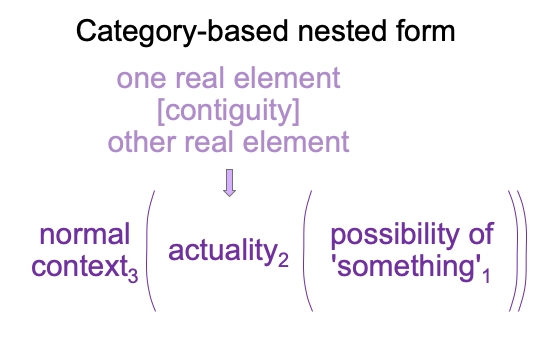
0449 The meaning underlying the word is a social construction that conjoins a cosmic and a personal origin story. The category-based nested form models social constructionThe model matches the origin story related by Burfeind.

0450 The Gnostic origin myth is an ancient civilized fairy tale, just like the stories of Adam and Eve.  They point to the origin and development of our current Lebenswelt.

The Gnostic origin story is a fairy tale about something Real. The first singularity explains why our current Lebensweltis not the same as the Lebenswelt that we evolved in.

The Gnostic origin myth is an expression of Original Sin.

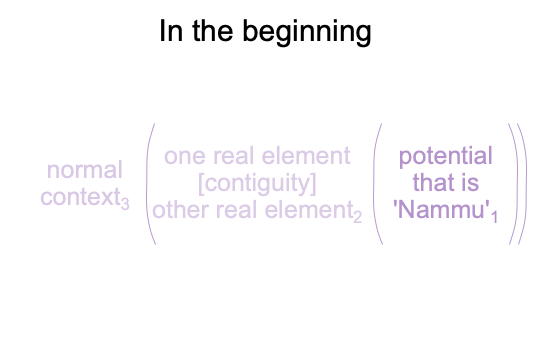
0451 From one vantage point, the Gnostic origin story describes the pleroma as the eternal cycles of the Lebenswelt that we evolved in and Sophia and Yaltabaoth as the start of our current Lebenswelt.

From another vantage point, the fairy tale describes a pleroma within our current Lebenswelt.

The ages of each civilization appear as emanations of male and female pairs. The fairy tale describes our current age as Sophia emanating without a male cohort, becoming pregnant by her Self, then hiding the male child in a cloud. Unawares, Yaltabaoth creates the universe of this particular age, thereby generating the foundation for an ego that does not love its Self.

0452 The pleroma may be seen as a repetition of the drama of Sophia giving birth to her aborted Yaltabaoth.

Yaltabaoth, as lion, builds his world in a cloud.  Then, Yaltabaoth, as snake, exploits the egos that it created.  Finally, the age passes with Yaltabaoth’s dissolution.

0453 So the pair is both female and male as well as Self and ego.

The Monad contains the Zeitgeists past, the current Zeitgeist and the Zeitgeists to come.

0454 The presence underlying the word “Gnosticism” describes two types.

In type 1 Gnosticism, the evil and material Yaltabaoth is sovereign power.

In type 2 Gnosticism, the evil and material Yaltabaoth is market exchange.

One is escapist.

The other is interventionist.

0455 Gnosticism is opportunistic. It is a religion of politics, drawing believers to either escape or intervene.  Escape hastens social collapse.  Intervention produces totalitarian states.

0456 Finally, the message underlying the word “Gnosticism” views the person as a single actuality composed of two contradicting actualities, the ego and the Self.

0457 These actualities were first separated in the distorting field of immaterial-material. The contiguity was significant. The ego is responsible for the Self. The ego is free to act in the Name of the Self

0458 Then, the two actualities were placed into conflict with the introduction secret knowledge.  The person is a single actuality composed of two conflicting actualities, ego and Self.

0459 In Late Modernism, the person in internal conflict supports diverse industries of Self-development, including state-supported educational organizations.

Secret knowledge encourages and legitimates idfantasy.

0460 In light of this definition of the word “Gnosticism”, the Neo-Evangelical approach may not seem that deranged.

0461 Burfeind has a point. The sacraments are key to defusing the foundational presumption behind the contradiction between the ego and the Self: The ego does not love the Self.

This contradiction should not occur in sacramental Christian religions. The sacraments are material and ritualistic (ego-driven), point to the immaterial (Self-experiencing) and encourage love (Spirit-enveloping). Grace inflows both ego and Self.  The ego grows in maturity. The Self grows in belonging.

The superego is the trellis. The ego is the vine. The Self is the grape, delicious and wholesome.

0462 Pietistic traditions do not have the sacraments available to them, so they must find different pathways to express the healing message that the ego should love the Self.

The Self will always be irresponsible.  The Self will always be a slave to “I like this” and “I don’t like that”.  The Self should never be truly free to act.  But, the Self is also who I am.

The pietistic tradition may say, “Love your Self.”

But, with that saying, comes an added message, “In order to love your Self, you must have an ego to be responsible for your Self. God calls you by Name. God expects your ego to act in the Name of your Self.”

0463 So where do I get this ego?

I read and listen to the word of God.  I learn to obey His commandments.

0464 If I fail to establish my ego in Christian truth, then I return to the beginning of the Gnostic origin myth.  My ego and my Self fall into conflict.

Gnosticism is a religion of the repetition disorder.

07/1/26

Looking at Peter Burfeind’s Book (2014) “Gnostic America” (Part 26 of 26)

0465 A type 1 Gnostic, who has been indoctrinated to be your Self, has an ego that says, “I am inadequate.” Otherwise, why would I need a Self-help book, or a drink, or a hit? Why would Sophia call to me?

Sophia says, “Escape. Return to the Monad.”

0466 A type 2 Gnostic, who may be so far into the conflict that the Self has won, projects her fallen ego onto others.  She demeans others as puppets of a rigid, doctrinaire, paranoid, traditional, Yaltabaoth-worshipping superego.

The ego of the Self-anointed is no longer responsible for the Self.  The Self may use her body for whatever purposes suits her proclivities.

0467 What do I mean by “her”?

I am “she” when my Self is my normal context.  My Self is an image of Sophia.

If everything is determined by culture, why can’t I declare my own culture?

My Self-wish transforms into a program for development.

My ego is like my ex-.  My superego is like his paranoid delusions.  My idreal is like a golden ring, serving as a gilded cage.

0468 A type 2 Gnostic sees others as marionettes of Yaltabaoth and the Establishment.  She stands beyond freedom and responsibility.  She serves another master.  She works for an institution.  She supports a cause. She stands righteous among the Self-anointed.

She knows about Freud.  She adores Jung.  She is a Marxist.  She is a big government liberal, demanding sovereign power.  Does that make her il-liberal?  Not in a world where “liberal” means “anything goes”.

Sovereign power constellates Personified Wisdom.

The type 2 Gnostic strives to grasp sovereign power.  She will master social evil. Her Self-wish is to control the builder gods and the Establishment, forcing them to work for her organizational objectives. Her Self-wish is to regulate and educate the pathetic ego-driven masses.

She is a post-religious social activist.

0469 A type 2 Gnostic will contextualize himself as a member of a New Age, the next emanation of the pleroma.

0470 What do I mean by “him”?

Is “he” the missing ingredient?

By “him”, I suppose, I mean Sophia-Self gives birth to… or rather, gives abortion to… the next Yaltabaoth.   She will put him into a cloud.   He will create the next age, even if he is a she, whatever that means.

0471 The next age comes in like a lion, then out like a snake.

Or, should it be, in like an ego, then out like a Self?

0472 Gnosticism is a religion of secret knowledge.

The Gnostic origin myth, itself, opens like lockbox, when the key is fashioned in truth.

0478 Ah, then, here we have it: What is truth?

On one hand, the words of the Gnostic are never to be taken literally.  They are symbols evoking fantasies that inform the Self.  The Self reads word-gestures. The Self relies on touch.

Sophia interpellates the Self through desire.

On the other hand, the possibilities inherent in the truth support the perspective-level actuality of the Holy Spirit. 

The Father virtually situates the Son [redeeming] me.

0478 I can put my hands together, with this conclusion:

The origin stories of Gnosticism and the Bible both point to a transition from the Lebenswelt that we evolved in to our current Lebenswelt.

The Gnostic origin story mythically re-creates a repetition disorder characteristic of unconstrained social complexity.

The Biblical origin story mythically portrays the transition as an actual historic event, serving as a fountainhead for disaster after disaster.

0480 Aren’t both these origin myths about Original Sin?

0481 If so, then what does that imply?

06/30/26

Semiotics and History – Baroque Scholasticism and Early Modernism (Part 2 of 2)

SaH0045 This strand of Semiotics and History considers the rise of capitalism in early modernism in terms of changes of political theology.

Oh, I meant to say “mercantilism”.

Okay, how about a label for whatever Shakespeare’s Merchant of Venice and income taxes in twenty-first century Americahave in common?

Also, I should have also said, “political economy”, instead of “political theology”.

Be that as it may, please enjoy the following commentary on Eric Santner’s challenging book.

This strand starts with of Looking at Daniel Novotny’s Article (2016) Izquierdo and Universals (and appears in Razie Mah’s blog in May 7-1, 2026, for orientation, see Razie Mah’s blog for May 7, 2026).

As well as Looking at Eric Santner’s Book (2016) The Weight of All Flesh (appearing in Razie Mah’s Blog in June, 2026, go to month and scroll down).

SaH0046 For a full list of strands in the course on Semiotics and History, see Razie Mah’s blog for February 3, 2026.