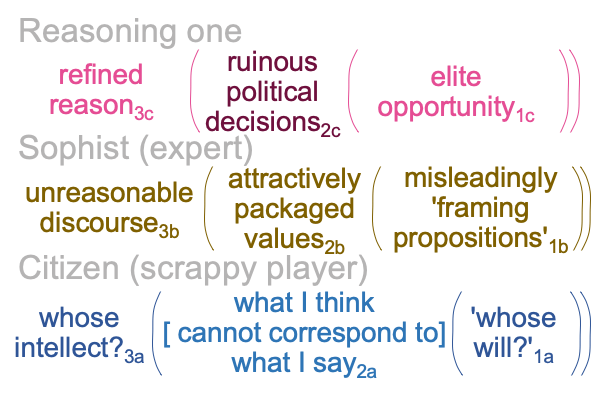
0826 Needless to say, the trader with refined reason3c belongs to one of the finest families in Athens.
The ancients have a saying, “The best, corrupted, become the worst.”
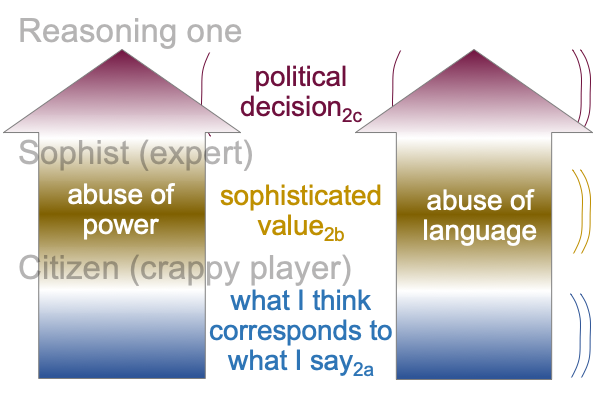
Abuse of power goes hand in hand with abuse of language.
Abuse of language manifests in the realm of possibility1.
Abuse of power develops in the realm of normal contexts3.
0827 Here is a picture.
0828 The actualities2 of the sophist interscope are topics of gossip and conversation.
0829 Does the sophist really believe what he says?
Is the idea that Athens should economically sanction Syracuse not the same as “war”?
Well, it is and it isn’t.
What is the definition of the word, “war”?
And finally, what about the enforcement of the sanctions?
Of course, Athenian troops can stop ships from Syracuse from docking, but is that enough?
I hear rumors that ships are now simply bypassing Athens and going to Thebes.
0830 In the forum, the bought-off… er… well-paid sophist hears what people are saying. He has a ready reply, “Thebes is causing a problem. We should think about going to war with Thebes. Not, this weak-kneed sanction business, but full-fledged conquest.”
0831 It’s like selling candy to a baby.
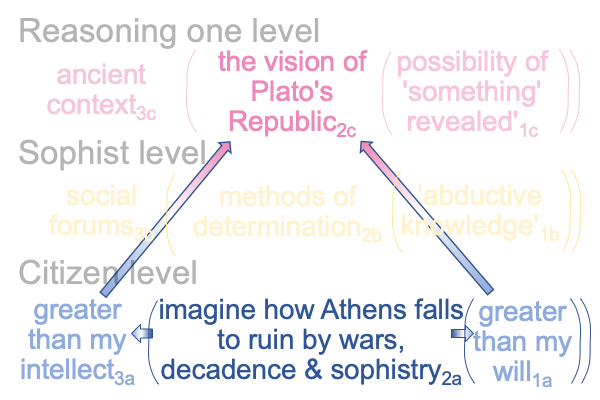
This is what Plato sees.
0832 What is there to stop the sophists3b and their behind-the-scenes sponsors3c?
If a reasonable person3a,1a adopts the sophist terminology, then the reasonable person3a,1a buys into the way that the sophist3b has framed the citizen’s reality and understanding.
Consequently, even the reasonable person’s thoughts are tainted, because what he says (using a word whose meaning, presence and message has been tweaked by the sophist) cannot correspond to what he thinks (because he thinks in terms of the traditional meaning, presence and message of the spoken word).
0833 A citizen may ask, “Would sending a delegation to Thebes asking what is going on be a way to avoid war?”
The sophist replies, “No, Athena forbid! Sending a delegation would be an act of war. Obviously, the traders in Thebesalready are trying to take advantage of our conflict with Syracuse. We all know that ships from Syracuse are docking in Thebes. Sending a delegation would only tip them off, so they would attack us, with the assistance of Syracuse, before we can attack them.”
0834 The sophist interscope supports ruinous political decisions.
But, does the sweetness of refined reason3c turn to bitterness?
Or does the fish rot from the head, down?
0835 The one who pays to support refined reason3c no longer believes that refined reason3c is right reason. Instead, it is a way to gain advantage1c by promoting political decisions2c that favor the elite, rather than all citizens. Without a doubt, the most advantageous political decision2c is the one2c where public citizens bear the risks and costs and private elites gain the benefits.
0836 Today, experts2b call these arrangements, “public-private partnerships”. The arrangement sounds attractive, “the public” (that is, a government bureaucracy) works with “private” citizens (that is, very wealthy operators) in order to accomplish goals that neither can achieve alone, such as an active war with Thebes while engaging in sanctions with Syracuse.
Finally, the citizen becomes confused and starts saying what the sophist says as if it is his own thought. Sanctions are war. Diplomacy is war. Thebes and Syracuse must be defeated. No one quite knows why, because reason3a,1a itself has fallen into sophistry2b.
0837 Tyranny is near when reason3a,1a falls into sophistry2b, because a dictator and his allies may declare what one can say, as if that is the gateway to what one can think. Citizens who have fallen into sophistry have no defense and end up blaming those who speak against sophistry.
0838 Weirdly, this is the topic is covered from a completely different approach, in the ninth and tenth primers of the series, How To Define the Word “Religion” and Related Primers, by Razie Mah, available at smashwords and other e-book venues. The titles are A Primer on Classical Political Philosophy and A Primer on Another Infrasovereign Religion.
0840 So, what was Plato’s problem?
We all know what happened to Socrates.
His admirers and compatriots, including Plato, were devastated.
Plato could only stop, and lay flat, and look into the empty sky.
0023 The full title of the book before me is A Player’s Guide to the Post-Truth Condition: The Name of the Game (Anthem Press: London and New York). The book seems brief, but it packs a lot of material in sixteen short chapters… well… technically, an introduction, fourteen chapters and a conclusion.
0024 Professor Steve Fuller introduces the topic with the headline, “How I Learned to Stop Worrying and Love the Post-Truth Condition”. The headline is a tongue in cheek reference to Stanley Kubrick’s 1964 intellectually pleasing masterpiece, “Dr. Strangelove”.
Yet, one has only to trace Kubrick’s career trajectory to envision a conclusion beyond worry and love. Kubrick dies in 1999 after wrapping up a homage to the will, titled “Eyes Wide Shut”.
0025 What matters is not whether something is true or false.
What matters is how something is decided.
The first statement concerns the intellect. The second statement concerns the will.
0026 So, how is a matter to be decided?
Shall we call upon the experts?
Consider the issues of anxiety and affection. An expert may reduce diverse and unsettling experiences to phenomena that can be observed and measured. Then, the expert may build a model, using a specialized disciplinary language. Next, with that model in hand, the expert will consider avenues to control the phenomena.
0027 For example, in a casual academic encounter at a university, I meet a needy and uncertain scholar who constantly nags her compatriot and (most likely) lover about the importance of managing her anxiety. Of course, the university setting is full of people making odd demands, so I think nothing of it. Later, I find out that her “husband” is a pharmaceutical salesman.
Indeed, she learned how to stop worrying about her field of inquiry and to love her husband with his briefcase full of Valium samples.
0028 So, is there a problem?
Fuller suggests that the “distance” between the layperson and the expert shrinks, because a layperson can become acquainted with the disciplinary language of any field of expertise well enough as to ask apparently intelligent questions. Yes, a question may be posed to the pharmaceutical salesman that goes like this, “I can see that your lover is addicted to Valium. Could you tell me exactly the mechanism for how this drug operates on the love-centers of the brain?”
To which the expert in marketing scoffs, “The human brain has frontal, parietal and occipital lobes. The human brain has a cerebellum. These anatomical structures perform various specialized neurological functions. Okay? The human brain does not have a ‘love-center’. What an ignorant question.”
0029 Indeed, the salesman goes on to testify before a legislative committee on the need to monitor and reduce the amount of medical disinformation on the internet. When laypeople read books on the neurological underpinnings of sexual attraction and drug addiction, they think that they’ve learned something. They think that they can ask revealing questions. So, they stupidly ask about “cerebral love centers”.
A law must be passed to deter this conduct.
0030 What does Fuller predict?
Just as during the Reformation, when Bibles printed in the layperson’s language opened the opportunity for any layperson to interpret sacred text,the current internet allows anyone who can read to become familiar with the language of any specialized discipline. Then, that layperson may publish a podcast that asks… um… revealing questions about what experts are supposed to know best.
The cost of entry into the market is astonishing low. So, many experts argue that it is the responsibility of the state to increase that cost through regulation and censorship.
0239 Francis Bacon (1561-1626 AD) lives at the start of the current Age of Ideas. He is a lawyer. He accepts that lying is part of everyday life, especially in the courtroom. He discovers that inquisitional modes of investigation force people to report in public what privately they do not hold. In short, the inquisitorial mode of testing and observing and measuring produces what I call “phenomena”. Courtroom phenomena do not reveal what a subject “privately” thinks. Courtroom phenomena reveal what the subject is openly willing to disclose under inquisition.
What I privately think associates to the noumenon.
What I am willing to say associates to phenomena.
0240 What does this imply?
Just as a triumphalist scientist wants to replace the noumenon with a mathematical or mechanical model,the scientismist one wants to replace what I privately think with what the Positivist’s judgment ought to be, that is, an empirio-normative narrative.
0241 Okay, then does that mean, once I am properly credentialed, that I have bought into a lie?
Yes and no.
Yes, phenomena cannot objectify their noumenon. If I do not testify to what I think, then I must be lying. So, the very idea of phenomena entails, not necessarily a falsehood, but a deception.
No, phenomena can objectify a model substituting for the noumenon. If I have successfully substituted an empirio-normative narrative for what I think, then I am always engaging in deception, even to myself. Either that, or I am always telling the “truth” (that is, the narrative) that can be objectified as what I say.
Did I write that correctly?
0242 The Christian doctrine of Original Sin derives from a mythic account of Adam and Eve. Adam and Eve are fashioned by God in a paradise near the mouths of the Tigris and Euphrates Rivers. They disobey God’s command not to eat of the fruit of the tree of the knowledge of good and evil.
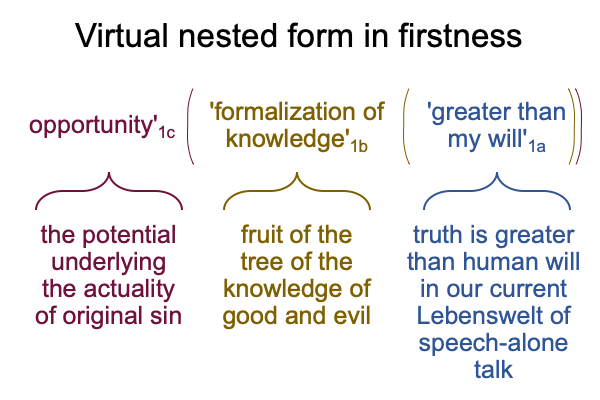
Okay, let me tweak the tree’s label to “the fruit of the tree of formalized knowledge1b“. Mythically, this tree occupies the center of the Edenic garden.
The problem is not disobedience, per se, but a capitulation to a post-truth condition imposed by… what else?… a speaking snake. Serpents must speak, because they cannot talk with their hands.
0243 Needless to say, the serpent has a variety of narratives to offer. The fruit will allow Eve to own its beauty (the capitalist model of value2b) as well as make her wise (the socialist model of value2b). Eve sees an opportunity1c. She makes an actionable judgment2c. And, the relativist one3c notches up two successes2c, since Adam is along for the ride.
So, the Fall in the Garden of Eden has a lot to do with disobedience (to God, but obedience to the serpent) and lying (to oneself by adopting the narrative of the serpent as one’s own).
0244 Saint Augustine associates the Fall to a permanent weakness called “concupiscence”, which transliterates to “con (with) cupi (Cupid) scence (the state of being)”. The state of being with Cupid is a little more entertaining than the state of being scammed by a speaking snake. But, the post-truth condition for each is pretty much the same.
0245 Why?
The foundational potential of the post-truth condition is the will1a.
By definition, the foundational potential of the prior condition is the truth1a.
0246 What does this imply?
Well, if Adam and Eve associate to the start of our current Lebenswelt, as proposed in The First Singularity and Its Fairy Tale Trace (as well as An Archaeology of the Fall, by Razie Mah, available at smashwords and other e-book venues), then the prior truth condition must associate to the Lebenswelt that we evolved in. Consequently, Adam and Eve may be historical, in so far as they are fairy tale figures associated with the start of the Ubaid archaeological period of southern Mesopotamia. The Ubaid marks the start of history (that is, our current Lebenswelt).
0247 Of course, Saint Augustine does not know this. So, he proposes that all humanity shares in the original sin of Adam and Eve through direct descent. All humans are subject to original sin2c because Adam and Eve are the first parents.
This turns out to be a scientific proposal. All humans are related to an original pair of humans. This hypothesis is debunked by modern genetics. There is no genetic bottleneck, as would be expected for a single-pair founding our species.
0248 So, Fuller points to a post-Augustine interpretation of our current Lebenswelt as a breeding ground for the post-truth condition. We are expected, by our inquisitors, to say only what we are publicly willing to disclose, as if that is what we are thinking. Whenever we live up to that expectation, we deceive ourselves. At the same time, we notch up successes2c for the relativist one3c.
On top of that, our hard-won academic credentials encourage us to utter statements based on the latest empirio-normative narratives2c, as if they2c are what we are thinking2a.
0249 Razie Mah heartily agrees. See his blog post for January 2, 2024.
0250 Perhaps, among other things, original sin involves defying the God of Creation by publicly mouthing the normative narratives of lesser deities, relativist ones3c, who put both the human intellect3a and will1a into perspective.
The sacrament of baptism plays a role in washing away that original sin, in so far as it introduces the infant to people who offer the story of the One True God, despite the fact that the story is unbelievable, according to all relativist one-heads.
0251 That said, Fuller’s genealogy of the post-truth condition points back to the very start of our current Lebenswelt.
Here is one vista that Fuller, as a guide to the post-truth condition, allows.
0252 Each person must decide which path to follow in the fourth Enlightenment Battle.
There are two paths.
One turns the person in to a certified mask that utters empirio-normative narratives.
One turns a person into a sign-tracker on a path that leads to a sign-vehicle that does not stand for what the empirio-normative judgment is telling me to think. This is the path of metalepsis. If Fuller is on target, the sign-tracker will discover an interventional sign-vehicle containing both a novel doctrine of original sin (for our current Lebenswelt) and a new appreciation of the human asan image of God (for the Lebenswelt that we evolved in).
In order to appreciate original justice, one must first respect original sin.
0253 Razie Mah offers three works that reconfigure the current empirio-schematic narrative of human evolution in a way that may assist sign-trackers. These works are titled, The Human Niche,An Archaeology of the Fall and How To Define the Word “Religion”. These works address the Lebenswelt that we evolved in,the first singularity and our current Lebenswelt.
Indeed, these works begin where Fuller’s excellent guidebook concludes.
0254 My thanks to Steve Fuller for his daring, and brief, exposition of the contemporary post-truth condition.
0001 On January 2, 2024, Razie Mah posts a blog challenging a Catholic podcast to take up a quest. Re-articulate the doctrine of original sin for the forthcoming age of triadic relations.
0002 The challenge rests on four points.
0003 Here is the first point.
In the 300s AD, Saint Augustine formulates the doctrine of original sin. In the process, he inadvertently proposes a scientific hypothesis. All humans descend from Adam and Eve as the original pair.
Of course, Augustine has no reason to question the Genesis text in this regard. The Bible is sacred text, a witness to God’s action in our current Lebenswelt. The science of genetics stands 1600 years in the future.
In the 1900s, geneticists definitively debunk the idea that all humans descend from an original pair, unless that founding pair lives over 500,000 years ago.
0004 This is not the only surprise.
In the 1800s and 1900s, archaeology discovers the historical depth of the ancient Near East. Now, the stories of Adam and Eve are listed among other origin stories of this age and location. All these stories (with the exception of the first chapter of Genesis) depict a recent creation of humanity, which does not make sense, since humans have been around for at least 200,000 years.
Why do all the written origin stories of the ancient Near East testify to a recent creation of humans?
0005 Indeed, if Augustine were around today, he would frame the doctrine of original sin within the paradigms of the current scientific age. Adam and Eve are not the first Homo sapiens, even though the second chapter of Genesis depicts their unique manufacture. The stories of Adam and Eve are ancient Near East mythologies. The artisanal fashioning of Adam and Eve, as well as the talking serpent, are correspondingly mythic. Also, the stories recorded in Genesis 2.4 through 10 concern the same start of humanity that is suggested by all other written origin stories of the ancient Near East.
0006 The problem?
What is this business about a recent start to humanity?
Why can’t the origin stories of ancient civilizations envision times significantly earlier than their civilizational foundings?
The social and biological sciences have done their utmost to portray human evolution in a way that excludes the witness of the earliest civilizations.
Does human evolution come with a twist?
Of course, it does.
0007 Why does Augustine claim that Adam and Eve are the first humans? The book of Genesis says so. But, once one realizes that all the origin stories of the ancient Near East point to an event horizon beyond which civilization cannot see,and that this event horizon is recent (rather than in deep evolutionary time), then the stories of Adam and Eve turn into fairy tales that address the coming-to-be of our current Lebenswelt.
0008 Before our current Lebenswelt, there are no civilizations. There is no unconstrained social complexity. There are no experts, or sophists, or relativist ones, or post-graduate ones.
Before our current Lebenswelt, humans live in the Lebenswelt that we evolved in, which is unquestionably different than our own civilized condition. Social complexity is always constrained. Social hierarchies seldom contain more levels than grand-parents, parents and children. Maybe there are specialists, like a midwife or a shaman, but there are no institutions for education in “nursing” or “medicine”.
0009 What does this imply?
Our current Lebenswelt is not the same as the Lebenswelt that we evolved in.
All the origin stories of the ancient Near East (except for Genesis One) testify to the beginning of our current Lebenswelt as the start of all humanity. The Lebenswelt that we evolved in cannot be remembered.
The history of the ancient Near East runs deep. Archaeologists point to the Ubaid of southern Mesopotamia, as the time and the place where the earliest unconstrained social complexity manifests. Civilization is further potentiated during the Uruk archaeological period, when urbanism starts and social stratification becomes obvious. Plus, uncanny inventions are made, such as the wheel and the use of the donkey for long-distance caravans. Civilization is obvious at the start of the Sumerian Dynastic archaeological period.
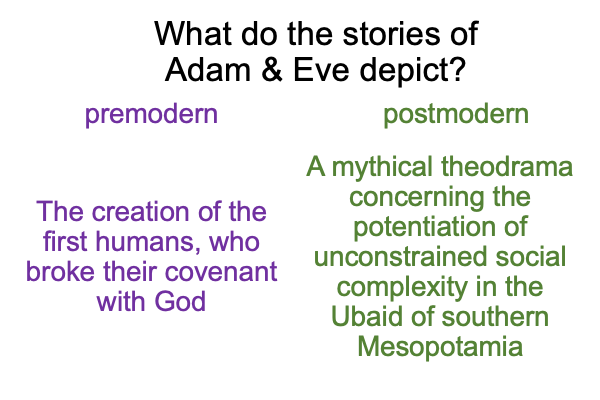
0010 So, what do the stories of Adam and Eve depict?
In the 300s, Augustine gives a premodern answer and formulates the first doctrine of original sin. Adam and Eve are the parents of all humans. The taint of original sin passes from one generation to the next.
In the 2000s, Augustine’s followers will give a postmodern answer and formulate the second doctrine of original sin. The stories of Adam and Eve are fairy tales about the start of our current Lebenswelt.Our current Lebenswelt begins with the first singularity.
0011 Here is the second point.
If Augustine’s hypothesis that Adam and Eve are the first humans fails, then is there another relevant scenario suggested before the modern age of ideas?
Thomas Aquinas offers one, when he reflects on the state of (the literal) Adam before the Fall. Before the incident involving the tree of the knowledge of good and evil, Adam and Eve live in a world of original justice. Then, after the Fall, they live in a state of original sin.
Does the state of original justice correspond to the Lebenswelt that we evolved in?
What was life like during the Lebenswelt that we evolved in?
Did hominins live up to a recent slogan offered by the expert-driven, science-oriented and empirio-normative-dominated World Economic Forum, “You will own nothing and be happy?”
Our Paleolithic ancestors own nothing (compared to anyone in any civilization) and they are happy (in ways that we currently cannot imagine).
0012 For example, our hominin ancestors adapt to the transcendentals that are extolled by religious intellectuals and ridiculed by secular sophists. It is as if the transcendentals are sign-vehicles that elicit adaptive sign-objects in the hominin mind, so our brains and bodies express a phenotype that serves as a sign-interpretant for those adaptive sign-objects.
Yes, our ancestors cannot label the transcendentals with spoken words. Instead, they experience the transcendentals as adaptations. Truth, beauty, nobility, temperance, strength, wisdom, and prudence do not have spoken labels. They have moments of perfection in the hominin body and mind.
0013 Aquinas knows nothing about the Lebenswelt that we evolved in. So, he depicts Adam as something of a Greek philosopher, rather than someone who modern anthropologists might recognize: a hominin who owns nothing, works in teams, belongs to community, suffers ailments and danger, yet is unimaginably happy. After all, our ancestors are who we evolved to be.
We are not so lucky.
0014 The Lebenswelt that we evolved in holds secrets that contemporary evolutionary anthropologists cannot articulate using the disciplinary languages of the social sciences. (See Razie Mah’s blog for January through March, 2024, as well as Comments on Michael Tomasello’s Arc of Inquiry (1999-2019), available at smashwords and other e-book venues). Tomasello’s technical term, “joint attention”, is an explicit abstraction that describes hominins, working in teams, being productive and having fun. It is a mystery how they do it. Yet, that is what hominins evolve to do.
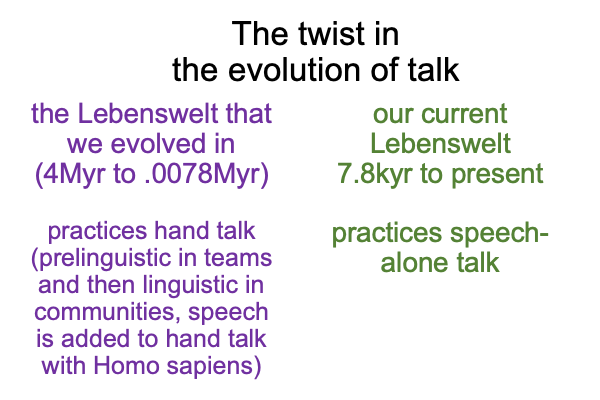
0015 Another big secret about the Lebenswelt that we evolved in is that, unlike modern anthropologists, our hominin ancestors cannot conduct explicit abstractions. Our hominin ancestors cannot explicitly label things or events with spoken words. Why? They talk with their hands. Speech is added to hand talk at the start of our own species, Homo sapiens. Then, Homo sapiens practices a dual-mode way of talking, hand-speech talk, for over 200,000 years before the Ubaid of southern Mesopotamia appears, nominally 7,800 years ago, as the world’s first culture to practice speech-alone talk.
0016 Hand talk and hand-speech talk facilitate implicit abstraction.
Even when hand-talk becomes fully linguistic, explicit abstraction not possible. Manual-brachial gesture-words are holistic. The referent exists before the word. The gestural-word pictures or points to its referent.
Speech-alone talk permits implicit abstraction. It also facilitates explicit abstraction.
Spoken words label parts, distinct from the whole. For example, the rotational motion that goes into making clay pots is explicitly abstracted with the invention of the pottery wheel. Then, the pottery wheel is explicitly re-oriented to become the wheel of a cart.
Spoken words exist before the referent. Spoken words cannot picture or point to anything. That is why the referents for spoken words exist as meanings, presences and messages in the realm of possibility. How often do we create artifacts that validate the meaning, presence and message underlying spoken words? How long do such validations last?
0017 The differences in the semiotics of hand talk and speech-alone talk are discussed in the opening chapters of the fictional drama, An Archaeology of the Fall.
0018 Point three follows points one and two, in so far as the mythic, as well as the historical, Adam and Eve stand at the event horizon beyond which the origin stories of the ancient Near East cannot see. The stand at the very start of our current Lebenswelt. They signify the first singularity.
See The First Singularity and Its Fairy Tale Trace, by Razie Mah, available at smashwords and other e-book venues.
0019 The fourth and final point is this fool’s errand. Razie Mah’s blogs for July through October 2024 offer a stumbling yet ambitious start to the quest posted on January 2, 2024.
The sequence of presentation in the three-part e-book, Original Sin and The Post-Truth Condition, is not quite the same as the sequence of appearance in the blogs. The blogs are sequenced for space and convenience.
The numbering of the points follows the list presented here.
0020 Fuller’s account of the post-truth condition is examined first. This examination is foundational.
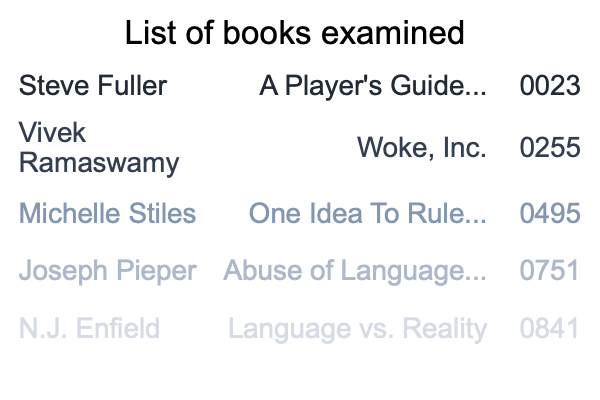
The results are applied to a book by American entrepreneur and politician, Vivek Ramaswamy, as well as a monograph on American propaganda by Michelle Stiles.
An essay by Josef Pieper on the abuse of language, reconceptualizes the application and serves starting point for a second formulation of the doctrine of original sin. In the blog, the examination of Pieper appears between the examinations for Ramaswamy and Stiles.
By the end of Pieper’s work, a connection between the post-truth condition and original sin, deepens.
0021 But, that is not all.
An examination of a book on language and cognitive psychology shows that, in 2022, secular academics are yet to confront the hypothesis of the first singularity. This examination stands as a warning that this hypothesis challenges both theology and science. Theologians need to devise a post-Augustine formulation of the doctrine of original sin. Scientists need to consider that (1) the human niche is the potential of triadic relations, as proposed in Razie Mah’s e-book The Human Niche, (2) our current Lebenswelt is not the same as the Lebenswelt that we evolved in, as dramatized in An Archaeology of the Fall, and (3) the semiotics of speech-alone talk is radically different than hand and hand-speech talk, as discussed in How To Define The Word “Religion”.
0022 The post-truth condition is a product of the semiotics of speech-alone talk.
0001 Daniel Estulin holds a notable resume. He is a doctor of conceptual intelligence and a foreign policy advisor to sovereign states in Latin America and Eurasia. He has authored many books, and hosted a Spanish language TV show on RT (formerly, Russia Today). The subtitle of the book is “Tectonic Processes of Global Transformation”.
This look is a teaser for a more extensive examination, Comments on Daniel Estulin’s Book (2021) “2045 Global Projects At War”, by Razie Mah, available at smashwords and other e-book venues.
0002 Estulin formulates the concept of global project and applies it to a number of civilizations, nations and international cabals. His approach is intuitive and relies on his considerable experience and knowledge. Estulin’s book is not structured in a manner that the reader learns a particular technique. Consequently, the above-mentioned comments add value. Perhaps, there is a method to Estulin’s approach.
0003 Certainly, the concept of global project is valuable, especially when applied, by Estulin, to the world in the present day. Estulin is so well informed that he exercises the concept without trouble. Does he want the rest of us to wield this tool without his years of experience, trials and reflection?
I don’t know.
0003 All I know is that humans tend to think in the ways of purely relational structures, often without realizing that fact. So, I read Estulin’s text with two purely relational structures in mind, the Greimas square and the category-based nested form.
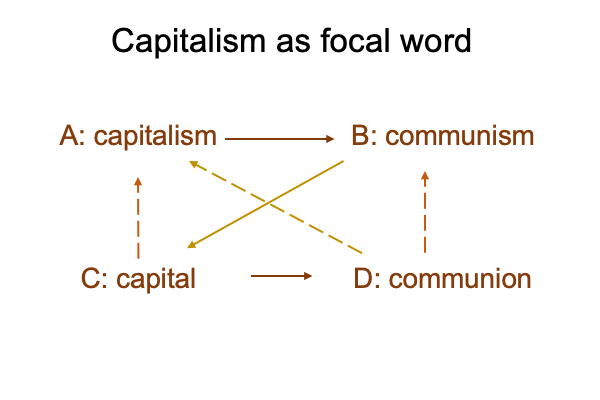
I start with a Greimas square and focus on the key word of “capitalism”. A quick introduction to the Greimas square may be found in the other blog for this month (at www.raziemah.com for January 2023).
0004 Here is the result.
Figure 01
0005 The four elements are clarified by the following statements.
A is the focal term. A is also the social head. A goes with economics.
B contrasts with A. B is also the social body. B goes with politics.
C contradicts B and complements A. C is capital. Capital goes with information, intelligence and conspiracy system. Anyone who gets an investment newsletter appreciates this. The stuff of investment letters scale up when considering prices, markets and monetary policies. C is what the social head fixates on. C functions as a mind-independent being. C is what the social head thinks about.
D contrasts with C, contradicts A and complements B. D is communion. Communion (D) is the object that brings us together. Communion (D) is not a mind-independent being, even though it appears to be. It (D) is mind-dependent, in the same way that a stomach and lungs are mind dependent. We don’t just want to eat or breath. We want to eat and breathe well. Communion (D) is aesthetic, while economics (A), politics (B) and conspiracy system (C) are calculating.
0020 So, consider the cities imaged by the global project of the New Babylon. Say “yes” to Renaissance Venice. Say “no” to Edinburgh, ship those jobs overseas and repackage the assets. Say “hello” to the City of London, full of intrigue, secret societies and corruption.
0021 Unfortunately, New Babylon is at war with other global projects.
In order to appreciate the drama, one must read Estulin’s own words.
0022 Nevertheless, Razie Mah’s e-work, Comments on Daniel Estulin’s Book (2021) 2045 Global Projects at War, available at smashwords and other e-book venues, adds value by providing a technique that students and educators may find beneficial.
Each global project contains all three permutations, arranged into an interscope. An interscope is like a three layer cake. The layers are content, situation and perspective. P1, P2 and P3 combine into three different interscopes. These interscopes associate to global projects.
0023 This examination is only a teaser for both Estulin’s book and the corresponding commentary by Razie Mah.
The New Babylon global project is one among many. Estulin covers almost a dozen.
So, one must be selective.
Razie Mah’s commentary develops diagrams for the global project of China.
0024 For all who are interested in the dynamics of global projects, Estulin’s book is a good place to start. Mah’s comments offer a comprehensible technique to apply. The latter complements the former. I encourage intellects to play with Estulin’s approach and Mah’s diagrams.