0025 Marat was in the busy-ness of cultivating biopower in the normal context of Jacobin discipline. He confounded Reason and the Supreme Being.
Other citizens were in the business of keeping their heads attached to their bodies. The way to do that was to keep busy. No one wanted to get involved in the business of citizen Marat.
0026 Marat, the citizen, stands at the site of a surplus of immanence.
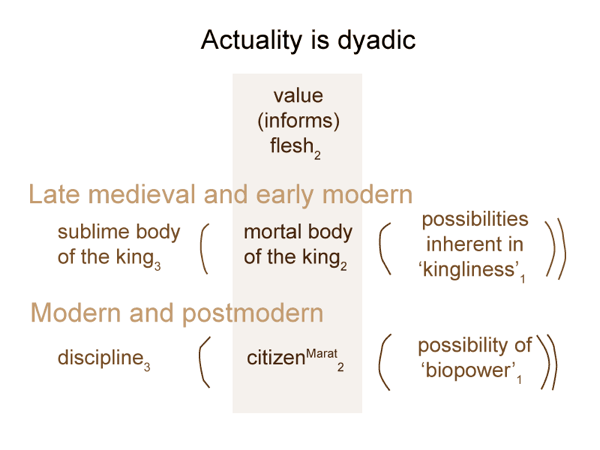
For this reason, I will use the term citizenMarat to designate anyone whose actuality is supplemented by the normal context of discipline and the possibilities inherent in biopower.
Likewise, the term citizenregular denotes the person subject to the sovereign. Citizenregular is the sane one who wants to keep out of trouble.
0027 Is the surplus immanence awarded to citizenMarat the real subject matter of today’s political economy? What about citizenregular?
0028 Plus, how does the flesh enter into the picture?
Marx’s theory of labor concerns the flesh. The flesh is a social substance materially abstracted from laboring bodies. It applies to office work as well as factory work. It does not depend on the mode of production.
0029 Does that make sense?
This flesh is material, yet spectral. It is an object. It is the subject matter of middle and late modern political economyas well as late medieval and early modern political theology.
The flesh becomes a subject of interest. The flesh has value.
0030 To me, the flesh belongs to the realm of actuality.
0031 At the same time, value also belongs to the realm of actuality.
Since actuality belongs to secondness and secondness is dyadic, flesh and value may be contiguous.
For example, value may inform the flesh. This may be written as value [informs] flesh, where inform is the contiguity between two elements.
Or, the flesh may embody value. This may be written as value [embodied by] flesh, where being embodied is the contiguity between the two elements.
0032 Flesh is the actuality that I encounter. Value is the actuality that accounts for ‘what I encounter’. One is material. One is ghost-like.
Value [informs] flesh occurs in a particular context and is powered by a specific potential.
I am inclined to associate this dyad with the mortal body of the king (in political theology) and citizenMarat (in political economy).
0033 Here is how that fits into the former diagram:
0034 Santner continues to examine David’s painting, The Death of Marat.
Marat trafficked in the potential of political rabble rousing.
The corpse in the tub had been busy. Correspondence is in hand. A letter of introduction appeals to Marat’s generosity. Another paper, barely legible, contains the words de le patrie (for the country). An assignat, paper money, is also in view.
0035 Do these clues point to something equivalent to the glorious body of a king?
0036 Does this painting portray a transition from royal to popular sovereignty?
It seems so. Here is a busy body, murdered in the conduct of power relations within the modern context of discipline. His murder testifies to the actuality of value [informs] flesh. The value that informed the body of Marat translates into correspondence, “[blank] of the country” and printed money.
0037 At the same time, the upper register of the painting is dark and empty, like the interior of a room that cannot be lived in.
Is this artistic trick a theological statement?
Unlike the glorious body of the king, discipline never rises above itself. The flesh of citizenMarat is never redeemed.
0038 Speaking of valuation, consider the 5-libre, I mean livre, assignat. Santner notes that this currency was backed by the confiscated properties of the church and aristocracy. The currency took seven years to fail.
Santner dwells on this valuation. The currency was born in theft. Or should I say, “confiscatory taxation”? Printed to cover the costs of the political economy in Revolutionary France, it quickly collapsed.
0039 Does the assignat, plus the other clues, indicate an abstract material, proceeding from the corpse of Marat to the lack of representation in the upper register of the painting?
0040 It makes me wonder: Who was meant to view the painting?
The answer, of course, was the regular citizen.
0041 David rendered a splendid work to commemorate Marat on the event of his death. David did not paint Marat as a monstrous busy body whose discipline organized the most terrifying party of the French Revolution. The Jacobins were deranged.
In contrast, the citizensregular were sane, keeping out of politics as much as possible.
0042 I can ask the same question about late medieval and early modern political theology: Who was supposed to sing the doxologies about the sublime body of the king?
The answer, of course, was the subject of the realm.
0043 Christianity borrowed from Greek philosophy in order to explain the subject.
The person is an individual in community. The individual in community is a subject of a political realm.
The king is the political community writ small. The king is also a person writ large.
God gives each person one soul with two aspects, one active and one passive. The active soul animates the body. The passive soul takes in impressions and is susceptible to feelings, especially the feelings of others.
0044 Middle and late modernism imbued the individual spirit with reason and burdened the passive soul with sanity.
0045 The resulting nested forms look like this:
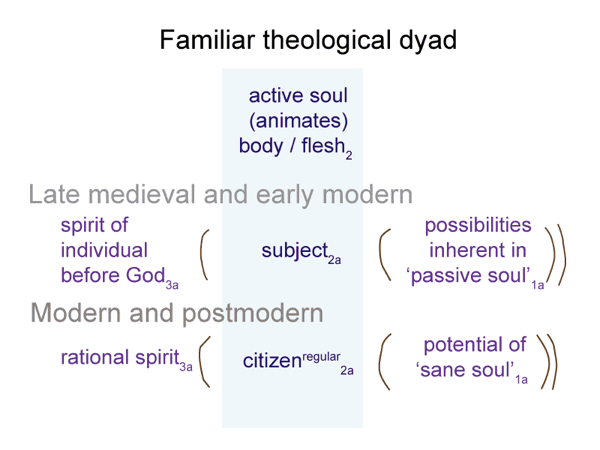
0046 Clearly, the late medieval and early modern subject is close to the original Christian formulation of the person. The middle and late modern citizenregular is further removed.
0047 However, the relational structure is the same.
The subject belongs to the king and the citizenregular “belongs to” citizenMarat, as a content level to a situation level within an interscope.
0048 Here is the interscope for the subject and the king in late medieval and early modern political theology.
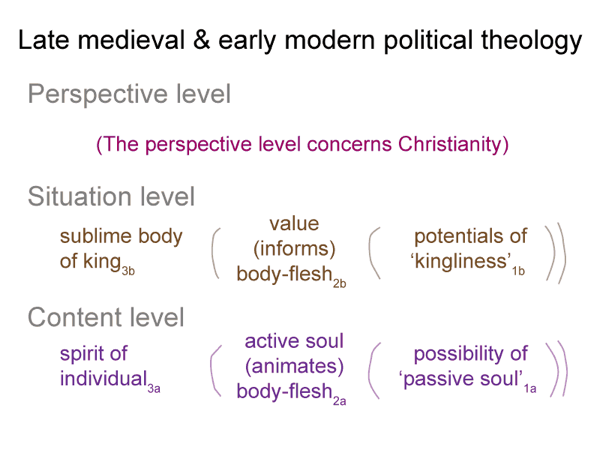
For the realm of actuality, I substituted the actual dyad for the king’s mortal body (on the situation level)2b and the subject (on the content level)2a.
0049 Now, the question arises: How does the subject discover the qualities of kingliness?
The subject learns the qualities of kingliness from political doxologies.
Here, Christian theology, which is revealed knowledge, gets twisted into a gnostic formulation, which is secret knowledge.
In religion, a doxology is a litany praising the qualities of God.
Guess what happens when a doxology is applied to the royal person.