0050 What does the following statement imply?
Impressions of communal spaces must be received by a blank-slate capable of receiving impressions as integral to a map of narodal cognition.
How does a denkfurher go about teaching a student to serve as a blank slate?
0051 The scholastic interscope for how people think may assist in imagining the process.
For a derivation, see Looking At John Deely’s Book (2010) “Semiotic Animal”, in Razie Mah’s blog for October 2023.
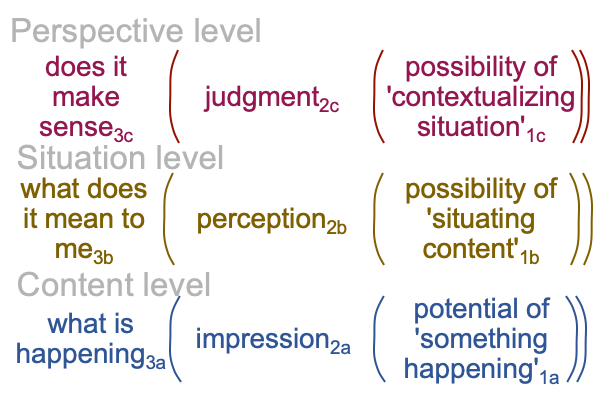
0052 On the content level, the normal context of what is happening3a brings the actuality of an impression2a (or sensation2a) into relation with the potential of ‘something happening’1a.
On the situation level, the normal context of what it means to me3b brings the actuality of a perception2b into relation with the potential of ‘situating content’1b.
On the perspective level, the normal context of does this make sense3c brings the actuality of a judgment2c into relation with the potential of ‘contextualizing the situation’1c.
0053 Obviously, the ethnographer enters a narod (a community) with the aim of mapping its cognitive space, then publishing that map in a monograph.
0054 So, I suppose that the initial interaction between ethnographer (who does not belong to the community) and the narod consists of sensations2a and impressions2a.
But, what is an impression2a?
The scholastics propose a dyadic actuality that corresponds to what the ethnographer encounters.
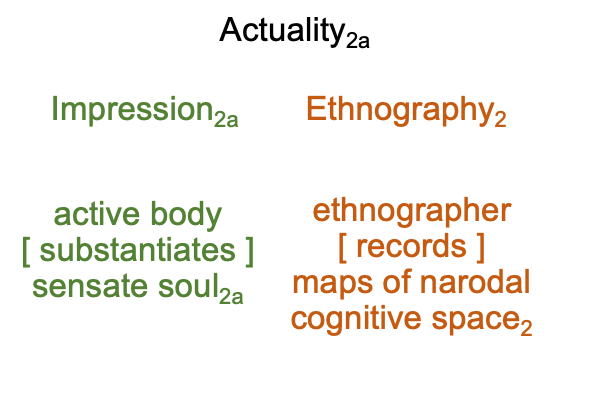
An impression2a consists of the dyad, {active body [substantiates] sensate soul}2a.
0055 Here is a comparison of impression2a to ethnography2.
How do these two relate to one another?
One can almost assign philosophers to each real element. Merleau Ponty goes with “active body”2a. Carl Jung goes with “sensate soul”2a. The external and internal senses, including the automatic decoding of words, goes with active body. Feelings and qualia associate to sensate soul.
0056 In this comparison, the presence of the ethnographer, participating in the activities of a narod, is like an active body. This active body substantiates a sensate soul, which, through training as an anthropologist, is capable of receiving the matter of the active body2a and the form of an impression2a.
0057 How does this contribute to the ethnographer’s construction of the narod’s cognitive space?
Well, look at the corresponding normal context3a and potential1a. The cognitive space opens into the question, “What is happening”3a, operating on the possibility of ‘something’ happening1a.
0058 The same story line applies in a comparison of perception2b to ethnography2.
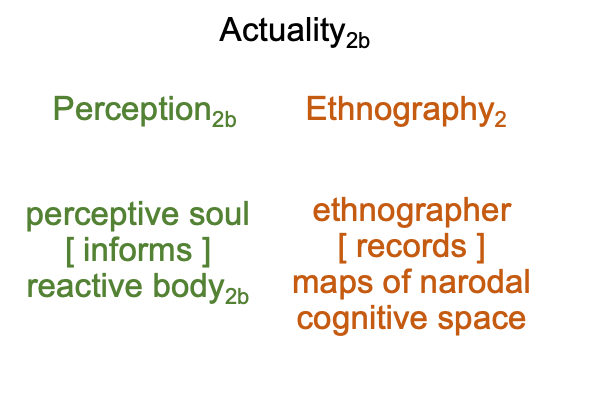
The ethnographer’s participation allows reception of {the narod’s perceptive souls [informing] their reactive bodies}2b. The ethnographer will record the people’s phantasms and emotions.
0059 The ethnographer, ironically, cannot sit in judgment2c of the community, because the ethnographer does not enjoy or suffer the narod’s commitments. Yet, an implicit Hippocratic Oath characterizes the commitment of the ethnographer. First, do no harm. This responsibility… this oath… is what makes an ethnographer a true professional. The ethnographer professes that the recorded cognitive maps will not be used for nefarious purposes.
0060 The scholastic map of how humans think allows me to ideate the following comparison, where the narod (the community under investigation) consists of a summation of the content and situation levels, in such a fashion that each person in the community matters and contributes to the forms of the narodal cognitive space.
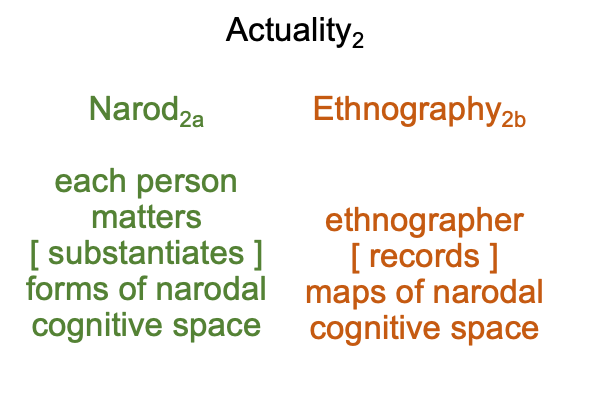
0061 In sum, the actuality of the narod2a is situated by ethnography2b, as shown in the figure below.
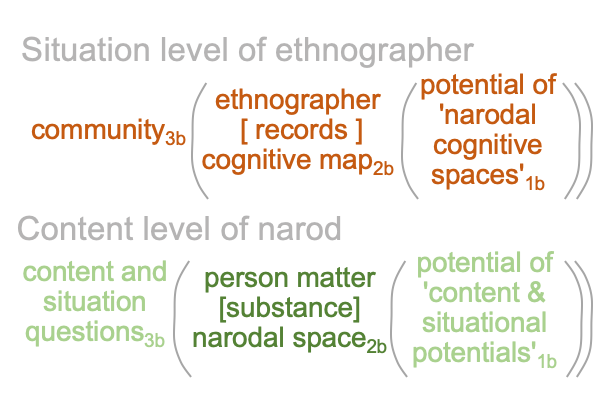
The content-level question is, “What is happening?”
The situation-level question is, “What does this mean to me?”
0062 A researcher may try to be a tabula rasa, but cannot be, because he (or she) has already been raised in a civilization where ethnography is a profession. Every community senses this, and regards the ethnographer as an emissary from a particular (and different) civilizational sphere. To me, this is a remarkable feature of the ethnographic enterprise. Plus, it is one of the phenomena of the noumenon of humans in the Lebenswelt that we evolved in.