0034 Of course, Dugin’s terminological twist both reveals and conceals.
The narod reveals what the ethnos becomes, once it enters our current Lebenswelt.
In this manner, the narod conceals the ethnos.
0035 Here is the crux. Evolutionary theory is required grasp the esse_ce (esse, being substantiating) and the essence (substantiated form) of the ethnos. Why? How else does one intellectually transit from our current Lebenswelt to the Lebenswelt that we evolved in?
So, the author’s objective remains viable. Further reflection is warranted.
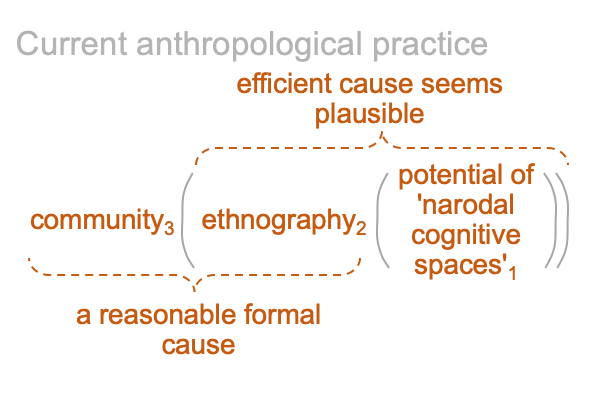
Here is the current anthropological practice as it now stands, using Dugin’s terminology.
0036 I now attend to the actuality2.
Peirce’s category of secondness consists of two contiguous real elements. Aristotle’s hylomorphe is exemplar. The two real elements are matter and form. The contiguity, placed in brackets for clear notation, takes the label of “substance”.
Yes, this is one more technical definition to add to the label, “substance”.
“Substance” is the contiguity between matter and form (in the format of Peirce’s secondness).
Here is a picture.
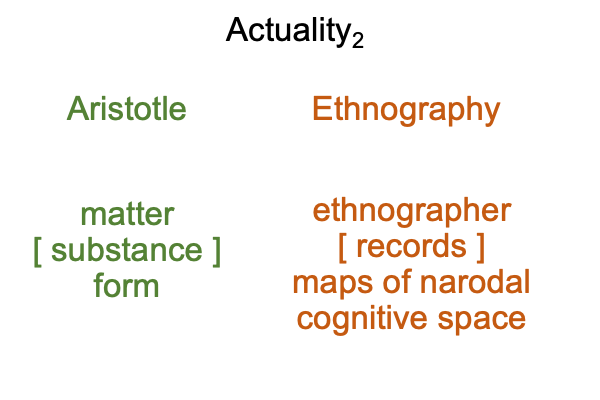
0037 The two real elements of ethnography are the ethnographer (as matter) and maps of narodal cognitive spaces (as form). They arise from the potential of narodal spaces1.
Here, the term, “narodal”, substitutes for “communal”. Narodal is communal in our current Lebenswelt.
The normal context3 is community3. According to Robin Dunbar, brain size corresponds to group size in mammals (with lots of caveats). Current human brain size matches a community of 150 individuals. Our very distant ancestors have brain sizes that go with bands of 50 individuals.
0038 The contiguity is [records].
Here is where the graphing plays out.
0039 The comparison is evocative.
The ethnographer serves as matter, a metaphorical tabula rasa, emptying himself (or herself) in order to encounter the applied relational structures that constitute the narodal cognitive space. Surely, it is not easy to separate the person from the relational structure. Kinship serves as an obvious example. The kinship relational structure is accompanied by cognitive impressions that may be difficult to process, unless one has methodically eliminated the biases of one’s own civilization.
0040 The manner for such kenosis is highly idiosyncratic, perhaps accounting for why the author calls for a re-integration of diverse methodological and theoretical tool-kits used to train ethnographers.
The practical and ideological methods of various anthropological thought-leaders (denkfurhers) have one feature in common. They are indifferent, if not hostile, to evolutionary approaches. A glance at the previous two figures helps to explain why. Impressions of communal spaces must be received by a blank-slate capable of receiving impressions that are integral to a map of narodal cognition. The ethnographer offers that “blank slate”.
0041 The discipline of anthropology learns from its mistakes.
One of the most profound errors in ethnography is committed by one if its founders, Franz Boaz (1858-1942). Boaz primes the narodgraphic expectations of students, by situating ethnography within a typology of primitive cultures.
0042 A Primer on Sensible and Social Construction (by Razie Mah, available at smashwords and other e-book venues) should assist in appreciating the following two-level interscope.
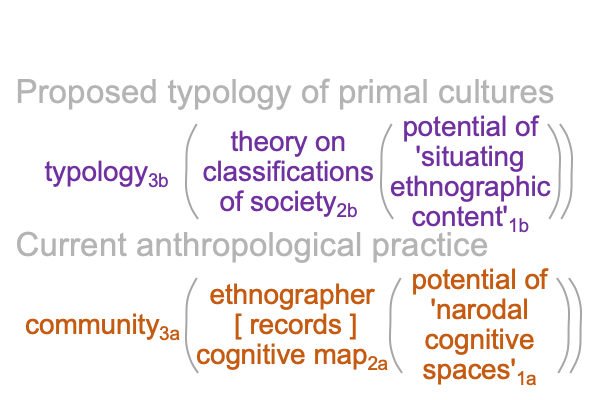
0043 On the content level, the normal context of community (narod)3a brings the actuality of the dyad, {ethnographer [records] cognitive map}2a into relation with the possibility of ‘narodal cognitive spaces’1a.
On the situation level, the normal context of typology3b brings the actuality of a theory on classification of primitive societies2b into relation with the potential of ‘situating ethnographic content’1b.
0044 One of Boaz’s students, Margaret Mead (1901-1978), goes off to a narod in the eastern Pacific and records precisely what is expected from the type of society predicted by theory. How convenient.
Surely, the above sensible construction yields an intriguing, rather than an integrating, anthropology. Mead’s ethnographic account turns out to be a best seller. What better way for the modern consumer to get a taste of the forbidden fruit of anthropological… um… “knowledge”. Ethnography offers a map of… you know… sexual liberation in paradise.
0045 What does this imply?
The author is onto something crucial by suggesting that biological… er… evolutionary theories be used to either situate or put into perspective ethnographic data.