0020 There goes the normal contexts of integration3 and the human niche3.
Well, maybe, they don’t go away entirely.
0021 The normal context of community3 allows the inquirer to acknowledge the dyadic nature of ethnography. Ethnography is a discipline, an art, just like any style of writing.
0022 But first, a little trip down memory lane is advantageous.
If I translate the name, “ethnos”, I get “people”.
0023 Notably, in Comments on Alexander Dugin’s Book (2012) The Fourth Political Theory (by Razie Mah, available at smashwords and other e-book venues), the word “ethnos” takes on a very specific connotation.
The short story is told on the days of February 1 and 2, 2023, in Razie Mah’s blog. Razie Mah looks at on particular chapter of Michael Millerman’s book (2022) Inside “Putin’s Brain”: The Political Philosophy of Alexander Dugin. Mah utilizes the Greimas square.
0024 The Greimas square is a semiotic tool that is most useful in ascertaining where a focal word stands within a system of differences. Yes, spoken words (parole) constitutes one system of differences. The other system of differences is… um… “langue” (which is “language” in French). According to Saussure, spoken language consists of two arbitrarily related systems of differences, parole and langue.
So, the focal word will be “people”.
0025 The Greimas square operates on four rules, each corresponds to a corner of the square.
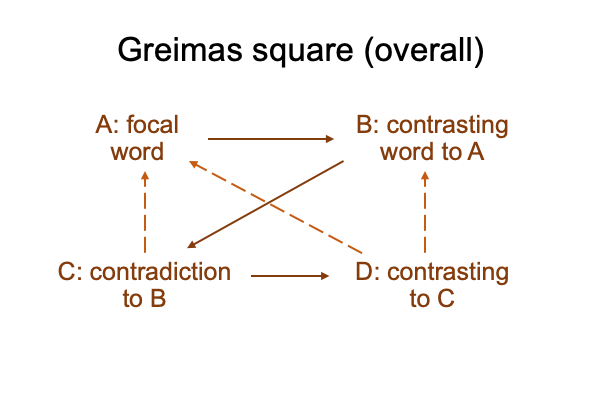
A is the focal word.
B contrasts with the focal word (A).
C stands against the contrast (B) and complements the focal word (A).
D contrasts with the first contradiction (C), stands against the focal word (A) and complements the contrast (B).
0026 For Dugan, a political theoretician in our current times, the focal word (A) is “people”. There is the famous line in the American Declaration of Independence, starting “We, the People…”. That is a good way to imagine the starting point. What on earth is “people”?
Well, there’s lots of political theories that characterize the people. For example, there is capitalism, socialism, communism… and all sorts of other “-isms”. These contrast with (A). They are intellectual constructions that, according to Dugin, have failed.
0027 What stands against political theories (“-isms”) defining “what people are” and “what they ought to be”?
Dugin uses a Russian term, “narod”, meaning “traditional folk”. Traditional folk are pre-political. They intuitively know that they belong together, because they share common cognitive spaces. Narod folk may be specialized, but they are not so specialized that one “specialty” gets so alienated (like modern political theorists) as to imagine that they can intellectually articulate the esse_ce and the essence of a narod.
0028 How is that for a sentence?
No narod (C) would ever talk like that. Only an person with academic credentials (B) would dare to talk like that.
Somehow, the political theorist (B), using speech-alone, talks a pre-political narod (C) into differentiating into a politically defined people.
The narod practices speech-alone talk. They think that speech is for sensible construction. Even their social constructions are regarded as sensible. At least, social constructions seem that way.
Political theorists enter the historical scene only when a narod’s sensible constructions, which are often built on social constructions, start to fail. One expects this type of failure when technical innovation occurs, increasing the number of specializations, and questioning the old ways of doing things.
0029 So, if Dugin is on target, “ethnography” should be renamed “narodgraphy”, which is a very awkward term and easily ridiculed (“near-odd-graphy”).
0030 But, the question that Dugin raises cannot be so easily dismissed, because the term, “ethnos”, contrasts with “narod” in a most interesting way, as seen in the following figure.
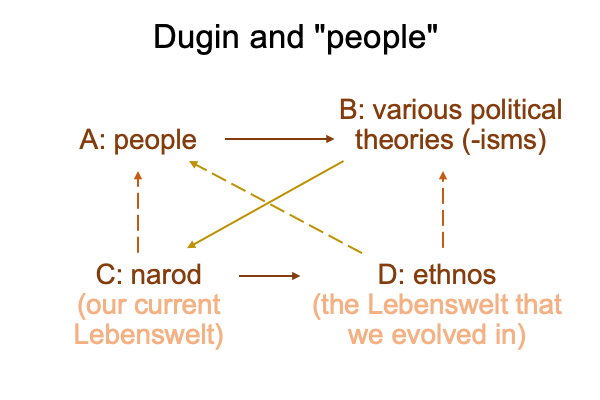
0031 For Dugin, traditional societies (the people that an ethnographer studies) are narod. Plus, each pre-political narod, somehow, perhaps by historical annealing, emerges from… what?… a pre-pre-political?… no, it is deeper than that… may I say?… an upwelling in social belonging, social circles swirling within social circles, that touches base with the evolved character of human nature.
Dugin emphasizes this. The narod emerges from the ethnos. The narod cannot return to its ethnos.
0032 In short, the narod belongs to our current Lebenswelt.
The ethnos belongs to the Lebenswelt that we evolved in.
Our current Lebenswelt is not the same as the Lebenswelt that we evolved in.
0033 Therefore, the integration between evolutionary science and anthropology that Fuentes aims for may not (technically) be possible, because the ethnographer (or narodgrapher) can only map the cognitive spaces of a “narod”, not an “ethnos”. The narod cannot return to its ethnos. At the same time, ethnography is possible because both the ethnographer and the narod (the subject of the research) belong to our current Lebenswelt.