0012 Let me begin with the formal cause, along with a substitution.
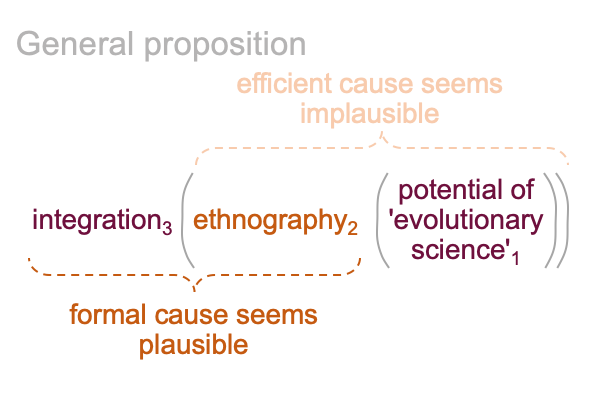
“Ethnography2a” substitutes for “anthropology2a“.
0013 Section 1 is titled, “Providing context”.
Doesn’t that sound like the old Aristotelian term, “formal causation”?
0014 The author starts by bellyaching about the divisions within anthropology. Methodological and theoretical tool-kits (efficient causes) are in abundance, testifying to the lack of a consistent normal context3… er… integration3.
Indeed, the very term, “ethnography”, does not denote “logos” or “understanding”. “Ethno-” means people. “-Graphy” means “writing” or “mapping”.
Ethnographic accounts by Westerners attempt to write out (or map out) the cognitive spaces held in common by the encountered group (or “people”).
0015 But, is a group the same as “people” (or “ethno-“)?
Well, the salient group turns out to be a community. Typically, an ethnographer lives (or works) in a community. The encountered group (or “people”) is a community (numbering around 150).
0016 As it turns out, the community (150) is relevant to human evolution. British evolutionary psychologist, Robin Dunbar, concludes that there is a consistent ratio between brain volume and group size (with caveats). The human brain size corresponds to a group size of 150, matching size of a community (150).
See Comments on Clive Gamble, John Gowlett and Robin Dunbar’s Book (2014) Thinking Big (by Razie Mah, available at smashwords and other e-book venues, part of the series, A Course on the Human Niche).
0017 Happily, the fact that the community (150) coincides with the group size expected for the volume of the human brain produces an efficient cause that appears to be consistent with the normal context of integration3.
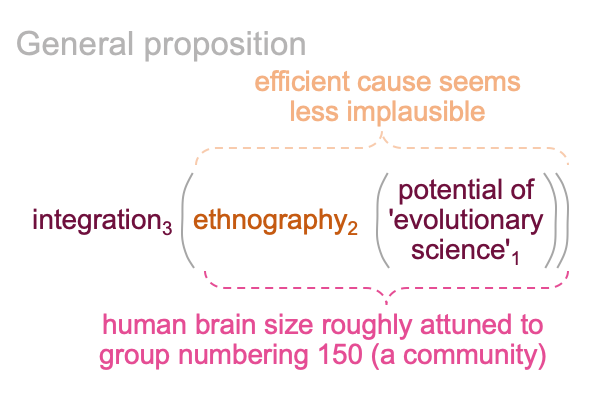
0018 Unhappily, as soon as anyone talks to an ethnographer, then the normal context3 and potential1 appear to be highly unlikely.
Yeah, integration3 is not a plausible normal context.
The potential of ‘evolutionary science’1 at least has the size of community correct.
So, maybe I can shift to a plausible efficient cause and the formal cause will make itself clear.
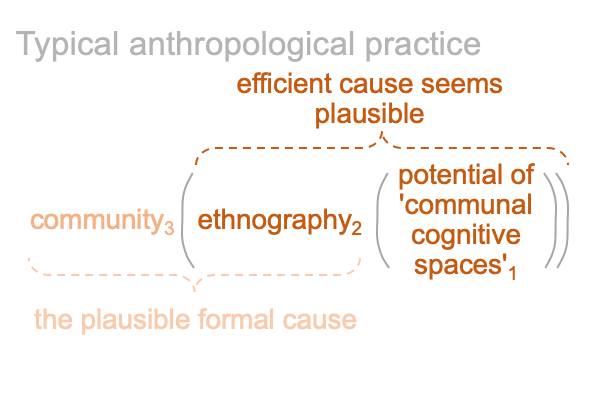
Okay, the ethnographer is trained to encounter a community and to map the cognition within the community (without losing one’s identity as an anthropologist).
0019 This training suggests that the proper normal context3 is community3.
Here is a picture with a plausible efficient cause and a reasonable formal cause.
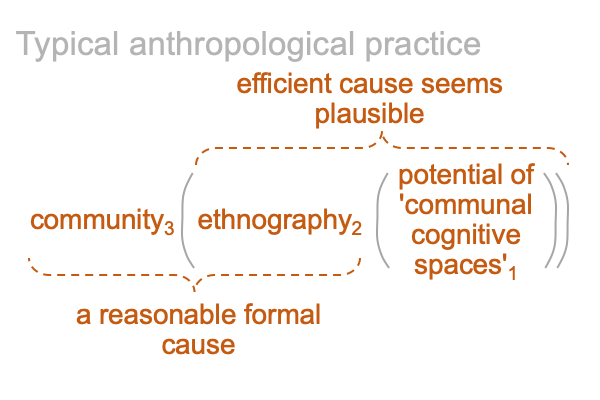
The normal context of community3 brings the actuality of ethnography2 into relation with the potential of ‘communal cognitive spaces’1.