0911 So, what am I saying?
Do the sixteenth-century reformers engage the same relational structure that this examination of the publications of Tartu-Moscow School brings to consciousness?
How weird is that?
0912 Is this a case of historical determinism?
Or do the fundament and the derivative interscopes serve as semiotic templates?
According to the author, Juri Lotman argues against sociological or economic determinism. He adopts Ilya Prigogine’s ideas about self-organization, such as the “explosion” that occurs when a seed germinates, a butterfly emerges from its chrysalis, a flock of geese begin their migration, as well all sorts of spontaneous moments. That includes political and religious movements in civilization.
0913 What does Lotman intuitively sense from all his inquireies into the literature produced by Russian civilization?
Somehow, an explosion occurs when a text as form2af entangles semiotic meaning as matter2am.
Indeed, semiological and structural matters in the mother-tongue and literary style2bm substantiate a literary text2bfthat is modeled2c according to a disciplinary langauge3c operating on the potential of ‘observing related and relevant phenomena’1c.
0914 And, in German history, Martin Luther is exemplar in this regard.
The matter of the people’s ability to read the Bible in their own tongue2bm substantiates the 95 theses2bf that are modeled2c as a declarations that identify the contradictions in scholastic interpretations3c and the hypocrisy of the Church1c. Surely, the clerics debate in Latin and not in common vernacular. The little (and now, literate) people want to hear what they are saying.
The 95 theses2af entangles the language of reform2am, in the normal context of a literate people being able to read a translated Bible3a operating on the potential of ‘decadence and renewal of the Church’1a.
0915 Here is a picture of the resulting content-level of the derivative interscope.
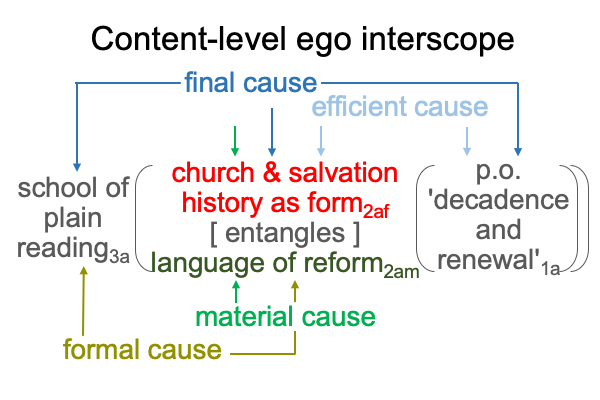
The astute reader may wonder, “What is the literary text2af? Luther’s theses? The Bible in Latin? The Bible in vernacular? Church and salvation history?”
0916 May I say that, in the above actuality2a, a model2c stands for the thing itself2a, the noumenon of a historical moment or movement?
Also, may I say that, in the above figure, the actuality of church and salvation history as form2af has emerged from the matter of history as a literary text2bm and now entangles the matter of a novel language of reform2am?
How confounding.
0917 Plus, what about Aristotle’s four causalities?
Material causes comport with economic (the lowered cost of printing due to the innovation of the Gutenberg press) and sociological (the outrageous selling of ‘indulgences’ in order for aristocrats to purchase absolution for their excessive conduct and their excessive wealth) causations.
But, these are like soil analysis to a plant biologist. They are conditions, more than formal causes.
0918 The formal cause is the germination of the seed of general literacy3a (also made possible by the printing press, but also by the success of priests in spreading the gospel) in the soil of a rigid aristocracy and clergy who are the only ones who used to be able to read2a. Oh, the newly self-minted bourgeoisie probably play an important role in that germination, because they hatch all sorts of plans to reform everything that the aristocracy and the clergy use for self-promotion.
0919 The final cause harmonizes (3) the idea that the Bible is open to a plain reading3a, (2) an impasse in church and salvation history2af, where illiterate folk are excluded from theological debates but are expected to purchase theologically-suspect indulgences and to pay the costs of building a more magnificent cathedral than a neighboring diocese2am, and (1) the potential of ‘renewal after demanding an end to the decadence’1a.
0920 The efficient cause brings the language of reform2am into relation with the potential… the hope… of an end to decadence and the birth of a renewal1a.
The results are explosive.
The Reformation produces a civilizational blow-out that lasts all the way to the present day.