0900 Lotman and Uspenskij pursue independent approaches once this interventional sign-relation comes into play. Lotman continues a scientific path and enters discussions on how semiological structuralist models2c can overcome the distinction between synchrony and diachrony. Uspenskij orients his path toward semiotics as an adjunct to the work that historians do. Each historical text is about ‘something1a‘ and all these ‘somethings1a‘ have one feature in common: semiotics (or semiological structuralist models).
I suppose that both paths suggest that, if a history is to be about ‘anything’, that ‘that thing’ must take the form of a literary text2bf.
Such a suggestion is very different than what some label, “historical determinism”.
0901 Juri Lotman argues against Soviet academic attempts at historical determinism in the late 1920s.
Historical determinism?
Material arrangements [substantiate] human conditions?
If history as form2af entangles language as matter2am arising from the potential of ‘meaning’1a, then ‘meaning’ cannot be constrained to economics, sociology, communication systems, and other material-oriented disciplines that do not include linguistics (that is Saussure’s semiology3a).
0902 Eventually, Lotman settles on Ilya Prigogine’s characterization of self-organizing systems, which achieve states that cannot be deduced from their initial conditions.
Yeah, I mean, like the growth of mushrooms or ideas or cities or civilizations.
Each dyadic aspect of such growth may be modeled deterministically. The relationality among the dyadic actualitiescannot be deterministically modeled. But, that does not mean that models of relationality are worthless. Science does not end when each linear cause and effect2 is contextualized by a normal context3 and potentiated by multiple possibilities1. Or does it?
0903 Remember that Juri Lotman and Boris Uspenskij are scholars of Slavic literature and languages. The Slavic narod is baptized into the Byzantine Orthodox tradition, which maintains an unbroken historic thread to both Jesus, and before him, Plato and Aristotle. In the West, the thread to Aristotle is cut. Aristotle’s philosophy is re-discovered when the Crusades (which sacked Constantinople) return home with Greek and Arabic translations of Aristotle.
So what does an unbroken chain of tradition from the present, through St. Cyril and St. Methodius, through Jesus, to Aristotle imply?
0904 Comments on Alexander Dugin’s Book (2012) The Fourth Political Theory offers an image. This sequence of four elements corresponds to the four corners of a Greimas square. The sequence can also be configured as labels for a periods of Russian history.
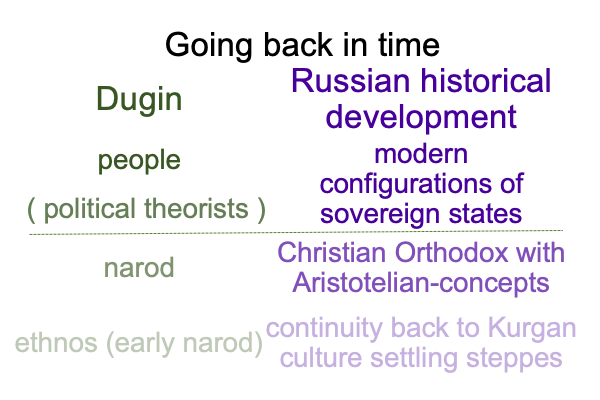
0905 The closest that the Slavs get to their ethnos is the migration of speech-alone talking tribes from northern Mesopotamia over the Caucasus mountains and onto the steppes, where they tame horses, make wheeled carts, build very large settlements, are ruled by their own chiefs, then eventually invade into the Indian and European subcontinents, spreading proto-Indo-European languages.
The next historical moment starts with the conversion of the Slavs to Orthodoxy by brothers Cyril (826-869 AD) and Methodius (815-885). Plus, a (Scandanavian-originating? Slav-assimilating?) kingship starts with Oleg the Wise (879-912). These traditional folk and clerics and kings may be called, “narod”, using Dugin’s terminology.
0906 Remember Machiavelli (1469-1527)?
Well, Ivan the Great (1440-1505) unites the principalities around Moscow, centralizes the Russian state, and fashions the title, “tsar” (which harkens back to the Roman title, “Caesar”). He champions the idea that Moscow is the third Rome.
Constantinople falls to the Ottomans in 1453, ending the Byzantine polity.
In 1452, Johannes Gutenberg prints 180 copies of the Bible using a mechanical press.
Sailing from Spain, Columbus discovers a new continent to the west of Europe that is not India in 1492.
0907 All this happens before the Luther posts his 95 theses on the church doors in Wittgenstein (1517), inadvertently launching the so-called “Reformation”. Inadvertently? Luther’s arguments are available to all literate folk because of the new-fangled printing press. The Gutenbergs are not the only ones with a movable-type printing press.
Was Martin Luther (1483-1546) a political theorist?
John Calvin (1509-1564)?
0908 It seems that, currently, most moderns regard them as theologians.
But, if history is a species of semiotics, then I suspect that they may also be political theorists, because theoretical political models2c (SVi) can stand for the dyad2a, {church and salvation history as form2af [entangles] the language of reform2am} (SOi) in regards to a school that is focused on the semiotics of plain reading3a operating on potential ‘meanings of institutional decadence and renewal’1a (SIi).
0909 Say what?
How about the following interventional sign-relation?
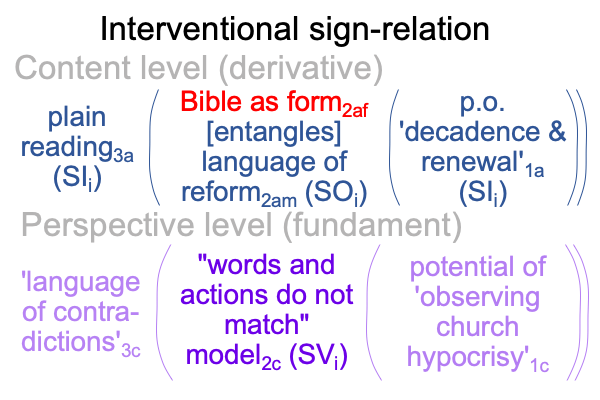
0910 Surely, this is not a model2c of prayer, sacraments and mystical union with the Son of the Father2c.
Political theorists love to point out hypocrisy. All they do is criticize. At least, that is what the bishops of Christendom say when they hear news of Martin Luther’s critical theory.