0882 The author raises an impressive option in the section of semiotics as a meta-discipline.
Should academic research in the humanities require conceptual frameworks or hermeneutical subtlety?
The answer becomes obvious once the author concedes that most contemporary researchers working with Uspenskij’s paradigms concentrate on applications.
0883 The author suggests that the determination of a semiological3a structural3b model2c of a clearly demarked historical moment (such as Peter the Great attempting to move the mountain of Slavic indolence) or movement (such as indolent Slavs convincing themselves that, if the Czar Peter the Great acts like he is divine, then he must be the Antichrist) freezes the dynamics of history. This is correct…
…until the historian’s Zeitgeist melts.
0884 Perhaps, a fixation about the difference between synchrony and diachrony distracts attention from a more foundational point.
0885 What value does the fundament interscope offer over and above what a historian is already doing?
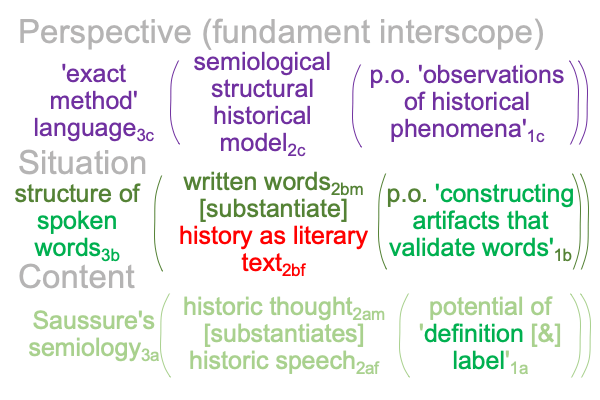
The historian already constructs history as a literary text2bf, using spoken words2af, based on observations of historical phenomena1c as if these are the observable and measurable facets of a historical noumenon, a thing itself.
In doing so, the historian intellectually freezes the dynamics of history.
0886 Does the historian generate the equivalent of a semiological3a structural3b historical2af model2c?
Here is a picture of the fundament interscope.
0887 Yes and no.
Yes, the historian treats history as a literary form2bf because the historian writes a text, a literary form about a historical moment or movement.
No, the historian does not treat history as a literary form2bf because the historian does not construct a semiological3astructural3b model2c that serves as an interventional sign-vehicle (SVi) that stands for an interventional sign-object(SOi), constituting a content-level actuality2a in a derivative (and open to the future) interscope.
Rather, the historian imposes present-day divisions of time and place onto the past, using labels such as “era”, “movement”, “dynasty” and so forth.
0888 Say what?
An interventional sign-relation bridges from the perspective-level actuality2c of the fundament (or “loquens”) interscope to the content-level actuality2a of the derivative (or “ego”) interscope in the same way that a sign-vehicle(SV) stands for a sign-object (SO) in regards to a sign-interpretant (SI). In this instance, the SI is the content-level normal context3a and potential1a.
08891 Here is a picture of the interventional sign-relation relevant to this article.
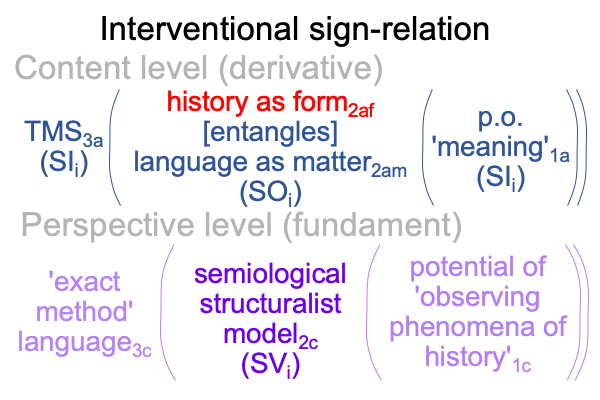
0890 A semiological structuralist model2c (SVi, virtually contextualizing the situation-level dyad of {written words2bm[substantiate] history as a literary form2bf}) stands for the entanglement, {history as form2af [entangles] language as matter2am} (SOi), in regards to the normal context of the Tartu-Moscow School of Semiotics3a operating on the potential of ‘meaning’1a (SIi).
0891 At this point, a discussion about the difference between synchrony and diachrony draws attention to a crucial point.
0892 Necessarily, history must be segmented into moments and movements (whatever way a scholar wants to slice it) in order to arrive at a model2c that allows the scholar to draw contemporary meaning1a, presence1b and message1c, (depending on how far the intellect wants to go into the derivative interscope).
0893 According to the author, Juri Lotman argues that the diachronic aspect of history may be captured by stringing synchronic models1c in sequence, like pearls on a necklace.
The key point is that each pearl involves the past coming into the present through the interventional sign-relation. The historian-semiotician uses the positivist intellect of the Tartu-Moscow School3a to manifest contemporary meaning1a(SIi), whereby a model2c of a past moment or movement (SVi) stands for {history as a form2af [entangling] present-day language as matter2am}(SOi).
0894 This brings me back to the question, “Does the historian generate the equivalent of a semiological3a structural3bhistorical2af model2c?”
0895 While some historians claim authenticity by writing out historical events as they sequentially and perhaps, instrumentally, occur, the reader of these highly dense volumes often gets lost in the details. In short, the lack of a semiological3a structuralist3b model2c results in the reader wondering, “What does this intricate detailing of eventsstand for?”
0896 Is it necessary that the loquens (“speaking”) interscope entangles the ego (“me”) interscope?
0897 Here is a difficulty.
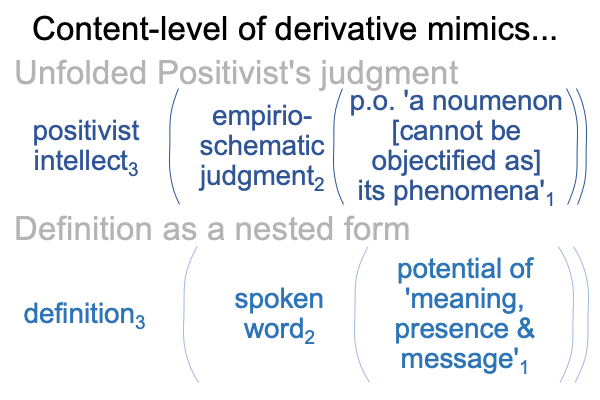
0898 On one hand, the perspective-level of the fundament (or loquens) interscope mimics the unfolded empirio-schematic judgment and the content-level of the derivative (or ego) interscope recapitulates the unfolded Positivist’s judgment.
On the other hand, the content-level of the derivative (or ego) interscope coincides with something that looks like the normal context of definition3 (such as the TMS school3a) bringing the actuality of a spoken word2 (the dyad where {history as form2af [entangles] language as matter2am} into relation with the potential of meaning1a, presence1b and message1c.
0899 In other words, the pearls on a string, and even the pearl-alone approach, touches base with scientific detachment(ego, in Descartes’ use of the term) and connects with me (ego, in the classic Latin use of the term), in a way that a tabulation of happenstance and intrigues does not.