0921 The author provides two case studies. I will cover the first, concerning the history of science.
Vladimir Vernadskij (1863-1945), a Russian-Ukrainian geochemist, formulates a law that living matter will occupy every niche that is available, whether environmentally (geologically) or ecologically (biologically). Plus, that occupation may create novel environmental and ecological possibilities. He called the propensity, “the pressure of life”.
0922 How about an example?
0923 The early Earth’s atmosphere is composed of hydrocarbons, carbon dioxide, water, and nitrogen.
The atmosphere is translucent, because ultraviolet radiation from the sun is absorbed by hydrocarbons, producing colored complex molecules that give the atmosphere the appearance of a global smog.
0924 Prokaryotes conduct photosynthesis and find ways to live in almost any area wet enough to support its life-forms. Photosynthesis uses the energy of light to build carbon-based biomolecules and simply releases oxygen gas as a waste-product. Over time, the accumulating atmospheric oxygen reacts with the hydrocarbon gases, reacts with the soluble iron in the oceans (precipitating the huge iron-band formations), and so on. Later, in the Precambrian, oxygen-dependent eukaryotic cells appear. Eukaryotic cells build into the multi-cellular organisms of the Cambrian Era.
The atmosphere is now transparent.
0925 The law of “life pressure” is like an observation, or rather, an understanding.
0926 How does understanding work?
First, one encounters an actuality2.
Then, one finds an appropriate normal context3 and potential1.
0927 In other words, understanding associates to a category-based nested form where all the slots are filled in, in a manner that comports with Aristotle’s four causes.
0928 Here is a picture of Vernadskij’s formulation.
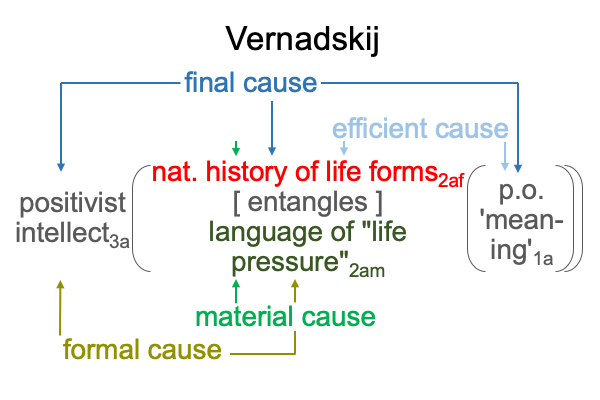
0929 The normal context of Vernadskij’s observations of geology and chemistry3a brings the dyadic actuality of {natural history of life as form2af [entangles] a language of aspiration as matter2am} into relation with the potential of ‘the meaning of what life is doing, trying to occupy every available niche through adaptation’1a.
0930 Vernadskij’s law2am does not arise from a mathematical or mechanical model, based on truncated material and efficient causation (that is, material without formal and efficient without final causes).
Plus, the natural history of life forms2bf is very much like a literary text2bf put into perspective by semiological3astructuralist3b models2c.
0931 According to the interventional sign relation, a biological parallel to a semiological3a structuralist model3a (SVi) stands for the literary text2af (again, the natural history of life forms2af), along with its entangled language2am (SOi) in regards to Vernadskij’s geochemical positivist intellect3a operating on the potential of ‘meaning’1a (SIi). The meaning1aof what Vernadskij observes3a supports the aspirational term, “life pressure”2am.
0932 The author reports that, in the early 1960s, Vyacheslav Ivanov (1929-2017), a philologist and one of the members of the Tartu-Moscow School of Semiology, is the first to situate the language of life-pressure2am in terms of the potential of ‘presence’1b within the normal context of cultural relevance3b.
0933 Say what?
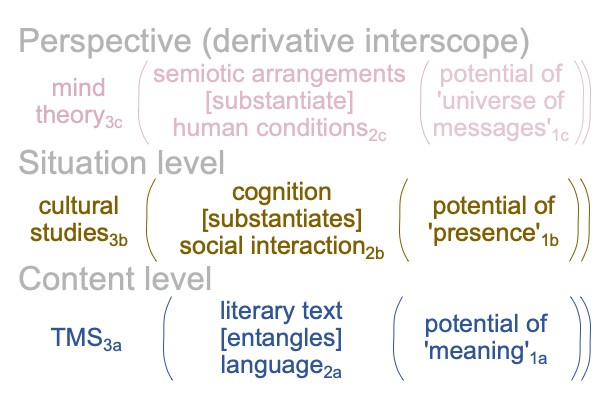
The presence of an (entangled) language of meaning1b undergirds the dyadic actuality of {cognition as matter2bm[substantiating] social interactions as form2bf} in the normal context of cultural processes3b.
Here is a picture of a general version of the derivative or “ego” interscope.
0934 Here is the history.
Lotman, following Ivanov’s intuition, grasps Vernadskij’s language of “life pressure2am” as a metaphor for the way that the intellect of the Tartu-Moscow School3a operates on the potential of meaning1a, presence1b and message1c. Then, he finds himself situating the metaphor2am with the presence of meaning1b, cognition2am, and social interactions2af, under the umbrella of cultural studies3b.