0706 After the second asterisk (2), Uspenskij discusses the future in a detailed manner.
Here is a comparison of the general and applied situation-levels of the derivative (or ego) interscope.

0707 Historical consciousness looks at the future as an extrapolation of the past and present.
Cosmological consciousness regards the future as part and parcel of a re-enactment of an originating primal event.
0708 I suppose the first has short-term expectations, born of sensible construction.
The second has long-term expectations, born of social construction.
0709 Here is the trick that Uspenskij does not articulate.
Sensible construction builds on social construction.
Sensible construction pertains to the content and situation levels of a three-level interscope. The perspective level is not even apparent until a dramatic failure occurs. A dramatic failure may come from ongoing sensible construction compromising the original social construction, as described, in fairy tale fashion, in the opening chapter of An Archaeology of the Fall.
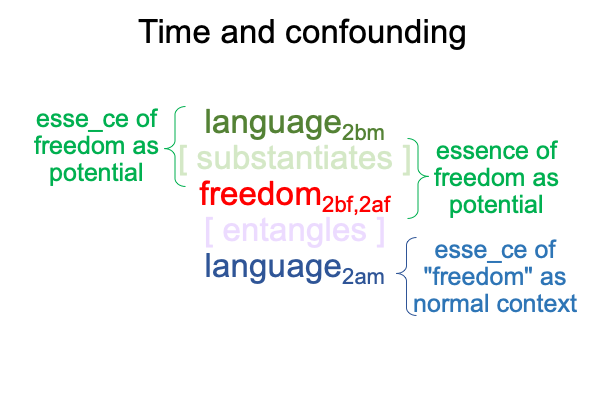
0710 For example, in America, the word “freedom” was originally a potential1 and “responsibility” was its normal context3.
One transit of Pluto later (248 years), according to modern corporate media, “freedom” is now a normal context3 and “responsibility” is someone else’s problem1.
By “someone else”, I mean “the taxpayer”.

0711 What does this imply?
Can corporations sell more product when freedom is the normal context3 rather than responsibility3?
Is this especially the case when the one who ends up holding the bag1 is not the person engaging in an addictive behavior2.
0712 Are apparently sensible, yet playfully transgressive, broadcast manipulations capable of altering the language of… what?… the language that supports the literary text as noumenon2bf… or the language that supports the literary text as a model of the noumenon2af?
0713 At some point, does a complete inversion of the co-opposition between “freedom” and “responsibility” occur, marking a turn – or a half-turn – of a cosmological cycle?
Or does the historical step-by-step conversion of “freedom” from the potential1 to act, while suffering the normal context of responsibility3, to the normal context of acting without constraint3, with others to suffer the consequences1, merely present the appearance of a cosmological process?
0714 In short, does Uspenskij’s model of time as a literary text2af entangling both historical and cosmological consciousnesses2am play out as a category-based nested form or an interscope moving diachronically through time?
0715 Here is a picture of the diachronic results for freedom as the textual thing itself2bf and its model2af.