0716 The implications are difficult to assess.
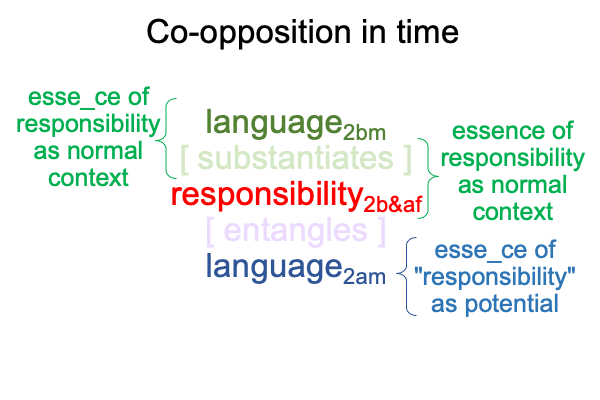
0717 Historically, at what point, does the entangled language2am become the language that substantiates2bm?
0718 At the second asterisk (2), Uspenskij moves from consciousness of past and present to perceptions of the future.
Historical consciousness looks at the future as an extrapolation of the past and present.
Cosmological consciousness views the future as a repetition of a primal foundation. It does not anticipate resolution.
0719 Why would this be the case?
0720 May I frame these views in terms of Hegel’s triad of thesis, antithesis and synthesis?
Historical consciousness offers a thesis, allowing sensible plans to be constructed.
Cosmological consciousness offers an antithesis. Sensible plans cannot be made. However, symbolic representation of the origination of an historical polarity grants a degree of awareness of the dangers occurring when thesis and antithesis exchange dominance.
0721 What do these re-framed views have in common?
Neither anticipate a synthesis.
The current paradigm of time2af continues as long as a synthesis does not resolve the tension between thesis and antithesis.
0722 At least, that is my guess.
My guess comports with Uspenskij’s discussion because a synthesis is not on the horizon. Uspenskij’s model2csuggests that a slow transition of language from talking about past, present and future2bf to talking about historical and cosmological consciousness2af will advance with his publication.
0723 Does that take the inquirer beyond the thesis of historical consciousness and the antithesis of cosmological consciousness?
Either way, continuity over time is anticipated.
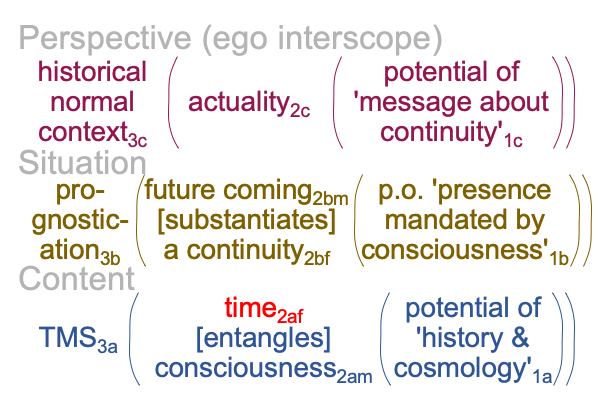
On the situation level, the normal context of prognostication3b brings the dyadic actuality, {the coming future2bm[substantiates] continued continuity2bf}, into relation with the possibility of ‘the presence of both historical and cosmological time’1b.
0724 Here is a picture of the derivative interscope.
0725 Uspenskij recognizes continuity in two, strikingly different literary texts.
0726 The first is the miraculous columns in Constantinople, built by Theodosius the Great in 386, showing a future conquest of the city by people who look a lot like the crusaders. When short haired, iron-sword bearing warriors come from the west (as predicted), they are taken aback by the panels on the column depicting the prophecies of Sibyl.
0727 The second is a thought experiment by American cyberneticist, Norbert Weiner (1894-1964).
Imagine an intelligence whose flow of time proceeds from our future to our past.
How could any communication occur?
It could only occur at the moment of the present, which is a very small window.
0728 Consider trying to get the letter, “m”, through this nanosecond portal.
A pulse of light, perhaps containing the entire “m”, will be received by a much less intelligent and not-so-prepared being (such as we humans) in an altogether incompetent manner. After all, nothing in the past prepared any human for such a transmission.
Weiner concludes that the reception of such an encoded photonic pulse would be experienced as either the suggestion of the letter, “m” or an omen of an “m”.
0729 Either way, the experience pictures and points to continuity.
0730 A psychic looks into her crystal ball, which inadvertently substantiates the matter of the encoded transmission into the form of the letter, “m”.
After consulting her mystic-oriented companions, she decides that, since “m” is the 13th letter of the alphabet, that she will announce, in thirteen days, that an alien intelligence, moving from the future into the past, generated the matter of a photonic expression of the letter, “m”, that simultaneously substantiated the form of the letter, “m”, in her crystal ball, the instrument of substantiations.
0731 She is the prophetic witness to a presence in an alternate time-direction.
Her crystal ball embodies the continuity.
History3c relies on the potential of ‘continuity’1c.