0732 The article concludes after the third asterisk (3).
Discussion shifts from the topic of the future to the metaphor of space.
0733 Historical consciousness discusses the future as the place that we are going.
Cosmological consciousness portrays the future as a place that we have been before.
0734 Both ways, the message1c is that the future will be a continuation of past and present.
But, what if we lived in a Lebenswelt where our hand-talk could not picture and point to these explicit abstractions?
What if we could manual-brachial gesture an arc from the location of the sun (or moon) towards its point of rising (past) or setting (future)?
Would these hand-talk words testify to an implicit abstraction?
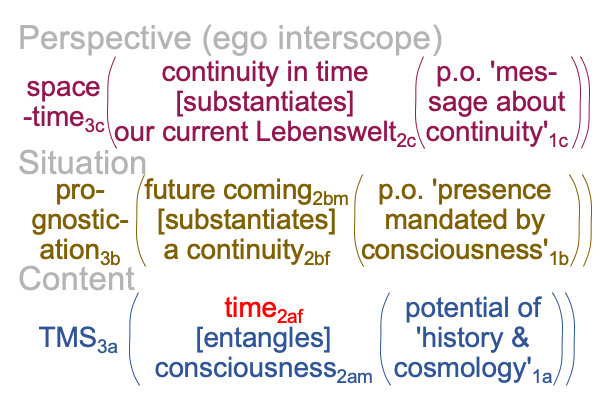
0735 What if we could not explicitly state that the normal context of space-time3c brings the dyadic actuality of {continuity in time as matter2cm [substantiates] our current Lebenswelt as form2cf} into the relation with the potential of ‘a message concerning the continuity of past, present and future’1c?
0736 Here is a picture of the interscope with that perspective-level nested form.
0737 Space is an excellent metaphor for time.
We move through time, just as we move in space.
0738 Our motion in space is continuous, so time must be continuous as well.
Well, it must be continuous if space and motion and time are metaphors for one another.
But, one wonders.
0739 Does the perspective-level hylomorphe, {continuity in time2cm [substantiates] our current Lebenswelt2cf} apply to the Lebenswelt that we evolved in?
Does the derivative interscope explicitly manifest in the Lebenswelt that we evolved in?
0740 Can one express the explicit abstractions of history, cosmology, consciousness, continuity, and space-time in hand-talk?
What is there to image or point to?
0741 It makes me wonder. Are the foundations for these explicit abstractions somehow, built into the human thing… er… being?
Matter and form?
After all, “ego loquens” means “I speak”.
But, what if our kind evolves in the milieu of hand talk?
0742 My two conclusions are obvious and open-ended.
First, Uspenskij’s work may be diagrammed using the fundament (loquens) and derivative (ego) interscopes.
Second, time is not the only semiotic problem.
0743 My thanks to Boris Uspenskij for publishing this brief, yet engaging article.