0697 Historical and cosmological consciousness?
After the first asterisk (1), Uspenskij discusses past and present in a detailed manner.
His discussion traces the contours of the specifying sign-relation.
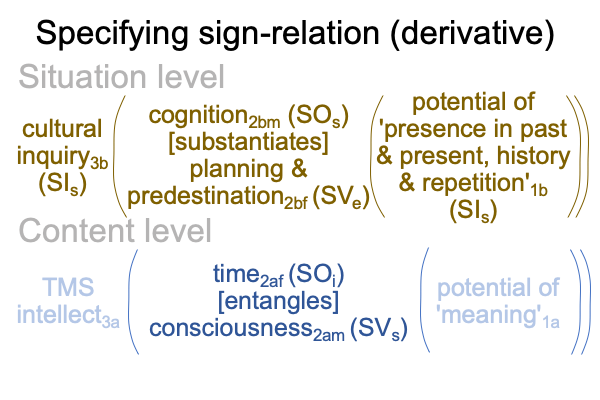
0698 The actuality of {time in the form of a literary text (or is it a semiological3a structuralist3b model2c based on the text2bf?)2af (SOi) [entangling] historical and cosmological consciousness2am (SVs)} stands for the actuality of {cognition based on past and present2bm (SOs)[substantiating] the present as a result of planning, as well as the present as a situation produced by cosmological antecedents2bf (SVe)} in regards to cultural – civilizational – inquiry3boperating on the potential of ‘the presence of past and present’1b (SIs).
0699 What does the term, “consciousness” imply?
Consider Julian Jaynes’s use of the term in Looking at Julian Jaynes’s Book (1976) The Origin of Consciousness in the Breakdown of the Bicameral Mind (Razie Mah’s blog for October 2025 and appearing in the e-book, Synaesthesia and the Bicameral Mind in Human Evolution, available at smashwords and other e-book venues).
0700 Consciousness involves reflective thought.
So the ‘presence1b‘ that cognition2bm emerges from (and situates) is reflective, as well as representative.
0701 What does this imply?
A spoken word labels a past event. Does that spoken word represent the past event? Does that spoken word serve as an artifact that allows us to reflect upon what it represents? Does that reflection eventually distort the representation? Can we then reflect upon that distortion?
We can, only if we are “conscious”.
0702 Spoken words do not picture or point to their referents.
Spoken words invite us to create artifacts that validate their referents.
This applies to the spoken language2am that is fixed in time in the form of a literary text2af.
0703 As to the past leading to the present, Uspenskij identifies two styles (or “genres”) of representation and reflection.
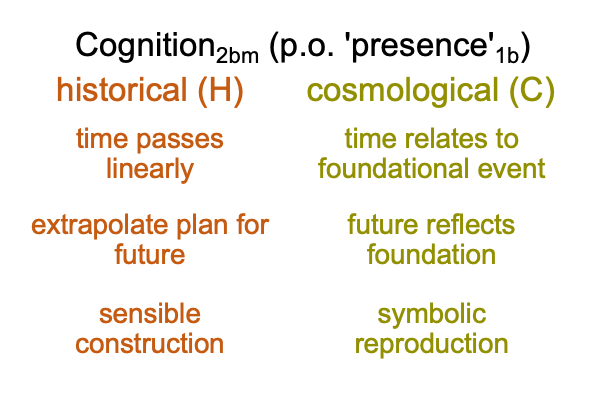
0704 Historical consciousness sees one event following another in a complicated chain of causalities. The continuity between past and present is like a path that leads somewhere. We can extrapolate where we are going (the future) by sensible construction based on past events.
Cosmological consciousness testifies to a foundation event that predicates what is to come (the future). Some call it “the cyclic view of history”. With respect to a founding event, what is to come is both our past and our present. So, the cognitive structure takes on the feel of a house of mirrors. One cannot plan ahead with conviction, but one can rely on symbolic reproduction to avoid or dodge cyclic catastrophes.
0705 Both historical and cosmological awareness appear in all civilizations.
Why?
Time as a literary form2af [entangles] the language of consciousness2am.