10/8/26

Looking at Ian Hodder’s Book (2024) “Entangled.”  (Part 21 of 22)

0276 Chapter nine (C9) is on method. Chapter ten (C10) considers an “entangled string theory” as well as other approaches.  Chapter 11 (C11) draws a short conclusion.

All these chapters deal with the issue of what the noumenon must be, in order to conduct the most informative archaeological inquiry.

0277 In this examination, I conclude that the conceptual apparatus of entanglement corresponds to a phenomenological presentation of what the noumenon of archaeology must be.

0278 The basis for such a conclusion is found in Razie Mah’s four part e-work Biosemiotics as Noumenon (2025).

0279 Here is a picture of the Positivist’s judgment, which ground natural scientific inquiry.
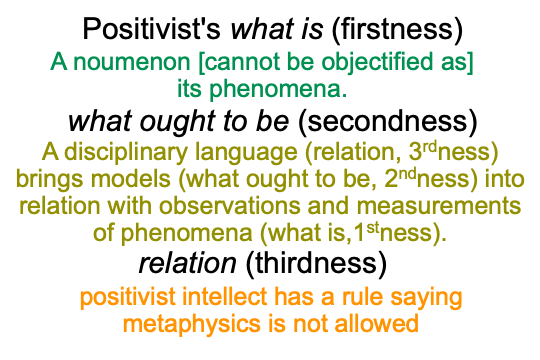
0280 A judgment brings what ought to be into relation with what is.   The three elements are what is, what ought to be, and relation.  In the above figure, the positivist intellect belongs to the relation (and the relation is imbued with the category of thirdness). The empirio-schematic judgment belongs to what ought to be (and is imbued with the category of secondness).  The dyad of the noumenon and its phenomena belongs to what is (and is imbued with the category of firstness).

0281 From this, I would expect a benefit from a robust conceptualization of the noumenon.

Otherwise, the noumenon is simply the thing that must be responsible for the phenomena.

But, what does that imply?

Obviously, one wonders whether what one is measuring really corresponds to phenomena of a real noumenon or an imaginary one.
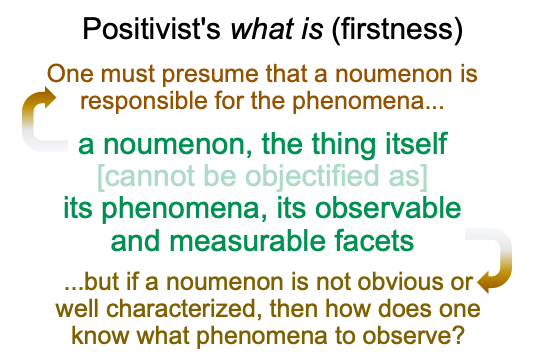
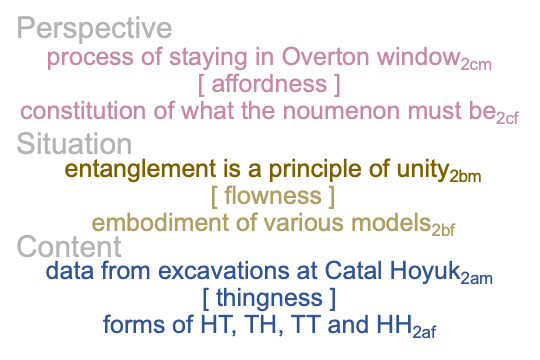
0282 In other words, Hodder’ entanglement is relevant because it reveals what the noumenon must be.

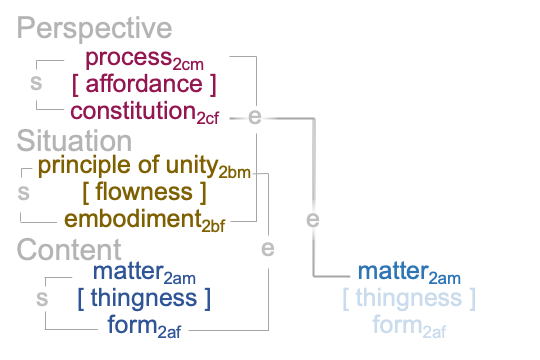
Here is my picture of his theory as an exercise in thingness, flowness and affordance.
0283 Chapter 9 discusses methods as if the noumenon is not under question.  He mentions tanglegrams (S2C9), formal networks (S3C9), sequencing concerns (S4C9) and other diachronic aspects (S5C9), as well as other interpretations (S6C9) without mentioning that… well… what exactly is the thing itself?

0284 I wonder whether all the other approaches elucidated in chapter ten (C10) confront the conundrum that I am trying to articulate.

If scientific appreciation of what the noumenon must be stands within the Overton window of Hegel’s and Marx’s things, then what if that is not enough?
10/7/26

Looking at Ian Hodder’s Book (2024) “Entangled.”  (Part 22 of 22)

0285 What do I mean by “not enough”?

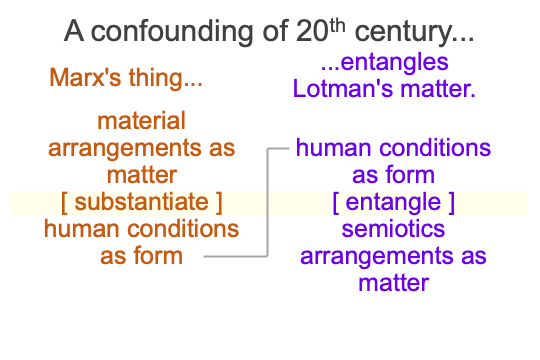
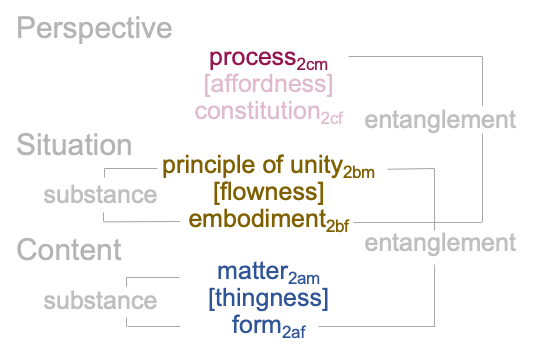
0286 From this examination, I have demonstrated that Hodder’s sociological and anthropological appreciation of “entanglement” mirrors, so to speak, a philosophical definition of a confounding.  Using Aristotelian terminology, a confounding occurs when the form of a thing entangles other (non-originating) matter.  Form is contiguous with two matters, one originating and one entangled.  The two contiguities are “substantiation” and “entanglement”.

0287 This applies to content-level and situation-level hylomorphes.  In the following figure, entanglement connects form on one level with matter on the adjacent higher level. This connection also occurs in the sign-relations isolated by scholastics of the Latin Age.

0288 Clearly, this expression of entanglement theory stands outside the Hegel-Marx Overton window.

This expression stands outside of the range of ideation among modern anthropologists in 2026.

0289 The story is even more complicated.  The three-level interscope fully contains two sign-relations, the specifying and the exemplar, familiar to Latin Age scholastics.  Even that is not enough.

There is one more confounding that resolves into a sign-relation.  The interventional sign connects the perspective-level of one interscope with the content-level of another.  What is constituted2cf in one interscope stands for matter3am in another interscope.  The discovery of the interventional sign-relation completes a line of thought that started during medieval times.

0290 The Hegel-Marx approaches that the author discusses in chapters 10 and 11 (C10 and C11) need to be adjusted in order to account for phenomena regarded as observable and measurable facets of a noumenon characterized by substances, confoundings and sign-relations.

0291 The story of the emergence of Lotman’s thing is told in Razie Mah’s blog for December 2025, titled Looking at Igor Pilshchikov and Michael Trunin’s Article (2016) “The Tartu Moscow School of Semiotics” as well as follow-up examinations appearing in January through March of 2026.

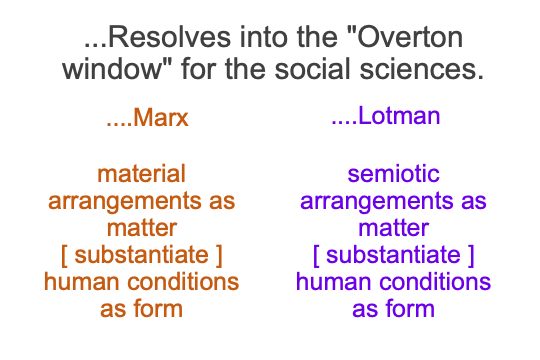
0292 Juri Lotman (1922-1993) is a Soviet era academic with expertise in the arts of the Slavic civilization.  He and a collaborator, Boris Uspenskij (1937-present), find that Marxist vocabulary is inadequate to discuss the phenomena of Slavic historical art production.  So, they adopt semiology and structuralism in order to build models of artistic and literary productions.  The models allow them to discuss Slavic art-works according to modern, scientific sensibilities.

0293 In sum, for Juri Lotman and Boris Uspenskij, Marx’s thing entangles the matter of semiotics.

0294 The confounding resolves in… what appears to me… to be the new Overton window for the social sciences for the twenty-first century.

0295 I wrap up with three noteworthy conclusions.

0296 First, Hodder’s anthropological theory of entanglement associates with Marx’s thing.  Razie Mah’s hypothesis that the human niche is the potential of triadic relations associates with Lotman’s thing.

Second, despite occupying different poles of the twenty-first century Overton window, Hodder’s sociological theory of entanglement and the philosophical definition of “entanglement” as a component of a “confounding” do not exclude one another.  They either complement or align.

Third, excavations at Catal Hoyuk permit the suggestion that cultural emissaries from the Ubaid of southern Mesopotamia influence a change in things2a, embodiments2bf and processes2cm associated with Level VII (starting around 6600 B.C.).  This suggestion is consistent with the hypothesis of the first singularity proposed by Razie Mah.

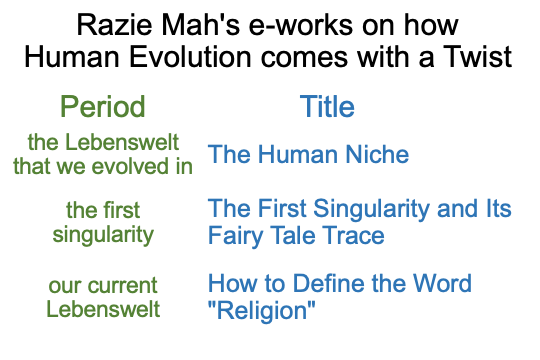
0297 Here is a summary of Razie Mah’s e-works on human evolution.

0298 My thanks to Dr. Ian Hodder for this book, as well his many collaborators.  I hope that this examination adds value to his inquiries.