0047 Before discussing a Peircean formulation of “entanglement” (E), I want to sum up the previous discussion (D) with the following figure.
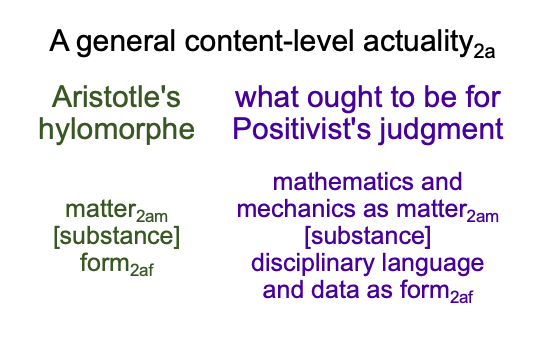
0048 Notice that the model, as well as observations and measurements, are out of view in this actuality2a. This actuality2a is an unfolding of the Positivist’s judgment, followed by a reification of the empirio-schematic judgment into a dyad reality. The missing ingredients will re-appear later.
0049 “Entanglement” first appears as a Peircean term in Razie Mah’s blog for December, 2025, titled Looking at Igor Pilshchikov and Mikhail Trunin’s Article (2016) “The Tartu-Moscow School of Semiotics”. The term is developed in subsequent examinations of articles from a special 2017 issue of Sign System Studies, dedicated to Semiotics and History. These reviews appear in Razie Mah’s blogs for January through March 2026.
0050 An entanglement couples other matter to an already existing form, as shown in the following figure.
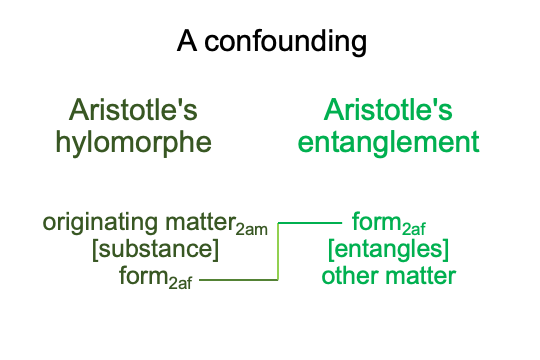
0051 A coupling of a hylomorphe and an entanglement is called a “confounding”. Confoundings are dangerous because they are full of contradictions. Secondness exhibits the logics of contradictions and non-contradiction, so a confounding can resolve in any number of ways.
0052 In chapter twelve (C12), the author discusses binocular rivalry, also known as “aspect-shift”. Show one eye the image of a rabbit and the other eye the image of a duck, then the person reports either a rabbit or a duck. One can even construct an ambiguous image that reads as either a rabbit or a duck, depending on which neural network commands consciousness at any particular moment.
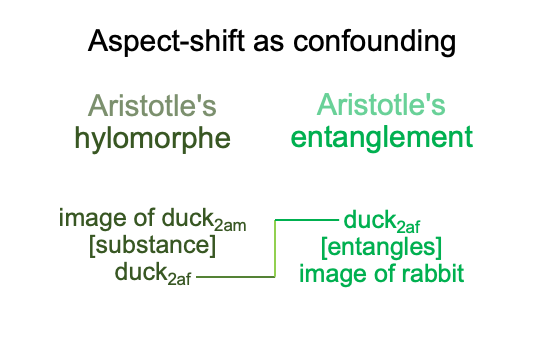
0053 Here is how the aspect-shift works. Consciousness reports one form, either a rabbit or a duck. But, because the one image contains two matters (or visible patterns) one matter will substantiate the form and the other will be entangled by the form at any given moment. The visual apparatus does not have the logic to solve that contradiction. That is not what the visual apparatus evolved to do. So, the confounding never resolves.
0054 Most confoundings resolve, one way or another.
0055 If I apply the above lesson to the hylomorphe2a that emerges from the potential of the dyad, {a noumenon [cannot be fully objectified as] its phenomena}1a in the normal context of the positivist’s intellect3a, then I wonder, “What is the entangled matter?”
I suspect that the entangled matter will end up supporting the form of an embodiment when the confounding resolves.
0056 Here is a diagram of what I am trying to way.
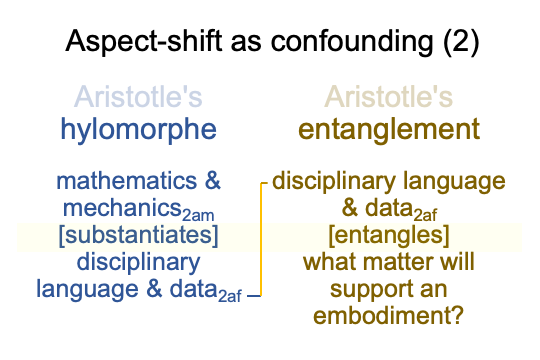
0057 Grab a pencil and paper. Write down what you think that the entangled matter might be.
If mathematics and mechanics2am conveys the appearance of the noumenon1a and if technical words and data2af shape the appearance of its phenomena1a, and if Aristotle’s hylomorphe2a emerges from and situates the potential of {a noumenon [cannot be objectified as] its phenomena}1a, then what?
What is written on the paper in front of you?