What about this vision of Original Sin as a reification of our own interpretations of the ‘what is real’. Once reified, a “serpent” inspires us to actions that produce results that differ from expectations (i.e. what is defined to be ‘real’). How do we deal with those results? Examples? And how does this picture resonate with traditional interpretations of these chapters of Genesis. This topic is addressed in chapters 11,12 and 13.
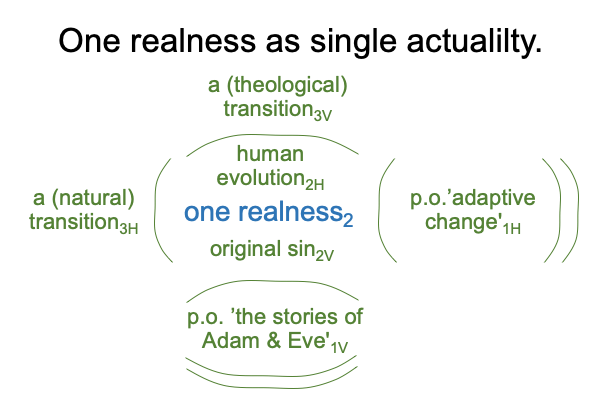
0009 The actualities of human evolution2 and original sin2 intersect.
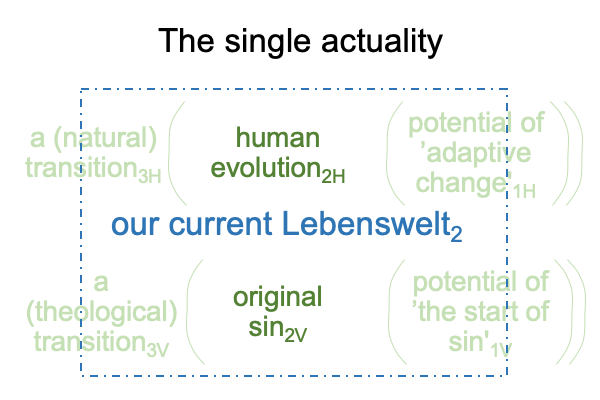
Here is the diagram of the intersection for this example.
Figure 03
0010 The intersection is a relational structure. The e-masterwork, How To Define The Word “Religion”, available at smashwords and other e-book venues, introduces the intersection. This relational structure associates to the message underlying the term, “religion”.
0011 Note how all the items in Haarsma’s title are captured by elements in the above intersection.
Two transitions (3H and 3V) touch base with the question, “When?”.
Two actualities (2H and 2V) go with human evolution2H and the doctrine of original sin2V. These two actualities join into a single reality, which I currently label as one realness.
The potentials (1H and 1V) are implied. Let me examine each.
0012 The potential of adaptive change1H arises in response to a niche. Typically, the niche involves some material advantage (to be exploited) or disadvantage (to be ameliorated). For our lineage, the niche involves immaterial advantages and disadvantages. How so? The Homo lineage adapts into the niche of triadic relations, as discussed in the e-masterwork, The Human Niche.
0013 The potential of the start of sin1V is not so different than the potential of the Genesis Primeval History1V. For this reason, I enter the potential of the stories of Adam and Eve1V, as the possibility underlying original sin2V. I could also have entered the potential of the letters of Saint Paul1V.
At the same time, the mythological character of the Primeval History comes into play. The stories of Genesis 2:4-11 are set in the Ubaid, Uruk and Sumerian Dynastic archaeological periods.This setting is discussed in the February 2022 blog series at www.raziemah.com, entitled, Looking at Carol Hill’s Article (2021) “Original Sin with respect to Science”.
0014 In the Introduction, Haarsma states that human evolution2H and the doctrine of original sin2V seem dissonant.
0015 All intersections seem dissonant.
Why?
Two apparently independent actualities constitute a single actuality.
0016 I call the single actuality, “one realness”.
What should I label this “one realness”?
0017 Maybe, the term, “our current Lebenswelt”, will do.
The word, “Lebenswelt”, is German for “living world”.
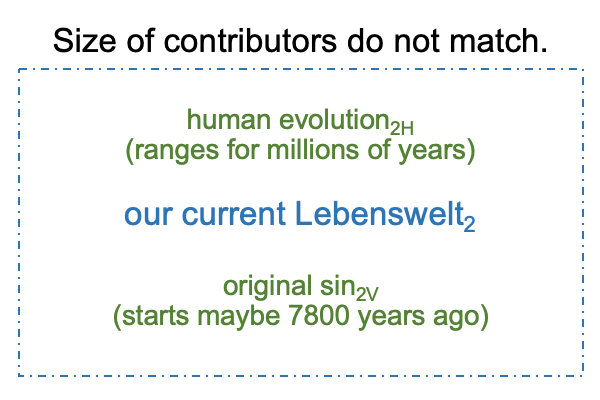
0018 Here is an initial picture of two actualities constituting a single actuality.
Figure 04
0019 The problem?
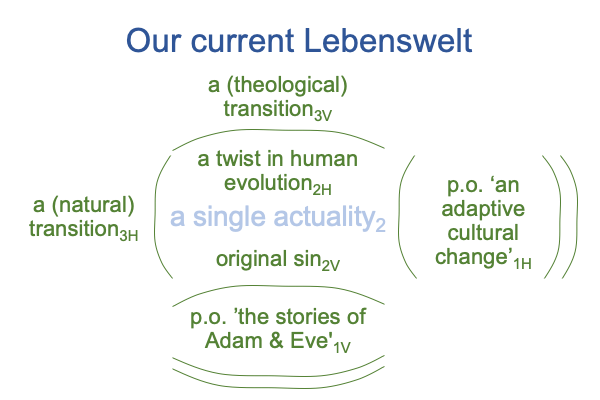
Original sin2V applies to our current Lebenswelt, the world after Adam and Eve.
Human evolution2H covers a much longer timeline than our current Lebenswelt.
This introduces a wrinkle to the fabric of Haarsma’s work.
The natural3H and theological transition3V marking the start of our current Lebenswelt2 involves only a fraction of the entirety of human evolution. It is like trying to fix one’s glasses with a tool kit designed for automobiles. It is like cutting a handkerchief from a bedsheet.
0020 Haarsma premises his book on the tenet that there are several possible ways to harmonize human evolution and the doctrine of original sin.
Plus, none of them are good.
Why?
None of them raise the following question, coming from the standpoint of original sin2V and addressing experts on human evolution2H.
Why is our current Lebenswelt is not the same as the Lebenswelt that we evolved in?
0020 Clearly, a natural transition3H and a theological transition3V contextualize the start of our current Lebenswelt2.
Furthermore, our current Lebenswelt2 arises from two, apparently independent, potentials: an adaptive change in human prehistory1H and a cultural change that is captured in the stories of Adam and Eve1V.
As already noted, these two potentials point to the Ubaid, Uruk and Sumerian Dynastic archaeological periods of southern Mesopotamia2.
According to the e-work, The First Singularity And Its Fairy Tale Trace, these two potentials pertain to a cultural change that potentiates civilization (specifically) and unconstrained social complexity (generally)2. This cultural change marks the start of our current Lebenswelt.
0022 In brief, the doctrine of original sin2V challenges the discipline of modern Anthropology2H, which currently proposes a litany of material causes for the potentiation of civilization, such as the birth of agriculture, or the use of irrigation, or population pressures, or this or that material condition.
0023 Original sin2V forces the Christian to ask the scientist, “What if the natural transition3H to our current Lebenswelt is not material?”
This is the location where Loren Haarsma cannot go, because he values the discoveries of natural history and genetics. For years, he has been working with human evolution writ large.
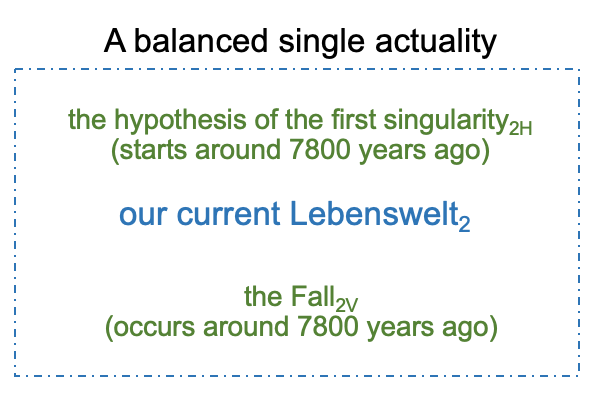
The result is that the initial intersection is lopsided.
Figure 05
On top of that, natural history and genetics cannot propose a scientific hypothesis for a cultural change in the way humans talk.
0024 The first singularity2H is a hypothesis inhuman evolution2H.
The hypothesis explains why our current Lebenswelt is not the same as the Lebenswelt that we evolved in.
The hypothesis pertains to the start of our current Lebenswelt.
The hypothesis is plainly stated in The First Singularity and Its Fairy Tale Trace, available at smashwords and other e-book venues.
The hypothesis2H is dramatically portrayed, in tandem with originating sin2V, in the fiction, An Archaeology of the Fall.
This produces a balanced intersection.
Figure 06
0025 With this in mind, I digress, in order to discuss two complementarities between the contributing actualities (2H and 2V).
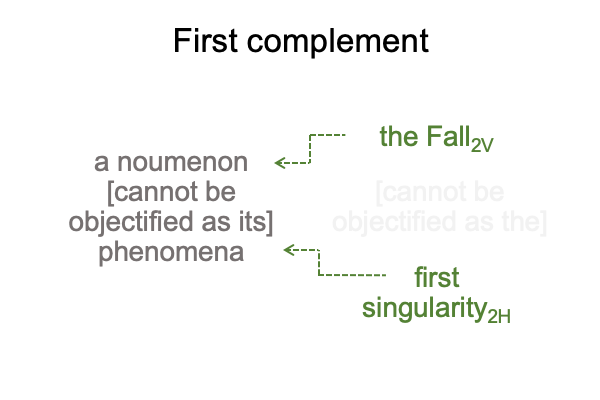
0026 The first complementarity matches the construction of what is in the Positivist’s judgment, as developed in Comments on Jacques Maritain’s Book (1935) Natural Philosophy. What is presents itself as an actuality, composed of two contiguous real elements, characteristic of Peirce’s category of secondness. But, this presentation is an illusion, because the two elements are really the same thing, regarded from two different vantage points.
The real elements are a noumenon (the thing itself) and its phenomena (the observable and measurable facets of the noumenon). According to Kant, a noumenon cannot be objectified as its phenomena. So, the contiguity is [cannot be objectified as].
The two contributing actualities complement one another in the following manner.
Figure 07
The Fall is like a noumenon. The first singularity models its corresponding phenomena.
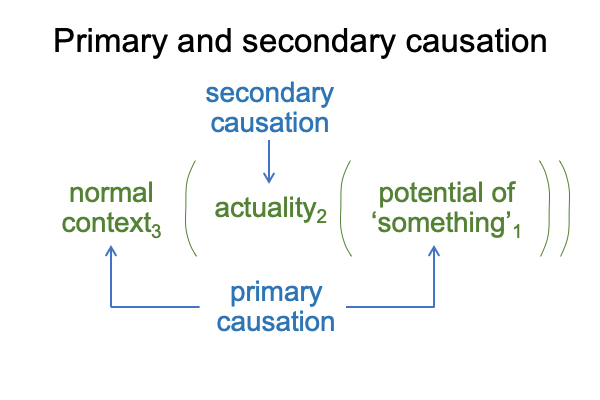
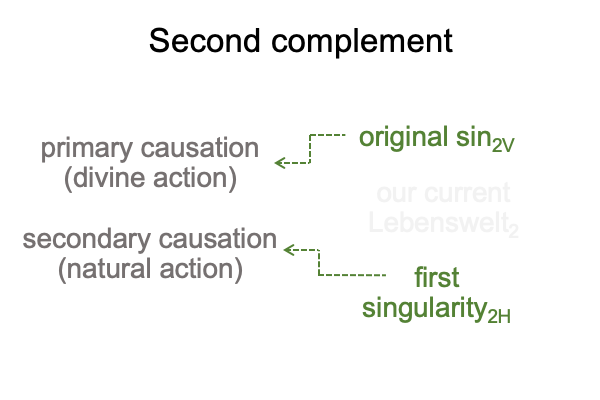
0027 The second complementarity matches the distinction between primary and secondary causation, which plays a role in Comments on Armand Maurer’s Essay (2004) “Darwin, Thomists and Secondary Causality” (see July 2020 of Razie Mah’s blog).
Secondary causation describes what goes on in the Peirce’s category of secondness, the realm of actuality2.Primary causation describes what goes on in Peirce’s categories of thirdness and firstness, the realms of normal context3 and potential1.
Figure 08
The two contributing actualities complement one another as follows.
Figure 09
0029 This digression into the complementarity between the two contributing actualities reinforces the idea that they should balance.
In chapter four, Haarsma discusses human evolution2H, as configured before the hypothesis of the first singularity. Indeed, he does not place any importance to the start of civilization, which is potentiated by the first singularity.
Does he realize that almost all of human evolution predates the stories of Adam and Eve?
I wonder.
Plus, I chuckle.
0030 Why?
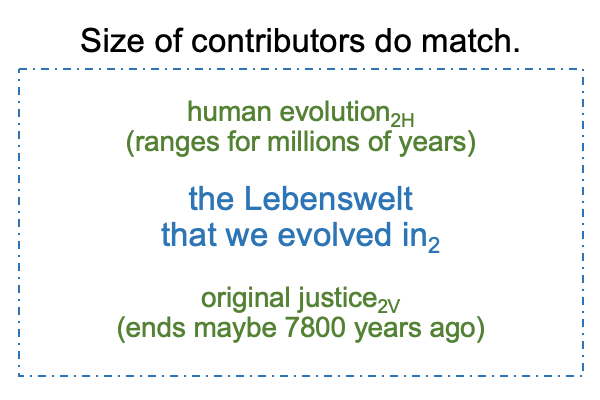
Saint Thomas Aquinas, the great medieval philosopher, argues that original sin is the lack of original justice.
So, the long period of human evolution2H is joined to original justice2H in the single actuality2 of the Lebenswelt that we evolved in.
Here is a picture.
Figure 10
0031 Wow. The size of the contributions match.
Plus, just as original sin2V asks theorists in modern Anthropology about a recent (and immaterial) natural transition in human evolution2H, which turns out to be the hypothesis of the first singularity2H,original justice2V challenges theorists in modern Anthropology concerning the nature of the ultimate human niche2H.
0032 At present, modern Anthropology has not confronted the concept of an ultimate niche in human evolution, now elucidated in the e-masterwork, The Human Niche. The ultimate human niche is not defined by material conditions. It is defined by an immaterial condition: The realness of triadic relations.
0033 The modern scientific community follows a rule: Actuality is all there is. Models are built from observations and measurements of material actualities. These models are couched in various disciplinary languages. In the empirio-schematic judgment, disciplinary language brings mathematic and mechanical models into relation with observations and measurements of phenomena.
0034 The problem?
Material actuality is not all there is.
0035 This point is obvious in the category-based nested form, derived from the semiotics-friendly philosophy of Charles Peirce. The category-based nested form manifests the realness of triadic relations.
In the nested form, a normal context3 bring an actuality2 into relation with the possibility of ‘something’1. The subscripts refer to Peirce’s categories of thirdness, secondness and firstness.
Material actuality2 is real.
Immaterial normal contexts3 and potentials1 are also real.
But, don’t tell that to modern anthropologists.
As soon as the hear, they will become “postmodern”.
0036 When a human encounters an actuality, the human does not understand. The human can observe and measure the phenomena associated with the actuality. The human may model these observations and measurements. The human may discuss the model using well-defined disciplinary language. But, understanding is not modeling.
Understanding is a triadic relation. Modeling is a dyadic formulation.
0037 Understanding concerns the noumenon, the thing itself. Actuality2 demands a normal context3 and potential1. Figuring out the normal context3 and potential1 leads to understanding.
Humans evolve to understand. Modeling things is only part of understanding.
0061 Chapter two is titled, “Creation, Evolution and Divine Action”.
Haarsma asks (more or less), “If the scientific evidence for human evolution is correct, then what does that imply about God’s action in intending, creating and blessing humans?”
I expand the query, asking, “If the scientific evidence for evolution is correct, then what does that imply about God’s creative action depicted in the first chapter of Genesis?”
0062 Obviously, the scientific evidence implies that God’s action in creating the world and humans is irrelevant.
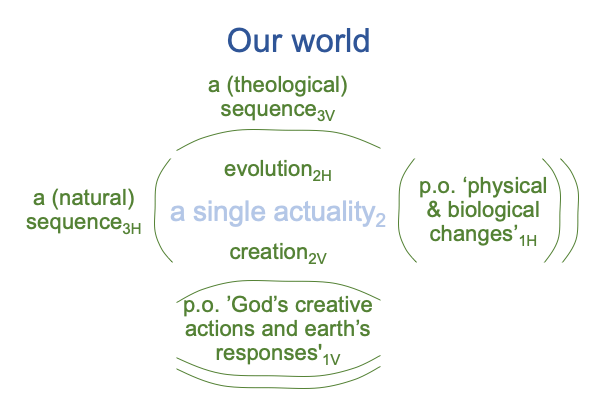
I start with the evolution of the planet and life2H and the Creation Story2V.
The single actuality is the world.
The world includes the Lebenswelt that we evolved in.
Figure 16
This intersection between evolution2H and Genesis 12V is packed with accidental and essential contradictions. Theologians are capable of distinguishing essential from accidental.
For example, one essential contradiction is this: Each narrative presents a sequence of events in the realization of our world. But, each sequence is unique. How can a Genesis day be the same as an evolutionary epoch? Yet, the two sequences are drawn into a single actuality. They are stuck together in a mystery. I call that mystery, “the world”.
0064 Plus, there is a world within the world.
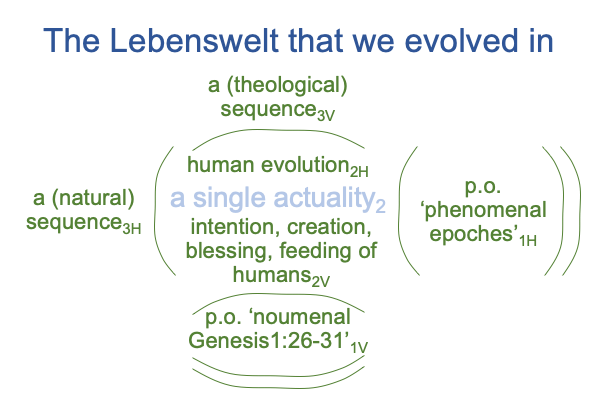
Genesis 1:26-31 portrays the intending, the creating, the blessing and the feeding of humans as well as the animals that humans keep. This implies that human evolution actually associates to our world, rather than our current Lebenswelt.
If I consider the intersection of all of evolution2H and the Genesis Creation Story2V, I arrive at configuration similar to the intersection of human evolution2H and Genesis 1:26-312V.
The single actuality is the Lebenswelt that we evolved in.
Figure 17
0066 Once these associations are made, then original sin2V binds to a twist in long-established trends in human evolution2H. Since this twist2H does not immediately alter prehistoric natural history or human genetics, the twist must be a cultural adaptation.
The single actuality is our current Lebenswelt.
Figure 18
0067 These intersections do not speak to us of dissonance, per se.
These intersections speak to us of mystery.
A mystery contains irreconcilable contradictions.
0068 One task of the theologian is to separate the accidental and the essential contradictions, in order to clarify the mystery. This is hard work. A mystery cannot be fully explained, partially explained or declared unexplainable. A mystery cannot be resolved by sensible construction. A mystery evokes social construction.
See the e-work, A Primer on Sensible and Social Construction.
0069 A mystery provides a message. The message is clear. A single realness coalesces from two disparate actualities. The two nested forms are bound. In this message of unity, the normal contexts and the potentials cannot be regarded as fully independent. Two nested forms bind into a mystery.
0115 My comments on chapters one and seven, 1A and 7A’, set the stage for original sin2V.
Chapter one claims that neither science nor theology can situate one another. When two actualities cannot situate one another, then they may intersect. The intersection associates to the potential of message, in the e-masterwork, How To Define the Word “Religion”.
Chapter seven discusses the formulation of the doctrine of original sin by Augustine. According to Augustine, Adam and Eve are the parents of all humanity. When taken as a scientific hypothesis in human evolution, the proposition fails.
Does that mean that narrative of human evolution2H and the doctrine of original sin2V do not intersect?
No, the intersection still stands.
0116 To me, the fact Augustine’s formulation contains a scientific proposition is amazing. How many theological formulations can be debunked by science? Remember, science cannot situate revelation. Revelation cannot situate science.
When Paul links Adam to all humanity in his letters to the Corinthians and to the Romans, Haarsma’s third intersection enters reality. How can this be? Augustine’s solution says that Adam and Eve are the parents of all humanity. For centuries, the nested form for human evolution is covered by Augustine’s proposition. Now, in postmodernity, the hypothesis of the first singularity is the solution.
A scientific twist in human evolution2H joins the doctrine of original sin2V in a single actuality, our current Lebenswelt2.
0117 Chapter eight follows the semitic structure of 1A:2B:3C:4D:5C’:6B’:7A’.
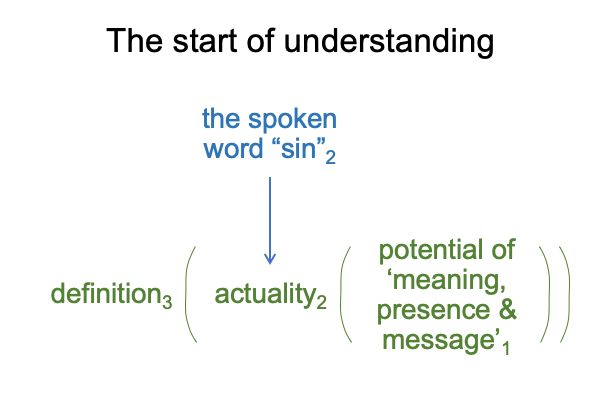
Chapter eight pays tribute to the slipperiness of speech-alone words by asking the question, “What is ‘sin’?”
0118 Of course, “sin” is merely a spoken word.
One needs a normal context3 and a potential1 in order to understand this actuality2.
0130 In chapter eleven, Haarsma raises other difficult questions.
I would like to elevate my own question for examination.
0131 When does sin begin?
Here is an artistic way to appreciate the answer.
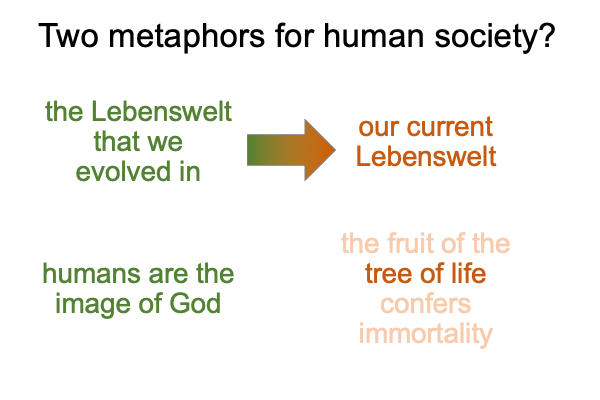
Consider the two interscopes of the Lebenswelt that we evolved in and our current Lebenswelt.
0132 Consider the theological actualities2V.
For the Lebenswelt that we evolved in, it2V is humans as images of God.
For our current Lebenswelt, it2V is the tree of life.
Here is a picture.
Figure 25
Consider the tree of life as a metaphor for the roots and the branches of belonging, intuitively nurtured by prehistoric humans living out their lives as images of God, …
0133 … then, in order to appreciate the depths of callousness and total depravity implied by the doctrine of original sin,consider the wickedness of plucking the fruit of the tree of life in order to attain immortality.
0134 Loren Haarsma tries to calm the dissonance of two apparently independent actualities: human evolution2H and original sin2V.
In doing so, he creates a semitic textual structure that allows my comments to suggest that these two actualities belong to a single reality. Two category-based nested forms intersect. The intersection of two nested forms offers a message. Here is a mystery.
0001 Jack Reynolds, Professor in Arts and Education at Deakin University, publishes a book with the subtitle, “A Hybrid and Heretical Proposal”. The book concerns two views that seem to resist hybridization: phenomenology and naturalism. Why? Does each regard the other as heretical?
Plus, where does that leave science?
Hmmm.
0002 Razie Mah examines Reynolds’ book in Comments on Jack Reynolds’ Book (2018) “Phenomenology, Naturalism and Science”, available at smashwords and other e-book vendors. The commentary is part of a series, “Phenomenology and the Positivist Intellect”.
0003 Phenomenology has an awkward relationship with science. It situates hands-on natural science. Yet, it competes for that role with visionary science.
Visionary science takes what is most precious to practicing scientists, the empirio-schematic judgment, and unfolds it into a situation-level nested form.
Phenomenology competes with and excludes visionary science.
0004 Consequently, phenomenologists and visionary scientists despise one another.
Both work to situate hands-on natural science, represented as a content-level nested form.
Each offers its own situation-level nested form.
0005 Perhaps, this is why Reynolds’ proposal directs attention away from the point of contention.
Hands-on science is naturalism. Hands-on science may be portrayed as the unfolding of the Positivist’s judgment into the content-level of an interscope.
Phenomenology and visionary science situate first-order natural science in very different ways.
0006 Phenomenology wants to consider phenomena in order to elucidate what the thing itselfmust be.
Visionary science wants to take an established scientific model and coronate it as what the thing itself must be.
A Christian theologian goes to the doctor and asks, “What is wrong with me?”
The doctor replies, “It might be original sin. The stories of Adam and Eve don’t need to be reconciled with science. But, Augustine and science, that is your problem.”
0005 Clouser relies on an interpretation of Genesis 1 and 2 appearing in Joseph Soloveitchik’s book, The Lonely Man of Faith. The title is ironic, since Soloveitchik is lonely in name only. He is one of the leading Orthodox Jewish theologians of the twentieth century.
The things that Soloveitchik writes. Some of them buttress Carol Hill’s argument.
0006 Here is the first point.
The Old Testament does not support the claim that Adam and Eve are the first humans. After all, where does Cain get his wife?
0007 Ah, that goes into the problem of Saint Augustine.
Augustine misreads Paul’s letter to the Romans. Well, actually, his Latin translation of Roman 5:12 has a crucial infidelity to the Greek text. The Latin slippage implies that we are all guilty of Adam’s sin. The Greek original suggests that we are all doomed because of Adam’s error.
The result?
The McGuffey Reader poetically waxes, “In Adam’s Fall, we sinned all.”
0008 Should Augustine have known better? Should the translator be blamed?
These questions step around an issue so tricky that everyone walks around it. Spoken words are slippery.
Augustine slips up. But, the slip serves as evidence for an important point.
0009 Adam and Eve may not be the first humans on Earth. But, they may be the first to rely on the slipperiness of spoken words to come to a conclusion that turns out to be highly problematic.
0010 Is this a theological implication of the first singularity?
Adam and Eve are the first humans in the history of redemption. They are neither perfect nor immortal. So, they screwed up.
0012 How did they do it?
They thought that they understood the meanings, presences and messages latent in their speech-alone words.
Ooops.
0013 This slip up brings Clouser back to Saint Paul, in his letter to the Romans, where Adam’s covenantal failure is compared to Christ’s covenantal success.
More or less, Paul says that sin enters the world through one man, Adam… but, wait a second… before Moses there is no law, so how can there be sin?
0014 In other words, the actuality of sin2 potentiating death1 in the normal context of the Mosaic law3 must have been functioning after Adam and before Moses, even though Moses is yet to be formally present.
0015 Clouser concludes that this imputation suggests that there are humans contemporary to Adam. Plus, their sins are not held against them, because God has not made Himself known.
0016 However, there are other suggestions that come to mind with the hypothesis of the first singularity.
Before Adam, do humans have access to a (metaphorical, or perhaps, literal) tree of life, which conveys an immortality unfamiliar to what we civilized folk currently imagine?
After Adam and before Moses, are folk, living within our current Lebenswelt, trapped within the imputation of Mosaic law, precisely as Paul notes?
0017 See the e-book An Archaeology of the Fall.
Also, see Comments on Original Sin and Original Death: Romans 5:12-19.
These are available at smashwords and other e-book venues.
0018 Paul’s aside fits the triadic structure found in A Primer on the Category-Based Nested Form.
Here is a picture for humans after Adam and before Moses.
Figure 1
0019 The normal context of the imputed Mosaic Law3 brings the actuality of sin2 into relation with the possibilities inherent in death1.
0020 Now, if I erase the normal context3 and potential1 and replace them with items from the stories of Adam and Eve, I produce the following nested form.
Figure 2
The normal context of the Garden of Eden3 brings the actuality of sin2 into relation with the potential of the tree of the knowledge of good and evil1.
0021 These two nested forms complement one another. The theological implications cannot be ignored. The Garden of Eden marks a transition from the Lebenswelt that we evolved in to our current Lebenswelt. The first singularity is a scientific hypothesis concerning the nature of this transition. The Mosaic law associates to our current Lebenswelt.
Adam and Eve are not the first humans.
Adam and Eve are fairy tale figures, standing at the portal to our current Lebenswelt.