01/26/21

Evolution and the Fall (Part 2)

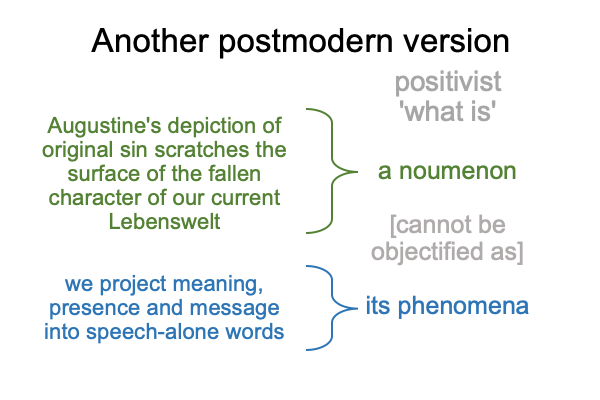
0007 Ours is a world where we project meanings, presences and messages into our spoken words, then construct artifacts to validate them (B2).  The artifact validates our projection, even in the face of unintended consequences.  One result is that spoken words, which are at first not deceptive, become deceptive, then wreak havoc until they are reformed.

Does that sound vaguely Biblical?

0008 An example is offered in the masterwork, How to Define the Word “Religion”.

0009 During and after the Reformation, the word, “religion”, labels Christian factions, vying for sovereign power in order to implement their organizational objectives.  The factions stand as artifacts that validate the term.  The terminology has consequences.  Enlightenment constitutions, especially the American, explicitly forbid the federal government from establishing a religion.

0010 The problem?

During the Enlightenment of the 18th century, and during the subsequent two centuries, new social noumena appear, claiming to be “not religious”.  The word, “secular”, is coined in the mid-1800s as a label.

What does it mean to identify oneself or one’s institution as “not religious”?

Well, it must mean that the entity does not belong to a Christian faction.

0011 The problem?

These “not religious” individuals (thinkers, leaders and supporters), societies (institutions) and movements (widespread affiliations) behave precisely in the same way that Christian factions do after the Reformation. They engage in social construction (meaning). They seek sovereign power in order to implement their organizational objectives (presence). Their righteousness contains inherent contradictions that cannot be resolved (message).

Indeed, modern “secular” individuals, institutions and movements meet the criteria that defines the term, “religion”, according to the above masterwork.

0012 The problem?

The US federal government has established a religion, contrary to the first amendment of its constitution.

It so happens, that the religion is not a “religion” (a Christian faction).

01/25/21

Evolution and the Fall (Part 3)

0013 What does the strange, historic reversal of the term, “religion” imply?

0014 The term is formed, deformed, and now, reformed.

0015 At first, the term is validated by the presence of Christian factions, vying for sovereign power.

Then, the term is exploited by “not religious” individuals, institutions and mass movements.  By identifying as “not religious”, theoreticians, organizations and broadcasters find that they can attain sovereign power in order to implement their own organizational objectives.  After all, they technically fulfill the Enlightenment mandate that sovereign states should not be in the business of establishing “religions” (Christian factions).

As a bonus, their competitors, Christian factions, cannot compete.

0016 Exploitation deforms the word “religion”, because “not religious” individuals, institutions and movements operate in precisely the same way as Christian factions during and after the Reformation, only with better technology. 

0017 The masterwork, How To Define the Word “Religion”, serves as a corrective to this deformation.  The current use of the word, “not religious”, is radically deceptive (B2), accounting for the application of the word, “secretive”, as an adjective, to secular individuals, societies and even, mass movements.

Do they know what they are doing?

Most “not religious” participants in mass movements think that their opponents are “religious”.  They are.  Yet, these same participants cannot recognize that their own stance is deeply religious, as defined by the masterwork.  The “not religious” are religious, too.  They revel in their own righteousness.

Hence, blatant hypocrisy defines our current times.

0018 In the ancient world, this type of impasse seizes a city or a region and brings it into memetic crisis (see Rene Girard in this regard).  The Bible describes the historical arc of Israel in roughly these terms.  The question revolves around the nature of God’s covenant with Israel.  God’s covenant is formed, deformed then reformed.

Plus, the path is not smooth.  God is at work throughout the Bible.  So are we.

0019 For two thousand years, Christians contemplate how Adam’s rebellion influences us (B2).  The doctrine of Original Sin characterizes a foundational feature of our current Lebenswelt.  We are fallen, then we figure out a truth, then we exploit that truth with a deceptive turn, and we fall again.  Sometimes, with God’s assistance, we figure out our mistake and reform.

Concupiscence is more than our desire to bathe our own corporeal dispositions with the waters of righteousness.  It is also our desire to inflame our spiritual dispositions with the fire of righteousness.  The Reformation term, “total depravity”, captures the way that we claim to define what righteousness is, rather than God.

0020 Isn’t that what Eve does, just before she plucks the fruit of the Tree of the Knowledge of Good and Evil?

01/23/21

Evolution and the Fall (Part 4)

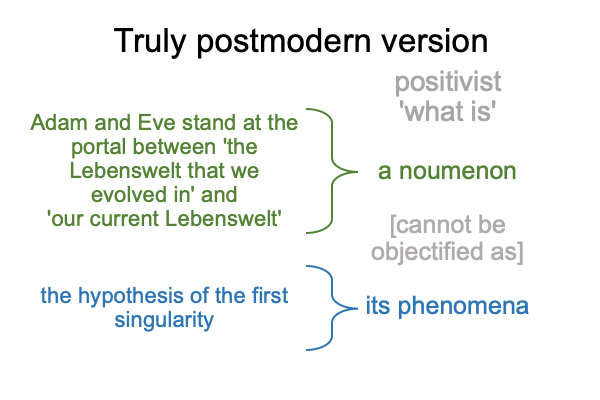
0021 The Genesis stories of Adam and Eve point to a real recent, prehistoric transition.

The first singularity (B1) initiates cycles of formation, deformation and reformation (or annihilation) (B2).  

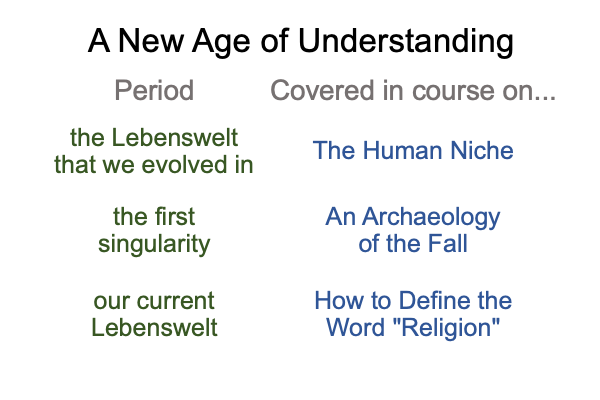
0022 The contributors to the book, Evolution and the Fall, edited by William T. Cavanaugh and James K. A. Smith (2017, Eerdmans: Grand Rapids, MI, ISBN: 9780802873798), are not aware of the masterworks, The Human NicheAn Archaeology of the Fall and How To Define the Word “Religion”.

As such, they try to adapt traditional Christian theology to an insufficient scientific paradigm.

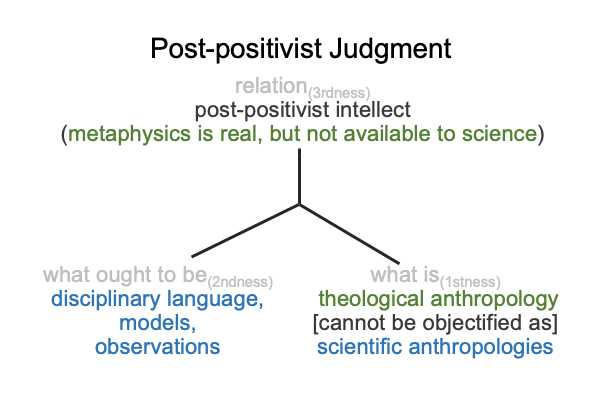
0023 As noted in Comments on Jacques Maritain’s Book (1935) Natural Philosophy, modern science does not permit metaphysics.  Consequently, human evolution must be accounted for by material and instrumental causations, whether in natural history (adaptation) or genetics (phenotype).  These are not sufficient, because the human niche is the potential of triadic relations.  Triadic relations are real, yet immaterial.  They entangle the material, but cannot be explained by it.

0024 Also, the modern paradigm for human evolution does not envision the fact that our current Lebenswelt is not the same as the Lebenswelt that we evolved in.  The transition from hand-speech talk to speech-alone talk leaves only one type of archaeological trace, the appearance of trends towards unconstrained social complexity.  Why?  A change of the semiotic qualities of talk is not a material cause, it is an immaterial cause.  Speech-alone talk potentiates unconstrained social complexity.

0025 Finally, some scholars, such as Rene Girard, capture essential features of our current Lebenswelt, and so are ignored by modern gatekeepers.  The writers of the past few centuries are often not aware of the materialistic Zeitgeist in which they operate. They wear blinders.  They do not see the object that brings all into relation.  After all, there is no material or instrumental power greater than sovereign power.  Is there?

0026 The three masterworks mentioned above offer novel scientific paradigms that (1) are consistent with current empirical knowledge and (2) transcend the proscription of metaphysics, by considering semiotics to be real.  Semiotics entangles the material, but the material cannot explain triadic relations.

0027 The three masterworks offer a new, truly postmodern answer to the questions: Where do we humans come from?  What went wrong?  What is the cure?

Good places to start include Comments on Daniel Houck’s Book (2020) Aquinas, Original Sin and The Challenge of Evolution, as well as Comments on Five Views in the Book (2020) Original Sin and the Fall.

06/2/20

Comments on Edmund Chattoe-Brown’s Essay (2019) “Does Sociology Have Any Choice But To Be Evolutionary?”

— Notes on Text

This work examines an article by Edmund Chattoe-Brown, appearing in the Frontiers in Sociology (26 Feb 2019, https://doi.org/10.3389/fsoc.2019.00006).  My comments rely on the category-based nested form and other relational models within the tradition of Charles Peirce.

‘Words that belong together’ are denoted by single quotes or italics.

Prerequisites: A Primer on the Category-Based Nested Form, A Primer on Sensible and Social Construction

Recommended: The Human Niche, An Archaeology of the Fall, How to Define the Word “Religion”, Two Primers on the Organization Tier, Speculations on Thomistic Evolution

— Table of Contents

Introduction and Conclusion   0001

Cheese in the Middle    0004

The Sandwich is Firm   0010

Evolution and a Cheese Sandwich     0022

Conclusion    0029

— Introduction and Conclusion

0001 Edmund Chattoe-Brown opens with an observation.

Sociology, as an academic discipline, tends to rule out evolutionary approaches.

Surely, sociologists want to avoid any connection between social behavior and genes. Or, should I say, society and genetics?

Why?

First, it is not polite.

Second, anthropologists have already thrown in with Darwin.  Archaeologists are convinced of the importance of evolution in understanding where the world comes from and how humanity comes to be.  Any sociologist interested in evolution can go into anthropology.

Consequently, sociologists face a choice whether or not to adopt evolutionary approaches.

0002 Edmund Chattoe-Brown concludes his essay, asking “What can evolutionary accounts do for sociology?”

For one, let us not put the cart before the horse.  Sociology is not to be at the service of evolutionary accounts.  Just the opposite, evolutionary accounts should make sociology “fun”.  Sociologists should not walk on eggs when discussing evolutionary accounts.

But, what is an evolutionary account?  Descent with modification?  Natural selection?  Or does it always reduce to biology, innate dispositions and the reading of gene sequences?

For two, today, sociology is a jumble of eclectic approaches, making it difficult to define a disciplinary core.  What kinds of analysis do sociologists engage in?  Non-quantitative historical sociologists rely on one toolbox.  Social statisticians work from another, quantitative toolbox.  One provides diachronic insights.  The other offers synchronic results.

Well, evolutionary accounts have similar specializations.  For example, diachronic radionuclide dating of fossils and synchronic genetic surveys complement one another.

For three, evolutionary analysis is able to lay a foundation for both diachronic and synchronic approaches.

But, obviously, such evolutionary analysis is not biological.  Genes will have nothing to do with unifying sociological evolutionary theories.

So, what does the term, “evolution”, mean to sociology?

0003 I suppose that evolutionary analysis is like a horse, at the service of sociology.  Also, sociology is like a cart, held up by a wheel on either side.  One wheel is historical and qualitative.  The other wheel is statistical quantitative analysis.

Chattoe-Brown sits in the driver’s seat of this horse-pulled cart, driving out of the barn of the introduction and conclusion.

— Cheese in the Middle

0004 Okay, my metaphors are goofy.  I hope that that will be a source of comfort and entertainment.

Chattoe-Brown’s introduction and conclusion act like two slices of bread.  In the middle, he places the Agent-Based Model (ABM).

The idea of an agent appeals to the theoretical inclinations of the historical sociologist.

The ABM allows the narrow numerical focus of the statistical side of sociology.

Does that mean that the ABM will contribute to evolutionary approaches?

I defer an answer.

0005 I ask, “How does the ABM fit into the category-based nested form?”

In order to answer, I draw upon A Primer on the Category-Based Nested Form and A Primer on Sensible and Social Construction.  These short pieces are enough to build a bridge between an ABM and an evolutionary approach.

0006 What does it mean to be an agent?

Well, an agent does “things”, broadly defined.  These things are actions that, ideally, can be qualitatively observed and quantifiably measured.  A bare-bones survey asks three questions.  What is happening?  What are you doing?  Why are you doing what you are doing?

In the synchronic moment, an agent acts2, in the normal context of what is happening3, upon the possibilities inherent in accomplishing ‘something’1.

Here is a picture of this content-level nested form.

Figure 1

0007 What does the term, “agent-based model” indicate?

Well, an agent does things. What is happening3 defines the content levela of an interscope.

 In addition to what is happening3a, an agent has the potential1 to situateb what he or she is doing2a.  This assessment1brelies on what I am supposed to do2b.  This assessment2b occurs in the normal context of what does it mean to me3b.

For sensible construction, what I am supposed to be doing2b better make sense2b.  These elements are both real and contiguous.

Here is a picture of this situation-level nested form.

Figure 2

0008 The situation-levelb actuality2 takes on the complete, dyadic structure of Peirce’s secondness.  The category of secondness is the realm of actuality.  Secondness consists of two contiguous real elements.  For the agent who models “his” own actions, the two real elements are making sense2b and what I am supposed to do2b.

The nomenclature looks like this: making sense2b [contiguity] what I am supposed to do2b.

The term, “contiguity”, typically means contact, attachment, dependency, sharing, holding together, two closely timed events and so forth.  Contiguity expresses causation, in the broadest sense.

The empirical sciences try to relate contiguity to material or force-field causation.  For example, iron filings on a sheet of paper align to the magnetic field of a magnet beneath the paper.  A magnetic field causes the iron filings to align.  The notation is magnet [contiguity] iron filings.  The contiguity is the magnetic field.  The contiguity is the point of interest for physicists.  They aim to mechanically and mathematically model this field.

What about the contiguity between making sense2b and what I am supposed to do2b?

The contiguity between these two real elements is yet to be articulated.

Still, the sociological imagination should already be engaged.  Humans always make sense2b of what they are supposed to be doing2b, even when their behavior makes no sense at all, to a so-called “disinterested” observer.

0009 Situationb virtually emerges from (and situates) contenta.

Together, they compose a two-level interscope.

Sensible construction is the hallmark of the two-level interscope.

Here is a picture of these two levels.

Figure 3

— The Sandwich is Firm

0010 So far, I imagine that an agent is an individual in community.

I am disabused of this notion with Chattoe-Brown’s first example.  The agent is a business firm.

Does a firm fit the picture of what an agent does2a and what an agent models2b?

Well, I suppose some translation is necessary.

0011 I start with the content level.

How does a business firm compare to an individual in community?

Here is my guess.

Figure 4

0012 The business firm obviously belongs to a different tier than the individual in community.  The relation among tiers follows the same pattern as the interscope.  The organization tierB emerges from (and situates) the individual in community tierA.

Nevertheless, there are parallels in the relational structures.

Management3aB ought to know what is happening3aA in the firm.  Sometimes, it3aB does not.

Production2aB strives to accomplish what must be done2aA.  This necessitates cooperative action.  Cooperative action increases productive capacity.

Does management2aB know this?

If they don’t, then human resources1aB should tell them3aB.  If the firm is not running smoothly, capital1aB is not put to best use.

There is a certain irony in the location of both labor support1aB and capital1aB.  Typically, labor associates to production2aB, the actualization of financial capital1aB.  However, labor2aB also comes with its own human capital1aB, which may or may not be utilized by a firm3aB.

Surely, this is an opportunity for sociological research.  What is the nature of human capital1aB?  Can human capital1aB be treated in a fashion that complements financial capital1aB?  

0013 What about a comparison of the situation levels between the firmbB and the individual in communitybA?

Figure 5

0014 This comparison touches base with Chattoe-Brown’s example of sales and price.

The firm3bB places products2bB onto a market1bB.  If the products do not sell2bB at a given price2bB, then the situation becomes dire for the entire firm.  In 1950, the economist, Armen Alchian, discusses a discontinuity between individualsAand firmsB.  The stakes are higher for firms, even though no one dies when a firm goes bankrupt.

Yes, the death of a firm seems so much larger than an individual’s fate.  Many individuals have done what they are supposed to do2bA, working at the firm3aB.  Suddenly, the firm no longer makes sense2bA.  A dream becomes a nightmare.

0015 The market is like an actuality independent of the firm.

Can a firm be considered an adaptation into a market niche?

Does that sound evolutionary?

What is a niche?

The following diagram presents Darwinian evolution as a sensible construction.

Figure 6

0016 The normal context of natural selection3b’ brings the actuality of an adaptation2b’ into relation with a niche1b’.  A niche is the potential1b’ of an actuality independent of the adapting species2a’.  

By comparison, a firm is an adapting species.  The actuality independent of the adapting species2a’, is the market.  The market2a’ is as changable as an evnironment2a’ or ecology2a’.  However, the biological terms do not capture the character of the market2a’, because the market is both material and immaterial.  The market plays upon what is real and what is imagined.  The Germans formulated a word that captures the market2a’ as a quixotic being.  The term is “Zeitgeist”.

Time is real.  Ghosts are unreal.

No wonder ancient civilizations worship the space between earth and heaven.  The god of the air, the wind, the cloud and the storm works under various names, including Yaltaboath.  Yaltaboath behaves like the actuality underlying the niche that any corporation adapts to.  Is Yaltaboath the personification of the open market’s multiplicity of specializations?  What about the market’s creative destruction?

0017 And, what about the times before civilization?

What about the era before business firms?

Is our current Lebenswelt the same as the Lebenswelt that we evolved in?

Consider An Archaeology of the Fall.

Okay, that’s a plug.

The contemporary firm belongs to our current Lebenswelt.

0018 Chattoe-Brown’s example of the firm as an agent-based model brings me right to the threshold of evolutionary theory.  The civilizational Zeitgeist is as fickle as Yaltaboath.  Change is in the air we breathe.  Yet, at the same time, each civilizational Zeitgeist lasts long enough to establish firms and profit from their endeavors.  Yaltaboath rewards as well as punishes. Attending to this god makes sense.

0019 So, let me go back to the previous figure.  Let me summarize.

How does natural selection3b’ work?

An actuality independent of the adapting species2a’ exists.

This actuality2a’ has a potential that can be exploited by the adapting species1b’.  This potential is called the niche1b’.

An adaptation2b’ exploits its niche1b’, leading to increased reproductive success in natural selection3b’.

0020 How does the business firm, as an agent-based model, fit into this picture?

The situation-level of the firm is the adapting species2b’.  The market is the actuality independent of the adapting species2a’.  So, the niche1b’ is the potential of the market2a’.

Here is how that looks.

Figure 7

0021 So, the content-levela of the firmB does not even appear in an evolutionary approach.  It is as if the abilities of management3aB, production2aB and support staff1aB are assumed to be functional.  The sales department1bB situates its product2aB as something that offers an advantage in the current market1b’.  Every product2aB fills a market niche1b’.

Just as every adaptation is a guess about how to exploit a niche, every firm speculates about the market that operates independently of the firm.

Of course, this must be a first approximation.  A second approximation will be required, because the presence of the firm itself may alter the market.

— Evolution and a Cheese Sandwich

0022 So far, the agent-based model is the cheese between the bread of the introduction and the bread of the conclusion.  As it turns out, the agent-based model may be re-articulated as a two-level interscope.  The two-level interscope is synchronic.  The two-level interscope expresses sensible construction.  The two-level interscope belongs to the organization tierB, which has parallels to the individual in community tierA.

Here is how that looks for firms.

Figure 8

0023 Plus, there is a diachronic, evolutionary twist.

For firms, the entire nested form for the situation levelb goes into the slot for adaptation2b’ in Darwinian evolution.

Here is how that looks.

Figure 9

0024 If sociology has no choice but to be evolutionary, then this double vision cannot be avoided.

The situation-level of a firmbB must be analyzed as it emerges from (and situates) its corporate content-levelaB.  To me, this analysis includes synchronic data and time-restricted models, typical of quantitative sociology.

The situation-level of a firmbB must also be pictured as an adaptation2b’ into a market niche1b’, where the market2a’ is (on first approximation) independent of the adapting species. (The second approximation brings in the idea of niche construction).  This drama is depicted in historical sociology.

Surely, the double vision cannot be resolved into one, even though both start with the relational structure of the agent-based model.

0025 With this said, I proceed to Chattoe-Brown’s second example of agent-based modeling: foraging.

He dwells for three sections on a case study for foraging for food.

Perhaps, the simulation applies to elk, in addition to ancestral hominins.

Is that a far cry from firms?

After all, the agent-based model starts with a two-level interscope of individuals in community.

Here is how that looks.

Figure 10

0026 This raises an odd question, “Does the individual adapt, in the Lebenswelt that we evolved in, in the same way as the firm adapts in our current Lebenswelt?

In our current Lebensweltthe firmb’ adapts to the potential of the market2a’.  The market offers rewards (and punishments) in the milieu of unconstrained social complexity.  The behavior of a firm allows agent-based modeling to the extent that the Zeitgeist remains sensible.

Does this parallel human evolution?

0027 Consider the key hypothesis presented in the masterwork, The Human Niche.

In the Lebenswelt that we evolved inthe situation level of the individual in communityb’ adapts to the potential1b’ of triadic relations2a’.  Triadic relations offer opportunities for sign-coordinated cooperative actions.  Surely, the milieu is constrained social complexity. The innate behavior of individuals allows agent based-modeling to the extent that ecology remains stable.

Here is how that looks.

Figure 11

0028 This raises interesting questions.

Do markets2a’ and triadic relations2a’ have common characteristics?

My impression?

The more diverse the market and the more diverse the sign-relations, the greater the “wealth” of organizationsB and individuals in communityA, respectively.

0026 Is there a homology between the adaptations of firms and individuals in community?

Here is a comparison of the two situation-level nested forms.

Figure 12

0027 My impression?

A sale2bB matches what I am supposed to do2bA.

A price2bB points to making sense2bA.

What about the potential of situating production1bB?

The sales department echoes an individual trying to situate what “he” is doing1bA.

No wonder everyone seems to be selling themselves.

The resonances multiply. 

Individuals in communityA enter into the market2a’.

Individuals in communityA also enter into management3a, production2a and support for a corporation1a.

So, the organization tierB and the individual in community tierA are entangled.

0028 Does that suggest that Chattoe-Brown’s cart is going out of its lane or that the cheese sandwich melts?

No.  But, it does imply that genetics has nothing to do with the way sociologists investigate the organization tier.

Of course, biologists confound genetics and evolution.  They apply for grants on the grounds that genetics solves questions in evolution.  It does.  But, there is always another, often ignored, side to biological evolution.  That side is Darwinian natural selection.

Chattoe-Brown’s exercise in computer models concludes that both the environment and genetic-dispositions are in play in the evolution of foraging strategies.  However, these “genetic-dispositions” are not phenotypes, they are adaptations.

Geneticists can eat their cake and have it too.  Their cake is phenotypes.  But, they claim that phenotypes are the same as adaptations.

Sociologists must approach evolution in terms of Darwinian natural selection.  Institutions are adaptations.

— Conclusion

0029 Is there a disciplinary core to sociology?

According to Chattoe-Brown, not at this time.

Chattoe-Brown is an enterprising sociologist.  He tries to sell agent-based modeling as the portal to evolutionary approaches.  The gambit works because agent-based modeling is a symptom of human evolution and a feature of the organization tier.

Human evolution occurs in the Lebenswelt that we evolved in, as illuminated in The Human Niche.

The organization tier differentiates from the society and the individual tiers in our current Lebenswelt, as portrayed in How to Define the Word “Religion”.

The transition from the first Lebenswelt to the second is a unique, prehistoric event, the first singularity, as captured in the fiction, An Archaeology of the Fall.

0030 Chattoe-Brown anticipates that evolution will provide a disciplinary core to sociology.

He may be correct in ways that he does not currently imagine.

There may be a parallel between the evolution of firms in our current Lebenswelt and the evolution of humans in the Lebenswelt that we evolved in.

Here is a short list of comparing firmsB and individuals in communityA.

Figure 13
10/3/16

Man and Sin by Piet Schoonenberg (1964) 2.2 CD

[In ‘the Lebenswelt that we evolved in’, the eternal cycles of the world and the always present ancestors ordinated each member in each band.

‘Freedom for responsibility’ did not constitute ‘free will’. Rather it was our natural evolved condition.

‘What we now call ‘concupiscence’ (or ‘the state of being with Cupid’) did not involve turning away from the divine. Instead, desire was triggered and channeled by band and tribal traditions.

How else could it be? Desire was a condition for survival. We mimicked the desires of others in order to survive, including the desire to ‘totally give myself to another’.

Our ancestors were in ‘the state of being with one another’. Grace came naturally. Timeless and ancestor-bound traditions facilitated, ordinated, and guided.]

06/8/16

Man and Sin by Piet Schoonenberg (1964) 2.2R

Summary of text [comment] page 71

[In sum, ‘the idea of natural love’ is pure propaganda.

It moves the interpellated person away from what the human evolved to be.

Where does one see this idea propagated in contemporary society?

On television and in the movies?

In popular books and magazines?

Wake up.

Does anyone writing for popular television, movies, books and magazines suffer the consequences of misleading their consumers?

Let the buyer beware.

‘Natural love’ sells, just like perfume.]

12/18/14

Beneath the Veil of Strange Verses by Jeremiah L. Alberg 2013 1B

Alberg presented a quick summary of Girard’s ideas (xiv-xvi, 14-16).  This summary affirms my suspicions that An Archaeology of the Fall places a discontinuity right in the middle of Girard’s hypothesis.

An Archaeology proposes that, 7800 years ago, humans began to change the way they talked, from hand-speech talk to speech alone talk, and the difference in semiotic qualities potentiated unconstrained complexity; that is, civilization.

“The world that we evolved in” is not the same as “the world that we live in”.

The world of constrained complexity is not the same as the world of unconstrained complexity.

Girard’s concept of mimetic rivalry pertains to our current Lebenswelt of unconstrained complexity.  Literature is full of it.  As we all know, or at least, as Girard convincingly argues, (what we once called) “literature” provides greater insight into the workings of the human mind than what we call “social science”.

But then, social science has its own “literature”.  How confusing is that?]