11/19/25

Looking at Dennis Venema and Scot McKnight’s Book (2017) “Adam and the Genome” (Part 8 of 22)

0071 Each story about a change of genotype potentiating a new phenotype also is a story about an adaptation into a niche.

For the nylonase-producing bacteria, the niche is a waste pond full of industrial polymers.

For animals with backbones, the niche could be related to protection and movement.

For the fruit fly example, the niche may consist of proteins or molecules that were not previously transported.  The transport protein related to p24 may be receptive to changes in an environment that is independent of the species.

For the S-receptor virus, the niche was a petri dish filled with lots of S bacteria.

0072 In all these examples, genetic changes would not have been of value if the phenotype did not exhibit an adaptive advantage.   Genetic changes may have occurred.  But, they would not have been remembered by later generations.

0073 What does this mean?

Phenotype2b and adaptation2b are two actualities produced by independent methods of inquiry.  They inherently contradict one another.  They also inherently complement. 

0074 They intersect and form one actuality: descent with modification.

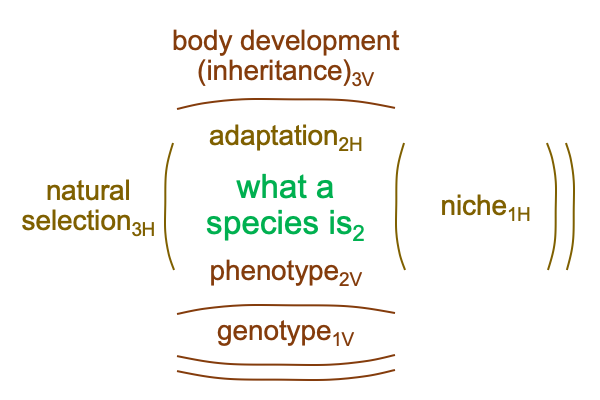
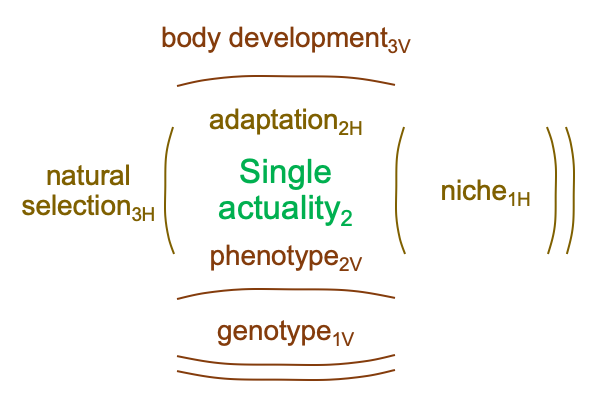
Here is my diagram of the intersection of adaptation2b and phenotype2b.
0075 Intersections are curious beings.

Classical Darwinism constitutes the horizontal axis.  It assumes some type of inheritance, but does not know how it works.

Neo-Darwinism constitutes the vertical axis.  It assumes the niche, and does not know how it works.

0076 Alone, neither classical nor neo-Darwinism can provide a full explanation of descent with modification.

Likewise, descent with modification cannot be reduced to one or the other nested form.

0077 Indeed, a miracle lies hidden within each intersection.

0078 On one hand, consider the virologists who find the right mix of R and S bacteria to observe the R-killing virus evolve to the S-killing virus.  They do not know whether other mutations would have produced an S-latching virus. They can only account for the genetic changes retrospectively (that is, after the event).  They could not have predicted what mutations would do the trick.

So, the genetic part is like a miracle.

0079 These scientists precisely define the niche.  The resulting gene changes are what (miraculously) happen to occur.

0080 On the other hand, consider the geneticists who isolate the chromosomal changes between chordates without backbones and chordates with backbones.  They may understand the DNA-altering mechanisms involved in these changes, but they cannot prospectively re-enact the niche that rewarded the phenotypes as adaptations.

So, the niche part is like a miracle.

0081 These scientists delineate the genetic changes.  But, they have no idea how to reconstitute the niche.  The niche is what (miraculously) happened to occur.
11/18/25

Looking at Dennis Venema and Scot McKnight’s Book (2017) “Adam and the Genome” (Part 9 of 22)

0082 Perhaps, intelligent design corresponds to the fact that an intersection lies at the heart of evolutionary biology.

0083 Phenotype2H and adaptation2V are two mutually exclusive, contradictory and complementary actualities.  They intersect to form one actuality: descent with modification2.

0084 No matter how fully one accounts for descent with modification.  There is always room for a miracle.

0085 Also, there is room to ignore a miracle.

Intersections are funny that way.

0086 Intersections are introduced in the chapter on message in How to Define the Word “Religion”.  Intersectionsconvey the message underlying the word.

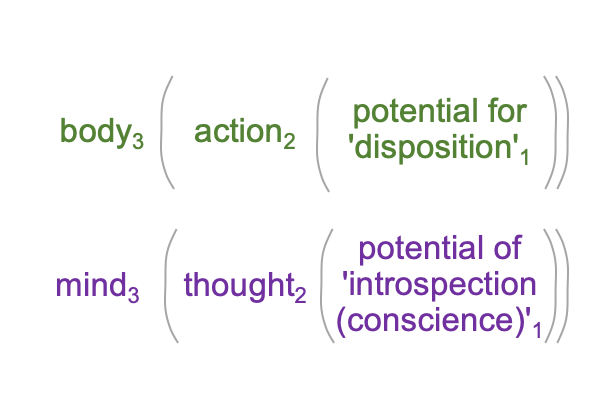
0087 A primal example of a religious message is the intersection of action and thought

0088 First of all, action and thought each has its own nested form.

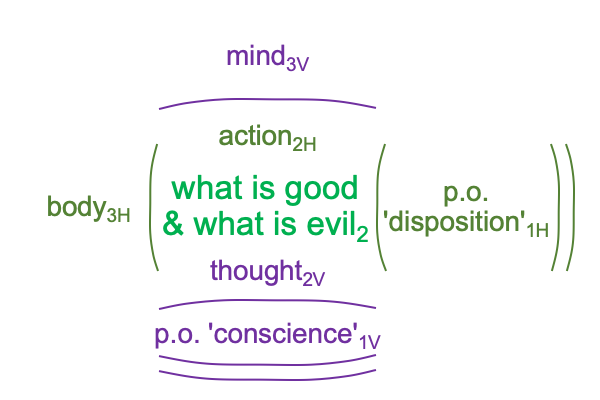
0090 If these two actualities are two independent ways of describing what is good and what is evil, then they may fuse into one – contradiction and complement filled – actuality.

0091 I diagram the following intersection in a particular manner.  There are other variations.  When I depict an intersection, I try to place the more celestial normal context on the vertical axis and the more mundane normal contexton the horizontal axis.  To me, the following configuration is particularly evocative.

Here is the intersection of action2 and thought2.

0092 The message is clear.  Thought2V and action2H are two contradicting and complementing actualities.  They constitute one contradiction-filled actuality2what is good and what is evil.  Thought2V cannot be divorced from action2H.  Action2H cannot be isolated from thought2V.

0093 A mystery binds thought2V and action2H.

The mystery cannot be resolved without destroying the completeness of what is good and what is evil.  As soon as one axis disappears, the mystery vanishes.

To me, that is the character of religious messages.

A religious message violates the rules of non-contradiction because its contradictions can never be resolved.  Two actualities intersect.

Would it not be interesting if a history of civilization was written with this intersection in mind?

11/17/25

Looking at Dennis Venema and Scot McKnight’s Book (2017) “Adam and the Genome” (Part 10 of 22)

0094 Furthermore, I can compare the intersection of what is good and what is evil with the message of descent with modification.  

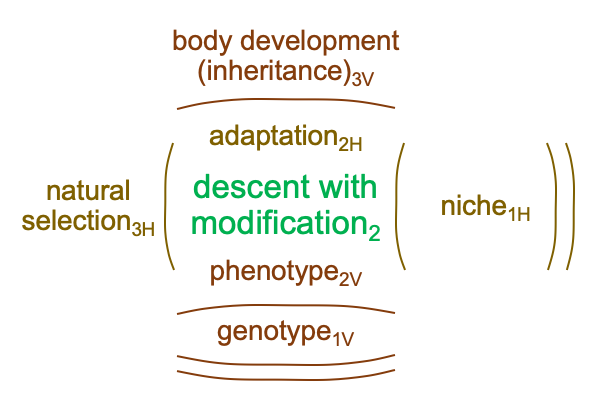
0095 For reading ease, here is the intersection at the heart of evolutionary biology.

Note that the Latin word, species, means “kind”.  A species can be an individual, a biological species, or a biological genus.

0096 Even though these two messages express vastly different content, they share the same mysterious relational structure.

0097 Is it creepy to think that what a species is shares the same relational structure as what is good and what is evil?

0098 It gets more creepy. 

Look at the first chapter of Genesis.

Note how God’s thoughts are also actions.

Note how the six days express the creation of kinds in various ways.

0099 Now, let me consider the two intersections presented so far.

The elements compare (as allegories of one another) according to their locations in the intersection, leading to all sorts of suggestions.

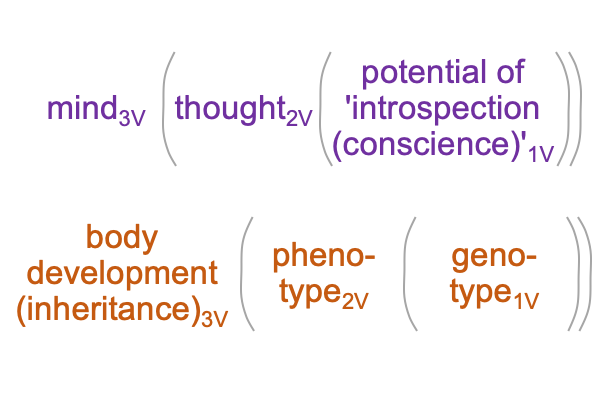
0100 Let me start by comparing the normal contexts.

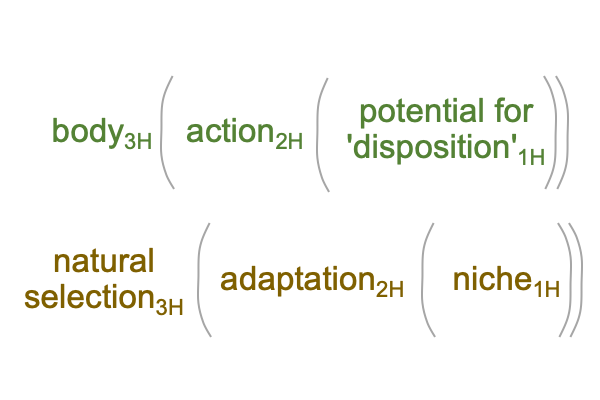
Natural selection3H is like body3H.  Body development3V is like mind3V.

Can I say that another way?

Body development (and biological inheritance)3V as the normal context for the phenotype2V parallels mind3V as the normal context for thought2V.

Natural selection3H as the normal context for adaptation2H parallels the body3H as the normal context for action2H.

0101 What does this suggest?

Well, to start, the first comparison calls to mind the concept of intelligent design where ‘something thoughtful’ is contained in DNA2a.  Okay, make that the genotype1V.  DNA2a parallels what undergirds the phenotype2V.  Phenotype2V parallels thought2V.  Genotype1V parallels conscience1V.  So, is there an actuality2a that undergirds conscience2V in the same way that DNA2a undergirds genotype1V?

Here is a comparison.

I know that the actuality underlying the genotype1V is DNA2a.

What about conscience1V?

0102 It makes me wonder.

What about modern scientific manipulations of animals and plants through selective breeding and now, genetic engineering?

The human body3H  is the normal context where human actions2H perform operations that alter the DNA2a of living organisms3V.

If we were disembodied minds2V, would we do these things?

We stand in the place of gods3V when altering2H the genotypes1V of species.

Where is our conscience1V?

We cannot completely predict the body and behavior of the phenotypes2V that we potentiate1V.  When unintended consequences occur, some3V will ask, “What were ‘we’ doing2H?”

But, ‘we’ does not include those of us who stand in the place of gods3V or have the power to ignore what is good and what is evil2 because ‘we’ were born3H that way3V.

0103 Shall I make another… hmmm… “thought provoking” comparison?

0104 Conscience1V compares to genotype1V.

0105 What does this parallel inspire me to imagine?

Let me ask, “Why do no other species that we observe engage in introspection?”

Well, what do we do when we engage in introspection?

Okay, we try to figure out what went wrong, among other things.

Do other animals introspect about what went wrong?

No, during an incident, an animal knows that something is going wrong.  An animal learns from what happened.  But, animals never seem to dwell (or introspect) on events in their lives.

It makes me wonder whether animals exhibit an intersection between thought2 and action2.  Maybe, thought2b virtually situates action2a.  Maybe, action2b situates thought2a.

It makes me wonder about what phenotypic structures2V are responsible for human thought2V.

It also makes me wonder whether something broke between the Lebenswelt that we evolved in and our current Lebenswelt.

11/15/25

Looking at Dennis Venema and Scot McKnight’s Book (2017) “Adam and the Genome” (Part 11 of 22)

0106 What about disposition1H and niche1H?

Good grief.  This comparison sounds almost deterministic.

Here is a picture.

Of course, the disposition of a species1H should parallel the potential of something independent of the adapting species1H.

Does that include the human religious disposition1H?

Okay, then what is The Human Niche?

Oh my, Razie Mah wrote a masterwork with exactly that title.

0107 These parallels (and there are many more) illustrate the following claim: Those who abandon Christianity because Adam and Eve cannot be the biological ancestors of all humans do not simply lose their religion.  They gain an alternate religion.

In terms of message, an alternate religion manifests an alternate intersection.

In the United States, from 1967 to 2017 AD, that religion is Big Government (il)Liberalism.

Some would say, “Bigilib.”

0108 Dominic Burbidge, an administrator for the Programme for the Foundation of Law and Constitutional Government at the University of Oxford, wrote a serious piece on contemporary universities for the Witherspoon Institute.  His article is titled: Listening: An Antidote to the Modern University’s Incoherence.

I find the article hilarious.

0109 Here is his argument in a nutshell:  The modern university consists in three disparate academic traditions: the University of Rationalism, the University of Subjectivism and the University of Revolution.  He proposes a fourth university in order to balance these three traditions.  He calls this fourth (proposed) institution: the University of Listening.

0110 Here is my interpretation:  The modern university is a single actuality that we call the University of Rationalism.

Within this university, two contradicting and complementary styles flourish.

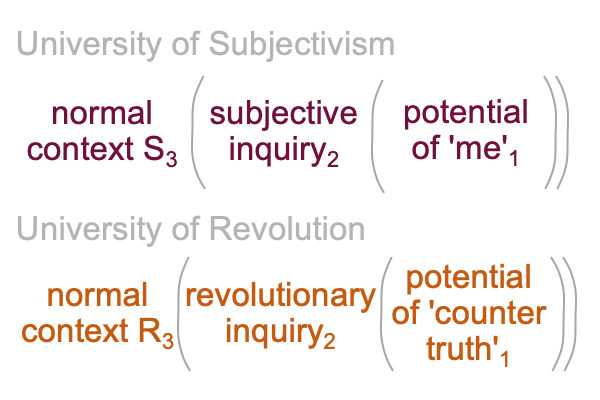
The so-called University of Subjectivism engages in inquiry2 that emerges from (and situates) the potential of the individual person, “me”1.

The so-called University of Revolution channels inquiry2 into the potential of a counter-truth (to a prevailing truth, already established by the (old-school) University of Rationalism, or even better, founded on Christian doctrine)1.

In short, the new University of Rationalism redefines the term, “rational”.

Are you listening to me?

0111 Burbidge did not mention the normal contexts for these growing academic traditions.  I will label these normal contexts, “S” and “R”.

0112 Here are the two nested forms.

0113 The normal contexts may now be named.

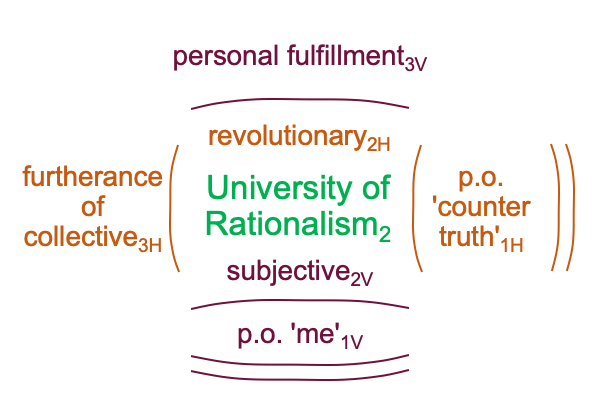
Normal context S3 is personal fulfillment3.

Normal context R3 is furtherance of the collective3.

0114 The inquiry of subjectivism and the inquiry of revolution coalesce into the single actuality of the (new school of the) University of Rationalism.

0115 Here is the resulting intersection.

0116 Oh, do I need to say that this is all found How To Define The Word “Religion”, by Razie Mah, available at smashwords and other e-book venues?

To teach the course, take a look at Razie Mah’s blog for December 2023.

Okay, what else does this imply?

This intersection describes the message underlying the religion of BG(il)L.

That is not enough, what else?

Our phenotype2V entails the innate expectation of “religion” characterized by meaning, presence and message.  Meaning goes with social construction (as opposed to sensible construction).  Presence associates to three nested tiers: societyC, organizationB and individual in communityAMessage includes the intersection.

Now, admittedly, there is a twist.  Our current Lebenswelt is not the same as the Lebenswelt that we evolved in.  More on that later.

11/14/25

Looking at Dennis Venema and Scot McKnight’s Book (2017) “Adam and the Genome” (Part 12 of 22)

0117 Right now I am discussing our current Lebenswelt.

For example, in 2017, various elites in Washington D.C. hosted a March for Science.  Here, practitioners of subjective and revolutionary inquiries… or should I say?… experts on capitalism and socialism claimed to “support science”.  

In short, the protesters claimed the mantle of rationalism.  But, really, they claimed the ideologies of capitalism and socialism formatted in the style of scientific discourse.

See Original Sin and the Post-Truth Condition, by Razie Mah, available at smashwords and other e-book venues for that… um… creative fusion.

Rationalism is now the single actuality encompassing the inquiries of subjectivism and revolution.  This is a mystery.  It is also a religious message.  The federal government has established a religion.

0118 Our civilization used to think that the term, “rational”, means “reasonable”.  “Rational” also meant “without passion”.  Now, rational inquiry means anything but religious.

Rational inquiry became more and more anti-religious… er… anti-Christian when Big Government (il)Liberalism increased in sovereign power in the United States, before, during and after the so-called Cold War (1945-1989 AD).

0119 That is not all.

So-called progressives consolidated sovereign power in all branches of the federal government.  They infiltrated every institution that received advantage from the federal government.  They divinized organizational objectives demanding federal action.

The message of subjectivism and revolutionary inquiry is this: The Progressive religion offers personal fulfillment and the furtherance of the collective, by being rational, where “rational” is defined as anything but “religious”… where “religious”… means “Christian”.

Amen!

0120 What about Burbidge’s proposal of a new academic tradition, the University of Listening?

Here is where I attain pure hilarity.

0121 Clearly, BG(il)Ls have redefined the word “rational”.  Rational used to mean reasonable or without passion.  Now, it means not religious.  Also, it means “scientific”, if you catch my drift.  That is the only way that subjectivity and revolution fit under the one roof of so-called “rationality”.  Trust the science.  Science is rational.

0122 Does that mean that the word “rational” is really no longer appropriate?

Let me shout from my megaphone, “The contradicting and complementing universities of subjectivism and revolutionought to throw off their old singular actuality.

But, what new word needs to be forged in order to replace the old single actuality of the University of Rationalism?

0123 I want to coin a new word for the single actuality composed of the two intersecting actualities.

The word should sound like “university”.

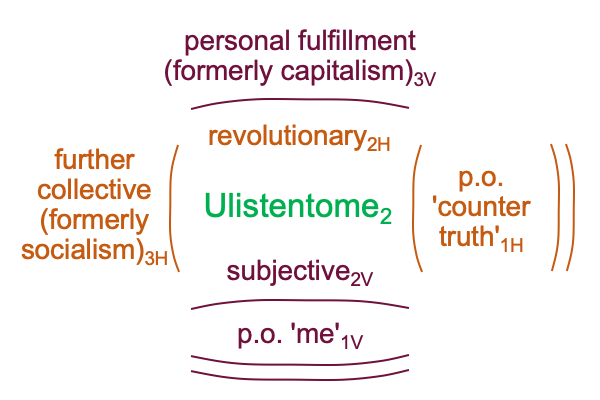
So, I propose the term “you listen to me” collapsed into the spoonerism “ulistentome”.

0124 Here is the intersection that I advocate.

0125 I propose that the term university be replaced by ulistentome.

Also, the word college should give way to harangue.

Seminary should become hope for salvation.

0126 Three academic institutions stand out in Boston.  These are Harvard UlistentomeBoston Harangue and the Gordon-Conwell Theological Hope for Salvation.  The first two are BG(il)L.  I am not sure about the third, explaining why I suggest the label: hope for salvation.

0127 Here is an assignment for the Christian student who would abandon faith in Jesus, the Messiah, when Adam and Eve are no longer the biological parents of the entire human species.

Compare these three messages (or intersections): descent with modification (or species), what is good and what is evil, and ulistentome.  Compare similar elements within these three relational structures.  See how they resonate.  Savor the ironies.  See how they illuminate one another.

0128 These resonances, ironies and illuminations ripple across the curtain that Venema lowers on Augustine’s drama of the story of Adam and Eve.  There is more to descent with modification than meets the eye.  Evangelicals may no longer be able to watch Augustine’s drama, but the curtain has come alive.  Evolutionary biology contains a religious message in the intersection of adaptation and phenotype.

Evolutionary biology manifests a mystery.

06/28/20

Comments on Robert Pennock’s Essay (2009) “…the Difference between Science and Religion?” (Part 1)

0001 In 2009, Robert Pennock wants to clear the fog of intellectual warfare, by publishing an article in Synthese (DOI 10.1007/s11229-009-9547-3).  The full title is, “Can’t Philosophers Tell the Difference Between Science and Religion?: Demarcation Revisited”.  Of course, a recitation of this title should be accompanied by a pouring of the Balvenie, matured in rum casks and aged 14 years.  After all, that is nearly the length of time that the words in Pennock’s paper have matured, in the cask of the Synthese.

Pennock’s abstract puts the headline question into context.  The 2005 decision, Kitzmiller versus Dover Area School Board, rules that Intelligent Design (ID) cannot be taught as a science.  This suggests that it cannot be taught at all, because the flip side of science is religion.  Public schools cannot teach religion.  That would violate the separation of church and state.

0002 The ruling follows a prior legal defeat, the 1981, McLean versus Arkansas decision against teaching creationism as science.  Afterwards, creationists contend that religion and science cannot be distinguished.  They cite a philosopher who claims that there are not sufficient criteria for demarcation, especially when considering method.

In contrast, Pennock argues that the word, “sufficient”, should be replaced by the word, “ballpark”.  Rules of thumb are capable of distinguishing between science and religion.  One rule of thumb is methodical naturalism.  Science relies on it.  Religion does not.

Does Pennock influence the 2005 Kitzmiller vs Dover trial?

Of course, why would Pennock write about the incident years later?

The text itself, is not clear.  

What is clear?

Judge John E. Jones III rules that ID pretends to be a science.  ID is really an apparatus of a sectarian religion.  Teaching ID in public schools would be the establishment of a religion, in violation of the first amendment of the Constitution of the United States.

Both sides of the case ask the judge to rule on this point.

0003 The ruling comes as a victory for Big Government (il)Liberals (BG(il)L), who portray the contest as follows.

The “villains” are the Board of Directors of the Public Schools of Dover, Pennsylvania.  Creationists gain enough seats to vote to make the ID textbook, Of Pandas and People, available as biology curricula.  In this book, natural selection becomes “Darwin’s theory”, which is not a fact, but a theory.

The “heroes” are several parents who sue the district.  They all fall under the label, “Kitzmiller”.

Curiously, “kitze” is a neuter noun for a kid goat.  “Miller” is a person who grinds grain in a mill.  Perhaps, the concatenation carries a symbolic message.

The “villainous” school district is defended by the Thomas More Law Center, which does not realize that they are about to have their heads handed back to them.  This becomes clear after they call key leaders of the ID movement to testify.

The lawyers at the Thomas More Center think that this trial will provide a platform for these players.  But, as the media circus tent goes up, many ID players withdraw.  What a disaster for the Dover Board lawyers!

0004 The BG(il)L corporate media portray the legal drama as a replay of the 1925 Scopes Trial.

To Pennock, the trial is more like the 1981 McLean vs Arkansas trial.  The McClean decision concludes that so called “creation science” is not science, but religion.  Here, “religion” means “a Christian faction”.

Such a ruling seems simple enough. But, the judge, William Overton, relies on a philosopher of science, Michael Ruse, who offers criteria to distinguish science from non-science.

0005 What are the criteria (A-E)?

Science (A) must be guided by natural law.

Science (B) explains by reference to natural law.

Science (C) is tested against the empirical world.

The conclusions of science (D) are tentative, and not necessarily the final word, because…

Science (E) is falsifiable.

0006 After the 1981 Overton decision, two philosophers, Larry Laudan and Philip Quinn, take issue with Ruse’s criteria. Do they write on behalf of the ID movement?  Is this damage control?  Pennock is drawn into the debate after he contributes expert testimony on the question whether ID is science or whether ID is religion. 

Is this the trauma giving rise to Pennock’s article?

Hard to say.

0007 Pennock reflects upon the question posed in the title.

He wants to offer a more acceptable path for distinguishing science and religion.

06/27/20

Comments on Robert Pennock’s Essay (2009) “…the Difference between Science and Religion?” (Part 2)

0008 Can one differentiate science from non-science?

Why is this question relevant?

The first amendment of the U.S. Constitution states that the federal government shall not establish a religion.

Is that the same as establishing a non-science?

So, the first question twists.  Is religion a non-science?

It turns away from an old relevance, where the word “religion” means “a Christian faction”.

It twists towards a new relevance, where “religion” is defined by an underlying meaning, presence and message.  This is the topic of the masterwork, How To Define the Word, Religion.

0009 Why is this twist relevant?

What if the U.S. federal government establishes a religion?

What would be the nature of this religion?

Clearly, this religion is not a Christian faction.

Rather, it consists of diverse movements, a thousand points of light, that (F) claim to be “not religious” and (G) demand sovereign power in order to implement their organizational objectives.  Since each objective arises from the potential of righteousness, these diverse religions constantly signal their virtues.  They are keen on making sure that their organizational objectives get the government funds that they deserve.  Righteousness wins power and money.

Does the legal debate that Pennock addresses concern a single point of light, among thousands?

No.  Public education is… um… a big fish.

Yes, it’s a gigantic fish with sharp teeth.

0010 So, the question turns full circle.

Can science be taught as a religion?

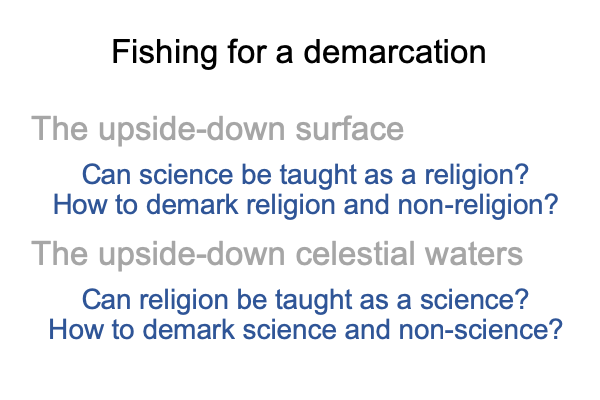
The world is upside down.  The ocean is where the sky should be.  The sky is where the sea should be.  The demarcation problem rests on the surface of this upside-down ocean.  In this world, whales fly in the waters above.

The Story of Creation floats as a little boat that draws the leviathan of public education down from the heights, in a re-enactment of an orientation-challenged Moby Dick.  The Captain Ahab of Creation Science wants to kill the leviathan, directly.  In doing so, he would bring the celestial waters of the deep state into consciousness.  The highly elevated deep state contains a thousand institutions, whose points of light orient Big Government (il)Liberals.  Plus, this heavenly sea holds some really big fish.

Because these institutions3aC, both lights and fish, have organizational objectives2aC that emerge from (and situate) the potential of righteousness1aC, they are religions.

They appear to be stars dwelling high in a fish-filled celestial ocean of righteousness.

Ah, the relevant question becomes, “How does one distinguish religion from non-religion?”

0011 Here is how this fully twisted vision appears.

Figure 01

0012 Does this explain why the dismissal of the demarcation problem is premature?

If the world is upside down, then The Creation Science aims to lance a leviathan that dwells deep in the narratives of the heavenly waters of Big Government (il)Liberalism.

06/26/20

Comments on Robert Pennock’s Essay (2009) “…the Difference between Science and Religion?” (Part 3)

0013 Okay. I must hold, in my mind, the upside-down celestial waters.

Within these waters, a leviathan swims, asking the questions, “Can Intelligent Design be taught as a science? How do we demark science and non-science (that is, religion)?”

But, those on the surface, the sailors on the ship, The Creation Science, suspect that the leviathan is really asking, “Can we teach science as a religion?”

Of course, it all depends on how one defines the word, “religion”.

0014 In section 3, Pennock considers the philosophy behind the 2005 Kitzmiller vs Dover decision and establishes five points (H-L).

First (H), Kitzmiller does not follow the criteria used in the McLean case (points A-E).

Second (I), Kitzmiller relies on a ballpark demarcation (a ground rule, so to speak).  Creationism violates this ground rule.

Third (J), the ground rule is methodological naturalism.  This rule says, “Metaphysics is not allowed.”

The word, “metaphysics”, is rooted in two terms, meta- (to cross over) and -physics (the physical).  Naturalism does not allow its followers to pass out of the realm of phenomena.  Phenomena consists in that which is observable and measurable.

0015 Pennock dwells on this point (J) at length.

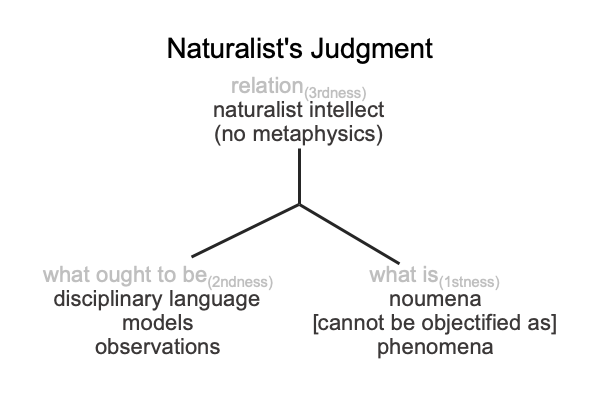
To me, he describes the Naturalist’s judgment.

Allow me to elaborate.

A judgment is a primal triadic relation, consisting in three elements: relationwhat is and what ought to be.

0016 The relation is the naturalist intellect, which rules out metaphysics.  This relation is imbued with Peirce’s category of thirdness.  Thirdness associates with a normal context3, as described in A Primer on the Category-Based Nested Form.

0017 What is consists of phenomena.  Phenomena are observable and measurable features of a thing or event.

There is a certain philosophical emptiness to phenomena.  After all, phenomena do not constitute the thing itself, even though some may imagine that this is the case.  The thing itself cannot be objectified as its phenomena.  So, there is a word for the thing itself: “noumenon”.

What does this imply?

What is may be expressed as a continuity between two real elements, a noumenon and its phenomena.  That continuity is placed in brackets for notational clarity.  What is consists of a noumenon [cannot be objectified as] its phenomena.

This dyad belongs to the category of firstness.  Firstness is the monadic realm of possibility.  Phenomena have the potential to be observed and measured.  A noumenon has the potential of capturing the attention of the naturalist intellect.

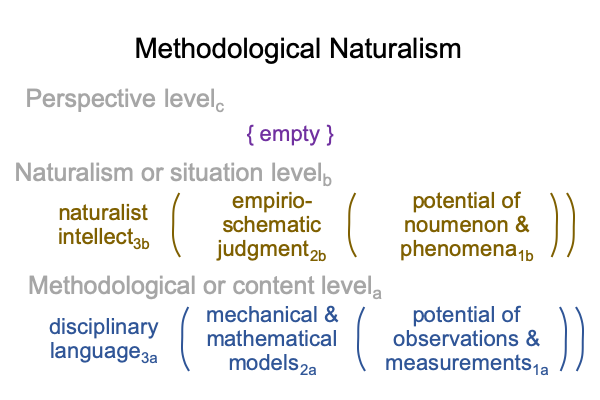
0018 What ought to be consists of another judgment, where disciplinary language (relation, thirdness) brings together mechanical and mathematical models (what ought to be, secondness) with observations and measurements (what is, firstness).  This triadic relation is called “the empirio-schematic judgment” and first appears in Comments on Jacques Maritain’s Book (1935) Natural Philosophy.

The empirio-schematic judgment, what ought to be, in the Naturalist’s judgment, is imbued with secondness, the character of actuality.

Here is a diagram.

Figure 02

0019 Fourth (K), the ground rule of “no metaphysics” does not appeal to the criterion of falsifiability (E).

At this point, I can see that the criteria espoused by Michael Ruse applies to portions of the Naturalist’s judgment.  A and B cohere to the naturalist intellect (relation) and the selection of noumena (what is).  Noumena must be things that have observable and measurable facets to their forms.  C, D and E pertain to the connection between the empirio-schematic judgment (what ought to be) and phenomena (what is).

In terms of the metaphor of inversion, Michael Ruse’s criteria keep us firmly fixed in the celestial waters, where the leviathan of the “not religious” sciences swims.

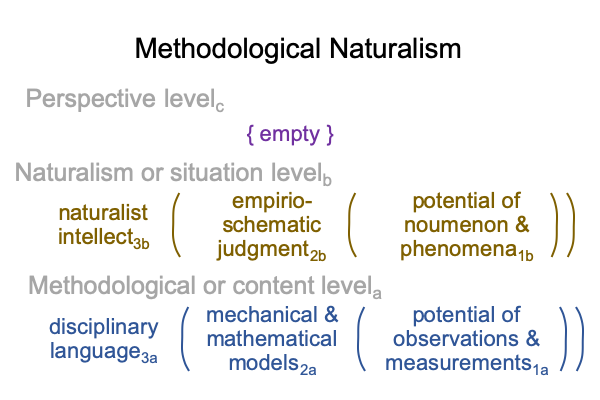
0020 In order to appreciate this whale of a topic, swimming in the heights of state-funded liquidity, I unfold the Naturalist’s and the empirio-schematic judgments into category-based nested forms, based on their assigned categories. The result is a two-level interscope

The interscope is introduced in A Primer on Sensible and Social Construction.

Here is the diagram.

Figure 03

0021 Methodologicala naturalismb may be depicted as a two-level interscope.  Method goes with the empirio-schematic judgment.  Naturalism goes with the Naturalist’s judgment.

The naturalist intellect3b rules out metaphysics.  This rule is Pennock’s last point (L).  The rule, “no metaphysics”, comes from an occluded perspective level.  The rule does not reveal what is in the perspective level.  Indeed, the naturalist views the rule as coming from the content level.

Disciplinary language for each science3a follows the rule of the naturalist’s intellect3b.  Any disciplinary language3a that discusses metaphysics cannot be labeled as a “science”.

Of course, in this situation, the word, “metaphysics”, is code for Christian theology.  But, that is not what “metaphysics” really means, as previously noted.

This exclusion follows the logic of normal contexts.  Normal contexts exclude, align or complement.

0022 Creation science talks about metaphysics, while pretending not to.So, in the 1981 McLean vs Arkansas trial, the leviathan in the celestial waters of BG(il)L descends to upset the boat, The Creation Science, and bites off the leg of its captain.

06/25/20

Comments on Robert Pennock’s Essay (2009) “…the Difference between Science and Religion?” (Part 4)

0023 At this point, I run with two metaphors.

First, the world is upside down.  The ocean of Big Government (il)Liberalism sloshes above, as a world suspended in surreal liquidity, heavy and looming.  The regulatory sea holds a thousand points of light, each submerged in its own righteousness.  A leviathan swims in these celestial waters.  This leviathan applies the first amendment of the U.S. Constitution to education by state and federally funded institutions.  These schools may teach science, but not religion.  Here, “religion” means “a Christian faction”.

Second, a small boat, initially named The Creation Science, then later (after the unfortunate moment when the captain lost a leg to stand on) named The Intelligent Design, floats on the surface, that is, the bottom, of this inverted ocean.  This boat hunts the above-mentioned leviathan.  The academically inclined sailors fashion a lance of that looks like the methodological level of science.  But, the captain does not fully comprehend what harm it can do.

The captain?

0024 Philosopher Larry Laudan comes under scrutiny in the fourth section of Pennock’s essay.  After the McLean case (the leg-bite), this philosopher writes three articles denying a demarcation between science and religion.  There are no criteria for strictly distinguishing what is religiouswhat is scientificwhat is pseudo-scientific and what is unscientific.

Laudan struggles mightily against the criteria of Michael Ruse (A-E).

Two arguments support his conclusions (M and N).

The first (M) says, more or less, “There is a lack of unity between philosophers about the demarcation criteria.”

Okay, experts rarely agree.  That is the nature of experts.

The second (N) says, more or less, “The 1981 McLean versus Arkansas case is hollow, because it canonizes a false stereotype of what science is and how it works.”

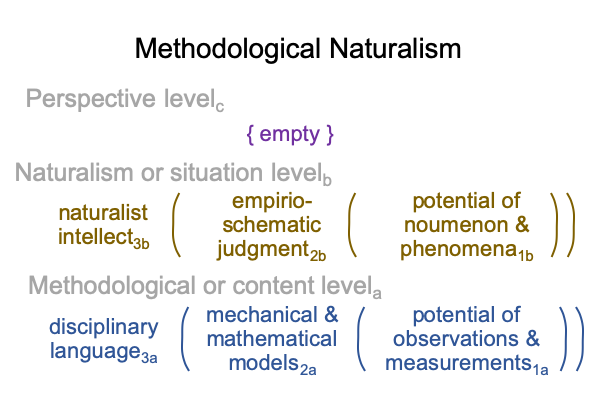
I suspect that this is correct because Ruse’s criteria (A-E) pertain to what is and what ought to be in the Naturalist’s judgment.  The empirio-schematic judgment (what ought to be) unfolds into the content level of the following two-level interscope.  The Naturalist’s judgment unfolds into the situation level.

Figure 04

0025 Michael Ruse’s criteria (A-E) draw attention to the content level.

Perhaps, this is why the author, Robert Pennock, wants to set the record straight.

The 1981 McLean case focuses on the content of science.

The 2005 Kitzmiller case focuses on the situation of science.

What does this suggest?

0025 The Intelligent Design comes up with a better tactic.  Of Pandas and People follows the style of the empirio-schematic judgment.  Ruse’s criteria lack teeth.Pennock sees this and proposes that science must be distinguished, not on the methodological levela, but on the naturalism levelb.  The ground rule of the naturalist intellect3b is “no metaphysics”.

06/24/20

Comments on Robert Pennock’s Essay (2009) “…the Difference between Science and Religion?” (Part 5)

0026 In 1981, the ship, The Creation Science, encounters the leviathan swimming in the celestial waters.  The captain loses a leg to stand on, but realizes that he can fashion a new leg even better than the first.  He repairs the ship and re-brands her, The Intelligent Design.  In 2005, this ship lures the leviathan down from its heavenly deep, once again.

In this interval, philosopher Larry Laudan vigorously attacks the foundation of the leviathan’s first victory.  He pulls teeth.  He demolishes the argument that science and religion may be distinguished on the basis of method.

Finally, The Intelligent Design opens sail with a methodology identical to the empirio-schematic judgment and coherent with its content-level nested form.  The normal context of disciplinary language3a, describing methods, brings the actuality of metaphysically-open models2a into relation with the possibilities inherent in observations and measurments1a.

0027 Once again, here is the two-level interscope for methodologicala naturalismb.

Figure 05

0028 Pennock wants to defend the demarcation of science and religion.  Method does not offer sufficient critieria.  So, he configures a new foundation.  He calls it “methodological naturalism”.  But, the “methoda” has already been neutralized by Laudan.  So, “naturalismb” is the key.

To this end, in section 5 of this article, Pennock constructs a weak version of the distinction between science and religion, one that grants many of Laudan’s points.  Tellingly, instead of referring to the ship’s new name, The Intelligent Design, Pennock sticks to the old label, The Creation Science.

Pennock writes four sub-sections (O-R).

0029 The first (O) concerns the dustbin of history.

Creation Science is not even a bad science.  For example, some say that the Earth is only a few thousand years old.  Others say that Noah’s Flood is global.  These models are not supported by data.

0030 The second (P) concerns disciplinary language.

The ship, The Creation Science, has no coherent disciplinary language, outside of Biblical interpretation.  The language of Intelligent Design is also incoherent.  Even if one observes phenomena associated to impossible events, one cannot conclude that the events are miraculous.

Okay, one can conclude that the events are miraculous.  But, that would violate the rules of the naturalist intellect3b.

0031 The third (Q) is pragmatic.

Methodological naturalists recognize science.  Why can’t philosophers like Laudan?  Why are courses on the philosophy of science not taught by theologians?

What do the sailors on The Intelligent Design hear?

Someone in the waters asks, “Why are courses on the philosophy of religion not taught by scientists?  Er… I mean… taught by highly certified naturalists who self-identify as ‘not religious’?”

Oh, never mind, they are.

0032 The fourth (R) is empirical.

Science educators say that there is a real distinction between science and non-science, such as Creation Science.  The National Science Teacher’s Association insists that scientific claims are not religious.

Or, should I say that the empirio-schematic judgment is not religious?

What about “scientific” or methodological naturalism?

Is that not religious?

Of course, the rule of naturalism says, “No metaphysics.”

Who is surprised that no mechanical or mathematical models appeal to supernatural forces?

Pennock finally feels the sharp point of an issue that cannot be confronted.  He states that his account explicates “scientific” naturalism as a methodological commitment, not a metaphysical one.  The ground rule of “no metaphysics” is… um… not metaphysical.

0033 Say what?

What is the philosopher’s task?

Is it possible for a philosopher to accept that the claim to be “not religious” may, indeed, be not religious?

Since when do philosophers spout tautologies?

Take a glance, once again, at the two-level interscope for methodological naturalism.

There is a certain circularity to the structure.  The content-levela is the empirio-schematic judgment.  The empirio-schematic judgment is the actuality2 of the situation levelb.

0034 Where does the ground rule of “no metaphysics” come from?

Does it come from inside the circle?

Does it come from outside the circle?

Why is the perspective level empty?

What does that imply?