Looking at Dr. D. Basak’s Book (2025) “Sumerian Mythology…” (Part 1 of 20)
0001 The full title of the book before me is Sumerian Mythology, Ancient Civilizations, and the Epic Search For Humanity’s Origins. That is a great title. This publication is the 13th in a sequence of 37 books downloaded into the Amazon product line between the end of July, 2025, and the start of January, 2026. This literary output is staggering.
0002 Plus, it raises a question in my mind.
How does one identify an artificial intelligence (AI) produced article or book?
0003 Every sentence is well constructed. The text is highly segmented.
Are these clues?
0004 For example, the preface divides into A (5 subsections) and B (1 subsection). Each subsection contains two paragraphs. The preface also includes additional material, C, informing the reader what to expect, why this is essential reading, and how this qualifies for understanding.
Of course, this is standard textbook formatting.
However, the two clues, well-constructed sentences and high segmentation, still apply to the question at hand.
0005 Here are some other clue.
Flat statements contain no wordplay. The entire book consists of (1) direct statements and (2) a negative followed by an affirmative. No, I don’t mean to be negative, it is obviously better to be positive.
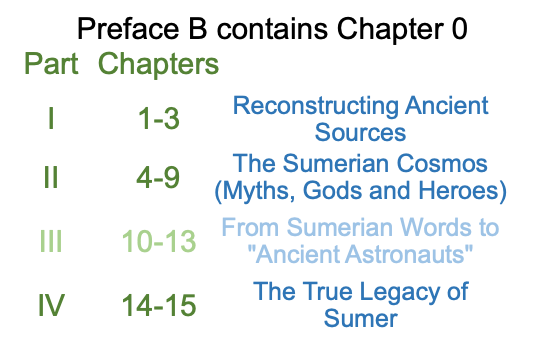
Fractal repetitions appear within the book’s organization. For example, the preface’s B subsection constitutes (what may be called) “Chapter 0”, which recapitulates the topics of the subsequent 15 chapters.
0006 Here is a picture of the list of chapters.
0007 Even though the text itself does not state that it is AI generated, one may raise the question and ponder the clues. These clues do not prove an answer, one way or another. But, they do raise another question.
If the work at hand is AI generated, then what does that imply?
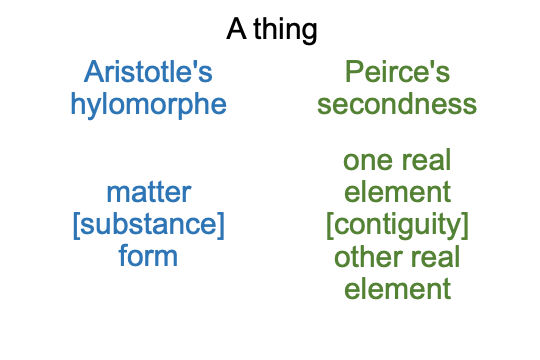
0008 The postmodern scholastic will start with Aristotle’s hylomorphe, which is an exemplar of Peirce’s category of secondness. These concepts may be derived from Razie Mah’s e-books A Primer on the Category-Based Nested Form and A Primer on Sensible and Social Construction.
The book that I have before me is a thing. A thing is composed of two contiguous real elements. For Aristotle, the real elements are matter and form. The contiguity is placed in brackets for clear nomenclature.
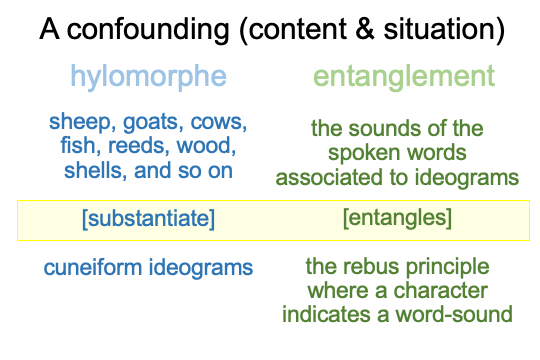
0009 Here is a diagram.
0010 My question as to whether the book is AI generated and what that implies is called “an entanglement”. The following diagram is sort of confusing (something that an AI would avoid), because two expressions are linked in that they have the same form.
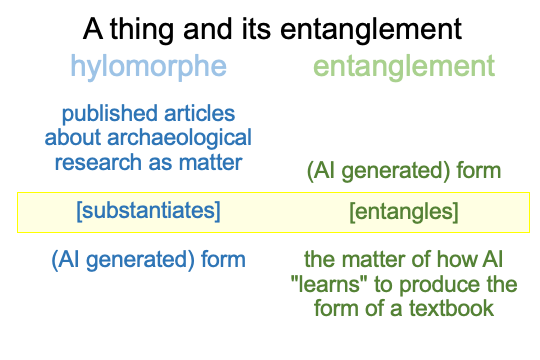
0011 In the hylomorphe, describing the book before me, the phrase, “AI generated”, is put into parenthesis because the question remains open. The form is a book.
In the second (upside down, so to speak) thing, the (AI generated) form entangles another matter. That “other matter” is a question about how the AI learns what it is going to say. Obviously, the answer will include the originating matter. One may wonder, “What else?”
A thing and its entanglement consists in two matters (one originating and one entangled) and one form. The technical name for this pair is “confounding”.
0012 With the above confounding in mind, I may consider Chapter 1.
Here is a list of the learning objectives.
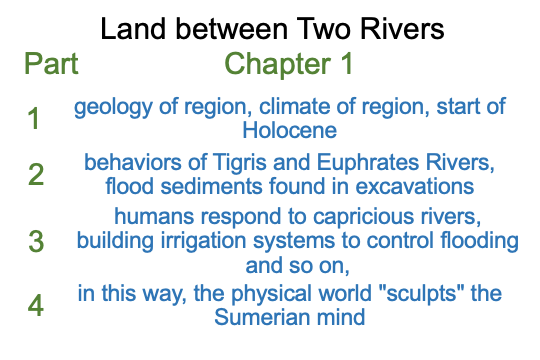
0013 This list suggests that the search for humanity’s origins, involving the Sumerian civilization and its mythology, arises in response to the precarious and fertile landscape between the Tigris and Euphrates Rivers. Annual floods from both rivers deliver silt. They can also deliver floods and destruction.
Excavations at locations in southern Mesopotamia find strata associated to floods during the Ubaid, Uruk, and Sumerian Dynastic archaeological periods.
0014 The irrigation systems control the rivers and redirect their water into productive agricultural uses. These systems require large scale labor under central (yet local) authority.
0015 To me, these conclusions are precisely what an AI program would deliver, after processing the literature (web-pages) cited at the end of the chapter. But, these are my suspicions. I have no proof.
0016 However, I can construct a confounding. There is one form, the land between the Tigris and Euphrates Rivers. These rivers are subject to annual crests that deposit silt and may cause catastrophic flooding. The originating matter is the geology and climate of southern Mesopotamia during the Ubaid, Uruk and Early Sumerian Dynastic archaeological periods. The entangled matter is the mind of the Sumerian people, who celebrate the mythology that this book addresses.
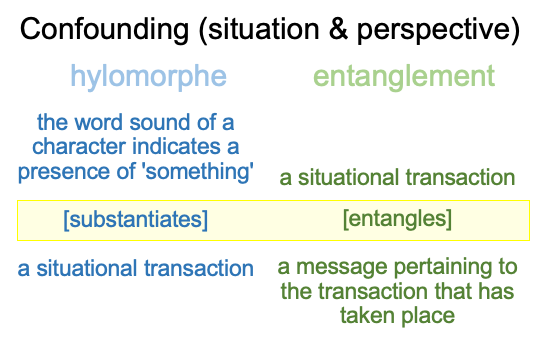
0017 Here is a picture of the confounding.
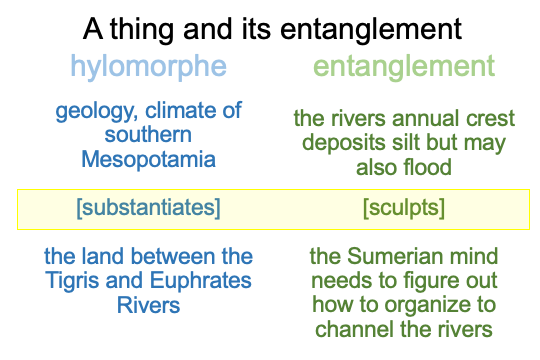
0018 The confounding leaves this reader with a hypothesis. Sumerian mythology is an ideological component of an organizational imperative. The Sumerians must figure out how to organize to channel the rivers in order to irrigate their fields and to avoid catastrophic flooding.
In the process, the organizational imperative captures the Sumerian imagination.