0178 Chapter four (C4) is titled, “Things Depend on Humans”.
This chapter follows the break-out section on Catal Hoyuk.
0179 Over time, things fall apart. The author provides examples from England, where stone walls, marking the boundaries of fields, are inherently unstable. He describes the use of internal buttresses to stabilize walls in level III to I of Catal Hoyuk, as well as the Chalcolithic west mound (dating 6000 to 5500BC).
0180 To me, internal buttressing of walls may require explicit abstraction.
The smelting of copper probably entails specific recipes (serving as explicit abstractions).
The cylinder seals found at the site definitely indicate explicit abstraction.
0181 Nothing says, “Things depend on humans.”, like ownership.
That is what cylinder seals are all about. They are used to seal lists of goods as well as other documentation associated with ownership and transfer of ownership.
0182 Cylinder seals are things that depend on humans.
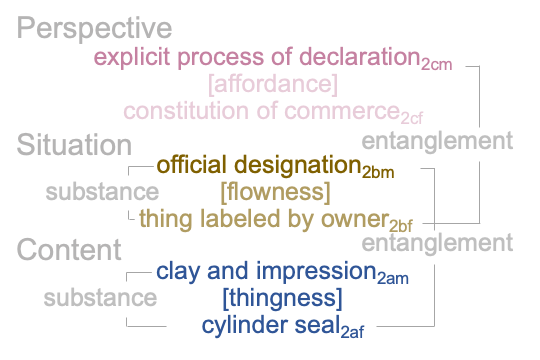
There are two confoundings in the following virtual nested form in the category of secondness.
0183 In the first confounding, clay and a specific impression2am [thingness] a cylinder seal2af and the cylinder seal2af [entangles] the matter of an official designation2bm. Each element demands an explicit abstraction. What is the image on the seal? What does it designate?
In the second confounding, the official designation2bm [flowness] the embodiment of a thing that is labeled (with a sealed stamp) by its owner2bf and that label2bf [entangles] the matter of an explicit process of declaration2cm, that is, a process by which ownership is explicitly asserted.
0184 That is not all.
I already mentioned that sign-relations are built into the three-level interscope (points 150-156).
I explicitly detailed the specifying sign-relation.
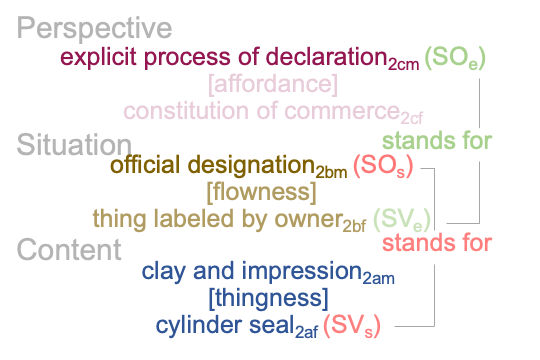
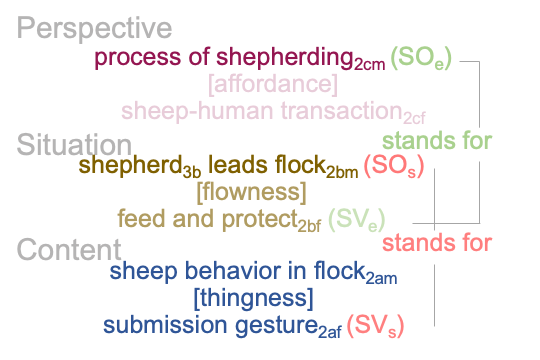
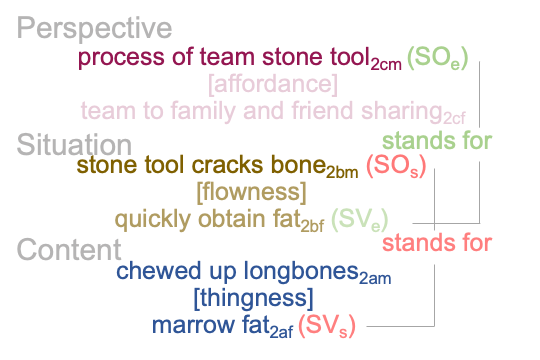
0185 The two confoundings for cylinder seals correspond to the specifying (subscript “s”) and exemplar (subscript “e”) sign-relations. Here is a picture the sign-vehicles (SV) and sign-objects SO).
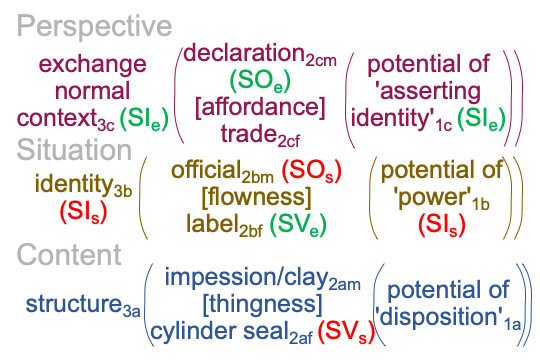
0186 Finally, all the elements of the specifying and exemplar sign-relations are labeled in the following three-level interscope.
0187 In the Lebenswelt that we evolved in, the elements of two sign-relations cannot be labeled with the gestural words of hand- or hand-speech talk. Instead, the sign-relations are simply performed. These sign-relations are adaptations into a niche composed of the potential of triadic relations. This biological proposal is set forth in Razie Mah’s e-book, The Human Niche (2018).
0188 In our current Lebenswelt,elements of the two sign-relations can be labeled with speech-alone words. The production of the seal (from thingness to flowness, so to speak) touches base with labor specialization. Not just anyone can fashion a cylinder seal for use. The embodiment of the label on a thing (from flowness to affordness, so to speak) touches base with social specialization.
0189 To me, the author – not even consciously – transits from a world where families build their own homes in a marvelously productive location (C2 and C3) to a world where social and labor specializations create things that depend on their… um… continued interventions to prevent the created things from falling apart (C4 and C5).
What was once an intrinsic manifestation of the three-level interscope of thingness, flowness and affordness shifts to extrinsically arranged specialties organized to maintain cultural traditions.
The intuitively obvious transitions into entrapment.
0191 The disciplines that deal with these topics include behavioral archaeology (S3C4) and material science (S2 and S3, C4).
0192 For example, these sciences try to figure out how the people of Catal Hoyuk dealt with refuse. These experts see attempts at refuse organization throughout the Levant in the PPNB. House floors are swept clean. Middens outside the settlement are established. This occurs without signs of social or labor specialization, long before the Ubaid of southern Mesopotamia appears on the scene.
0193 Behavioral ecology (S4C4) studies the domestication of plants and animals. Plant domestication is well underway before the sea-level rise. Cereals, lentils, fruit trees, and tubers respond to selective use and care by humans, consistent with Darwinian analysis. Humans offer a novel niche to plants and animals, because a relation with humans is an actuality that is independent of each adapting species. Plants and animals, in turn, offer niches for cultural adaptations.
One hand washes another, even in the biological realm.
0194 Mutuality is not exclusive to humans and plants and animals. For example, certain predatory fish will allow small grazing fish (otherwise an easy meal) to nibble parasites off their exteriors. It is a win-win situation. The predator gets rid of parasites. The grazing fish gets a meal and does not serve as a meal.
Of course, humans take “mutuality” to a whole new scale.
0195 Humans give food to the animals. Every type of animal is different. The humans read the signs that the animals offer.
A vast literature in behavioral and evolutionary ecology can be used to understand the phenomena of domestication. To me, these phenomena are observable and measurable facets of human adaptations to specifying and exemplar signs, which dwell within the three-level interscope that associates to Mariusz Tabaczek’s inquiry into classical and contemporary hylomorphism (points 0004 to 0012).
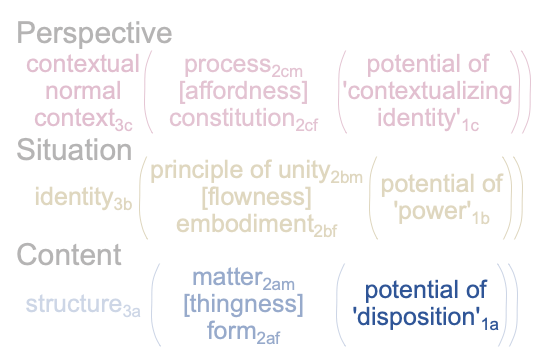
0196 In the following diagram, the specifying sign is rendered in light red and the exemplar sign is rendered in light green.
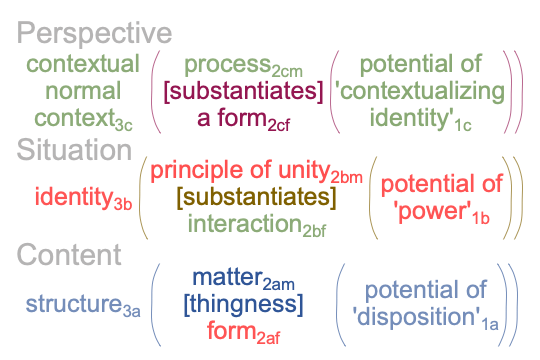
0197 In the specifying sign, a content-level form2af (SVs) stands for situation-level principle of unity2bm (SOs) in regards to identity3b operating on the potential of ‘power’1b (SIs).
In the exemplar sign, a situation-level embodiment2bf (SVe) stands for a perspective-level process2cm (SOe) in regards to a perspective-level normal context3c operating on the potential of ‘contextualizing identity’1b (SIe).
0198 For example, sheep perform a submission gesture, making it easy for humans to figure out how to become a leader of sheep. The sheep recognize their shepherd. Sheep are disposed to submit. The human whose identity3b is the shepherd2bm has the power1b to lead the flock2b on the basis of the way that he is able to read submission gestures2af.
0199 Animal domestication involves s human becoming pack leader and taking responsibility1c for feeding and protecting his flock2bf.
0200 In the specifying sign, the sheep’s submission2af (SVs) stands for the flock2bm (SOs) in regards to the shepherd3b operating on the potential of ‘human power’1b (SIs).
In the exemplar sign, the form of the feeding and protecting of the flock2bf (SVe) stands for a specialized way of living2cf (SOe) in regards to the normal context of animal domestication3c operating on the potential of ‘human responsibility’1c (SIe).
0201 On top of that, the process of serving as a shepherd2cm [substantiates by way of affordance] a human-sheep transaction2cf enacts the suggestion, “Give fodder to the animals.” (Genesis 1:30).
0202 The biblical reference is not an accident.
Domestication of animals implies that our kind adapts to the potential of ‘responsibility’1c.
0203 Does that connection appear in the vast scientific literature of human behavioral ecology?
Maybe, the connection may be winnowed from references to immediate and delayed return systems (S6C4).
Or, the connection pertains to the conclusion (S7C4) that things can be unruly, even when they depend on humans.
0204 Chapter 2 through 5 enact a subtle transition from the Lebenswelt that we evolved in to our current Lebenswelt.
0205 The Lebenswelt that we evolved in associates to the lowest levels of the excavation at Catal Hoyuk. From the earliest levels of XII to level VIII, there are many indications that these hand-speech talking people contextualized their identities2b with responsibility1c. Teams3c, rather than individuals3b, were specialized. Families and friends volunteered to work in teams. Foraging and other activities were conducted by teams. The community was a team of teams. Social harmonization was obligatory.
0206 Levels XII through VIII may be labeled, “old school”.
Chapters two and three (C2 and C3) draws from the lessons of excavation levels XII through VIII.
0207 The “new school” shows up in level VII and associates to a material change from cooking with clay balls to cooking with pottery. This is not the only change. After level VII, labor and social specialization becomes more evident, culminating in the adoption of metallurgy (copper smelting), secondary product processing (wool and skin production) and cylinder seals (stylized declarations of ownership or product).
Chapters four and five (C4 and C5) draw from the lessons of excavation levels VII to I.
0208 The Lebenswelt that we evolved in practices hand- (before humans) and hand-speech talk (with humans), manifests implicit abstraction, and lives in a world of constrained social complexity. This is a world where words are not lies, as noted in chapter 2B of Razie Mah’s fiction, An Archaeology of the Fall.
Our current Lebenswelt practices speech-alone talk, engages in explicit abstraction, and lives in a world of unconstrained social complexity. This is a world were words are lies, as noted in chapter 2A of the same novel.
0209 Chapter five (C5) completes Hodder’s subtle transition. The section titles tell a story. S2C5 is labeled (more or less) “Inequality, Power and Entrapment”. S3C5 discusses “Poverty Traps”. S4C5 explores “Emotional Bondage”. Of course, I adjusted the titles (ever so slightly) in order to bring out the true value of the labels. My bad.
0210 The lesson is clear.
Our current Lebenswelt is not the same as the Lebenswelt that we evolved in.
Humans depend on humans (C5) implicitly.
0211 The social circles tell the tale.
My reference is Razie Mah’s e-works, Comments on Michael Tomasello’s Arc of Inquiry (1999-2019) as well as The Human Niche. The first contains two parts (2024). The second presents the hypothesis that the human niche consists of the potential of triadic relations (2018).
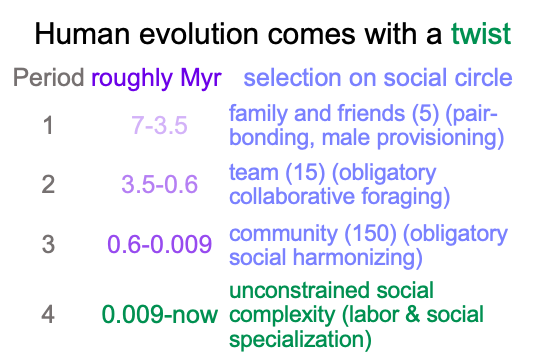
0212 Family and friends (5) is the social circle under the greatest selective pressure from the separation of our lineage from the chimpanzees to the start of bipedalism (roughly, 7 to 3.5 Myr). During this era, male-female pair-bonding with male provisioning may have co-evolved with bipedalism.
The walking “southern apes” evolve by 3.5 Myr..
0213 The team (15) is the social circle under intense selective pressure from the start of bipedalism to the domestication of fire (roughly, 3.5 to 0.6 Myr). This is the era of obligatory collaborative foraging. Hand talk serves as an adaption to the team. This is clear in Razie Mah’s Comments on Steven Mithen’s Book (1996) Prehistory of the Mind. Hand talk is prelinguistic, in so far as team members perform only sensible construction (two-level interscopes, specifying sign relation).
During this time, the Homo genus first appears around 1.8 Myr.
0214 The community (150) is the social circle under critical selective pressure from the domestication of fire to the first singularity (roughly, 0.6 to 0.009Myr). This is the era of obligatory social harmonizing. Cooking with fire empowers more teams. More teams yield and larger groups. The community may be regarded as the team of teams. Hand talk becomes fully linguistic, capable of counterintuitive, yet fully referential, statements, such as the name of the character, [image RAVEN][image-MAN].
0216 Social construction creates cognitive spaces for communal belonging. It does through by intentionally activating implicit exemplar sign-processing. Counter-intuitive statements cannot be sensibly regarded (so, they are not appropriate for team actions). At the same time, they channel exemplar sign-processes towards the potentials of transcendentals (truth, beauty, goodness) and virtues (responsibility, honesty, and so forth). Exemplar sign-processing adapts to obligatory social harmonizing.
0217 During this time, Homo sapiens appears, around 300kyr, with the voice added to hand-talk as an adornment. See Razie Mah’s e-work, Synaesthesia and the Bicameral Mind in Human Evolution (2025). Over the next three-hundred thousand years, the voice extends from adornment to a fully linguistic complementary mode of talking. Razie Mah applies the label, “hand-speech talk”.
Paleolithic art and tools may be regarded from the stance of a millennia long exploration of the semiotics of hand-speech talk. The semiotic qualities of hand-speech talk are rooted in the iconicity and indexality of hand talk and branch into the purely symbolic nature of speech talk.
0218 The twist to human evolution arrives with the constellation of a speech-alone talking culture. Rising sea-levels force two unrelated hand-speech talking cultures,one dwelling in the coast and ravine of the channel of the Tigris and Euphrates Rivers and the other settled on the surrounding dry land. One Neolithic and one Mesolithic culture are forced into proximity, leading to the familiar sequence of pidgin, then creole, formation. The only difference is that this creole, the Sumerian language, consists of speech-alone talk.
0219 The technical reference is Razie Mah’s The First Singularity and Its Fairy Tale Trace. The dramatic referral is An Archaeology of the Fall.
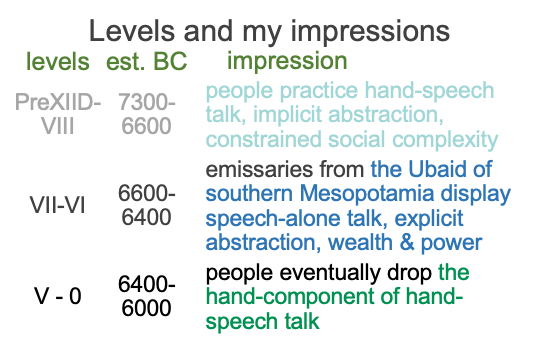
0220 The highest rate of sea-level rise occurs around 6800 B.C. That rise serves as a nominal starting pointfor the appearance of a speech-alone talking culture, on the cusp of experiencing trends towards unconstrained labor and social specialization.
By 6600 B.C., emissaries from the Ubaid may have contacted central Anatolia.
0221 Here is the timeline.
0222 By the time contact is made, Catal Hoyuk is 700 years old. Why would these settled, traditional folk adopt cooking with clay pots? Why would they be using cylinder seals a few hundred years later? These adoptions come from outside the community.
0223 The hypothesis of the first singularity provides a reason for why the Ubaid would be sending emissaries to distant settlements, such as Catal Hoyuk. They are traveling to preach the good news of a society, with wealth and power, willing to trade and eager to exchange ambassadors.
Plus, these emissaries practice speech-alone talk.
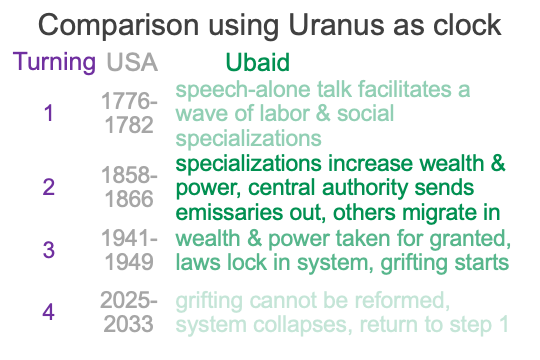
0224 Perhaps, I can measure time with the orbit of the first outer planet, whose unseen presence serves as a metaphor for a four-generation spiral of coming together, establishing permanence, falling down and surviving crisis. Uranus has a periodicity of 84 years. This period comes very close to the timeframe for the theory of the fourth turning.
Each orbit of Uranus corresponds to four human generations.
0225 For the USA, I date the start of a first orbit to the passage of Uranus through the constellation of Gemini, from 1776 through 1782. The years correspond to the American Revolutionary War. The second passage through Gemini contains the War of Southern Rebellion and the War of Northern Aggression, known today as “the Civil War”. The third passage covers the USA’s involvement in the Second Battle Among the Enlightenment Gods: The Hot War Among Fraternal Ideologies (1940-1945). The fourth passage begins… um… at the present moment.
0226 The USA may be a good analogy to the Ubaid of southern Mesopotamia because settlement by iron-bearing Europeans seems to expand into a power vacuum. The native Americans are stone age. The Europeans have greater wealth and power, due to their established labor and social specializations, as well as their tools and weaponry.
For the Ubaid, small cumulative advantages of explicit abstraction applied to everyday living may have had similar psychological impact on hand-speech talking cultures. The hand-speech talking people of Catal Hoyuk were taken by surprise by these speech-alone talking emissaries who seemed more advanced than themselves. The emissaries introduced clay pots for cooking. They offered recipes.
0227 Here is a list for the four passages of Uranus through Gemini for the USA and – what I imagine – the corresponding trends in the Ubaid.
0228 Emissaries from the second or third Ubaid passage may have made contact with Catal Hoyuk in their explorations. A parallel between the Ubaid and the USA may be drawn, at least in terms of metaphor and timing. It makes me wonder. How weird is that?
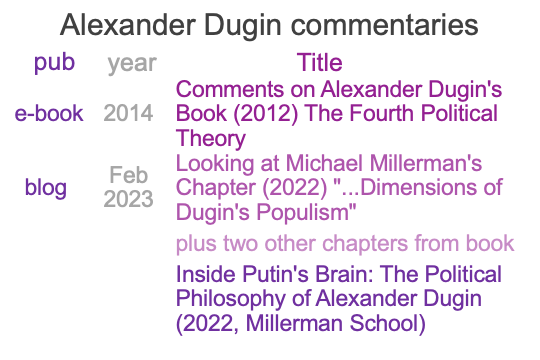
0229 Intimations of the adoption of speech-alone talk and the potentiation of civilization may be also found in contemporary Russian political theory, in particular, the writings of Alexander Dugin. Here are some of the commentaries by Razie Mah.
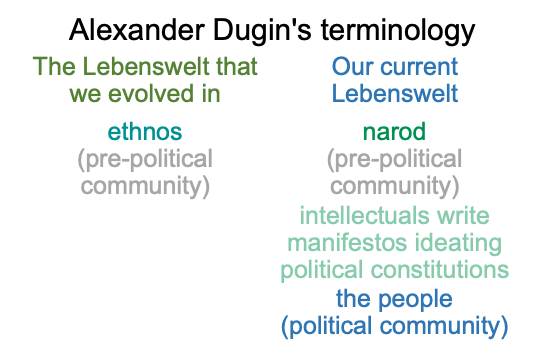
0230 Alexander Dugin’s terminology is telling. Today, we, the people are the focus of attention. This attention to the people stands in contrast to political theories about how to constitute a people. For the past century, three ideologies have gained sovereign power, these are capitalism (also called “mercantilism”), fascism and communism.
Each of these ideologies participated in propaganda and military wars of great intensity. Mercantilism draws the world into the First Battle Among the Enlightenment Gods: The Tragic War of the Naive Mercantilists (1914-1918). Fascism ignites the Second Battle Among the Enlightenment Gods: The Hot War Among Fraternal Ideologies (1939-1945). Communism and Capitalism dominate the Third Battle Among the Enlightenment Gods: The Cold War Among Materialist Ideologies (1945-1989).
0231 Dugin, writing after 1989, complains that these political theories failed to create a people worthy of the name. The intellectuals have failed. Capitalism, fascism and communism have been discredited.
The problem is that we cannot return to a pre-political community. He uses the Russian label, “narod”, to designate traditional culture, which is not really interested in power as a thing in itself. Rather, the narod is interested in well… having fun and pleasing the gods. For the Russian people, that means God, as well as the saints, as well as the priests and monks, as well as the old ladies who do not ignore what they witness.
0232 What is even more interesting, Dugin takes one more intuitive step. The narod, the pre-political traditional community in our current Lebenswelt, cannot return to its original condition. Just as a people cannot go back to their narods, a narod cannot go back the its ethnos, its pre-pre-political condition.
0233 Dugin’s surprising claim keys into the hypothesis of the first singularity. The narod belongs to our current Lebenswelt. The ethnos belongs to the Lebenswelt that we evolved in.
0234 The entanglements of the ethnos resolve into the thingness, the flowness and the affordness of adaptation into the niche of triadic relations, motivated by obligatory collaborative foraging and obligatory social-circle harmonizing.
The entanglements of the narod resolve into the thingness, the flowness and the the affordness that derives from the capacity of speech-alone talk to explicitly abstract each of the elements in the three-level category-based nested form, among other realities. These explicit abstractions create the entanglements… er… “entrapments” familiar to unconstrained social complexity.
Individuals in community are confounded, and who is not more prepared to diagnose the social illnesses and to propose clinical solutions (that will require sovereign power to enact) than political theorists? Who is more expert than an academically certified political theorist in proclaiming what a people should be?
0235 So what am I saying?
Chapters two through five (C2 though C5) subtly transport the reader from the Lebenswelt that we evolved in to our current Lebenswelt.
So do the levels of excavation at the remarkable archaeological site of Catal Hoyuk.
0236 Now that the reader is introduced to entanglement (C2-C5), then how does that change the construction of scientific anthropological models (C6-C11)?
Chapters six through eight (C6-C8) aim to develop the concept.
Chapters nine though eleven (C9-C11) focus on methodology.
0237 Chapter six (C6) is titled “Exploring Entanglement”.
An inquirer can look at the evolution of the Homo lineage in terms of entanglements.
0238 So far, I have shown that “entanglement” belongs to the philosophical construction of “a confounding” and may resolve into two-adjacent levels of a three-level interscope (as well as a sign-relation identified by Latin Age scholastics). Consequently, I cover the same territory using this alternative to Hodder’s sociological construction.
0239 Oldowan stone tools provide an example.
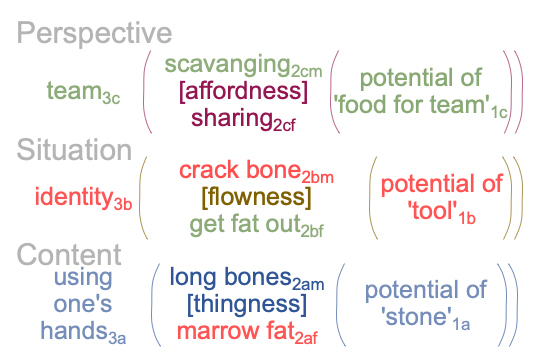
Our bipedal ancestors are on the lookout for food that is (seasonally) available (at specific locations) and ignored by other species (due to some processing issue). Oldowan stone tools provide a clue. Consider a partially scavenged carcass of a large animal. Other scavengers have already eaten most of the dead beast. However, they cannot get to the marrow fat in the long bones. A rock cleft in order to reveal a sharp edge will do the trick to getting that marrow fat.
0240 Since this trick works well, a team (remember the term, obligatory collaborative foraging) turns this success into a habit that lasts for generations. The team that makes Oldowan stone tools is one of many teams. Once a clever way to get food, without placing the team in great danger, is habitually pursued, then the team’s success enhances the reproductive success of team members. Over generations, the cognitive and physiological processes that go into a successful team become more and more… hmmm… “natural”. Our ancestors adapt to the team’s success.
0241 Razie Mah’s proposal is that team activities may be diagrammed using category-based nested forms. This serves as evidence that our lineage adapts to the potential of triadic relations.
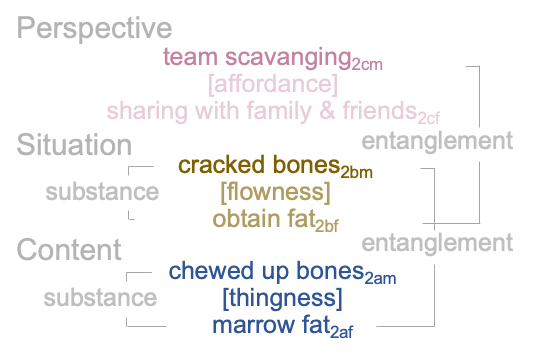
0242 Here is a diagram of a three-level interscope for obtaining fat from scavenged long-bones.
0243 The thingness of the long-bone2a becomes salient in the normal context of a hand-held tool3a having the ‘hardness to crack what no teeth can break’1a.
The normal context of identity3b brings the actuality of {a stone-tool can crack a long-bone2bm [substantiating by way of flow] getting marrow fat out2bf}2b into relation with the possibility that ‘an intentionally altered stone has a sharp hard edge‘1b.
Finally, the obtained fat2bf has the perspective-level potential of ‘food for the team’1c. Each member of the team has family and friends3c, so of course they3c will scavenge as much as they can2cm in order to share2cf upon returning to the band.
0244 The three-level interscope contains specifying and exemplar sign relations. The sign-vehicles and sign-objects belong to the realm of actuality2.
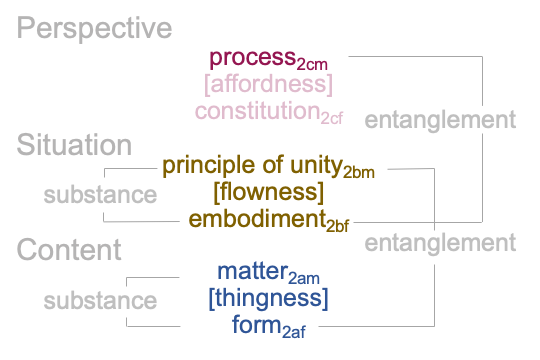
0245 Hodder’s sociological approach to entanglement adds a third layer corresponding to the philosophical apparatus of confounding, as shown below.
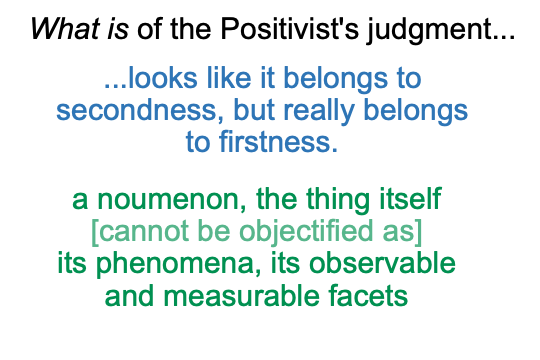
0246 Chapter six (C6) parallels the notion that the above diagrams associate to a noumenon.
Phenomena are the observable and measurable facets of their noumenon.
Observations and measurements of phenomena support the construction of models based on a specific disciplinary language.
0247 Chapter seven (C7) discusses entanglements and affordances. These topics do not come to mind when considering the dig at Catal Hoyuk.
Spoken words are a little quirky.
I suppose that there are nuanced differences between “dig” and “excavation”.
One must not dismiss the sensitivities (and the vocabulary) of others.
0248 The author (S2C7) recalls an episode in a book by art historian and critic, Ernst H. Gombrich (1909-2001). The “H.” is for Hans Josef. Trained in art history at the University of Vienna, he held academic appointments at Oxford University, Harvard and Cornell, while working at the Wahrburg Institute until his retirement in 1976. His most popular book is a text, published in 1950, titled, The Story of Art.
0249 Another book, The Sense of Order, contains the episode, where an expert sums up the shift of artistic expression during dynastic Egypt as trending from “tactile” to “optic”. In a similar way, after the Middle Ages, the art of the West trends from “religious” to “decorative”. Gombrich wonders whether the same laws of stylistic development apply to these two observations?
I ask, “Was there a change in artistic dispositions1a?”
0250 If so, a change of artistic disposition would not influence content-level matter2am as much as the content-level form2af.
0251 Gombrich mentions another art critic who distinguishes Renaissance from Baroque styles of art on the basis of how each made him “inwardly dance”.
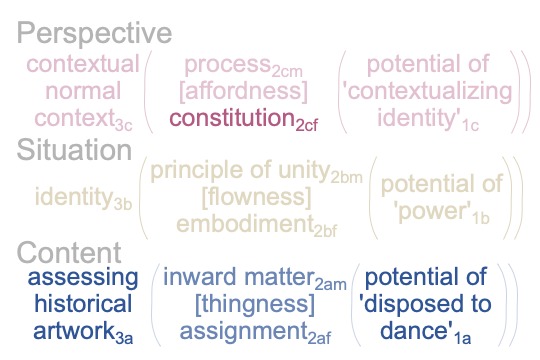
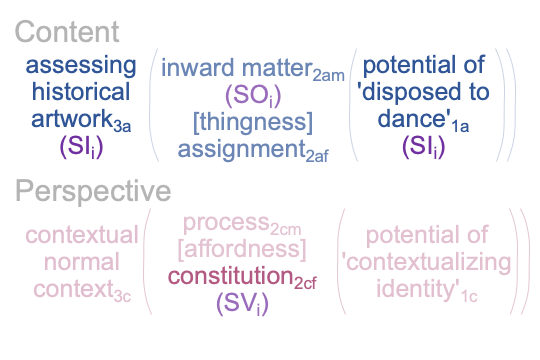
0252 To me, this art critic has processed so many works of art2cm, that he constituted a perspective level form2cf (SVi) that stands for an inward matter2am (SOi) in regards to assessing a historical work of art3a operating on his potential of ‘being disposed to dance’1a (SIi).
0253 In this example, the interventional sign-relation manifests. The sign-vehicle is the perspective-level form2cf. The sign-object is content-level matter2am. The sign-interpretant is the content-level normal context3a (structure3a) operating on its potential (dispositions1a).
The interventional sign concludes one three-level interscope and initiates another. Perspective-level form2cf “writes” content-level matter2am by… how?.. precipitating an appropriate normal context3a and potential1a?
0254 Here is another way to diagram the interventional sign-relation.
0255 In S4C7, Hodder discusses burials in the floors of the houses and the recovery of (some, not all) heads for plastering and display. The honored skulls uphold the walls of the house (so to speak).
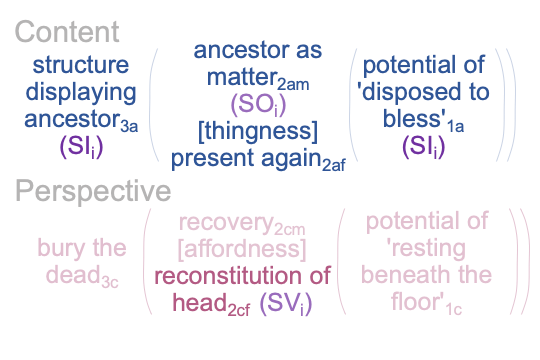
0256 Here is a picture of the associated interventional sign-relation.
0257 The reconstitution of the head long after burial2cf (SVi) stands for the ancestor as matter2am (SOi) in regards to the structure of a display3a operating on the potential that ‘the ancestor is disposed to bless the family’1a (SIs).
The interventional sign resolves a confounding. The perspective-level thing is {recovery2cm [substantiates by way of affordance] the reconstitution of a deceased’s head2cf}2c. Plus, the form of reconstitution2cf [entangles] the ancestor as matter2am.
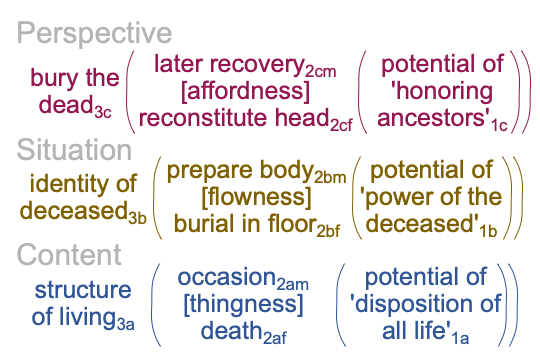
0258 Let me step back and present the perspective-level thing2c from point of view of its three-level interscope.
The reconstituted head2cf entangles the ancestors as matter.
0259 The associations in the above figures are not fixed. They are not models. They are guesses as to what the noumenon must be.
If the above figures represent the noumenon of the handling of the dead in Catal Hoyuk, then do the observed phenomena allow one to build an archaeological model that makes sense?
0260 Chapter 8 (C8) offers two examples regarding the onset of domestication in China and the Middle East. The reviewed research covers radiocarbon dates prior to 6800BC. These dates do not cover the strangest entanglement of all: the semiotic transition that starts with the Ubaid of southern Mesopotamia.
Consider Razie Mah’s four blogs, Looking at Melinda A. Zeder’s Article (2025) “Unpacking the Neolithic”, published on January 1, 2026.
0261 In the e-work, The First Singularity and Its Fairy Tale Trace (2012), Razie Mah proposes that the late Neolithic is subject to two trends. The first is material and associates to the domestication of plants and animals. The second is semiotic and associates to a transition from hand-speech to speech-alone talk, initiated by the Ubaid of southern Mesopotamia.
To date (2026), archaeologists have focused only on the first trend. They are not even aware of the latter trend, even as a possibility.
0262 Why is this the case?
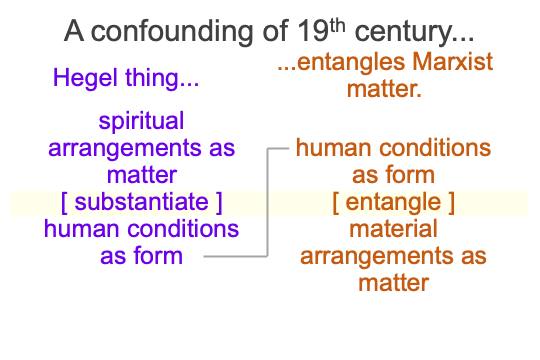
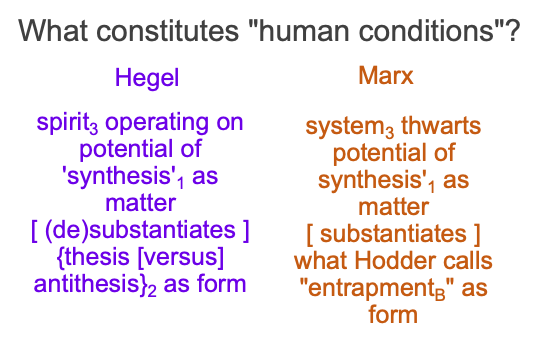
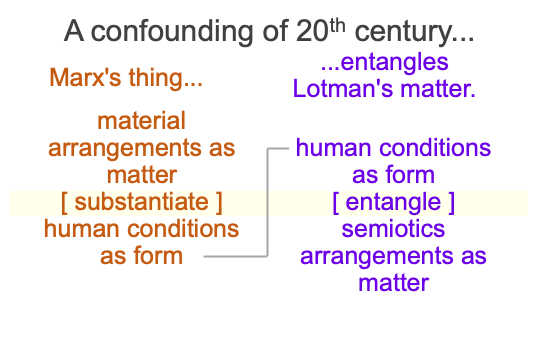
0263 As previously mentioned, Hegel’s thing entangles Marxist matter and the confounding resolves into a thesis and an antithesis for modern social science.
Here is a diagram of the confounding.
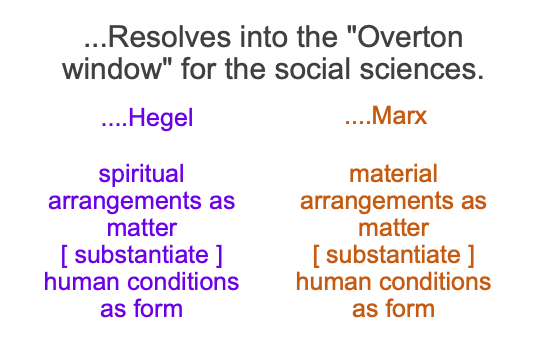
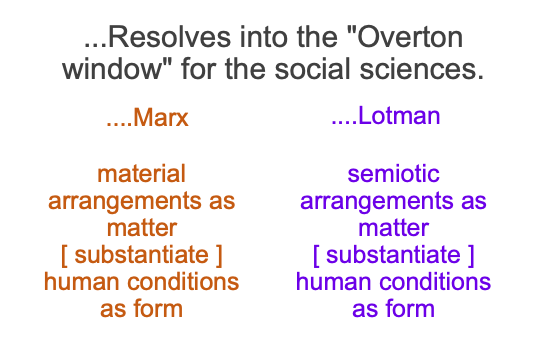
0264 The resolution of this confounding turns into the two limits of an Overton window for the positivist social sciences during the entire twentieth century.
0265 The Hegelian thing addresses adaptations in the style of social constructions. The emphasis is on symbolism. For example, a display of a recovered skull is labeled, “symbolic”, by many social scientists.
The Marxist thing addresses adaptations in the style of sensible construction. The emphasis is on dependencies, human-thing, thing-thing, thing-human and human-human.
0266 As far as I can see, Hodder’s work runs between these two end-posts.
0267 Are human conditions substantiated by way of spiritual or material arrangements?
Hegel says spiritual. Marx says material.
0268 Hegel’s and Marx’s things are reifications of fully triadic category-based nested forms. The normal context3 and potential1 are set as matter2m. The actuality2 serves as form2f. Since the category-based nested form for each thing is different, the human conditions2f are distinct, yet… may I say?… bound to one another.
0269 The spirit3 operating on the potential of ‘synthesis’1 as matter [(thwarts) the continuation of] the dyad of thesis in perpetual conflict with antithesis2 as form.
The system3 operating on the potential of ‘(thwarting) synthesis’1 as matter [maintains] entrapment in the condition where thesis and antithesis are never allowed to end2 as form.
0270 If Hegel’s and Marx’s things constitute one’s perception of what the noumenon must be, then that perception will influence what one observes and measures.
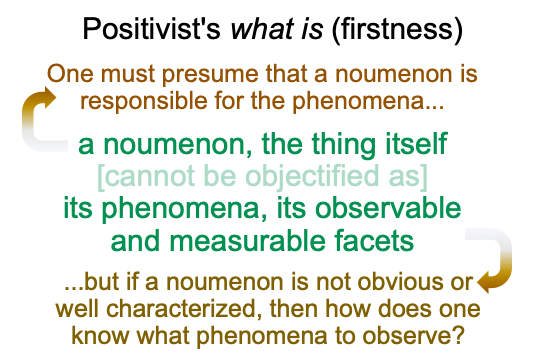
0271 The Positivist’s judgment is foundational for science, as discussed in Razie Mah’s four part e-book, Biosemiotics as Noumenon. The Positivist’s judgment contains three elements: what is,what ought to be and relation.
0272 Here is a picture of what is for the Positivist’s judgment.
0273 I now ask, “What happens when the Overton window anchored by Hegel’s thing and Marx’s thing characterizes what the noumenon must be?“
0274 Obviously, the researcher will look for particular types of phenomena.
For example, in an archaeological excavation, if material artifacts do not change over time, then the anthropologist will build models based on a system3 that excludes the potential of ‘synthesis’1.
If the anthropologist excavates phenomena that change over time, then models will reflect changes in outlook3, attitude3 and so forth.
0275 Consequently, I suspect that Hodder’s book attempts to portray a noumenon, with the goal of influencing which phenomena become salient during archaeological excavations.
0276 Chapter nine (C9) is on method. Chapter ten (C10) considers an “entangled string theory” as well as other approaches. Chapter 11 (C11) draws a short conclusion.
All these chapters deal with the issue of what the noumenon must be, in order to conduct the most informative archaeological inquiry.
0277 In this examination, I conclude that the conceptual apparatus of entanglement corresponds to a phenomenological presentation of what the noumenon of archaeology must be.
0278 The basis for such a conclusion is found in Razie Mah’s four part e-work Biosemiotics as Noumenon (2025).
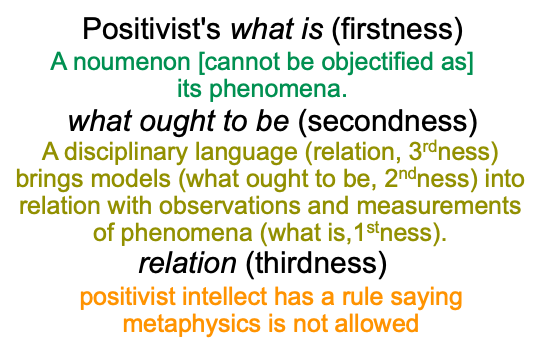
0279 Here is a picture of the Positivist’s judgment, which ground natural scientific inquiry.
0280 A judgment brings what ought to be into relation with what is. The three elements are what is, what ought to be, and relation. In the above figure, the positivist intellect belongs to the relation (and the relation is imbued with the category of thirdness). The empirio-schematic judgment belongs to what ought to be (and is imbued with the category of secondness). The dyad of the noumenon and its phenomena belongs to what is (and is imbued with the category of firstness).
0281 From this, I would expect a benefit from a robust conceptualization of the noumenon.
Otherwise, the noumenon is simply the thing that must be responsible for the phenomena.
But, what does that imply?
Obviously, one wonders whether what one is measuring really corresponds to phenomena of a real noumenon or an imaginary one.
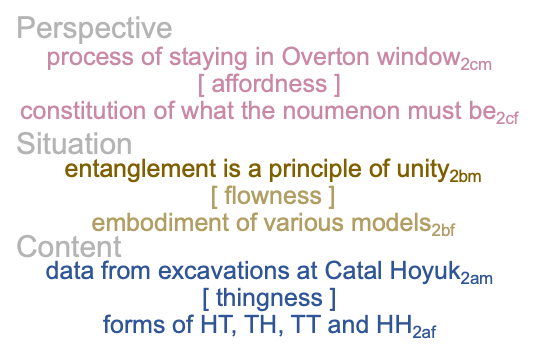
0282 In other words, Hodder’ entanglement is relevant because it reveals what the noumenon must be.
Here is my picture of his theory as an exercise in thingness, flowness and affordance.
0283 Chapter 9 discusses methods as if the noumenon is not under question. He mentions tanglegrams (S2C9), formal networks (S3C9), sequencing concerns (S4C9) and other diachronic aspects (S5C9), as well as other interpretations (S6C9) without mentioning that… well… what exactly is the thing itself?
0284 I wonder whether all the other approaches elucidated in chapter ten (C10) confront the conundrum that I am trying to articulate.
If scientific appreciation of what the noumenon must be stands within the Overton window of Hegel’s and Marx’s things, then what if that is not enough?
0286 From this examination, I have demonstrated that Hodder’s sociological and anthropological appreciation of “entanglement” mirrors, so to speak, a philosophical definition of a confounding. Using Aristotelian terminology, a confounding occurs when the form of a thing entangles other (non-originating) matter. Form is contiguous with two matters, one originating and one entangled. The two contiguities are “substantiation” and “entanglement”.
0287 This applies to content-level and situation-level hylomorphes. In the following figure, entanglement connects form on one level with matter on the adjacent higher level. This connection also occurs in the sign-relations isolated by scholastics of the Latin Age.
0288 Clearly, this expression of entanglement theory stands outside the Hegel-Marx Overton window.
This expression stands outside of the range of ideation among modern anthropologists in 2026.
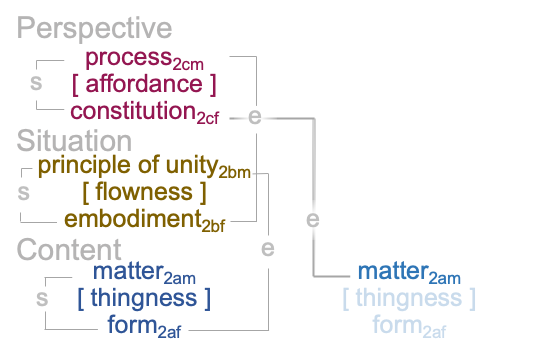
0289 The story is even more complicated. The three-level interscope fully contains two sign-relations, the specifying and the exemplar, familiar to Latin Age scholastics. Even that is not enough.
There is one more confounding that resolves into a sign-relation. The interventional sign connects the perspective-level of one interscope with the content-level of another. What is constituted2cf in one interscope stands for matter3am in another interscope. The discovery of the interventional sign-relation completes a line of thought that started during medieval times.
0290 The Hegel-Marx approaches that the author discusses in chapters 10 and 11 (C10 and C11) need to be adjusted in order to account for phenomena regarded as observable and measurable facets of a noumenon characterized by substances, confoundings and sign-relations.
0291 The story of the emergence of Lotman’s thing is told in Razie Mah’s blog for December 2025, titled Looking at Igor Pilshchikov and Michael Trunin’s Article (2016) “The Tartu Moscow School of Semiotics” as well as follow-up examinations appearing in January through March of 2026.
0292 Juri Lotman (1922-1993) is a Soviet era academic with expertise in the arts of the Slavic civilization. He and a collaborator, Boris Uspenskij (1937-present), find that Marxist vocabulary is inadequate to discuss the phenomena of Slavic historical art production. So, they adopt semiology and structuralism in order to build models of artistic and literary productions. The models allow them to discuss Slavic art-works according to modern, scientific sensibilities.
0293 In sum, for Juri Lotman and Boris Uspenskij, Marx’s thing entangles the matter of semiotics.
0294 The confounding resolves in… what appears to me… to be the new Overton window for the social sciences for the twenty-first century.
0295 I wrap up with three noteworthy conclusions.
0296 First, Hodder’s anthropological theory of entanglement associates with Marx’s thing. Razie Mah’s hypothesis that the human niche is the potential of triadic relations associates with Lotman’s thing.
Second, despite occupying different poles of the twenty-first century Overton window, Hodder’s sociological theory of entanglement and the philosophical definition of “entanglement” as a component of a “confounding” do not exclude one another. They either complement or align.
Third, excavations at Catal Hoyuk permit the suggestion that cultural emissaries from the Ubaid of southern Mesopotamia influence a change in things2a, embodiments2bf and processes2cm associated with Level VII (starting around 6600 B.C.). This suggestion is consistent with the hypothesis of the first singularity proposed by Razie Mah.
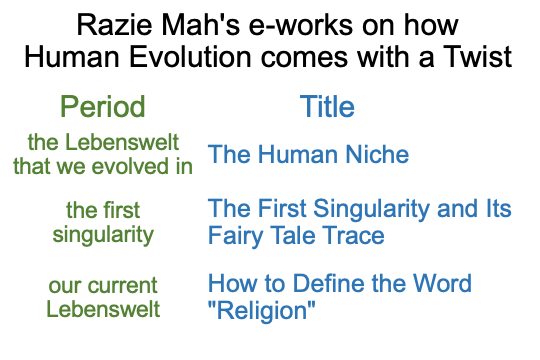
0297 Here is a summary of Razie Mah’s e-works on human evolution.
0298 My thanks to Dr. Ian Hodder for this book, as well his many collaborators. I hope that this examination adds value to his inquiries.
0001 The full title of the book before me is Sumerian Mythology, Ancient Civilizations, and the Epic Search For Humanity’s Origins. That is a great title. This publication is the 13th in a sequence of 37 books downloaded into the Amazon product line between the end of July, 2025, and the start of January, 2026. This literary output is staggering.
0002 Plus, it raises a question in my mind.
How does one identify an artificial intelligence (AI) produced article or book?
0003 Every sentence is well constructed. The text is highly segmented.
Are these clues?
0004 For example, the preface divides into A (5 subsections) and B (1 subsection). Each subsection contains two paragraphs. The preface also includes additional material, C, informing the reader what to expect, why this is essential reading, and how this qualifies for understanding.
Of course, this is standard textbook formatting.
However, the two clues, well-constructed sentences and high segmentation, still apply to the question at hand.
0005 Here are some other clue.
Flat statements contain no wordplay. The entire book consists of (1) direct statements and (2) a negative followed by an affirmative. No, I don’t mean to be negative, it is obviously better to be positive.
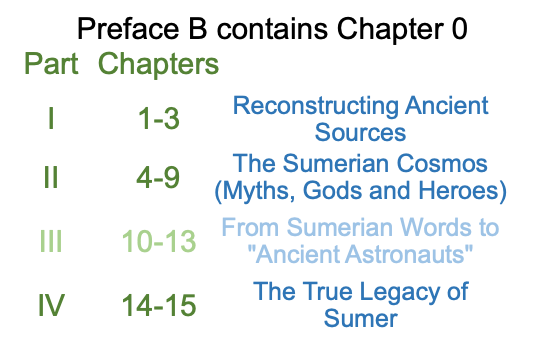
Fractal repetitions appear within the book’s organization. For example, the preface’s B subsection constitutes (what may be called) “Chapter 0”, which recapitulates the topics of the subsequent 15 chapters.
0006 Here is a picture of the list of chapters.
0007 Even though the text itself does not state that it is AI generated, one may raise the question and ponder the clues. These clues do not prove an answer, one way or another. But, they do raise another question.
If the work at hand is AI generated, then what does that imply?
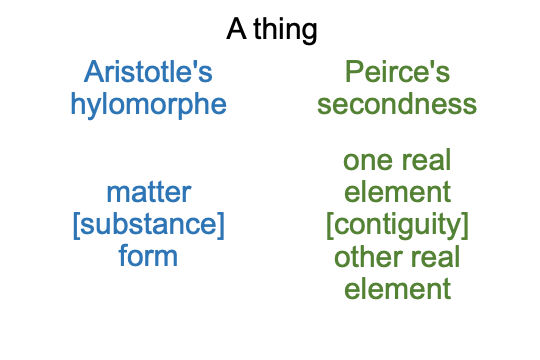
0008 The postmodern scholastic will start with Aristotle’s hylomorphe, which is an exemplar of Peirce’s category of secondness. These concepts may be derived from Razie Mah’s e-books A Primer on the Category-Based Nested Form and A Primer on Sensible and Social Construction.
The book that I have before me is a thing. A thing is composed of two contiguous real elements. For Aristotle, the real elements are matter and form. The contiguity is placed in brackets for clear nomenclature.
0009 Here is a diagram.
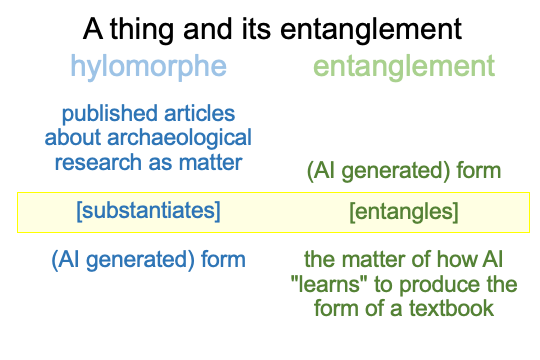
0010 My question as to whether the book is AI generated and what that implies is called “an entanglement”. The following diagram is sort of confusing (something that an AI would avoid), because two expressions are linked in that they have the same form.
0011 In the hylomorphe, describing the book before me, the phrase, “AI generated”, is put into parenthesis because the question remains open. The form is a book.
In the second (upside down, so to speak) thing, the (AI generated) form entangles another matter. That “other matter” is a question about how the AI learns what it is going to say. Obviously, the answer will include the originating matter. One may wonder, “What else?”
A thing and its entanglement consists in two matters (one originating and one entangled) and one form. The technical name for this pair is “confounding”.
0012 With the above confounding in mind, I may consider Chapter 1.
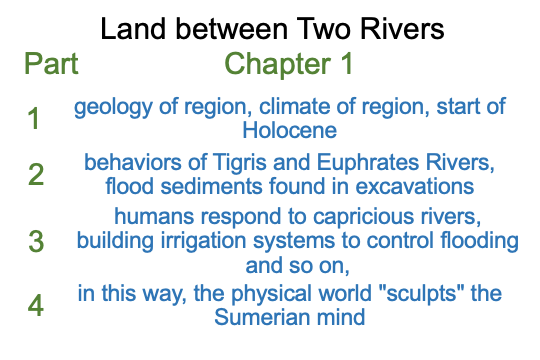
Here is a list of the learning objectives.
0013 This list suggests that the search for humanity’s origins, involving the Sumerian civilization and its mythology, arises in response to the precarious and fertile landscape between the Tigris and Euphrates Rivers. Annual floods from both rivers deliver silt. They can also deliver floods and destruction.
Excavations at locations in southern Mesopotamia find strata associated to floods during the Ubaid, Uruk, and Sumerian Dynastic archaeological periods.
0014 The irrigation systems control the rivers and redirect their water into productive agricultural uses. These systems require large scale labor under central (yet local) authority.
0015 To me, these conclusions are precisely what an AI program would deliver, after processing the literature (web-pages) cited at the end of the chapter. But, these are my suspicions. I have no proof.
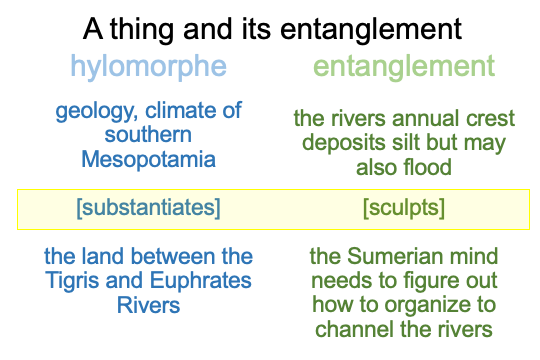
0016 However, I can construct a confounding. There is one form, the land between the Tigris and Euphrates Rivers. These rivers are subject to annual crests that deposit silt and may cause catastrophic flooding. The originating matter is the geology and climate of southern Mesopotamia during the Ubaid, Uruk and Early Sumerian Dynastic archaeological periods. The entangled matter is the mind of the Sumerian people, who celebrate the mythology that this book addresses.
0017 Here is a picture of the confounding.
0018 The confounding leaves this reader with a hypothesis. Sumerian mythology is an ideological component of an organizational imperative. The Sumerians must figure out how to organize to channel the rivers in order to irrigate their fields and to avoid catastrophic flooding.
In the process, the organizational imperative captures the Sumerian imagination.