0611 This examiner sets aside the remainder of the interview under examination, in order to address a possible solution to the last question, while relying on the discipline of biosemiotics.
0612 Am I the owl whose face appears on the wings of a moth?
Am I the small bird who would prefer to eat a moth and not be eaten by a predatory owl?
Am I the moth who would prefer to not be eaten by the small bird?
0613 What am I talking about?
Biologists observe a phenomena, appearing on the top surface of the wings of certain species of moths. Each wingdisplays a large black dot, in such a fashion that the human instantly recognizes the face of an owl. So, by extension, must small birds, the moth’s primary predator.
0614 I associate the appearance of an owl’s eyes2bf with a literary text2bf, substantiated by the language of pattern recognition2bm in the normal context of a visual system3b operating on the potential ‘laws of recognition for an animal’s visual system’1b.
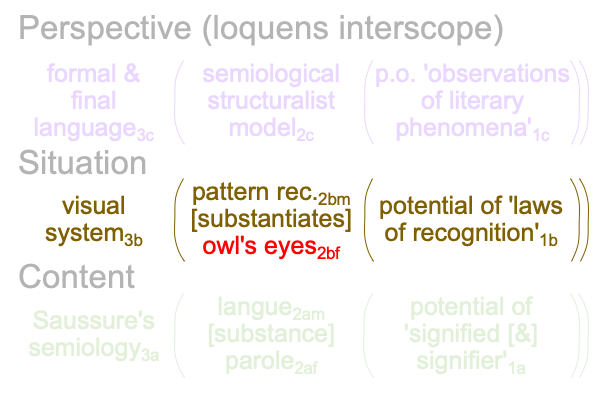
0615 With the situation-level of the loquens interscope filled, it is easy to say that the same level contains a specifying sign-interpretant (SIs) and sign-object (SOs). The specifying sign-vehicle corresponds to the content-level actuality2a(SVs).
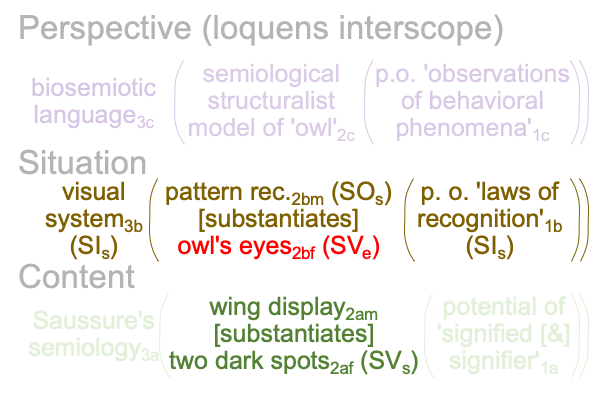
0616 The question arises, “Does this make sense?”
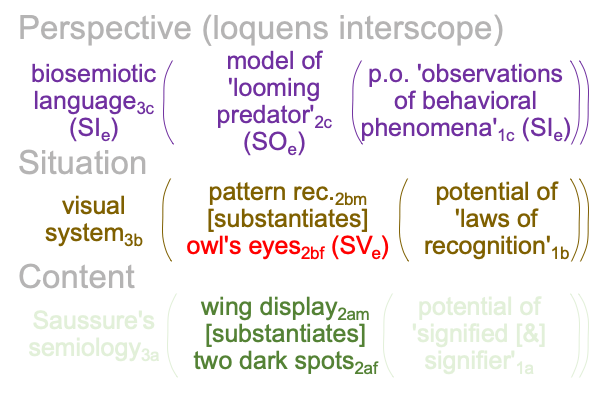
Yes, it makes sense when the appearance of the eyes of an owl2bf (SVe) stands for a primary… or is it secondary?… model2c of a looming predator2c (SOe) in regards to a biosemiotic language3c based on ‘observations of the behavioral phenomena of small birds’1c. (SIe).
0617 Ah, that statement constitutes the exemplar sign-relation, the sign-relation where a situation-level actuality2b is contextualized.
0618 The question again is, “Who am I?”
Am I a small bird whose ancestors have learned to immediately evade the appearance of a looming figure with two large eyes?
Or am I the human who acknowledges that small birds evade the moth when it opens its wings?
0619 Are humans supposed to know the experiences of small birds that well?
What do their cultural traditions say?
0620 This counter-intuitive example stands at the heart of the biosemiotic project, as discussed in Biosemiotics as Noumenon (Parts 1-4) by Razie Mah, available at smashwords and other e-book venues (as well as Razie Mah’s serial blogs from January through June, 2024).
If the behavior is innate for small birds, then human recognition of the bird’s sign-system is also innate.