Man and Sin by Piet Schoonenberg (1964) 2.3 YV
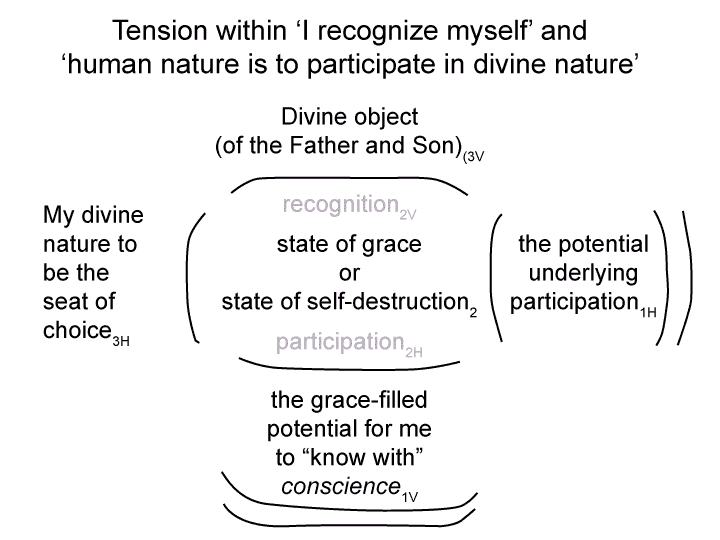
What about this vision of Original Sin as a reification of our own interpretations of the ‘what is real’. Once reified, a “serpent” inspires us to actions that produce results that differ from expectations (i.e. what is defined to be ‘real’). How do we deal with those results? Examples? And how does this picture resonate with traditional interpretations of these chapters of Genesis. This topic is addressed in chapters 11,12 and 13.
Summary of text [comment] pages 87 and 88
Grace maintains balance in the heart.
As long as the individual does not admit grace with “his” free choice, thus allowing the Holy Spirit to increase “his” Christian Liberty, the sinner clings to “his” own sinful choices, imprisoning “himself” in the houses of sin, law and death.
He falls into [words and] bondage.
Summary of text [comment] pages 87 and 88
[On one hand, the realm of actuality does not like contradictions.
It obeys the laws of non-contradiction.
On the other hand, if there is a contradiction, then there is actuality.
This is why the person knows “he” has a heart2 only when it is broken (filled with contradictions).]
Summary of text [comment] pages 87 and 88
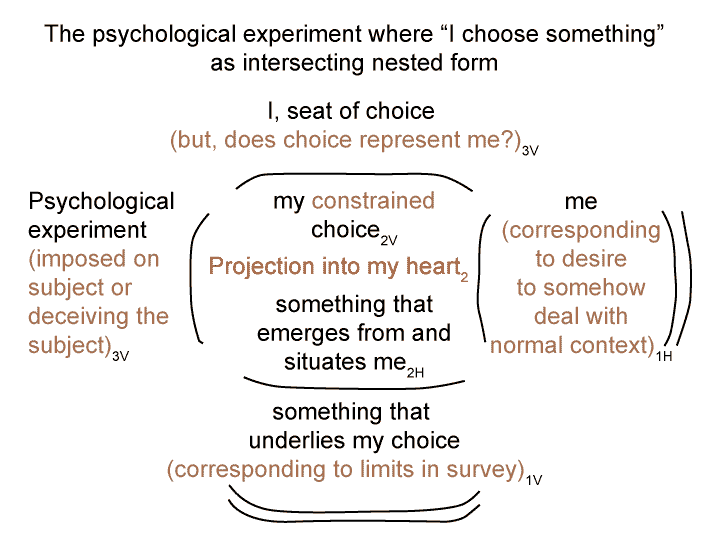
[For the thought experiment where ‘I choose something’, the interscope does not have a heart.
The intersection has a heart and that heart is broken. My heart2 is the single actuality containing my choice2V and something that situates my potential2H.
The imposition of a psychological experiment generates contradictions within these two actualities.]
[When can a researcher know whether the interscope or intersection applies to the conditions of the survey?]
Summary of text [comment] pages 87 and 88
[What about surveys where the intersection applies?
What about surveys where ‘the something that I may choose1V’ does not correspond to ‘the something that emerges from and situates me2H’?]
[Psychologists only can claim that survey measurements represent ‘the potentials inherent in the subject under investigation1a’ under the conditions where the interscope applies. Surveys only apply to sensible construction.]
[Base-level bias must exist in social science experiments because the researcher defines the thought experiment3a that stimulates a response in the subject1a.
The response (the upwelling of potential in the subject1a plus the potential of the survey to impose constraints1b) always conforms to the stimulus (the normal contexts3a&3b that the event occurs in).
This also explains why many social scientists rely on deception. Deception has the same character as bias. All experiments exhibit ‘base-level deception.]
Summary of text [comment] pages 87 and 88
[The psychologist may think that “he” is measuring my mental potential1a as if it were an actuality. After all, on the situation level, the content level nested form is packaged as the possibility of something that the subject might choose1b.
The psychologist may not imagine that “he” is measuring the hidden features in the actuality in the thought experiment where ‘I choose something’.]