0306 Now, I proceed to the derivative interscope.
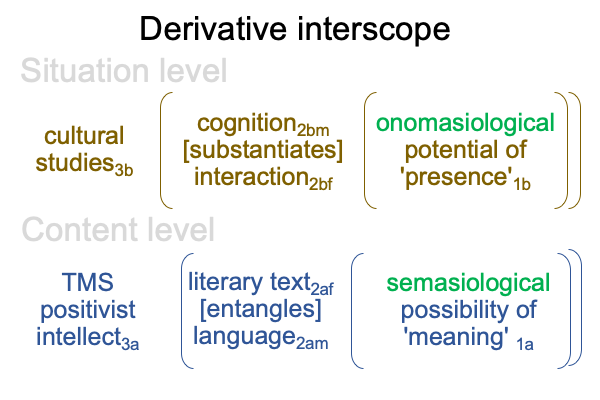
0307 The content level deals with semasiological issues. Given the words of a literary text2af, how do we discuss2amthese words2af by way of meaning1a?
Or should I ask, “Given a signifier2af, then what is the proper signification2am?”
The literary text as semiological structuralist form2af [presents signifiers that entangle] positivist language as matter2am.
Given a positivist language as matter2am, then what corresponds to its meaning1a?
0308 Does the correspondence reflect the nature of explicit abstraction?
Does the model-regarded parole2af of the literary text2af entangle a language2am, displaying the attributes of a langue2am emerging from (and situating) the possibility of ‘positivist meaning’1a?
Given the parole2af of a literary text2af, what does the entangled language2am corresponding to langue2am suggest by way of meaning1a?
0309 What type of confounding is this?
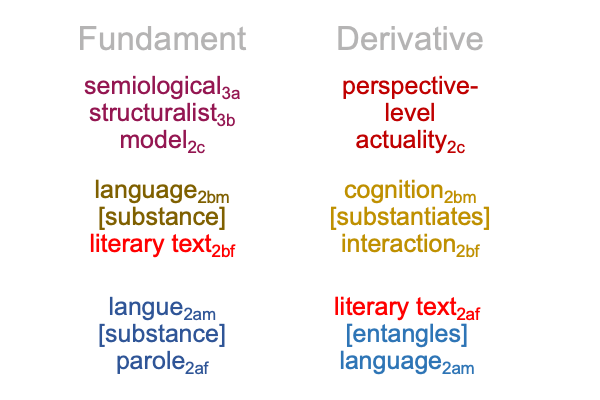
The single form is in red. The originating matter is language2bm (fundament). The entangled matter is language2am(derivative).
0310 The onamasiological question concerns whether there is a spoken parole corresponding to a particular (and perhaps, yet to be fully articulated) positivist langue.
When applied to the situation-level of the derivative interscope, the onamasiological question transforms into a cultural query, asking “Is there a presence1b to attach to the meaning1a underlying the content-level positivist langauge2am?”
0311 Say what?
Oh my. I now proceed step by step.
0312 Step one, the literary text2af (the SOi for the semiological2a structuralist2b model2c as SVi) entangles an explicit abstraction2am consisting of a label2am emerging from (and situating) a positivist3a meaning1a.
In this entanglement, the fundament is confounded with the derivative.
0313 In step two, I compare the two content-level actualities.
In the fundament interscope, langue2am (more or less actualizing a signified1a) [substantiates] parole2af (more or less serving as a signifier1a).
In the derivative interscope, the literary text2af, that was originally substantiated by the language2bm of the mother tongue, now serves as the form2af (perhaps, as a semiological2a structuralist2b model2c substituting for the literary text2bf) entangling an expert language2am that emerges from and situates the possibility of ‘positivist3a meaning’1a.
0314 This directly calls to mind the semasiological question, “Given a spoken word2am, then what is its meaning1a?”
In other words, what is the meaning1a (associated to signifier1a) of the explicit abstraction2am (associated to parole2af) in the derivative interscope?
0315 For the fundament, definition is regarded as implicit for the originating language2bm, specified by a text’s {langue2am [substantiates] parole2af}.
For the derivative, definition must be explicit, leading to the semasiological question. An explicit abstraction2am (a label, parallel to parole2af) is entertained (or entangled). However, the positivist meaning1a, which may serve as a metaphorical signifier1a for the explicit label2am resides in the domain of possibility1. An explicit abstraction2amemerges from (and situates) the potential of positivist meaning1a in the normal context of the TMS intellect3a.
0316 Step three, the derivative’s explicit abstraction2am manifests as a label2am arising (like a parole2af) from the potential of ‘positivist3a meaning’1a (serving as a metaphorical signifier1a). The label2am (the fundament’s parole2afserves as a metaphor) emerges from a meaning1a (the fundament’s signifier1a serves as a metaphor) and its signified1acarries the potential of ‘exhibiting explicit positivist3a meaning’1a (and the fundament’s signified1a serves as a metaphor).
0317 In short, the entangled language2am seems like parole2af.
Plus, positivist meaning1a seems like a signifier1a.
The language2am of the explicit abstraction2am (the metaphorical parole2af) appears to do justice to the TMS positivist intellect3a and the potential of ‘meaning’1a (the metaphorical signifier1a).
How about a diagram of four elements of the derivative interscope?
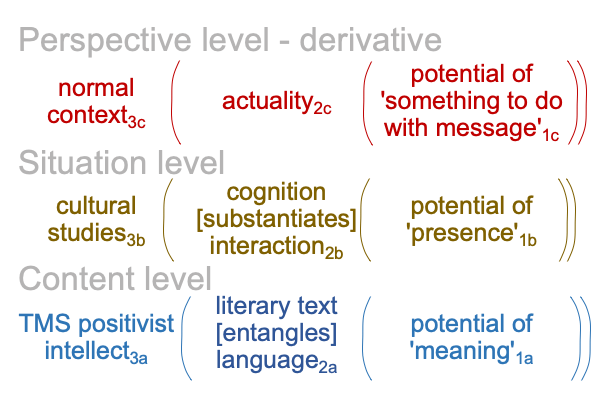
0318 So far, step three covers the content-level elements.
0319 Once again, Saussure’s langue2am (for the fundament interscope) also serves as a metaphor for the literary text2af(for the derivative interscope). The literary text2af (perhaps, now a semiological2a structuralist2b model2c substituting for the literary text2bf) is formally contextualized by the TMS positivist intellect3a and is alchemically enclosed in the scholar’s inquiry as a metaphorical langue1am, corresponding to the possibility of a ‘signified’1a.
Saussure’s parole2af serves as a metaphor for the language2am that is entangled by the literary text2af. This metaphorical parole2am is both finally and efficiently related to the potential of a ‘positivist3a signifier’1a“ by way of definition3.
Of course, this sounds a little goofy, since an explicit abstraction2am emerges from a metaphorical signifier1a, and I am not sure what the corresponding ‘signified’1 might be.
0320 For the fundament interscope, I know that langue2am [substantiates] parole2af.
For the derivative interscope, I suspect that the literary text (semiological structuralist model)2af as metaphorical langue2am [now appears to substantiate] a language2am as a metaphorical parole2af, offering an explicit label2amallowing a positivist signifier to constellate1a.
Does that imply that the label2am (metaphorical parole2af, associated to signifier1a) precedes its meaning1a(metaphorical langue2am, associated to signified1a)?
That is a very good question.
0321 In step four, I ask, “If the explicit abstraction2am that labels a positivist meaning1a constellates the potential of ‘a signifier’1a, then what is the corresponding ‘signified1‘?”
It cannot be the literary text2af, because the literary text2af is the metaphorical langue2am that corresponds to… um… the interventional sign-object (SOi) of the structuralist3a semiological2a model2c (SVi).
If that is the case, then the corresponding signified1 may be something1b that acknowledges the presence of the entangled language2am. Plus, it1b should show up on the situation level.
0322 Ah, I have arrived at the situation level.
If the onomasiological question concerns whether there is a spoken parole2af corresponding to a particular langue2am, then how does the question apply to a situation where the presence of a signifier1a, underlying an explicit abstraction2am, requires a corresponding situation-located signified1b?
Given the presence1b of a metaphorical signifier1a, then what technical term might label that presence1b as a signified1b?
Would such a signified1b support a referent2b as the situation-level actuality2b that virtually situates the entangled explicit abstraction2am?
0323 So maybe, the onamosiological question may be reframed by the situation-level of the derivative interscope.
Does the presence1b of a label2am associated to the entangled language2am of positivist signifiers1a in the derivative interscope serve as a signified1b that is situated by cognition2am, as a situation-level actuality2b in the normal context of cultural studies3b?
0324 Well, if that reframed question sounds plausible, then I can offer the following conclusions.
The fundament interscope operates as an empirio-schematic description of what is going on in any particular literary text. What is going on when an author writes and a reader reads entails implicit abstraction, for the most part. In other words, the writer conveys a text and the reader uses the same text in order to fill in the elements of a purely relational structure associated with langue.
This implicit process is the subject matter for semiology3a and structuralism3b. These two fields of inquiry culminate ina judgment, actualized as a model2c.
The derivative interscope serves as a Positivist description of what is going on when writing and reading a particular literary text. This description uses explicit labels2am, bearing the qualities of a metaphorical parole2af (that is, of a positivist signifier1a), that will be virtually situated by a cultural thing2b. In short, an explicit abstraction2am (SVs) broadly stands for a cultural thing2b (SOs) in regards to cultural studies3b operating on the potential of a signified1b(virtually situating a positivist signifier1a)’ (SIs).
0325 Thus, the situation level of the derivative wrestles with onomasiological issues in a strange manner.
Given a signified1b, then what is the name of the corresponding referent2b?
Does cognition2bm, as a situation-level actuality2b in the normal context of cultural studies3b, virtually situate the presence1b of a label2am associated to the entangled language2am of positivist signifiers1a in the derivative interscope?
0326 {Cognition as matter2bm [substantiates] social and cultural interaction as form2bf} situates the presence1b of positivist3a meaning1a in the normal context of cultural studies3b.
0327 May I further transform the onomasiological question and ask, “Is the situation-level actuality of cognition2bmand social interaction2bf the referent of an explicit abstraction2am (or label2am) that is entangled by a literary text2af?”
The answer is, “Yeah, just watch what people do after they read a particular text.”
Do actions speak louder than words?
Hmmm.