0276 Why do I mention this post-truth business?
From the 1950s until 1989, Juri Lotman (1922-1993) is a professor in a Soviet Socialist academic system. He does not cross the line while… at the same time… tunnels a way under the line that cannot be crossed.
Of course, it is funny to describe academic tunneling, but the further that Lotman digs into a scientific explanation for human conditions, the closer Lotman gets to popping up on the other side of the Marxist line.
0277 Here is a picture of the tunnel.
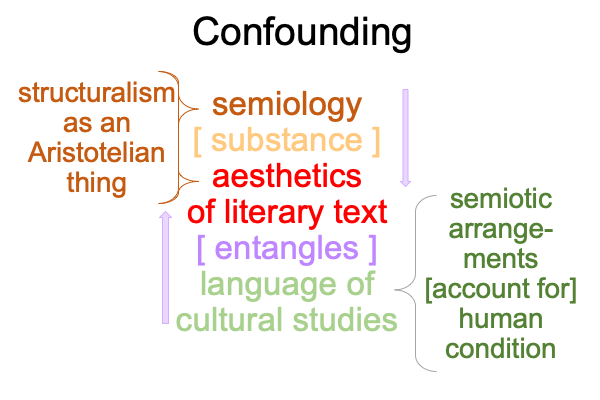
0278 If structuralism is a thing, then its matter is semiology and its form is aesthetics.
Why is that?
The recognition of structure… of a system… is aesthetic. This is how humans work, in our current Lebenswelt. We recognize structure3b and apply a label1b. That label is validated when it gets applied over and over again to similar structures. For example, every literary text2bf is different. However, every literary text belongs to a genre3b.
0279 The tunnel?
Aesthetics as form entangles cultural studies as matter.
The thing part of this confounding is the topic of sections one and two of the article (1 and 2). At this point, reviewing the first two sections of the article under examination may prove valuable. This examination adds value to the authors’ text.
0280 Lotman starts as a traditional literary historian, working in Moscow, the hub of a centralized empire that purports to embody Marxist theory. Authorities are hell bent on changing material arrangements. They anticipate changes in the human condition, according to their Marxist overlay of civilizational history itself (the model overlaying the noumenon).
0281 Lotman becomes a literary structuralist (1960s), leading the Tartu-Moscow School of Semiotics (er… Semiology) and initiating the University of Tartu Summer School. During this time, the School produces a remarkable langue(three-level interscope) that culminates in the parole of a semiological3a structuralist3b model2c.
0282 The examiner has already derived the following diagram of the fundament interscope.
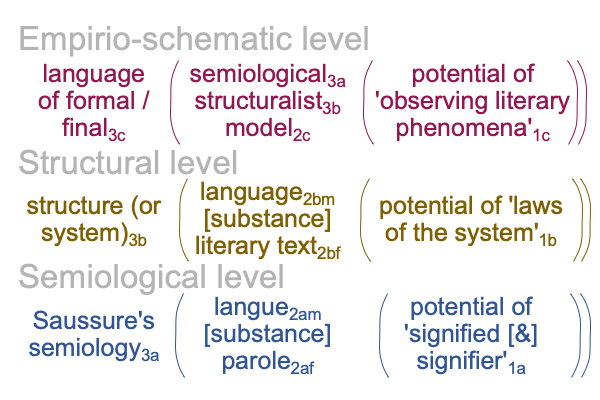
0283 Theoretically (A), the perspective-level actuality2c should serve as a science-friendly model that can overlay the noumenon of literature within the Slavic civilization.
But, that does not occur.
Instead, the so-called “Prague Spring”, nudges (B) the network of researchers (who are increasingly touching base with Lotman, whose voluminous correspondences currently reside at the Lotman Archives in Estonia) towards a different opportunity.
0284 What do I mean by that?
First, let me discuss the “should” (A).
Note how the three-level interscope depicted above is sustained by a Saussurean3a content-level actuality2a, arising from the potential of ‘the signifier and the signified’1a.
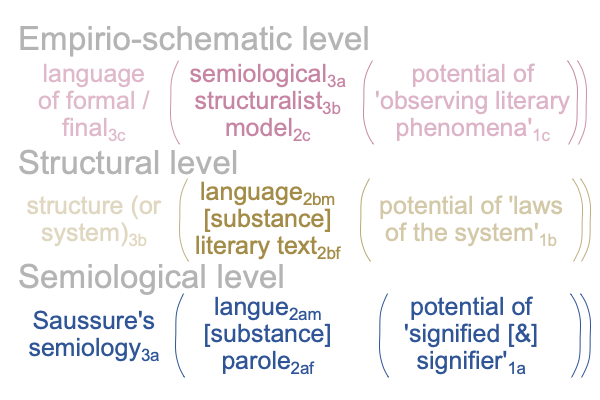
0285 The actuality2a itself exhibits material causation. That means that the substance, an arbitrary relation, is real.
Of course, this makes no sense, because how can an arbitrary relation be adaptive?
Okay, that is another story. See Razie Mah’s e-book, The First Singularity and Its Fairy Tale Trace.
0286 The normal context3a and the actuality3af involves formal causes. Surely, if parole2af manifests as a system of differences, then langue2am must as well.
0287 Efficient causes couple actuality2a and potential1a. The potential1a reminds me of the potential that underlies language2am on the content-level of the derivative interscope. Meaning1a? What is it1a? Well, it must involve the interplay between signified and signifier1a in the human mind.
0288 Here, I can harken back to human evolutionary history, by claiming that this interplay differs between implicit and explicit abstraction. Implicit abstraction is the sole province of hand- and hand-speech talk, belonging to the Lebenswelt that we evolved in. Explicit abstraction is an opportunity available for speech-alone talk, belonging to our current Lebenswelt.
The actualization of langue2am and parole2af from the potential of ‘signified [&] signifier’1a serves as an example of explicit abstraction.
See Razie Mah’s e-book, A Primer on Implicit and Explicit Abstraction, available at smashwords and other e-book venues.
0289 Doesn’t this claim sound like a huge research project?
0290 Efficient causes work in alignment with final causation.
Consider the following category-based nested form: A mechanical decoding and encoding process3a brings the actuality of {neural networks corresponding to three-level interscopes (langue2am) substantiating vocal utterances (parole2af)} into relation with the potential of positive and negative feedback loops1a.
0291 Compare the efficient causalities involved in the actuality2a, {neural network2am [substantiates] vocal utterance2af}, emerging from and situating the potential1a of the final causalities inherent in the following two statements.
The signifier1a associates to parole2af, the spoken word.
The signified1a goes with langue2am, which turns out to be a purely relational structure, such as a three-level interscope.
0292 On the semiological or content level, langue2am is like an impression2am that substantiates a parole2af, a spoken word2af. Consequently, the fundament interscope is founded in the same way that a person generates a written text. One must take a pen and inscribe the spoken word2af. So, the semiological level goes with what I think2am and what I say2af… er… write2af.
0293 On the structural or situation level, inscription2af has the potential of following (and thus revealing) the laws of a semiological system1b (or “genre3b“). Language2bm [substantiates] a literary text2bf (a new signifier, one worth showing to others). So, the structural level recapitulates what I say2af as a literary text2bf.
0294 The words in my literary text2b carry the potential to be regarded as phenomena of the text as a noumenon1c. This potential1c introduces the unfolded empirio-schematic judgment as the perspective level of the fundament interscope.
0295 Overall, this is what took place and would have continued uninterrupted (A), if it were not for the so-called “Prague spring” (B).