0184 I now summarize.
0185 First, ideology defines the Sumerian city (chapter 2, Basak) and the modern multiversity (section 2, Beck et al.).
0186 Second, Peirce’s natural sign typology may be used to frame the historic transition from ideographs to the rebus principle (chapter 3, Basak) as well as the historic development of academic journals (section 2, Beck et al.).
0187 Third, the same historic transitions in the second item may also be framed using Razie Mah’s category-nested form for the definition of a spoken word.
0188 Fourth, the creation of humans in the Eridu Genesis (chapter 4, D. Basak) portrayed as a nested form, matches the current crisis in academic publishing in the discipline of archaeology (discussion, Beck et al.).
0189 Fifth, D. Basak fails to recognize that the Sumerian divine assembly (the Anunnaki) may be portrayed by filling in slots within the purely relational structure of the category-based nested form. This failure indicates a blind spot that implicates the field of archaeology for the past 165 years. If the speculation that the book under examination is AI-generated is true (and that is not certain at the moment of writing) and if an AI program cannot process what its training material does not envision, then this failure may also apply to Jess Beck et al.’s assessment of the material arrangements that substantiate the conditions of young professional archaeologists.
These researchers are blind to parallels between ancient Sumerian mythology and their own professional crisis, because the Marxist thing clouds their vision.
0190 Sixth, the Marxist thing sinks into a sea of uncertainty. Anthropologists are burdened with material analysis. They cannot envision Lotman’s thing, {semiotic arrangements [substantiate] human conditions}, distilled within a Marxist political institution from the art and literature of Slavic civilization.
Only Lotman’s thing3b allows anthropologists to address the question, “What if tenure2a (SVs) stands for the substance2b (SOs) actualizing the potential of ‘observing and measuring a social conflict’1b in the normal context of the disciplinary language of the Tartu-Moscow School of semiotics3b (SIs)?”
What if tenure is not situated as a material arrangement?
What if tenure (SVs) stands for a semiotic arrangement (SOs)?
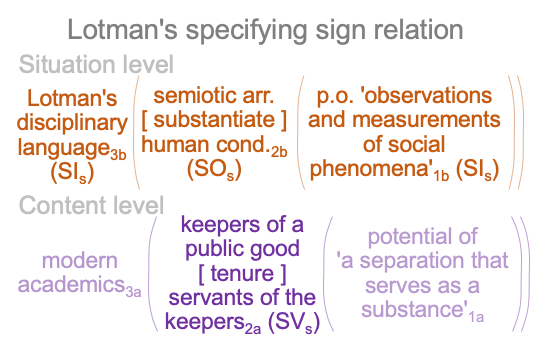
0191 Indeed, the specificative sign-relation says the following, “The content-level actuality of {keepers of the public good [tenure] servants of the keepers)2a (SVs) stands for the situation-level actuality of Lotman’s thing2b (SOs) in regards to the disciplinary language of the Tartu-Moscow School of Semiotics3b operating on the potential of ‘observations and measurements of phenomena of the current crisis in the publishing of research papers and its importance in promotions in post-modern universities’1b (SIs).
Where can I get information on this specifying sign-relation?
Take a look at Razie Mah’s blog for October, 2023, titled Looking at John Deely’s Book (2010) “Semiotic Animal”.
0192 Now, I would like to return to the idea that Dr. D. Basak approaches Sumerian mythology, ancient civilization and the epic search for humanity’s origins from a Marxist point of view, because, to date, all research in anthropology is conducted with the Marxist thing as a model.
0193 The following figure shows the challenge posed by a specifying sign-relation whose time has come (according to a Neptune in Aries cycle).
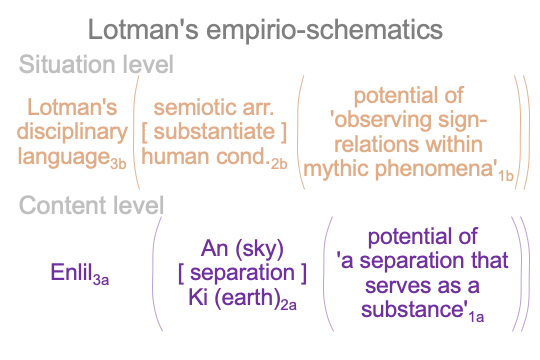
0194 This specifying sign-relation says, “The content-level dyad, {An (sky) [separation] Ki (earth)}2a (SVs) stands for the situation-level dyad, {semiotic arrangements [substantiate] human conditions}2b (SOs), in regards to a situation-level normal context, Tartu-Moscow School of Semiotics disciplinary language3b, operating on the potential of ‘observations and measurements of mythic phenomena’1b (SIs).