0094 What happens next?
0095 The potential of ‘a separation that performs as a substance’1 supports further differentiation.
An (the sky)2 becomes the normal context3 for Utu (the sun)2 and the Nanna (the moon)2 who arise from the potential of ‘separation as a substance’1.
Ki (the earth)2 becomes the normal context for Ninhursag (the mountains)2 and Ereshlugal (the underworld)2 who arise from the potential of ‘separation as a substance’1.
0096 Of course, Sumerian mythology does not describe the creation of minor gods in precisely this way. So, I extrapolate from the origin myth at hand.
Here is a picture.
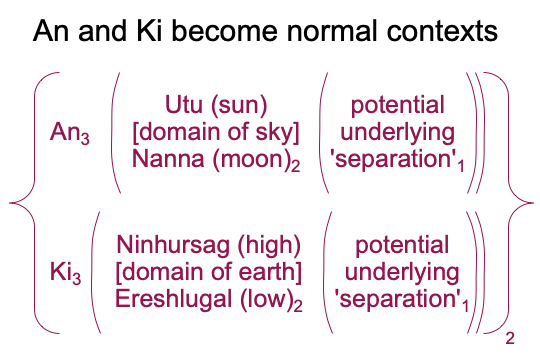
0096 [The domain of sky] is the substance that arises from a celestial potential of ‘a separation that performs as a substance’1.
0097 I ask, “What domain of the sky somehow captures a celestial phenomenon that associates to ‘a separation that performs as a substance’1?”
Is rain a good candidate?
Rain falls from the domain of the sky to the earth where it enters into domains associated to the trickster god, Enki. Enki is the god of freshwater that flows in streams and in underground passages that come to the surface as springs. All that underground fresh water is called “the Abzu”.
0098 [The domain of earth] is the substance that arises from a mundane potential of ‘a separation that performs as a substance’1.
0099 I ask, “What domain of the earth captures mundane phenomena that associate to ‘a separation that performs as a substance’1?”
Is fertility a good candidate? What about competition? What about the pursuit of love? What about grasping for power?
Perhaps, I may consider the goddess, Inanna, as the personification of ‘a separation that performs a substance’1.
Innana is the goddess of love and war. To me, that designation sounds like the two extremes of earthy, organic desire. Humans are animals, after all.
0100 In brief, I associate An2 and Ki2 to normal contexts3 dwelling within the actuality2 of Enlil3. Further, I associate the potentials1 underlying An3(2) and Ki3(2), to Enki (the god of freshwater and the Abzu) and Inanna (the goddess who drives people together and drives people apart). Enki1(2) and Innana1(2) label potentials that reside in the realm of Enlil3‘s actuality2.
0101 Here is a diagram of the actuality2. The overall normal context is Enlil3. The potential1 is ‘a separation that empowers a substance’ or ‘a separation that performs as a substance’ or ‘a separation in potential that supports a substance in actuality’.
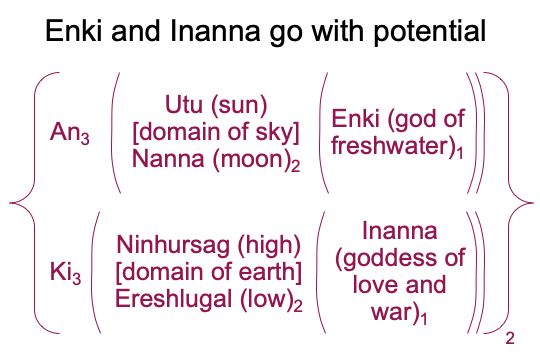
0102 An3, the sky god, belongs to the realm of actuality in Enlil’s nested form, yet serves as a normal context3 that is separated from Ki3, the earth goddess. The separation of An3 and Ki3 is not pictured in the above figure. [Separation] is the contiguity between these two gods. [Separation] is the substance of Enlil’s domain.
0103 Four gods belong to the realm of actuality in the normal contexts of An3 and Ki3.
Utu, the god of the sun, is separate from Nanna, the goddess of the moon. That separation is like a substance, belonging to the domain of the sky.
Ninhursag, the goddess of the mountains and other highlands, is separate from Ereshlugal, the goddess of underground places, including the resting place of the dead. The separation is like a substance, belonging to the domain of the earth.
0104 Two gods belong to the realm of potential within the actuality in Enlil’s nested form.
0105 Enki is the god of fresh water in streams and running underground.
Why do I associate him with the potential underlying Utu2 (the sun) and Nanna2 (the moon)?
The freshwater in streams and underground waterways comes from rain. Rain occurs when the sun and the moon are not visible. They are behind clouds. When the sun and moon are visible, then there is no rain. Rain is fresh water. The fresh waters are in motion, on land in streams and under land in passageways leading to springs.
Of course, my association is counter-intuitive. The logic of actuality2 is that of contradiction and non-contradiction. The logic of actuality applies to Utu and Nanna. The logics of possibility1 are counterintuitive. Firstness allows contradictions and is inclusive. We can see by the lights of Utu and Nanna. But, we cannot drink their sky-water. Their sky-water must come to earth.
Enki is like a substance that supports a separation in the domain of the sky.
0106 Innana is the goddess of love and war.
To me, a goddess that represents such a direct contradiction must belong to the category of firstness. I have two options. Enki goes with the sky. So, Innana goes with the earth.
Innana potentiates the gods of the earth, Ninhursag (the goddess of highland places) and Ereshlugal (the goddess of underground places). Why would the goddess of love and war pertain to the mountains and the caverns? Perhaps, love and war reflect desire and desire is what makes mountains (out of molehills) and pitfalls (out of stumbles).
Innana is like a substance that supports a separation in the domain of the earth.
0107 These associations in the category of firstness are highly speculative.
The fact that Enlil’s actuality2 consists of two category-based nested forms suggests a highly differentiated godhead. The only potential that is not labeled is the potential1 underlying Enlil3, which is the potential1 that ‘a separation can serve as a substance’. This potential1 is inverted in the potentials that I associate to Enki1(2) and Innana1(2).
0108 Enki1 labels a substance that has the potential of separation from the sky. That substance is rainwater.
Innana1 labels a substance that separates from the earth, yet is as grand as the mountains and as dangerous as the underground. We (humans) are grounded in desire.