0327 The word “liturgy” combines the Greek words laos (people) and ergon (work). The word translates into “public works”. The word associates to an objective that brings people into organization.
0328 Thus, the sublime body of the king serves as a normal context for the regal values that virtually situate organizational objectives, bringing the individual into the organization of the kingdom (here on earth, rather than in heaven).
For this reason, the sublime body of the king calls for public works (that is, liturgies), extolling the potentials of both kingliness and order. These public works treat the mortal body of the king like the well-dressed effigy that it may well be.
0329 Marx’s “fetish” has a lot in common with Freud’s “neurosis”.
The fetish neurotically attends to the apparent element that accompanies the hidden one. For this reason, the fetish goes with both busy-ness (attending to literal appearances) and something else (attending to value perceptions).
0330 Giorgio Agamben insightfully characterizes the hidden element as glory, opening the door to an inquiry into the archaeology of (political) glory.
He raises the question: How are religious doxologies co-opted by political ones?
How are outward manifestations of political situations glorified?
0331 The fetish is a situation-level contiguity.
The situation-level puts the content-level in its place.
For late medieval and early modern political theology, the fetish of a king’s mortal body puts the contiguity between an objectorg and the (political) subject in debt.
A petit objet a (an index of kingliness) virtually situates an organizational object orienting the active soul of the subject.
Active soul [animates] body2a becomes an organizational objective (inspired with indebtedness to the king) subject of the realm2a.
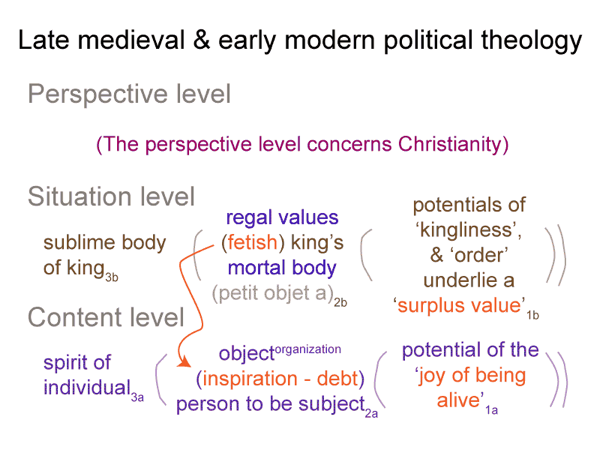
Consider, for example, the custom of kissing the ring of the sovereign.
The ring is the petit objet a. It is infused with regal value.
The ring reinforces an organizational object orienting the subject. Kiss the ring.
This objectorg is contiguous with the person as a subject of the realm.
This contiguity may be described using a variety of terms, such as inspiration, loyalty, duty and debt.
0332 That is not all.
The readily apparent subject on the content level2a emerges from and situates the possibilities inherent in joissance (here, the joy of being alive)1a.
Joissance1a, in turn, is virtually situated by the qualities of kingliness and order1b. These qualities1b set the stage for a social form of surplus value2b.
Consequently, the actuality of regal values [fetishizing] the king’s mortal body2b generates something equivalent towhat Marx called “surplus value”.
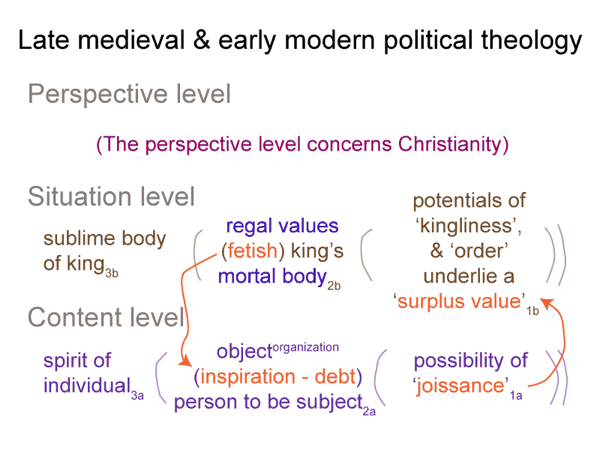
This generation occurs in the society tier, suggesting that Marxism projects the operations of the society tier onto the organization tier.
0333 The feedback loop changes with time.
In the following diagram, history proceeds from top to bottom.
Only the content-level associations are shown.
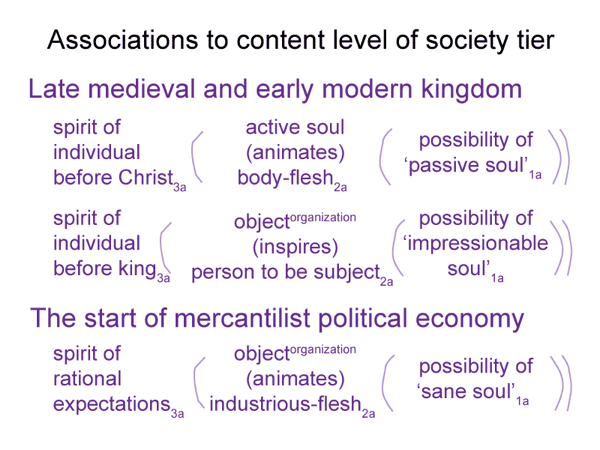
0334 The nested forms represent religious theology, political theology and political economy, respectively.
0335 In political theology, the spirit of the individual standing before the king attends to the king’s personage (and the regal values that inform that personage).
With the Peace of Westphalia, the king also becomes the pastor of his nation (at least for the Northern Europeans). The prince favors certain Christian factions over others.
0336 So what is an excluded Christian faction to do?
Many excluded Christian factions find joy in objectsorg other than the objectsorg of the sublime body of the king. Directed by a spirit of rational expectations, typical of industry, these folks take the only sane path. They make things that they can sell.
Thus, political economy overtook political theology.
The glory of the king passed into the glory of the fine commodities that the subjects produced.
0337 Here is how that looks in the 3-tier model:
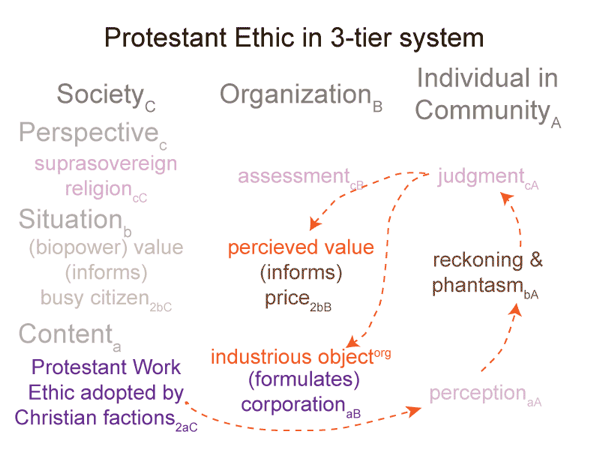
0338 Indeed, the industriousness of the Protestants became their way of advertising.
0339 Few political theologians of the day saw what was coming.
In the diagram, the reason is obvious.
The Protestant Ethic potentiates a new societal situation-level. It supports a new authority, so to speak, which took Thomas Hobbes by surprise. Hobbes published Leviathan in 1651, right around the time that the Puritans seized sovereign power and beheaded a mortal body that tried to live up to his regal values.
The Leviathan is an extended and rational argument against the pope serving as spiritual sovereign over the temporal sovereign, the king. Hobbes did not even mention the bloodthirsty Puritans.
Hobbes’ leviathan is depicted on the front cover of the original edition. A giant human composed of small humanscarries a sword and a (bishop’s) staff, not a sowing machine and a ship.
0340 Oh, did I say “blood-thirsty”? I meant to say “industrious”.
But then, can “industriousness” become an organizational object belonging to an institution capable of seizing sovereign power?
If so, then the institutions declaring industriousness to be righteous fit the definition of an infrasovereign religion.
An infrasovereign religion carries a capacity to grasp for sovereign power.
Sovereign power is empowered to spill blood.
0341 Let me look closely at this objectorg.
Industrious labor (rather than self-sacrifice) glorifies the Creator.
0342 The message contains two contradicting actualities: work and faith.
By faith alone, I will be saved. I must continually attend to my faith. My faith justifies my righteous certitude.
At the same time, my work advertises my commitment to the glory of God.
0343 Do these two actualities contradict?
Do they combine into a single actuality?
The following intersection depicts the Puritan message.
A contradiction is presented as a single actuality: salvation.
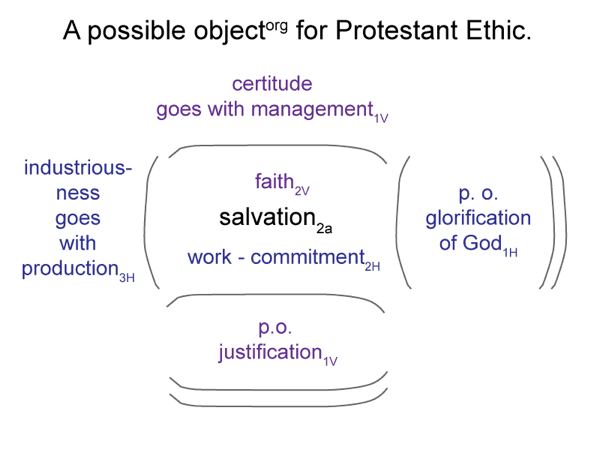
0344 Salvation is a single actuality composed of two contradicting actualities, the business of faith and labor glorifying God.
The Protestant Ethic boasts certitude and industriousness.
The English Puritans at the time of Thomas Hobbes constituted an infrasovereign religion capable of contending for sovereign power. They also developed the organization tier of the English economy by producing fine products that could be marketed.
0345 On one hand, Puritan leaders exhibited all the fervor of Jean-Paul Marat.
Indeed, their champion, Oliver Cromwell, prefigured Napoleon Bonaparte, as well as other tyrants.
The Puritan Revolution in England defines a phenomenon.
All varieties of mercantilism, fascism, communism and big-government (il)liberalism are constellations of infrasovereign religions.
As these constellations gain sovereign power, the nation tends towards tyranny.
0346 On the other hand, the English Puritans exhibited all the rationality of citizenregular.
They were industrious and tolerant, in their own market-oriented way. The Puritans blamed the sovereigns, rather than Christian factions, for the so-called “wars of religion”.
In many ways, they were correct.
0347 Aristocrats often manipulated Christian factions into openly fighting with one another. They hoped to establish a need for order, which they were already prepared to supply.
Plus, factional conflicts justified looting the monasteries and taking their lands and property.
Little did the aristocrats know that they were next in line.
Remember the assignat in David’s painting, The Death of Marat?