0191 The lecture continues.
Santner returns to Derrida’s treatment of Marx.
Marx’ Communist Manifesto, like Shakespeare’s Hamlet, begins with a specter. From the very start, Europe has been haunted by an excess (a ghost).
This excess does not belong to the oikos (the household). It belongs to commodities. Or, rather, it belongs to the management of commodities.
0192 A German jurist (of ill repute) wrote an essay on Hamlet in 1956. Carl Schmitt envisioned the play as intimation, prefiguring the clash between late medieval and early modern political theology of kingship and the emergence of England as a mercantile economy.
This is why I supplant the word “capitalism” with “mercantilism”.
0193 To Schmitt, England embraced the sea. The sea provided the roads for its empire. The sea set the stage for the Industrial Revolution. The British mercantile economy flourished from the difference in productivity between local factories and distant agricultural colonies.
Shakespeare’s plays were first presented around 1600, when mercantilism was taking hold in England.
0194 Santner agrees with Schmitt. The economic change transformed the production, circulation and accumulation of the immaterial stuff that once defined the glorious body of the king. Now, the king’s glorious flesh characterizes social relations within modern commercial societies.
0195 How do I fit this into category-based nested forms?
Following Foucault, I associate the immaterial aspect that once defined the glorious body of the king with the term “discipline”. Discipline is normative. It becomes the normal context of a nested form.
I associate the aspect called “stuff” with the potential engendered by the normal context of the king’s glorious body. This stuff weighs the term “flesh”. It corresponds to Foucault’s term “biopower”.
This immaterial normal context and this material possibility bracket a somatic actuality, the king’s mortal body.
0196 In mercantilist England, the value-laden mortal body of the king changed to social relations within commercial society. These relations are somatic, body-like, and organizational.
0197 To me, this sounds like the Preface, implying that lecture 1.3 starts a new iteration within a Semitic textual structure.
Semitic texts ask the reader to recognize a possibility. Greek texts attempt to isolate the only (or most convincing) possibility by eliminating all other possibilities.
0198 Psychoanalysis follows the Semitic style. The psychoanalyst is expected to recognize a possibility, rather than isolate an explanation.
Santner’s literary style of directed (almost free) association forces the reader to play the role of psychoanalyst. The reader must interpret Santner’s stream of consciousness, which is intuitive, suggestive and difficult to lock onto. Santner asks the reader (and psychoanalyst) to recognize a possibility.
0199 My diagrams are interpretations. The following figure may be compared to earlier diagrams.
Here is a comparison between Santner’s generalizing intuition and his political theological and political economic models.
Remember that thirdness goes with normal context, secondness with actuality and firstness with possibility.
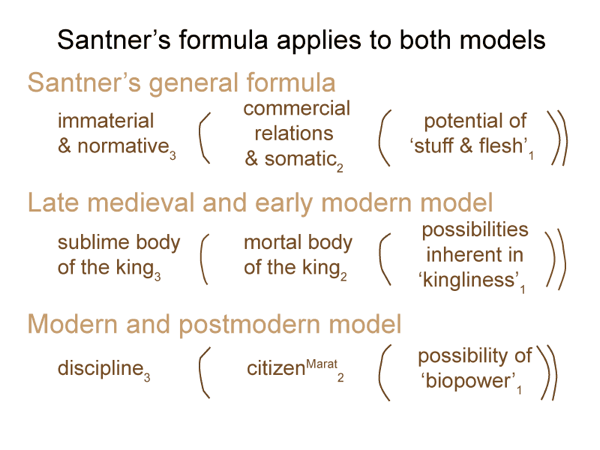
0200 The late medieval and early modern political theology of the king’s dual body and the middle and late modern political economy both share the structure of Santner’s general formula.
0201 They also both associate with the situation-level of the society tier.
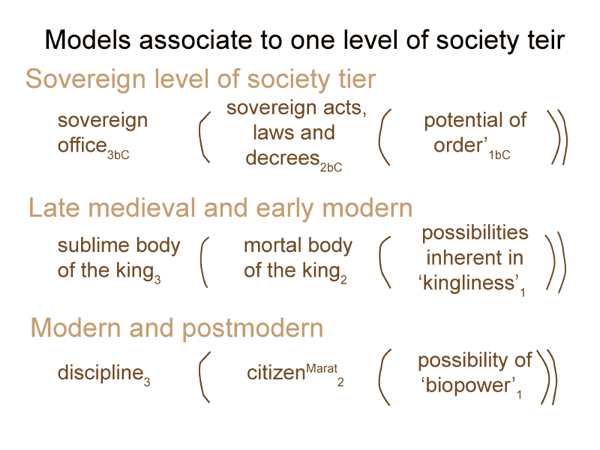
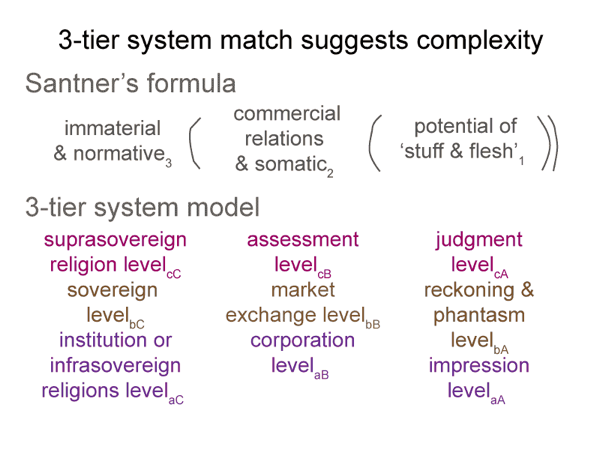
Terms within each nested form resonate. For example, the king’s sublime body3 and discipline3 matches sovereign office3bC.
0202 Santner’s consciousness flows through these connections into a more evocative and indirect resonance. His formula also applies to the 3-tier system, a nested form composed of three interscopes (or tiers).
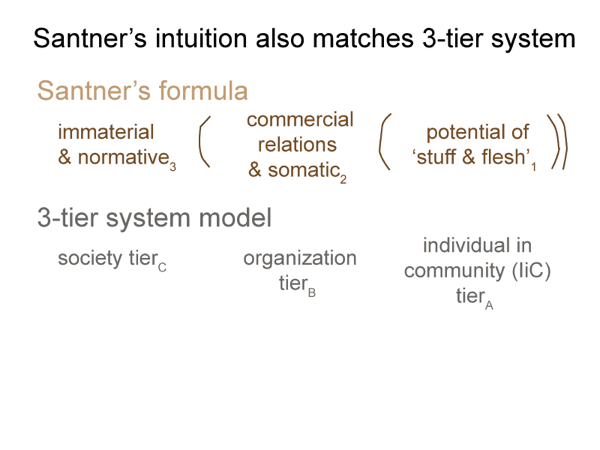
0203 This is crucial. Santner’s directed associations present a double vision. One frame fits the society tier. The other frame encompasses a model of institutions, organizations and individuals in community.
0204 To me, this portrays what Santner describes as the dispersion of the immaterial stuff of the one sublime king into the many bodies of the citizen.
Both citizenMarat and citizenregular belong to the society tier. Yet, the generalized structure of their nested formsextends into the domains of institutions, organizations and individuals.
0205 This association between Santner’s general nested form and the 3-tier system also evokes Marx’s concepts of surplus value and commodity fetish. Marx’s concepts apply to a circulation of immaterial stuff (in the realms of normal contexts and possibility) within and among the tiers.
Shakespeare’s The Merchant of Venice illustrates. A circulation of immaterial stuff encompasses the situation levels of all three tiers, plus the content-level of the society tier.
Here is the same association between Santner’s general formula and the 3-tier system. The levels of the 3-tier system are explicit.
0206 Santner contrasts his general formula with the so-called “new materialisms” currently popular in academics.
He asks, “Which will it be, the circulation of immaterial stuff or the new materialism?”
0207 Santner examines Jean Bennett’s reading of Kafka’s famous story about Odradek. Bennett envisions a vital materialism where Odradek is like… self-organizing matter. Other scholars suggest the name refers to… od-radix and od-adresa… primal German and Slavic words for rootlessness and not-belonging.
In contrast, Santner finds, in Odradek, the figure of an un-economic man, a busy body who is not really necessary but cannot be disposed of. Odradek is like a bureaucrat whose work is cut loose from purpose or legitimation.
To me, this character differs from citizenMarat.
CitizenMarat is a true believer. Odradek holds the same political position as citizenMarat, but pretends to belief.
0208 What difference, at this point, does it make?
After all, the citizensregular are the ones uprooted and decimated by the busy bodies.
These folk are typically the main characters of Kafta’s tales.
0209 Consider the example of dangerous work.
The foreman is a busy body. He got the job because he is willing to snitch on the other workers. The foreman is instinctively wary of any worker with talent or charisma.
Uh oh. Enter the motivated worker.
Soon, a dangerous situation comes to pass. The passive-aggressive foreman places the confident worker in danger because he is the only one who can get this job done.
0210 After the injury, the broken talent ends up meeting his insurance agent, Franz Kafka.