02/25/15

Man and Sin by Piet Schoonenberg (1964) 1.7G

Summary of text [comment] page 47

[Natural evil is scandalous.

The “the scandal of natural evil” inspired individuals to turn away from Christianity.

Where did they go?

People were called to other religions, ones that had the audacity to call God “evil” and to propose cures to the “evils of His creation”.

These modern religions called themselves “not religious”.

Each variation of the postreligionist Enlightenment Godhead proposed cures for the evils of His creation.

Each produced evils that dwarfed the evils they were designed to cure.

Despite the disasters of the past two centuries, these thinkgroups continue flourish, longing for the infusion of sovereign power, longing to become a Public Cult, longing to materialize thinkpro-objects.

Is this what the Peace of Westphalia wrought?]

02/24/15

Man and Sin by Piet Schoonenberg (1964) 1.7F

Summary of text [comment] page 47

The scandal of natural, or “prepersonal”, evil is a case in point.

How could a God who called his creation “good” have included physical evil?

New theories in science were popularized as scandalous. But the scandal is obviated by the notion that God creates spontaneous orders; something that we humans also do, but can never take credit for, because we are embedded within them.

There is an analogy between moral and natural evil. They both share the same nested categorical structure.

There is also a collision between moral and natural evil. They intersect. They intersect precisely at “the scandal of natural evil”.

In nature, bad events happen.

In morals, we are limited and selfish. We cause bad things to happen.]

02/23/15

Man and Sin by Piet Schoonenberg (1964) 1.7E

Summary of text [comment] page 47

[This leads to a question:

What about scientific discovery?

Scientific discoveries alter the way we express lawessential, especially those features that exist independently of us. In Latin, the term is ens reale.

Notably, there is a difference in speed of response for each type of think.

For example, accounts of a new discovery may give political or some other advantage to a particular thinkgroup. They interpret lawessential in their own favor, thus producing an affirmative form of lawdenial. They will claim the discovery works to their benefit. Once these claims are debunked, these interpretations end up as fodder for thinkdivine. The claim itself remains in lawessential.

This fits the definition of “scandal”: “a fascination of the surface that blocks access to seeing deeper”.]

02/20/15

Man and Sin by Piet Schoonenberg (1964) 1.7D

Summary of text [comment] page 47

Next on the list: The opposition (to God) derives from our freedom. The opposition materializes a variety of levels. It both resembles and differs from evil in the prepersonal level.
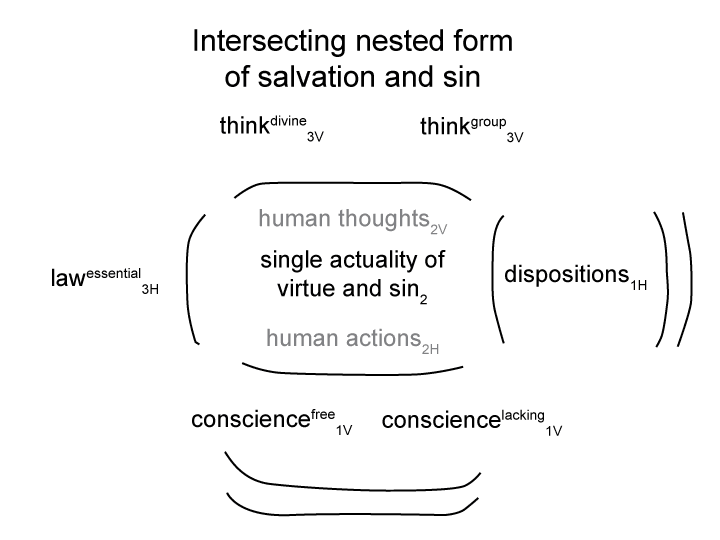
[In regards to the prior intersection, free will associates to consciencelacking and consciencefree.

The comment on “levels of freedom” associates to two points.

One concerns the diversity of thinkgroups that speech alone talk makes possible. Even if a person is not in opposition to God, there are many groups to join, each with its own independence. Both the individual and the group may find ways to oppose God.

Two concerns the horizontal level of the intersection. This nested form interscopes with other nested forms. The nested form of lawessential interscopes with other expressions of the natural law. Each interscoping nested form constitutes a level of lawessential that must be accounted for by thinkgroup_or_divine.]

02/18/15

Man and Sin by Piet Schoonenberg (1964) 1.7B

Summary of text [comment] page 47

Schoonenberg opens chapter 1, section 7, with a list. These are the topics that he has covered so far. These topics constitute an essential definition of “sin”.

Let me go through the points one by one.

Sin is an opposition to God’s salvific activity and to His creation, hence a crime against the world and against humans.

[This can be portrayed by the formalism of the intersecting nested forms for “the message underlying the word ‘religion'”.

Sin is at the core of any mob or conspiracy:

thinkgroup3V( sin2( consciencelacking1V)).

Sin is in opposition to God’s salvific activity:

thinkdivine3V( virtue2( consciencefree1V))

Opposition to His creation is a crime against the world and fellow humans. That crime is captured by:

lawessential3H( sin or virtue2( dispositions1H))]

02/17/15

Man and Sin by Piet Schoonenberg (1964) 1.7A

This blog continues the review of Piet Schoonenberg’s book, De Macht der Zonde (1962), translated into English in 1965.

Man and Sin: A Theological View (University of Notre Dame Press: Notre Dame, Indiana) is divided into 4 chapters plus an epilogue.

This blog continues on chapter 1, section 7, titled “God and sin”.

12/16/14

Man and Sin by Piet Schoonenberg (1964) 1.6AL5

[But then, what is scandal?

Scandals are crucial distractions.  They are like gargoyles on the facade of a church.  They repulse yet mark an entrance.  To focus on them is to remain on the outside.  To seek them out is to find an entrance.

The scandal itself serves as a barrier to seeing below the surface.  Yet, scandals are located at places where one should be looking.

How do we look below the surface?  How do we enter the door denoted by scandal?

Read the text with an attitude of forgiveness.   You will find insights in the text that were unknown (at least consciously) to the author.  These ideas linger below the surface.  They might have been embraced, if the author could have seen past the gargoyles.

This brings me to an interlude.

For the next few weeks, this blog will consider Jeremy Alberg’s book Beneath the Veil of Strange Verses (2013).

This book is all about scandal.]

12/12/14

Man and Sin by Piet Schoonenberg (1964) 1.6AL3

[This is one lesson: When it comes to our moment in eternity, we are all provincials.  De Chardin and Schoonenberg were both “universal men” in the middle of the 20th century.  We must read them with a sense of forgiveness, for imagining that they were “universal”.  After all, modern Western intellectuals in the 20th century posed as “universal” thinkers.

Such an idea was presumptuous.  Maybe, we ought call it “scandalous”.

The issue is not that modern Western intellectuals were monstrously wrong.

Nor is the issue the fact that that Schoonenberg cannot account for his scholastic and modern claims.  He knows that the claims are true because they resolve centuries of controversy.  He knows that they are true because of scientific advance.  But he cannot account for them.]