Man and Sin by Piet Schoonenberg (1964) 2.3 DX
[So the question becomes: How do I redeem the spiritual spark that makes up my true self?
Redemption is promised through secret knowledge (gnosis) that guides the ascent of the soul.]
What about this vision of Original Sin as a reification of our own interpretations of the ‘what is real’. Once reified, a “serpent” inspires us to actions that produce results that differ from expectations (i.e. what is defined to be ‘real’). How do we deal with those results? Examples? And how does this picture resonate with traditional interpretations of these chapters of Genesis. This topic is addressed in chapters 11,12 and 13.
[So the question becomes: How do I redeem the spiritual spark that makes up my true self?
Redemption is promised through secret knowledge (gnosis) that guides the ascent of the soul.]
Summary of text [comment] page 82
[Does the first singularity confirm Augustine’s social construction of Original Sin?
So far, I noted, in blogs on Anthony Zimmerman’s work, that Augustine’s paradigm looks like the myth of the descent of the soul.
Augustine was once a Manichaean philosopher.
In the Manichaean view, babies are evil.
Why?
They are material.
The incorruptible and good spirit that animates each baby collects corruptible and evil material in its descent.
The details about how this occurs are never quite clear. But, everyone knows the punchline: Babies are eternal spiritual sparks trapped in corruptible mortal flesh.]
[Jean-Jacques Rousseau (1712-1778 AD; 7512-7578 U0’) in his second discourse, proposes that civilization is founded on the idea of property.
The title of that discourse, by the way, is Discourse on the Origins and Foundations of Inequality.
Does that title sound vaguely familiar?]
Summary of text [comment] page 82
[Schoonenberg writes during the Cold Battle of Materialist Ideologies (1945-1989 AD).
Two contending post-religionist (enlightenment) religions survive the Hot Battle of Fraternal Ideologies (1930-1945).
These are Communism and Progressivism (so-called Big Government Liberalism)].
[Today, in the third and fourth generation after Schoonenberg wrote, ‘the symbolic order of big government liberalism’ is … unzipping.
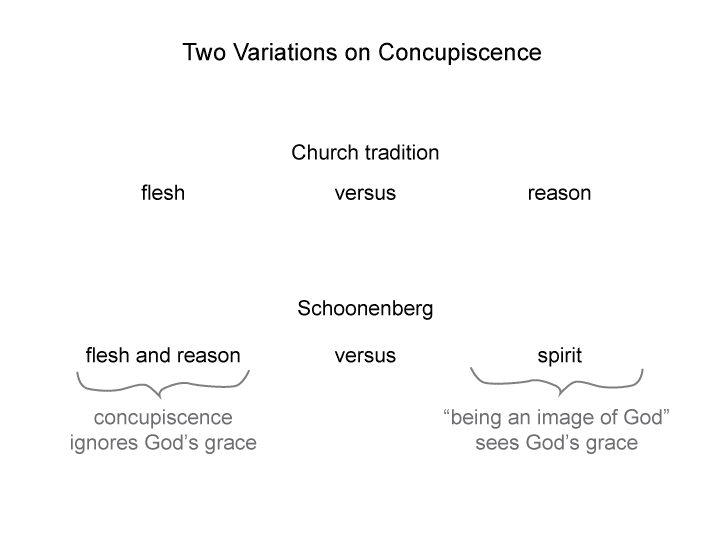
Schoonenberg aimed to show that another Scriptural contrast, ‘the whole person against God’s law’, could support the actuality of the term ‘concupiscence’.
Today, his work stands in testimony to fully zipped Modernism.]
[Of course, the hypothesis of the first singularity changes all that.]
Summary of text [comment] page 82
[Schoonenberg made clear that Church doctrine is not wrong.
Instead, it has been rendered less relevant due to civilizational circumstances.
In 7764 U0’, Original Sin was labeled mythology (defined by Modernism as equivalent to all other ancient origin stories).
Specialized modern languages (or discourses) set ‘mythology’ into a framework of ‘true’ versus ‘false’ in regards to actuality. Such is the scientific point of view. The Story of the Fall could not support the actuality of the term ‘concupiscence’.
The modern placement was both true (versus false) and deceptive (versus true).
‘Mythology’ may be false in contrast to experimentally verifiable true. But, ‘mythology’ is not make believe in contrast to scientifically believable. Instead, ‘mythology’ is true as opposed to deceptive or deceptive as opposed to true.]
Summary of text [comment] page 82
[Schoonenberg’s variation is similar to a traditional Church reading of concupiscence.
It is also similar to the theory of Sigmund Freud, founder of modern psychoanalysis.]