Category Archives: The science of Original Sin
What about this vision of Original Sin as a reification of our own interpretations of the ‘what is real’. Once reified, a “serpent” inspires us to actions that produce results that differ from expectations (i.e. what is defined to be ‘real’). How do we deal with those results? Examples? And how does this picture resonate with traditional interpretations of these chapters of Genesis. This topic is addressed in chapters 11,12 and 13.
Man and Sin by Piet Schoonenberg (1964) 2.3 XZ
Summary of text [comment] pages 87 and 88
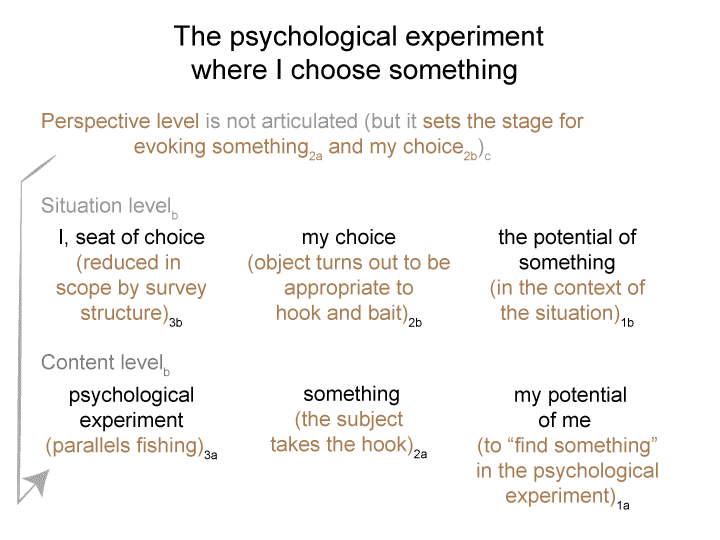
[In social science survey experiments, the bait is the thought experiement3a itself. The choice in the survey is the catch.
The bait inspires an upwelling in ‘the potential in me (the subject in the investigation)1a’. That upwelling tries to ‘deal with’ the bait.
Something2a emerges from and situates that upwelling.
Something2a may be an answer. But, that answer may not fit a survey question where the respondent gives a number between 1 and 51b. Something2a depends on the thought experiment3a calling it into being. My choice2b depends on the situationb.]
Man and Sin by Piet Schoonenberg (1964) 2.3 XY
[The ‘fisherman3c’ is the perspective level.
The ‘hook3a’ is the thought experiment.
Yes, even psychologists are ‘fishers of ‘men”.
Yet, they know not what they do.]
Man and Sin by Piet Schoonenberg (1964) 2.3 XX
[Sensible construction is characteristic of the social sciences.
In sensible construction, the perspective level is never challenged (unless, of course, something breaks).]
Man and Sin by Piet Schoonenberg (1964) 2.3 XW
[The subject is not aware of the experimentalist’s perspective.
Often, neither is the investigator.
This lack of awareness does not fit the label ‘bias’.
All surveys share the same relational structure. Even a researcher who carefully tries to eliminate biases cannot eliminate this feature.]
Man and Sin by Piet Schoonenberg (1964) 2.3 XV
Summary of text [comment] pages 86 and 87
[How is the psychological experiment, say a survey, like fishing?
Every something2a, that emerges from and situates the potential of the subject under investigation1b, has a hook to a thought experiment3a. That thought experiment3a reflects a perspectivec.]
Man and Sin by Piet Schoonenberg (1964) 2.3 XT
[Consider the discipline of experimental psychology.
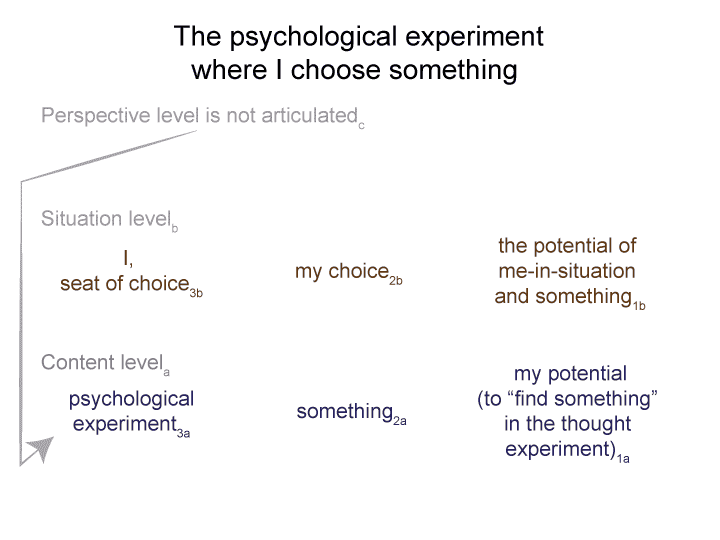
Every psychological experiment where the subject chooses something exhibits this two-level interscope.
The experiment investigates the situational nested form:
I, seat of choice3b( my choice2b( potential of something1b))
However, the experimentalists inject a perspective into the adjacent and lower level, as content.
The name ‘thought experiment3a’ seems appropriate. Does it not?]
Man and Sin by Piet Schoonenberg (1964) 2.3 XE
Summary of text [comment] pages 86 and 87
[Each of these models exhibits a simple relational structure.
The relational structure illustrates how difficult discussions of various topics, such as freedom, can be.
Imagine a thinker focusing on one structural element to the exclusion of other elements.
This is especially easy to imagine when the one thinker is trying to show how another thinker is wrong.]