Man and Sin by Piet Schoonenberg (1964) 2.3 US
[The use of the law in the name of ‘social justice’ serves as an example.
The use manifests the sin of pride through overt displays of scruples.
This is called virtue signaling.]
What about this vision of Original Sin as a reification of our own interpretations of the ‘what is real’. Once reified, a “serpent” inspires us to actions that produce results that differ from expectations (i.e. what is defined to be ‘real’). How do we deal with those results? Examples? And how does this picture resonate with traditional interpretations of these chapters of Genesis. This topic is addressed in chapters 11,12 and 13.
[The use of the law in the name of ‘social justice’ serves as an example.
The use manifests the sin of pride through overt displays of scruples.
This is called virtue signaling.]
Summary of text [comment] pages 83 and 84
[The prior blog reminds me of the quandry posed by Decartes’ formula, “I think, therefore I am”.
“I think” goes with ideas inside of me. “Therefore, I am” asserts the existence of the thinker (as a container of I think).]
[Progressive institutions insist on a litany of obligations, expressing what the citizen ought to be. Their demands backed by the sword of the sovereign.
Progressive institutions compete with the family, tribe and religion. They want to be responsible for you (not to you).
They work through words: legal codes, deceptive labels, surveillance, indoctrination, mandatory education, rewriting history, agenda setting, ridicule and ostracism.]
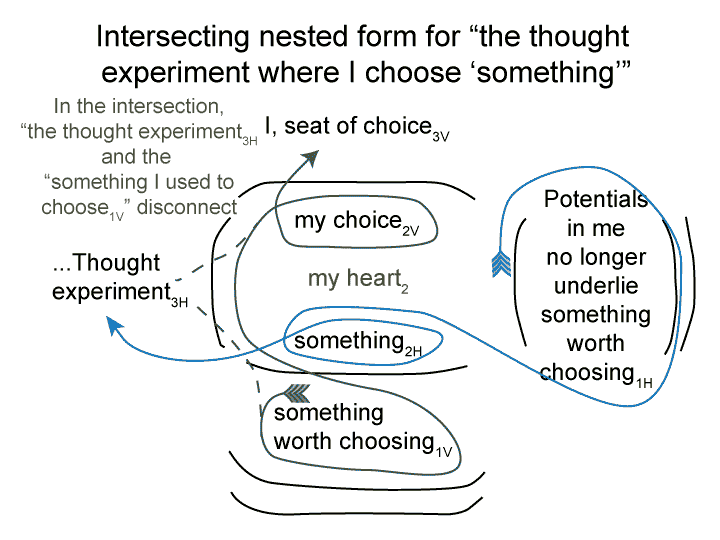
[… that obligations3H(2 for the intersecting nested forms, corresponds to:
Mirror of the world3H(my heart2
In the intersection, my heart2 is the single actuality of my choice2V and ‘something’ contextualized by the mirror of the world2H.
Words3H(2H, excuses3H(2H and resentments3H(2H correspond to the latter actuality.
They still cry out, “I am not responsible.”
But how irresponsible is that?
In my heart, I know that the values that I have been choosing1V no longer represent the desires inherent in me1H.
In our heart, I know the truth that I cannot accept:
My resentments are co-opposed to bondage.]
[How does this resonate with Schoonenberg’s claim that we have the freedom to serve God or Satan?
Freedom goes with both the potential of the person1a plus an actuality, the something contextualized by the thought experiment2a.
The thought experiment3a reflects illumination by social elites (or, in general, the Zeitgeist).]
[In the above examples, what do I desire?
I want to get along.
Therefore, the elites must never be satisfied with me.
They will always be morally superior in order to force me to pretend to desire things that I would never would desire on my own.
I desire to be left alone.
What I do to accomplish that desire validates the values that valorize elite moral superiority.]
[How did we get this way?
It started with the first singularity.
Humans adopted a new way of talking, speech alone talk, leaving behind the referential world of hand speech talk.
Speech alone talk allows us to create purely symbolic orders3a, specialized languages3a, thought experiments3a and mirrors of the world3a, whose unintended consequences (lawessential) can be ignored, and therefore must be ignored, by the elites who benefit from the ‘something2a’ that emerges and situates the possibilities inherent in me1a.]
Summary of text [comment] page 83
[Just as the regular first-century Jews selected the ‘something2a’ that empowered the Pharisees, many twentieth century Americans vote for ‘something2a’ that denies other people’s rights and properties.
By pretending to be a victim, we get free stuff.
We vote for Progressive representatives to scam easily intimidated common folk (who strive to build wealth).
The very rich folk, however, have different options.
They hire lobbyists.
How character building is that?]