An Intimation (or a Proof) of the Actuality of God
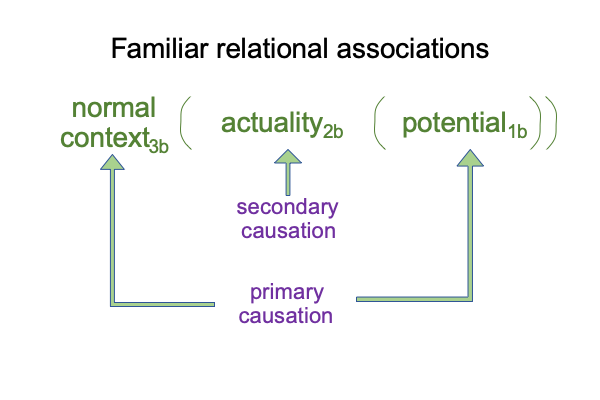
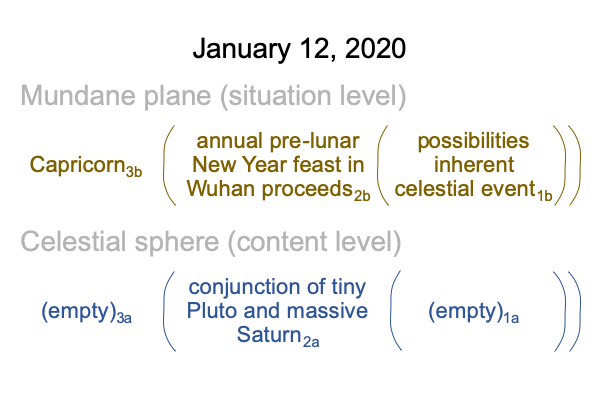
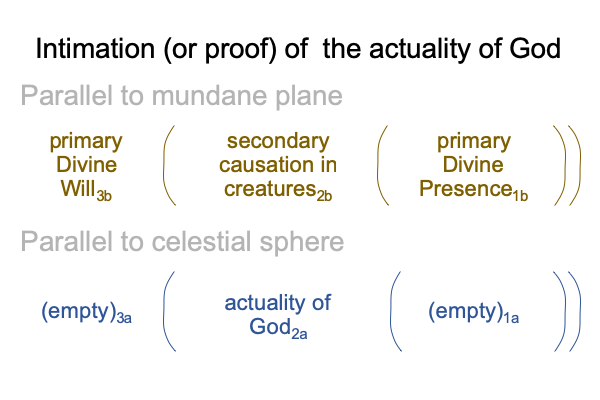
In the previous blog, I left with this two-level nested form.
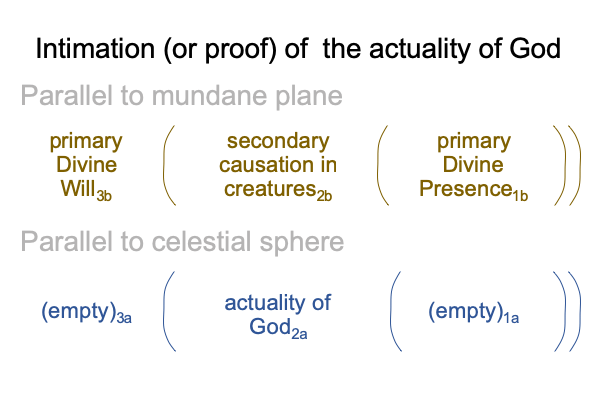
The two level-nested form characterizes sensible construction.
So, even though there are missing elements, I may draw sensible conclusions.
Here are some.
The content-level actuality of God2a must be assumed in order to obtain the situation-level nested formb.
The Divine Presence1b is the situational potential of the actuality of God2a.
The normal context of the Divine Will3b and the potential, the Divine Presence1b, virtually emerge from (and situate) the actuality of God2a. So does the secondary causation in creatures2b.
We (humans) do not know the normal context3a and potential1a that accompany the actuality of God2a. These slots are not truly empty. Rather, they are opaque.
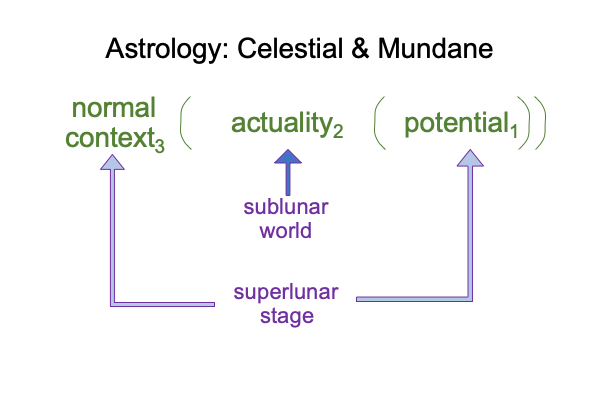
I can speculate as to how the actuality of God2a becomes apparent in history, by examining the astrologer’s vision, which has a similar relational structure.
Here is a picture of the astrologer’s vision, derived in the three prior blogs.
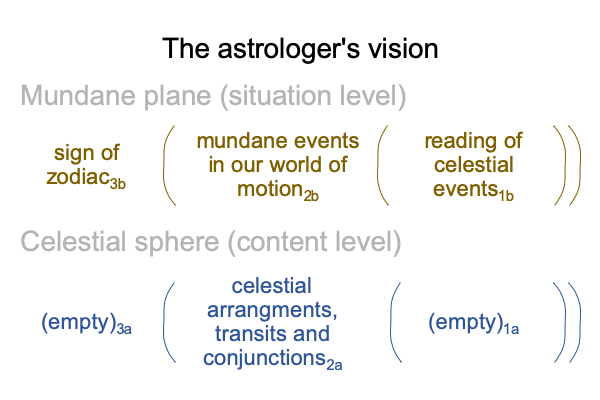
How did this relational structure come about?
I suppose that methods for reading the heavens1b are already formalized in the Sumerian Dynastic civilization of southern Mesopotamia, starting around 3000 BC. While that is five thousand years ago, the condition of unconstrained complexitystarts 2800 years earlier, with the first singularity, as discussed in An Archaeology of the Fall.
Yes, history has laws.
The first law is history is that our current Lebenswelt is not the Lebenswelt that we evolved in.
The second law of history is that history has a beginning, around 7800 years ago.
This year may be labeled 7820 Ubaid Zero Prime.
The third law of history is that history is the story of unconstrained complexity.
The fourth law of history is that the potential for unconstrained social complexity begins at the start of Ubaid in southern Mesopotamia, then radiates from there to other cultures of the time.
At the site of initiation, Ubaid villages (0 to 1800 U0’) grow and transform into Uruk town-chiefdoms (1800 to 2800 U0’), which develop further into early Sumerian city-states (2800 U0’ on).
The fifth law of history is that history is entangled with the semiotics of speech-alone talk.
What does this imply?
The astrologer’s vision develops in our current Lebenswelt, in an effort to sensibly comprehend mundane events in an increasingly complex, rapidly changing, social world. The Lebenswelt that we evolved in disappears behind the horizon of the first singularity. Why? Hand-speech talk and speech-alone talk have different semiotic qualities. The traditions of one cannot survive in the other. No written mythology of the ancient Near East (with one exception) pierces the veil. What does this suggest? The Ubaids cobble together their own formula for grasping what is going on in our current Lebenswelt.
So, the astrologer’s vision is conceived in mundane events during the formative Ubaid period. The Ubaid not that much different from now. Everything changes. Yet, everything stays the same. Everyone acts as if the current social world has been there forever. Everyone faces different challenges within that social world. In dealing with those challenges, the social world changes, sometimes quietly and sometimes boldly.
Here is a diagram of the seed of the astrologer’s vision.
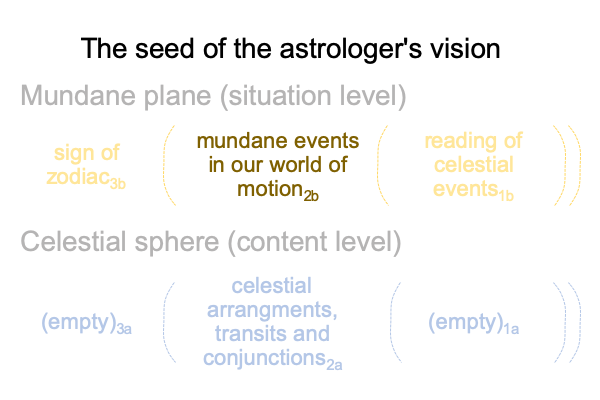
The proto-astrologers had only to look to the heavens to see a parallel to events on the mundane plane. The sky is always in motion. The sun moves. The moon moves. The roving luminaries move. At the same time, the stars do not move. They do not change their relative positions. So, astrologers connect the dots. The stars coalesce into constellations. The constellations along the transit of the sun, moon and planets gain value because they are the like the numbers on a gigantic mechanical clock.
The constellations are fixed and continually accrue mythic associations. Perhaps, this is how Capricorn, half-goat and half-fish, constellates the image of the Mesopotamian god, Ea, who lives on land during the day and in sea at night. As mentioned in the first blog in this series, the zodiac sign of Capricorn pictures the earthly-watery mix of the Ubaid, Uruk and Sumerian ecological and social worlds.
A connection between the always changing, yet always familiar, motions in the mundane world2b and the movements of the superlunary beings against the fixed constellations2a, grows into a formal system for specifying how events in the celestial sphere presage events in the mundane plane. The result is the astrologer’s vision.
The astrologer’s vision is a template for remembering past worldly events and for contemplating future events. The astrologer’s vision solves problems inherent in unconstrained social complexity2b by incorporating both change and stasis into a coherent theoretical system1b, where mundane events2b virtually situate (and emerge from) celestial conditions2a.
My example comes from the gospel of Matthew. Astrologers from the east, the lands of the Medes and Persians, follow a “star” and bring gifts to the infant Jesus. The fact that the child is of humble origins turns out to be significant. The Trinity works within their cognitive game, implicitly unveiling a larger picture, an intimation of the actuality of God2a.
Here is a diagram of the journey of the magi.
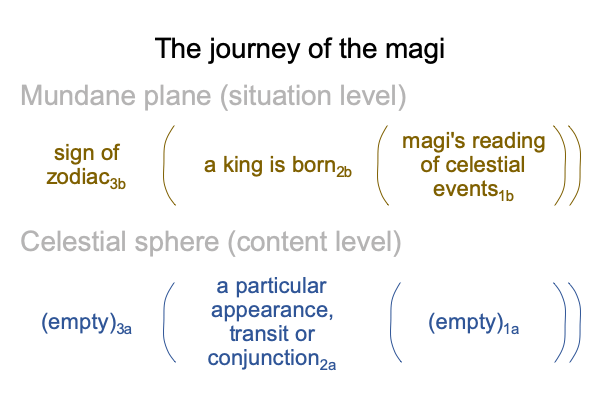
Indeed, the astrologer’s impulse, like the magi’s fancy gifts, seem weirdly confused. Surely, the magi anticipate a figure of future authority, but greet a somewhat befuddled young couple. Then, like the astrologers before them, they transcend their own expectations. They know that any celestial event2a must be read in the light of both the (unmoving) zodiac signification3b and the situation at hand2b. The events2b,2a remain actual. The reading1b accommodates. The astrologer bends like a willow.
Now, allow me to compare the journey of the magi with a prior figure, an intimation (or proof) of the actuality of God.
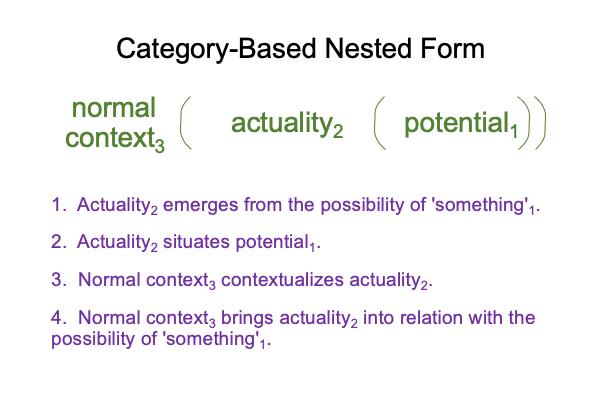
The relational structure begins with the situational actuality2b. The causation exhibited by creatures2b mirrors mundane events in our world of motion2b. Creatures act the same over and over again. Yet, they are wily and adaptive in unusual circumstances. Similarly, our behaviors and traditions in unconstrained social complexity establish habits and routines. Yet, the unexpected always arises, calling for us to be cleverer than we otherwise would be.
The journey of the magi adds a sublime twist to this comparison between two situation-level actualities. The birth of a royal child in the sublunary realm2b mirrors the secondary causation of creatures2b. It is as if all life is honored in the journey of the magi.
What about the situational normal context3b?
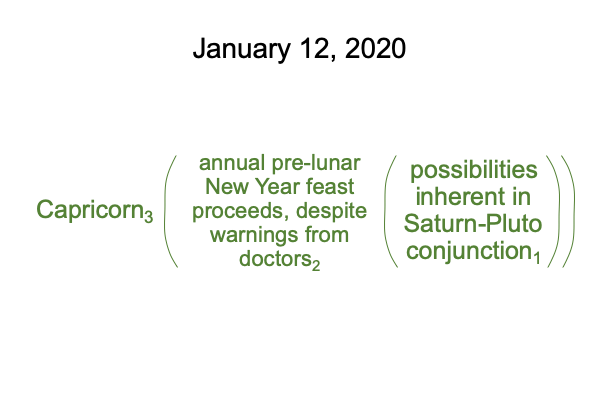
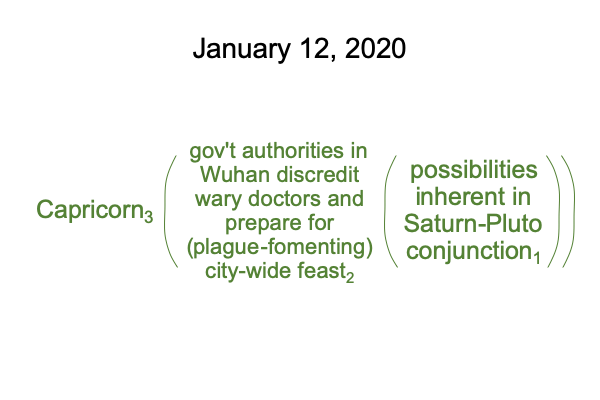
Astrology puts our earthly turmoil2b into the normal context of something that does not itself change, the twelve signs of the zodiac3b. For a particular celestial event, one sign will dominate, as in the example of the conjunction of Saturn and Pluto in January 2020.
The zodiac mirrors the Divine Will3b, which is unmoved and multifaceted. The Divine Will3b contextualizes our worldly affairs2b. Like the numbers of a mechanical clock, the Divine Will3b orients the moment at hand2b. Like the zodiac, the particularity of God’s Orientation2b is revealed. Everything has a proper season. Contextualization of our worldly events2b by the Divine Will3b allows us to remember, contemplate and decide.
What about the situational potential1b?
The Divine Presence1b addresses a moment in time. So, does the magi’s reading1b.
The magi’s reading of celestial events1b tells us of the nature of the Divine Presence1b. The Divine Presence1b is the potential1b of the actuality of God2a in the same way that the magi’s interpretation1b engages the potential1b of the actuality of celestial transits through unmoving constellations2a.
For the magi, the celestial sphere2a contains motion (the sun, moon and the roving stars), as well as a lack of motion (the stars in the constellations). These two features allow reading1b to occur. The regularity of celestial motion contributes to habits of interpretation, styling astrological hints and suggestions. The permanence of the constellations, along with the finite number of moving celestial bodies, contribute to astrology’s foundation.
For primary and secondary causation, the actuality of God2a transcends time and enters time. Here, time parallels motion. God’s transcendence of time is like the lack of motion of constellations. God’s entrance into time parallels the motion of celestial bodies. Transcendence speaks to the exclusivity of the Divine Will3b. Entrance addresses the inclusivity of the Divine Presence1b.
Yet, while the Divine Presence1b manifests in every moment in time, the entrance of the actuality of God2a into the flow of time divides all time. The Incarnation fixes one moment in the continuum of time.
The journey of the magi is significant in this regard. The gospel passage in Matthew highlights this precise moment, when the secondary causation of creatures2a simultaneously fulfills the primary causation of the Divine Will3b and realizes the potential of the primary causation of the Divine Presence1b.
The relational structure of the journey of the magi mirrors the relational structure of primary and secondary causation involved in the theodrama of the birth of a king, whose kingdom is not of this (mundane) World.
In this mirror, I can see an intimation (or proof) of the actuality of God2a.