Man and Sin by Piet Schoonenberg (1964) 2.2AC-2
[Comments on Alexander Dugin’s (2012) The Fourth Political Theory notes the coincidence between the turn towards postmodern language games and the establishment of a postreligious sovereign religion.]
The first task or group concerns the semiotics of speech-alone talk. One of these would be about unveiling the hidden history of a word. This topic is addressed in chapters 2 and 12.
[Comments on Alexander Dugin’s (2012) The Fourth Political Theory notes the coincidence between the turn towards postmodern language games and the establishment of a postreligious sovereign religion.]
[How did this come to be?
In America, the symbolic order began turning in the 1950s. It attained temporary stability in the 1960s. The language (as system of differences) remained weirdly jelled until the 2000s.
Many circumstances contributed to this stasis.
A demographic condition played a role. The so-called boomers born in the late 1940s and all the 1950s dominated discourse for many years.
An institutional condition may have also played a role in the the temporary stability. State-subsidized university systems promoted conformity in language use.
The state universities then set the stage for the postmodern conversion of discourse into a language game during the decades since the 1960s.]
[In brief, Progressive ‘freedom’ reduces the human to less than an image of God.
‘Progressive freedom’ is ‘unreal freedom’, just as ‘Progressive agape’ is ‘unreal fraternity’ and ‘Progressive equality’ is ‘unreal equality’.
Progressives express the unreality of love.]
[Look how the word ‘free’ has turned on the wheel of a changing symbolic order.
What happened to the ‘free eros’ acclaimed in the 1960s?
The word ‘free’ no longer implies ‘independence, responsibility, personhood, and grace’. It suggests ‘without cost to the user’.
‘Free eros’ became sex without commitment.
‘Free agape’ fared no different. ‘Free healthcare’ exemplifies ‘free agape’.
The original meaning underlying the word ‘freedom’ gave the slogans ‘free love’ (eros) and ‘free healthcare’ (agape) a real (though diminishing) association to independence, responsibility, personhood and grace.
Now, 50 years later, Schoonenberg’s assertions ring true.
‘Free love’ sounds like ‘the procreative acts of animals, without the procreation, of course.’
‘Free healthcare’ sounds like ‘standing in line to redeem a government coupon’.]
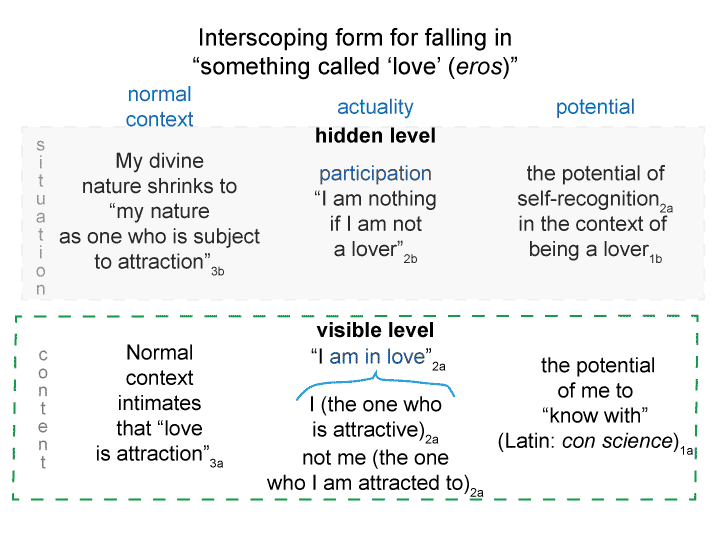
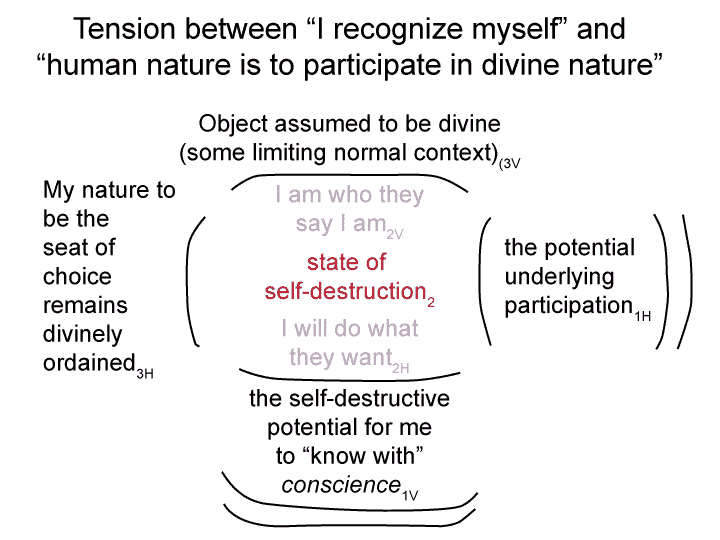
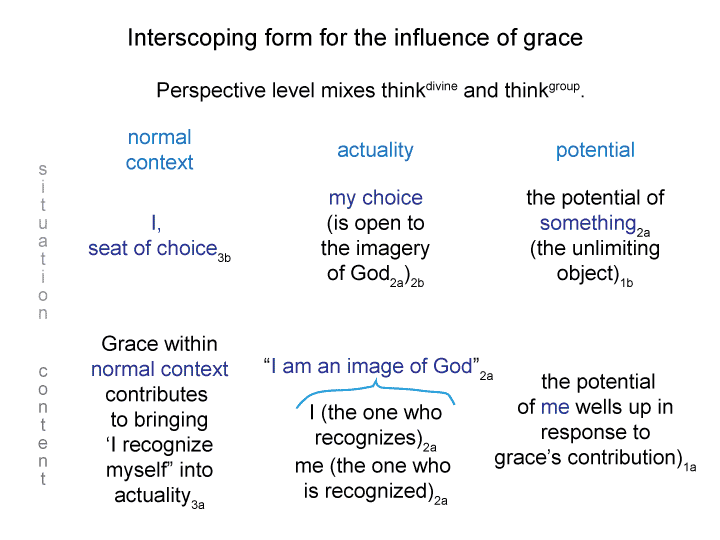
[To me, the nested forms of recognition and participation model both grace and self-destruction as actualities.
The state of grace is different from the state of self-destruction.
However, Schoonenberg pays tribute to a different contrast.
Grace (as supernatural) is different from nature (as natural).
This concern belongs to modernism. Modernism focuses on actuality and ignores normal context and possibility.
Or maybe, moderns focus on actuality in order to hide their agendas (normal contexts) and manipulations (biasing what is possible).
The contrast between grace and nature is a stand-in for the contrast between the supernatural and the natural.
Does this distinction belong to the realm of actuality?
Or, does it belong to the realms of normal context and possibility?]
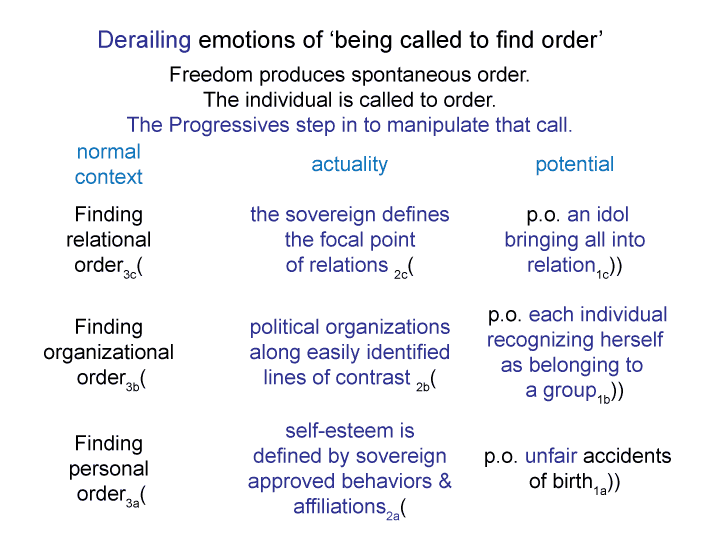
[Progressives decrease the liveliness of the spontaneous order by imposing ‘fairness’ with respect to material and immaterial limitations. They act as if ‘they are able to adjust spontaneous orders to suit their organization objectives’. They act as if self-esteem is a thing or a state of things.
Normal contexts are limited, and limiting. They are tailored to fit a Progressive designation.
‘Self-esteem’ is not situated by ‘recognizing myself as an image of God’. It is a thing to be manipulated. It is a thing to be directed according to various religiousinfrasov organizational goals.
For example, in America, race and gender awareness mimics tribal affiliation. Identity-based affiliations are supposed to increase self-esteem, according the Progressive’s definition of the word ‘self-esteem’.
Progressives diminish everyone in ‘their implementations of cures for our lack of self-esteem’. Consequences do not matter. They are religiously driven to impose their cures on all society.]