Looking at Alva Noe’s Book (2023) “Entanglement” (Part 3 of 24)
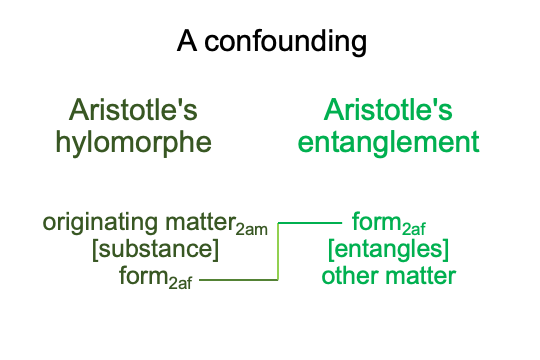
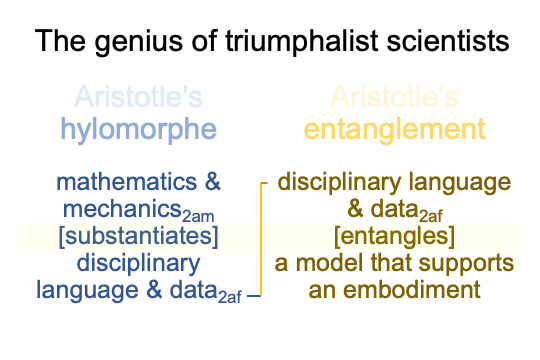
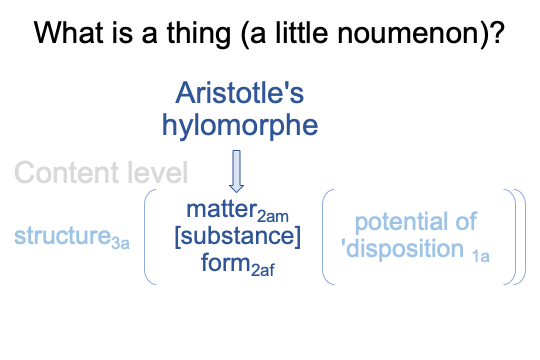
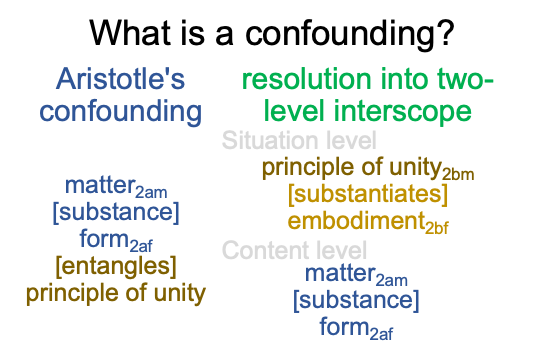
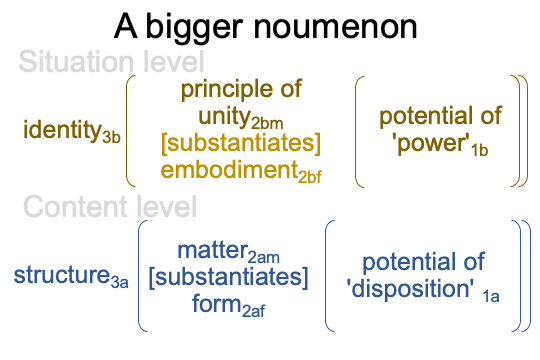
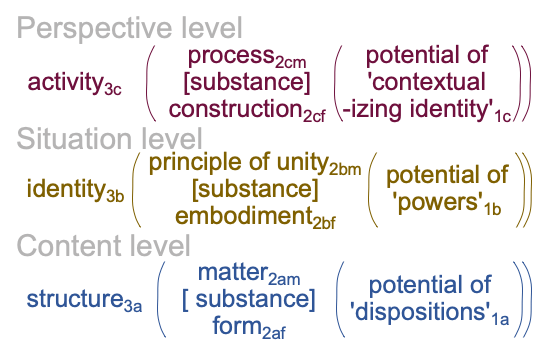
0036 The following aesthetic work will show (D) why I make the above associations in order to bring the triadic empirio-schematic judgment into a dyadic structure appropriate for the category of secondness, (E) a Peircean formulation of “entanglement”, using Aristotle’s terminology, and (F) how Peirce’s entanglement complements Dr. Noe’s use of the term.
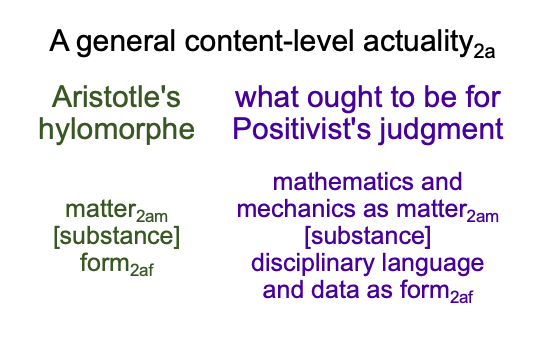
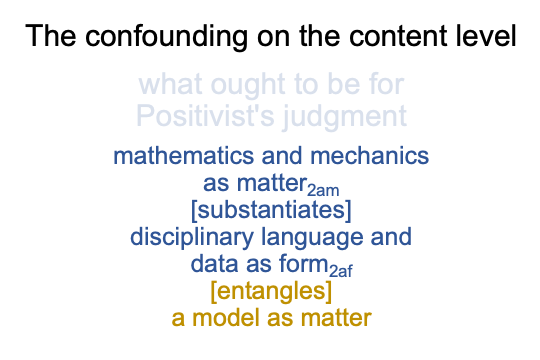
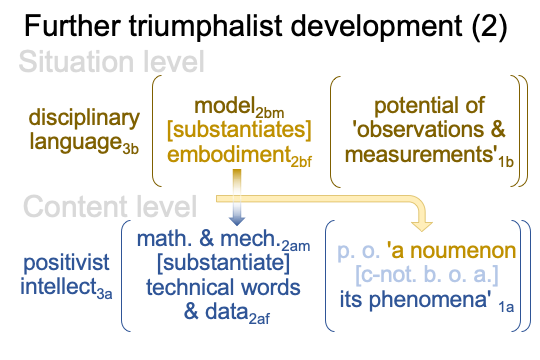
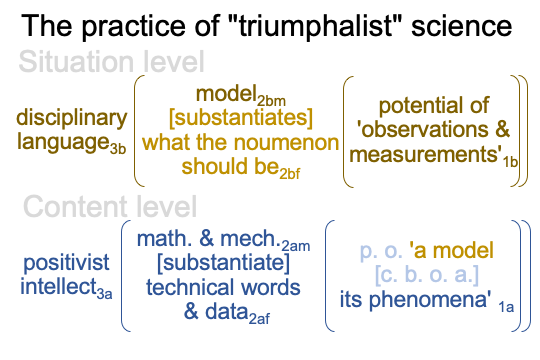
0037 The above reduction produces the following unfolding of the Positivist’s judgment (D).
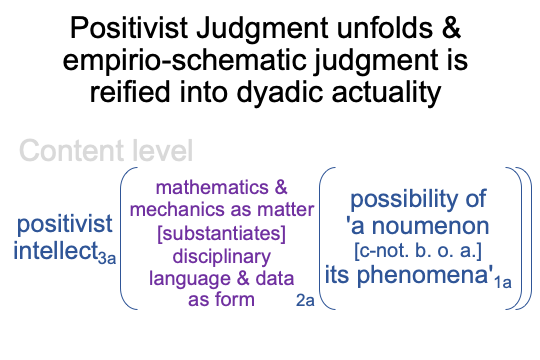
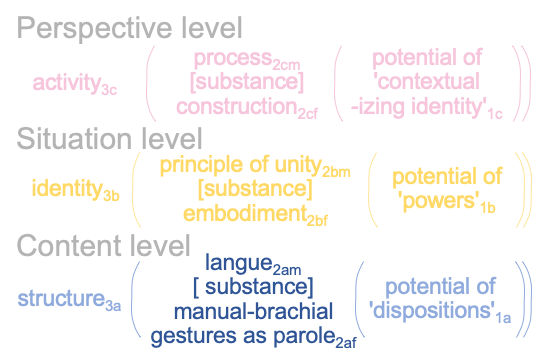
0038 Note how the actuality has become general. The positivist intellect3a contextualizes a general actuality where matter concerns the stuff of mathematics and mechanics2am and the form contains the general shape of data discussed by a scientific disciplinary language2af.
Is this the first step in Dr. Noe’s journey out of the laboratory and into the world of humanity?
0039 Is the particular actuality the inverse of the general?
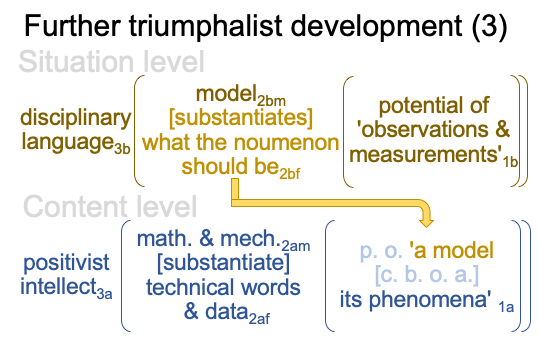
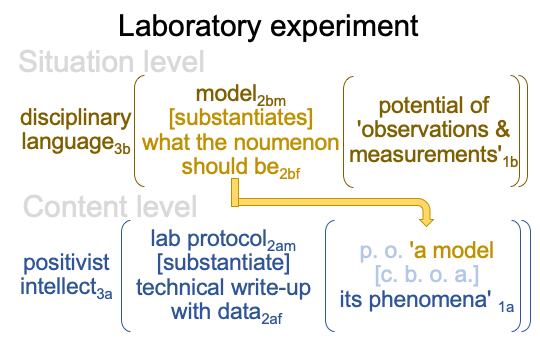
I noted earlier that the inverse could offer an equally compelling solution. I suspect that it is compelling when a particular scientist engages in particular research. In the case of a scientific publication, disciplinary language and data go into the introduction, methods and results sections as matter. The model shapes the analysis and discussion sections as form. This is precisely what Dr. Noe does for years and years researching cognition and the brain.
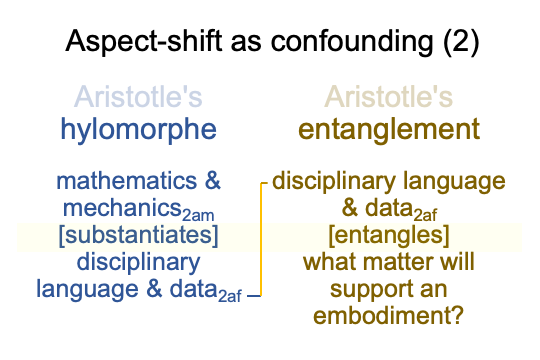
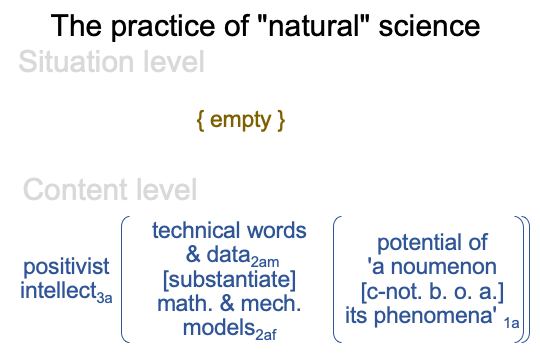
0040 Then, he steps back and the hylomorphe inverts. Without an explicit model, mathematics and mechanics become like matter. Without specific research experiments and related terminology, data and disciplinary language start to look like form. Mathematics and mechanics2am [substantiate] disciplinary language and data2af.
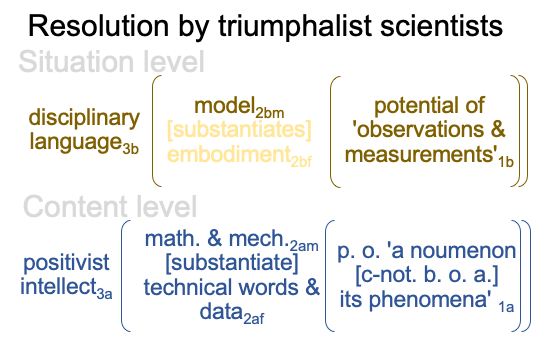
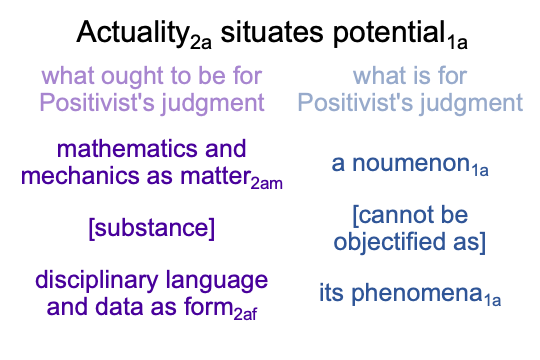
0041 To me (D, continued), what ought to be2a emerges from (and situates) what is1a.
Here is a diagram.
What does this imply?
0042 Recall, what ought to be2a is the empirio-schematic judgment. What is it2a observing and measuring? It2a is situating appearances1a. In the normal context of the positivist’s intellect3a, the empirio-schematic judgment2a emerges from (and situates) an appearance of an actuality1a (that is, a being in firstness exhibiting the structure of secondness).
In the above figure, matter2am seems to situate the noumenon1a and form2af seems to situate the phenomena1a.
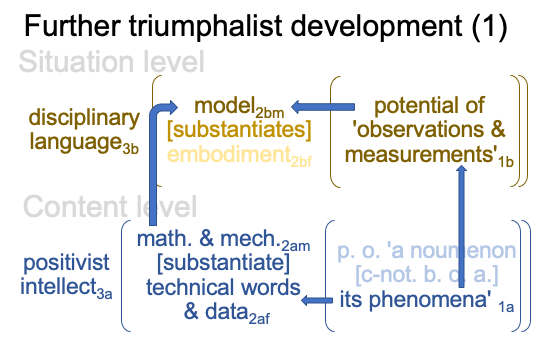
0043 Consider the title of Dr. Noe’s 2009 book, titled, Out of Our Heads: Why You Are Not Your Brain And Other Lessons From The Biology of Consciousness. The biology of the brain and of consciousness is a model. The model is not the issue. The issue is the fact that models are mathematical and mechanical matters. In other words, when a biological researcher studies the human brain and consciousness, only the mathematics and the mechanics matter. The thing itself1a appears as a mathematical and mechanical presence2am.
0044 This change in vision occurs as soon as one steps back from a particular research agenda into the generalities of science.
0045 Similarly, data2af is a form that shapes the appearance of phenomena1a. If only the observable and measurable facets of a noumenon can give rise to data, then does disciplinary language guide our attention towards phenomena that appear to serve as data? Ignore phenomena that do not appear to be the data the researcher is looking for.
0046 Mathematics and mechanics2am as matter reifies a general appearance of the thing itself1a. Whatever it1a is, it1a may be viewed as a mathematical or mechanical matter2am.
Disciplinary language and data2af as form emerges from (and situates) a general appearance for the observable and measurable facets of the thing1a. One cannot really talk about the thing itself. One can only scientifically talk about the data. The terminology must be exact. Otherwise, scientists cannot agree on what they are talking about.