0337 Sections seven and eight (7 & 8) offer three ideations that dwell within the ambiguity depicted above.
Section seven (7) first discusses Poldmae’s theory of verse.
0338 Jaak Poldmae (1942-1979) considers poetry in the Slavic and German civilizations. To me, it looks like his interest in metrics goes with the signifier and his interest in poetics associates to the signified. Once these substitutions are made, the following derivative interscope is readily completed from the authors’ brief description of verse theory.
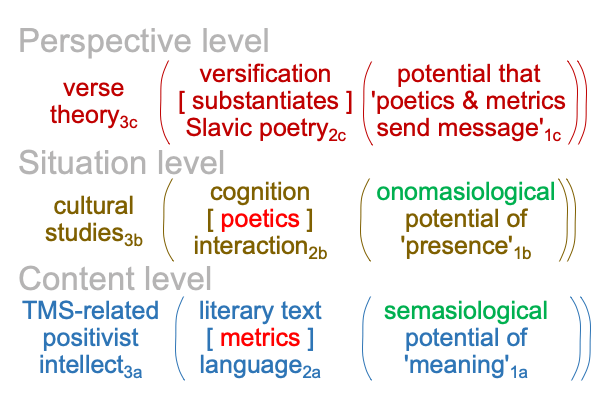
0339 While Poldmae may come unnervingly close to the old formalist habit of finding the literary devices, the above interscope is not a mere collection of mechanisms. Verse theory is an organic whole. Plus, the perspective-level category-based nested form looks like a clone of Marxist theory.
0340 To me, this begs the question, asking, “What happened to the content and situation levels of Marxist theory?”
Did they somehow deplete themselves?
Plus, the rubberstamper is uncharacteristically uninterested, because Poldmae asserts that poetry2c somehow corresponds to… or reveals… or depicts… the human condition2c.
Isn’t that what any Slav already appreciates?
0341 Section seven (7) next discusses the phenomenon… er… model substituting for the noumenon (?)… of intertextuality. Intertextuality delocalizes the poet, because the poet produces a text in relation to other (prior) texts. In a sense, a contemporary poet joins the conversation of other poets. The contemporary poet responds to the poetics and the metrics of… what?… civilization, past and present?
0342 Uh oh, remember Saints Cyril and Methodius?
Where did they come from?
The Byzantine civilization is a fusion of Greek and Jewish civilizations, made possible by the Christianization of the Roman Empire.
0343 Unlike America, Russia is not made of new cloth. The Slavic civilization is cut from old cloth, over and over again, in a theodrama that the American Empire simply wants to ignore.
Oh, I should say, “the USSA”?
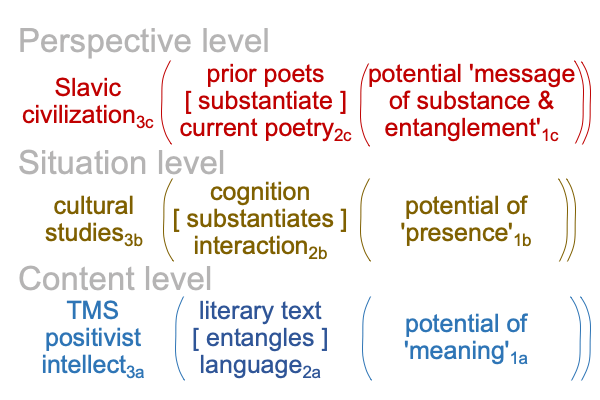
0344 The term “intertextuality” is a beautiful Platonic term, offered by Julie Kristeva, a French linguist, that serves to cover over the perspective-level actuality of the following three-level interscope, in such a manner as to comport with the actuality2c of Marxist theory3c.
0345 To appreciate the rhizomic character of intertextuality, an inquirer may consider Razie Mah’s blog for August 2025, titled Looking at Slavoj Zizek’s Book (2024) “Christian Atheism”.
Zizek is a philosopher, not a poet, but he sounds like a poet some of the time. He writes like a poet, even though he doesn’t know it. Only a poet would make “Christ”, the adjective, and our human condition, the noun. Isn’t that what the story of the Garden of Eden tells us? We have been kicked out of the Garden because we can now challenge God Himself. Now, outside of His Domain, we are “a-” (“without”) “-theists” (“God”).
Does Zizek suggest that Christian Atheism can stand in for… material arrangements2c?
0346 As if to confirm, Zizek concludes with a reflection on Alexandr Blok’s poem, The Twelve, written in 1918, depicting Christ as a holy ghost leading twelve Red Guards on their patrol of revolutionary Petrograd. Of course, Soviet authorities later replaced the word, “Christ”, with “sun”, because they were too embarrassed to substitute in “material arrangements”.
0347 Zizek aside, intertextuality and verse theory both cohere to the reality of Lotman’s and Jakobson’s legacy. Plus, they do not cross the line that Lotman’s derivative interscope tunnels under.