0156 In biology, appearances initiate sign-relations.
Sign-relations are based on Peirce’s three categories of firstness (monadic possibility), secondness (dyadic actuality) and thirdness (triadic relations).
So are category-based nested forms.
0157 Category-based nested forms are not material. Materials participate in these immaterial relations.
Category-based nested forms are real. They contain secondness (what most scientists consider to be their subject matter) within their relational structures.
0158 How real are triadic relations, such as signs and category-based nested forms?
According to Razie Mah’s 2018 e-book, The Human Niche, our kind adapts to exploit the potential of triadic relations. This e-book is packaged with separate reviews of four works: Steven Mithen’s Book (1996) The Prehistory of the Mind, Clive Gamble, John Gowlett and Robin Dunbar’s Book (2014) Thinking Big, Derek Bickerton’s Book (2014) More Than Nature Needs and Robert Berwick and Noam Chomsky’s Book (2016) Why Only Us?.
Later works by Razie Mah include the 2024 work, Comments on Michael Tomasello’s Arc of Inquiry (1999-2019).
0159 What else might be of interest to young professional archaeologists?
What else points to the failure of Marx’s thing?
Here is a question.
Does human evolution comes with a twist?
In four blogs posted on January 1, 2026, Razie Mah looks at Melinda Zeder’s Article (2025) concerning the term, “Neolithic”. He proposes that two transitions occur at the same time (S and T).
0160 The first (S) concerns the domestication of plants and animals, sedentary communities, and other items that archaeologists associate with the term, “neolithic”. This topic has been the subject of intense inquiry by archaeology since… around… 1861 to 1875? Research into the neolithic era has been conducted with Marx’s thing in mind.
0161 Well, shades of Neptune in Aries, according to my internet search, the term “neolithic” was first coined by John Lubbock in 1865, as a refinement of the stone, bronze and iron ages.
0162 The second (T) concerns a change in semiotic conditions, from hand-speech talk (the way of talking for Homo sapiens since its inception) to speech-alone talk. According to Razie Mah’s short 2014 e-book, The First Singularity and Its Fairy Tale Trace, the first culture to practice speech-alone talk is the Ubaid of southern Mesopotamia. The Sumerian language (which is unrelated to any family of languages) is a speech-alone creole formed when two hand-speech talking cultures (one living along coast and rivers and one living on hills in the dryland Arabian Gulf) are forced into proximity by the rising waters of the Persian Gulf. They form a pidgin, then a creole.
0163 Returning to that review of Melinda Zeder’s (2025) article in the journal, Prehistory, Razie Mah suggests that, within the currently conceptualized Neolithic period, another transition – a change in semiotic practices – occurs with the spread of speech-alone talk from the Ubaid to the hand-speech talking world, constituting an irreversible phase transition.
Needless to say, Razie Mah’s hypothesis of the first singularity suggests that a lot of research needs to be done in the field of archaeology.
The e-work, The First Singularity and Its Fairy Tale Trace, is framed as a research proposal.
0164 The word, “sumer”, is first published in 1869, when Neptune is in Aries.
0165 The review of Melinda Zeder’s article is published January 1, 2026, at a time when Neptune is about to enter Aries.
0166 I’m not saying that this is an astrological phenomenon. I am saying that anthropological researchers need a way to track civilizational changes within our current Lebenswelt, spanning from the most rapid sea-water rise at the end of the last ice age (nominally, at 0 Ubaid Zero Prime) to our current moment (nominally at 8823 U0′). The orbits of the outer planets may have periodicities convenient for marking spiraling developments in unconstrained social complexity.
I love sentences like that.
For U0′, subtract BC year from 6800 or add AD year to 6800. 6800BC equals 0 U0′.
Future refinements should be anticipated.
0167 This examination of two distinctly different contemporary works, a (possibly AI-generated) book on Sumerian mythology by Dr. D. Basak and a recent publication on the need for a change in publishing in archaeology, show that – whatever is responsible for the Sumerian civilization – is still operating today.
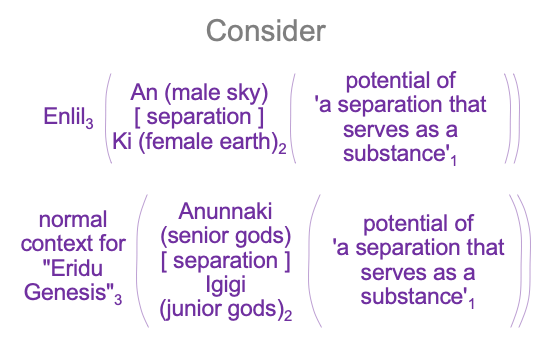
0168 There may be (say) two millennia (12 Neptunian cycles) between the routinization of the creation myth associated with Enlil3 and the one associated with the so-called “Eridu Genesis”.
Yet, from my associations (which are admittedly speculative), both narratives rely on the potential of ‘a separation that serves as a substance’1.
0169 Here is a picture.
0170 Does that potential still operate today?
The surprisingly evocative similarity between the creation of humans in the Eridu Genesis and a recent publication in Current Anthropology suggests that the current labor dispute will resolve with the creation of a new “human” that will take some of the work of the Igigi-like professional archaeologists.
I think that these new “humans” will be podcasters.
0172 Even more disturbing, the similarity suggests that [tenure]2a, the promise of low pay combined with total job security, is the substance that actualizes the potential of ‘a separation that serves as a substance’1a for the current labor dispute.
0174 Did the Igigi work so diligently for the Anunnaki because they were promised something akin to tenure?
I wonder.