0854 According to the Trunin, various reviewers conclude that Uspenskij proposes that history, as a species of semiotics, is analogous to the linguistic act of communication, that is, spoken language. Indeed, for the fundament interscope, history can be viewed as a literary text2bf substantiated by written language2bm. So, the reviewers are not off base. Spoken and written language as matter2bm substantiates history in the form of a literary text2bf.
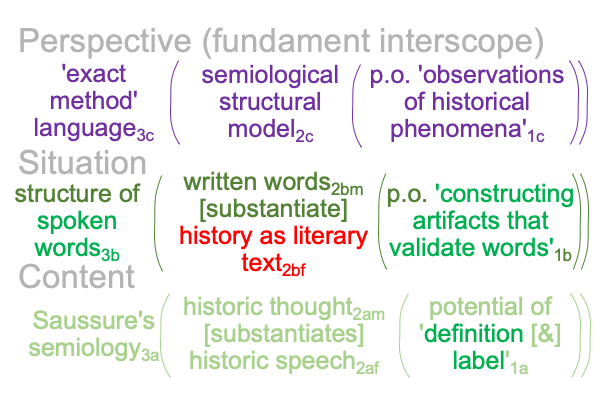
0855 On the content level, history already enters into the picture as past historic thoughts2am and historic words2af. What is spoken2af can be written2af. Many scholars claim that history only begins with the invention of writing, because written texts provide evidence that spoken words cannot.
However, what is the nature of the written… or spoken word?
Well, if the word involves an explicit abstraction, the signifier is a label. The signified may be called a “definition”, because the label operates on the potential of ‘something’, and that something… um… must be plausible enough to conjure a “definition”.
Did I say that correctly?
0856 Remember the historical moment when nouns were subjugated by verbs?
Well, I guess it was a prehistorical moment that is imagined by an archaeologist who never read Razie Mah.
This archaeologist proposes that the first spoken words are nouns, because things can be associated to sounds through synaesthesia. That is “cross-modal cognition”.
Then, verbs come along because, once nouns are spoken, verbs are necessary to validate the nouns as relevant, that is, capable of doing something.
0857 Here, the noun is the historic thought2am that emerges from and situates the potential of definition (reference) and label (utterance)1a. An utterance2af labels1a a definite thing1a (er… a signified1a) and voila! The form is the spoken word2af in the normal context of definition3a.
Then, the verb subjugates the noun, producing statements1b that serve as artifacts2bm that validate the relevance of nouns2c.
0858 The archaeologist’s own written words2bm emerge from (and situate) the possibility of a prehistoric era where nouns arise through synaesthesia and verbs appear in order to provide relevance to the nouns1b.
And, that is a little confusing because the archaeologist’s written words2bm are about spoken words2af that arise during a postulated prehistoric era when statements become possible1b.
0859 So, these prehistoric folk construct statements as artifacts1b, but cannot produce written words because writing has not been invented.
The archaeologist constructs the artifact of prehistoric statements1b as as a way to write about2bm the previous statement2af.
Plus, the archaeologist’s written words2am go into a literary text2bf titled, Talk to Me: The Prehistory of Simple Statements.
0860 Of course, Uspenskij’s claims are also theoretical. Theory carries implications.
However, the article bearing the title, “Historia sub species semitiotica”, consists of an application. Uspenskij makes a detailed case study for how the reformer, Peter the Great, ended being regarded as the antichrist.
0861 Nonetheless, I pause and reflect on the implications appearing in bright green in the preceding figure.
0862 On the content level, I substitute “label” for signifier1a and “historic speech” for parole2af, implying that the efficient cause of a spoken word2af is the potential of a label1a.
Furthermore, I substitute “definition” for signified1a and “historic thought” for langue2am, intimating a final causality. Saussure’s semiology3a intends to bring langue as matter2am into relation with the potential of definition as the signified1a.
0863 But, there is a problem.
“Definition1a” cannot be a signified1a.
Why?
Definition3 is a normal context that brings the actuality of a spoken word2 into relation with the potentials of meaning, presence and message1.
0864 Does that mean that a word’s meaning, presence and message1 may be labeled, “definition1a“?
0865 Well, why don’t I replace the term, “definition1a” with the term, “reference1a“.
A spoken word2af cannot picture or point to its referent1a.
So, how can I assume that my label1a for the signifier1a potentiates a signified1a that pictures or pointes to its referent1a, especially when that referent1a is an explicit abstraction?
0866 I suppose that when definition1a replaces the signified1a in Saussure’s semiology3a, the constellation2 of meaning, presence and message1 is deferred in favor of the construction of a situation-level artifact1b.
0867 Definition1a as signified1a is definition3 as normal context deferred.
Notably, the content-level of the adjacent higher interscope reproduces the category-based nested form for how to define a spoken word. So technically, definition1a is deferred in the fundament interscope and manifested in the derivative interscope of the Tartu-Moscow School of Semiotics3a.
The content-level of the derivative interscope mimics the unfolded Positivist’s judgment and expresses (however imperfectly) the category-based form for defining a spoken word.